
The pursuit of creating a machine that can match the versatility and delicate manipulation capabilities of the human hand is a grand challenge at the intersection of robotics, mechanics, and control science. This field, encompassing the study of the dexterous robotic hand, integrates knowledge from mechanical engineering, electronics, computer science, and materials. The ultimate goal is to develop a highly integrated mechatronic system capable of adaptive, compliant, and precise interactions with unstructured environments. The research presented here focuses on the development of such a dexterous robotic hand, driven by a novel actuation technology. This hand is designed not only for exploring advanced grasping strategies but also as a testbed for validating autonomous control algorithms for soft actuators. The design philosophy is rooted in bionics, aiming to replicate the human hand’s form and function while leveraging modern engineering solutions for actuation and sensing.
The human hand is a marvel of biological engineering, featuring 27 degrees of freedom (DoF) controlled by a complex network of muscles and tendons. A fully replicating dexterous robotic hand at this complexity is often impractical due to size, weight, and control challenges. Therefore, a simplified yet functionally rich kinematic structure is essential. The mechanical design of the presented dexterous robotic hand is based on a detailed analysis of human hand anatomy and kinematics, following a mechatronic integration approach to achieve high modularity and compactness.
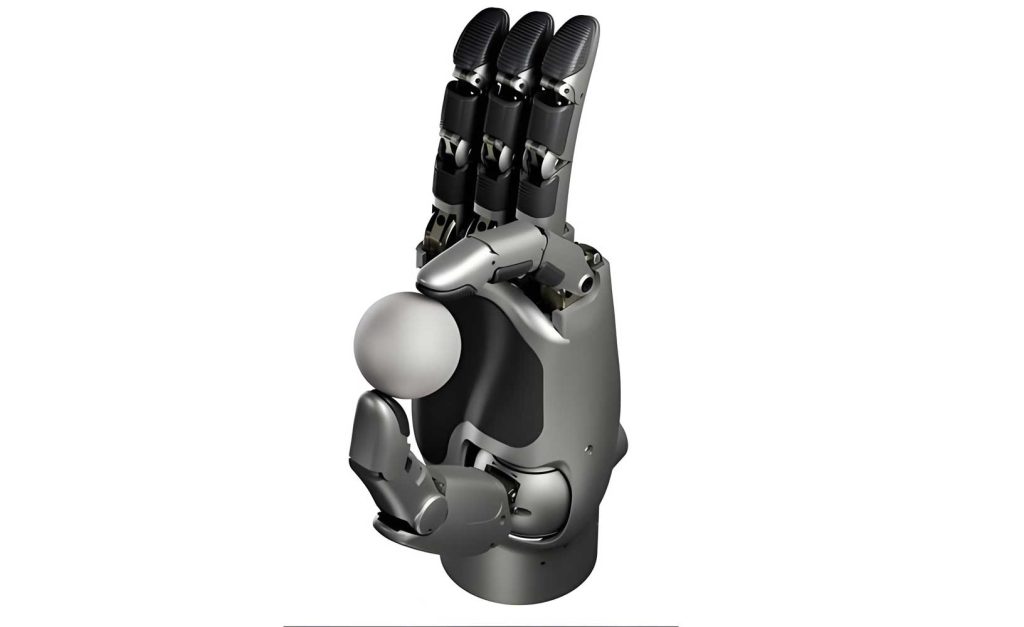
The overall scale of the hand is set at 1.5 times that of an average adult human hand, providing sufficient internal volume for routing and future sensor integration. The DoF allocation is a critical trade-off between dexterity and controllability. The hand features five fingers: one thumb and four modular fingers (index, middle, ring, and little). The thumb is granted 3 DoFs to enable opposition, crucial for power and precision grasps. This includes 2 DoFs at the carpometacarpal (CMC) joint (simulating abduction/adduction and flexion/extension) and 1 coupled DoF for the metacarpophalangeal (MCP) and interphalangeal (IP) joints. The other four fingers are designed identically, each with 2 DoFs: one independent DoF at the MCP joint and one coupled DoF governing both the proximal interphalangeal (PIP) and distal interphalangeal (DIP) joints. This coupling is inspired by the synergistic motion observed in the human hand and significantly reduces the number of required actuators.
The thumb’s design incorporates a cross-axis joint at its base to enable its characteristic conical workspace. The modular finger design simplifies manufacturing, assembly, and maintenance, while enhancing the system’s reliability. To minimize friction and backlash—common issues in multi-joint linkages—miniature flanged ball bearings (e.g., model 618/4) are incorporated at each joint pivot. A small clearance (0.5 mm) is designed into the joints to accommodate machining and assembly tolerances. The dimensions for a single modular finger are summarized in the table below.
| Phalange Segment | Length (mm) |
|---|---|
| Proximal Phalanx | 70 |
| Middle Phalanx | 40 |
| Distal Phalanx | 48 |
The choice of actuation is pivotal for a dexterous robotic hand seeking compliance and natural motion. Traditional electromagnetic motors often require bulky gearboxes, leading to weight, backlash, and reduced back-drivability. Here, Pneumatic Muscle Actuators (PMAs), also known as McKibben-type artificial muscles, are employed. PMAs are contractile actuators consisting of an inner elastic tube (e.g., silicone rubber) braided with a non-extensible sleeve. When pressurized, the tube expands radially, causing the braid to shorten and generate a significant tensile force. Their key advantages include a high power-to-weight ratio, inherent compliance, and a simple, lightweight structure. A single PMA can only pull, so they are used in antagonistic pairs—one acting as a flexor and the other as an extensor—to achieve bidirectional joint rotation.
The force-contraction relationship of a PMA can be modeled empirically. The axial force $F$ generated at a given pressure $P$ and contraction ratio $\epsilon$ is often described by a simplified model:
$$ F(P, \epsilon) = P \cdot \frac{D_0^2 \pi}{4} \cdot \left( 3 \left(1 – \epsilon\right)^2 – \frac{1}{\sin^2(\phi_0)} \right) $$
where $D_0$ is the initial muscle diameter, $\phi_0$ is the initial braid angle, and $\epsilon = (L_0 – L)/L_0$ with $L_0$ and $L$ being the initial and current length, respectively. For this dexterous robotic hand, PMAs with a diameter of 6 mm were fabricated, providing sufficient force for finger articulation.
The control of a single finger in this dexterous robotic hand is a hierarchical process focused primarily on joint position control. This forms the low-level execution layer upon which higher-level grasping and manipulation algorithms are built. The control strategy must account for the highly nonlinear dynamics of the PMAs and the joint mechanics.
The pneumatic circuit for one modular finger is designed for compactness and independent control. Two pairs of PMAs (flexor-extensor for the MCP joint and another pair for the coupled PIP/DIP joint) are used. High-speed on/off solenoid valves are chosen to regulate the airflow into and out of each PMA. By using Pulse Width Modulation (PWM) on these valves, proportional control of pressure—and hence force and position—is achieved. This method eliminates the need for expensive proportional valves, making the dexterous robotic hand more cost-effective.
The electronic control system for each finger is centralized on a custom PCB built around a C8051F040 microcontroller. This powerful MCU handles sensor reading, control algorithm execution, and PWM generation for the valves. The system integrates multiple sensing modalities for closed-loop control:
- Joint Angle Sensing: Hollow-shaft potentiometers (e.g., model R24HS) are mounted directly on the joint axles to provide continuous angular feedback.
- Fingertip Force Sensing: Thin-film force-sensitive resistors (e.g., FSS1500NST) are embedded in the fingertip pads to measure contact forces, enabling force control and contact detection.
The valve drivers use robust motor driver ICs like the MC33289, which offer built-in protection and diagnostic features. A block diagram of the single-finger control system is implemented as follows: The microcontroller reads the desired joint trajectory, samples the current joint angles and fingertip force, executes a control algorithm (e.g., PID) to compute the required pressure differential, and outputs corresponding PWM signals to the four high-speed valves governing the two antagonistic PMA pairs.
For joint position control, a classic but effective Proportional-Integral-Derivative (PID) algorithm is implemented with an integral anti-windup feature known as integral separation. This enhances performance by reducing overshoot during large error conditions. Let $\theta_d(k)$ be the desired joint angle at time step $k$, and $\theta(k)$ be the measured angle. The position error is $e(k) = \theta_d(k) – \theta(k)$. A threshold $\epsilon$ is defined. The integral separation PID control law is:
$$ u(k) = K_p \left\{ e(k) + \beta \frac{T}{T_i} \sum_{j=0}^{k} e(j) + \frac{T_d}{T} [e(k) – e(k-1)] \right\} $$
where:
- $u(k)$ is the control output (e.g., PWM duty cycle difference).
- $K_p$, $T_i$, $T_d$ are the proportional gain, integral time, and derivative time, respectively.
- $T$ is the sampling period.
- $\beta$ is the integral separation coefficient: $\beta = 0$ when $|e(k)| > \epsilon$ (PD control), and $\beta = 1$ when $|e(k)| \le \epsilon$ (full PID control).
This ensures a fast, low-overshoot response for large errors and precise, steady-state accuracy for small errors.
To simulate and tune this controller, a dynamic model of a single finger joint driven by an antagonistic PMA pair is developed. The model incorporates the PMA force equation, the valve flow dynamics approximated as a first-order system, and the joint dynamics derived from the Lagrangian formulation. The joint equation of motion can be expressed as:
$$ J \ddot{\theta} + B \dot{\theta} + \tau_g(\theta) = \tau_{PMA}(P_f, P_e, \theta) $$
where $J$ is the joint inertia, $B$ is the viscous damping coefficient, $\tau_g$ is the gravity torque, and $\tau_{PMA}$ is the net torque generated by the difference in forces from the flexor ($P_f$) and extensor ($P_e$) PMAs. Simulation parameters, tuned to match the physical system, are listed below.
| Parameter | Symbol | Value | Unit |
|---|---|---|---|
| Gas Constant | $R_g$ | 287.1 | J/(kg·K) |
| Ambient Temperature | $T_0$ | 300 | K |
| Initial PMA Diameter | $D_0$ | 0.008 | m |
| Joint Pulley Radius | $R_1$ | 0.01 | m |
| Viscous Damping | $B$ | 0.025 | N·m·s/rad |
| Atmospheric Pressure | $p_0$ | 0.101 | MPa |
| Valve Bandwidth | $\omega_0$ | 0.5 | Hz |
| Phalange Mass | $m$ | 0.113 | kg |
| Gravity | $g$ | 9.8 | m/s² |
Using the Ziegler-Nichols tuning method on this model, PID parameters were derived: $K_p = 398.7$, $T_i = 3.13\,s$, $T_d = 0.75\,s$. The simulation of a step response from 0° to 60° demonstrates the controller’s effectiveness. The integral separation PID provides a settling time of approximately 0.05 seconds with minimal overshoot and zero steady-state error, confirming the viability of the control approach for the dexterous robotic hand.
The physical implementation involved meticulous manufacturing of the finger links from lightweight aluminum, integration of bearings and sensors, and assembly of the PMAs with custom fittings. The entire pneumatic system, including valves and manifold, is housed in a forearm structure, with tendons (synthetic cords) transmitting force from the PMAs to the finger joints. Preliminary experimental tests on a single finger prototype validate the mechanical design and basic control functionality. The finger successfully tracks pre-defined angular trajectories, demonstrating smooth and compliant motion. The embedded force sensors provide meaningful feedback upon contact with objects, laying the groundwork for future hybrid force/position control and reactive grasping strategies.
In conclusion, this work presents the comprehensive development of a biomimetic, pneumatically actuated dexterous robotic hand. Through bionic analysis, a simplified yet functional 11-DoF kinematics was designed, emphasizing modularity for the four fingers. The adoption of Pneumatic Muscle Actuators provides inherent compliance and a high power density, making the hand suitable for safe human-robot interaction and adaptive grasping. A dedicated microcontroller-based control system for each finger enables low-level joint regulation using an integral-separation PID algorithm, which was successfully simulated and preliminarily tested. This dexterous robotic hand serves as a versatile platform for research into soft robotics, advanced manipulation algorithms, and prosthetic hand development. Future work will focus on implementing whole-hand coordinated control, enriching tactile sensing, and exploring machine learning techniques for autonomous grasp synthesis and manipulation in dynamic environments.