
Harmonic drive gears, renowned for their exceptional characteristics such as high reduction ratios, compactness, and precision, are pivotal components in advanced technological fields including aerospace systems, industrial robotics, and precision instrumentation. The operational longevity and reliability of a harmonic drive gear are fundamentally governed by the fatigue strength of its most critical component: the flexspline. The flexspline, a thin-walled cup with external teeth, undergoes continuous elastic deformation under the action of the wave generator. This deformation, combined with substantial loads during power transmission, induces complex stress states within its structure, particularly at the root of the teeth. The primary failure mode for flexsplines is fatigue crack initiation and propagation from these highly stressed regions. Consequently, a profound understanding and accurate prediction of the load-induced stress, especially at the tooth ring, are prerequisites for robust design, performance optimization, and ensuring the service life of the harmonic drive gear.
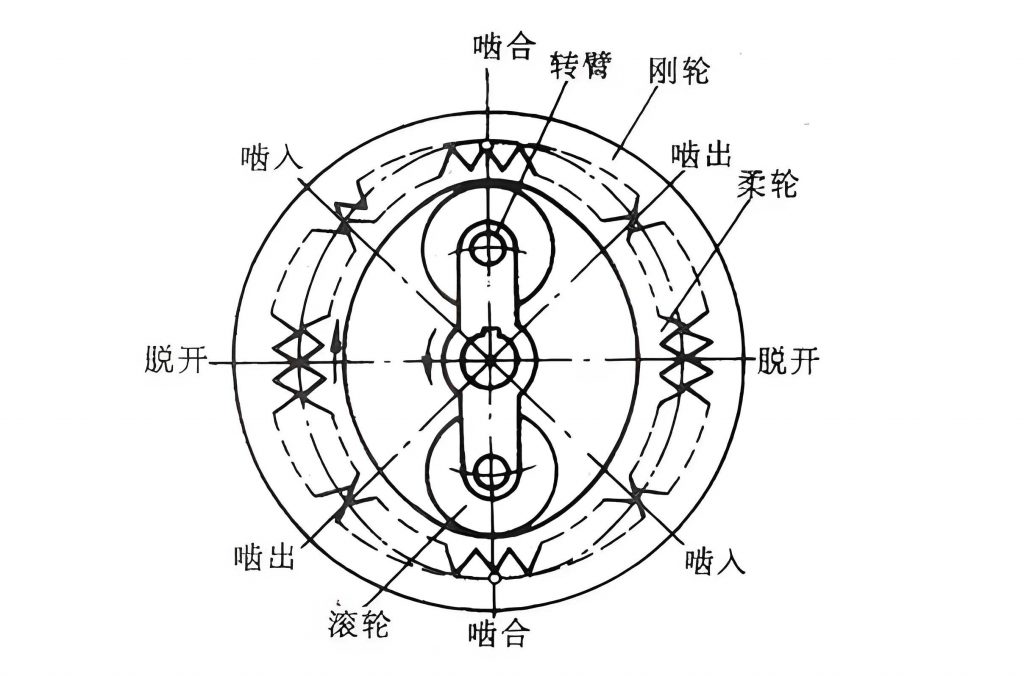
This article presents a comprehensive methodology for calculating the maximum load stress in the flexspline tooth ring of a harmonic drive gear. We begin by establishing the stress state under no-load (assembly) conditions, induced solely by the deformation from the wave generator. Subsequently, a novel analytical model is developed to compute the additional bending stress generated by the meshing forces under various load torques. By superimposing these two stress components, we derive an explicit expression for the maximum circumferential bending stress. This expression is then employed to systematically investigate the influence of key structural parameters—wall thickness, dedendum fillet radius, and tooth space-to-width ratio—on the peak load stress. The analytical findings are rigorously validated against detailed three-dimensional nonlinear finite element analysis (FEA). The ultimate goal is to reveal the underlying relationships between design parameters and stress performance, thereby providing clear theoretical guidance for the strength design and structural optimization of harmonic drive gear flexsplines.
Stress Analysis of the Flexspline Tooth Ring Under No-Load (Assembly) Condition
Before analyzing the loaded state, it is essential to quantify the pre-existing stress in the flexspline due to its forced elliptical deformation by the wave generator. This assembly stress acts as a preload and forms the baseline upon which operational loads are superimposed.
Contact Mechanics Model of the Tooth Ring
Under the action of an elliptical wave generator, the neutral surface of the flexspline tooth ring does not maintain perfect contact with the generator profile around its entire circumference. A wrapping phenomenon occurs primarily in the region around the major axis. Thus, the deformed neutral surface can be conceptually divided into a contact zone (where the flexspline is in contact with the wave generator) and a free, non-contact zone. The major axis point experiences the maximum radial displacement, denoted as \( w_0 \).
The initial, undeformed neutral surface is a circle of radius \( r_m \). After deformation, the major semi-axis becomes \( \rho_a = r_m + w_0 \). The minor semi-axis \( \rho_b \) of the deformed flexspline midline can be determined using established formulas from harmonic drive gear theory. The geometry of the contact zone is known and is represented as an offset curve (equidistant line) of the ellipse defined by \( \rho_a \) and \( \rho_b \).
Expression for Circumferential Bending Stress in the Contact Zone
The curvature \( K(\varphi) \) of the deformed midline in the contact zone, as a function of the initial angular position \( \varphi \), is given by the curvature of the ellipse offset:
$$ K(\varphi) = \left| \frac{c_1}{\rho_b} \frac{(c_1^2 \cos^2 \varphi – \cos^2 \varphi – c_1^2)^{3}}{(c_1^4 \cos^2 \varphi – \cos^2 \varphi – c_1^4)^{3}} \right| $$
where \( c_1 = \rho_a / \rho_b \).
The change in curvature \( \chi \) relative to the initial circular state is related to the bending moment \( M_1(\varphi) \) by beam/plate theory:
$$ \chi = \frac{M_1(\varphi)}{E I_z} = K(\varphi) – \frac{1}{r_m} $$
where \( E \) is the Young’s modulus, and \( I_z \) is the area moment of inertia of the tooth ring cross-section. For a ring of width \( b_1 \) and thickness \( \delta \), \( I_z = b_1 \delta^3 / 12 \).
Solving for the bending moment:
$$ M_1(\varphi) = E I_z \left[ K(\varphi) – \frac{1}{r_m} \right] $$
The resulting circumferential bending stress \( \sigma_\varphi \) at a distance \( \delta/2 \) from the neutral surface is:
$$ \sigma_\varphi = \frac{M_1(\varphi)}{I_z} \cdot \frac{\delta}{2} = \frac{E \delta}{2} \left[ K(\varphi) – \frac{1}{r_m} \right] $$
The maximum assembly bending stress occurs at the major axis where \( \varphi = 0 \) and the curvature change is greatest:
$$ \sigma_{\varphi, max} = \frac{E \delta}{2} \left( \frac{\rho_a}{\rho_b^2} – \frac{1}{r_m} \right) $$
Accounting for the Influence of the Tooth Structure
The presence of teeth significantly increases the local bending stiffness of the ring. However, the stiffness of the tooth itself is much higher than that of the slot (dedendum) region. Consequently, under bending deformation, a larger portion of the circumferential strain is concentrated in the more compliant slot areas, leading to localized stress concentration at the tooth root fillet. This effect cannot be captured by the simple ring model and must be accounted for by a stress influence factor, \( K_\sigma \). Empirical studies on harmonic drive gears have yielded formulas for this factor. One such established formula relates \( K_\sigma \) to key tooth geometry parameters:
$$ K_\sigma = 0.344 \exp\left(1.243 \frac{s_f}{\delta}\right) + 5.833 \left( \frac{r_1}{\delta} + 0.482 \frac{s_f}{\delta} – 0.693 \right)^2 + 0.886 $$
where \( s_f \) is the tooth thickness at the root line, \( r_1 \) is the dedendum fillet radius, and \( \delta \) is the ring thickness.
Therefore, the maximum assembly stress at the critical tooth root location is the product of the ring bending stress and the stress influence factor:
$$ \sigma_{assy, max} = K_\sigma \cdot \sigma_{\varphi, max} = K_\sigma \cdot \left[ \frac{E \delta}{2} \left( \frac{\rho_a}{\rho_b^2} – \frac{1}{r_m} \right) \right] $$
This stress serves as the foundational pre-stress state for the harmonic drive gear before any torque is transmitted.
Load Stress Analysis of the Flexspline Tooth Ring Under Transmitted Torque
When the harmonic drive gear transmits torque, meshing forces arise between the flexspline and the circular spline teeth. These forces impose additional loads on the flexspline tooth ring, generating significant local bending stresses that are concentrated at the tooth roots, particularly in the major axis region where engagement is deepest.
Equivalent Beam Model for a Single Tooth under Load
To analytically determine the stress caused by meshing forces, a single tooth in the primary load-bearing zone is modeled. Considering the dominant stress component and for simplification, the complex three-dimensional tooth geometry is represented as a planar, variable-cross-section cantilever beam fixed at the tooth ring’s neutral surface. The beam accounts for the different cross-sections: the robust tooth section and the slender slot section. The critical load case is the maximum tooth-pair meshing force, \( q \), acting at the tooth tip, which can be resolved into radial (\( q_r \)) and tangential (\( q_t \)) components relative to the flexspline.
The beam is subjected to the meshing force \( q \) and a supporting reaction force \( F_{wg} \) from the wave generator. Internal forces on a cross-section include bending moment \( M \), shear force \( F_S \), and axial force \( F_N \). For the purpose of calculating bending stress at the root, the primary internal resultant is the bending moment \( M_y \). Equilibrium conditions for the simplified planar model yield the shear force \( F_S \) in terms of the tangential load component \( q_t \), tooth height \( h \), ring thickness \( \delta \), and tooth pitch \( p \):
$$ F_S = \frac{q_t}{p} \left[ h + \frac{\delta}{2} – (s_2 – h \tan \alpha_1) \tan \alpha_1 \right] $$
where \( \alpha_1 \) is the pressure angle and \( s_2 \) is the position of the support reaction.
Derivation of the Additional Bending Stress
The bending moment distribution \( M(s) \) along the beam length (coordinate \( s \)) is piecewise due to the changing cross-section and load points. However, analysis shows that the moment difference caused by \( q_r \) and \( F_{wg} \) is relatively small. A simplified, conservative expression for the moment along the entire pitch can be used:
$$ M(s) = M_{y\sigma} – F_S (p – s) $$
where \( M_{y\sigma} \) is the moment at the fixed end (\( s=0 \)).
The beam’s deflection \( w(s) \) is governed by the differential equation \( d^2w/ds^2 = M(s)/(EI_x) \), where \( I_x \) is the area moment of inertia of the cross-section about the bending axis. The tooth section and slot section have different inertias, \( I_{x1} \) and \( I_{x2} \), corresponding to equivalent tooth height \( h_0 \) and ring thickness \( \delta \), respectively.
By integrating the deflection equation for both sections and applying boundary conditions (zero deflection and slope at the support point \( s_2 \), and continuity of deflection and slope at the transition point \( s_f \) between tooth and slot), the six unknown constants (four integration constants, \( M_{y\sigma} \), and \( s_2 \)) can be solved. The solution yields the expression for the fixed-end moment \( M_{y\sigma} \):
$$ M_{y\sigma} = q_t (h + \frac{\delta}{2}) \cdot \frac{K_s (1 – K_s/2)(1 – \delta^3 / h_p^3) – 0.5}{K_s (1 – \delta^3 / h_p^3) – 1} $$
where \( K_s = s_f / p \) is related to the tooth geometry at the root, and \( h_p = \delta + h_0 \).
The maximum additional bending stress due to the load, occurring at the outer fiber of the slot section at the fixed end, is then:
$$ \sigma_{y\sigma} = \frac{6 M_{y\sigma}}{\delta^2} $$
This stress is the incremental stress caused purely by the transmitted torque.
Total Maximum Load Stress Expression
Under operational conditions, the total stress at the critical point (tooth root in the major axis zone) is the superposition of the assembly stress and the load-induced bending stress. Therefore, the maximum circumferential bending load stress \( \sigma_y \) in a harmonic drive gear flexspline is:
$$ \sigma_y = \sigma_{assy, max} + \sigma_{y\sigma} = K_\sigma \cdot \left[ \frac{E \delta}{2} \left( \frac{\rho_a}{\rho_b^2} – \frac{1}{r_m} \right) \right] + \frac{6 M_{y\sigma}}{\delta^2} $$
This closed-form expression explicitly relates the peak stress to material properties (\( E \)), wave generator geometry (\( \rho_a, \rho_b \)), flexspline dimensions (\( r_m, \delta \)), tooth geometry (\( K_\sigma, h, K_s, h_p \)), and the operational load (\( q_t \)).
Parametric Study: Influence of Key Structural Parameters on Maximum Load Stress
Using the derived stress expression, we can systematically investigate how key design parameters of the harmonic drive gear flexspline influence the peak load stress. For generalized analysis, dimensionless parameters are defined: the thickness coefficient (\( \delta / r_m \)), the dedendum fillet radius coefficient (\( r_1 / m \), where \( m \) is the module), and the tooth space-to-width ratio \( \nu \) (ratio of space width to tooth thickness on the pitch circle). The analysis considers multiple load levels: no-load (NL), rated torque (RAT), average allowable torque (AVT), peak startup/stop torque (STT), and maximum instantaneous torque (MIT).
Effect of Tooth Ring Thickness
The relationship between maximum load stress and the tooth ring thickness coefficient is non-monotonic and load-dependent. Under pure assembly (no-load) conditions, the stress increases linearly with thickness, as a thicker ring resists deformation more, leading to higher membrane/bending strains. Thinner rings and wider slots (higher \( \nu \)) generally yield lower assembly stress.
Under loaded conditions, a distinct minimum stress point emerges. Initially, increasing the thickness from a very low value drastically reduces the load-induced bending stress \( \sigma_{y\sigma} \) (which is inversely proportional to \( \delta^2 \)), overwhelming the gradual increase in assembly stress. Beyond an optimal thickness, the assembly stress begins to dominate the trend, causing the total stress to rise slowly again. This optimal thickness coefficient increases with the applied load magnitude, as heavier loads demand a more robust ring to mitigate bending stress. Furthermore, a higher space-to-width ratio \( \nu \) tends to shift the optimal point toward a slightly smaller thickness.
Effect of Dedendum Fillet Radius
The dedendum fillet radius \( r_1 \) primarily influences the stress concentration factor \( K_\sigma \). Analysis shows that for a given optimal thickness, the maximum load stress first decreases and then increases as \( r_1 \) grows. An optimal fillet radius exists. A small fillet creates a sharp notch, leading to severe stress concentration. Increasing the radius alleviates this concentration, reducing stress. However, beyond a certain point, a very large fillet effectively increases the local thickness and stiffness of the ring at the root, attracting more bending moment and thus increasing the nominal stress. For typical harmonic drive gear designs, the optimal dedendum fillet radius coefficient falls within the range of \( 0.6m \) to \( 0.7m \). This optimal range is relatively consistent across different load cases but increases slightly with larger space-to-width ratios \( \nu \).
Effect of Tooth Space-to-Width Ratio
The space-to-width ratio \( \nu \) affects both the stress concentration factor \( K_\sigma \) and the load distribution parameter \( K_s \). Its influence is coupled with the ring thickness. When analyzed at the respective optimal thickness for each load case, the maximum load stress shows a relatively mild dependence on \( \nu \), often exhibiting a shallow minimum. The dominant factor for the absolute stress level remains the load torque. However, the value of the optimal \( \nu \) itself decreases as the load torque increases. Under heavy loads, a moderately smaller \( \nu \) (slightly wider teeth) provides better load-sharing and stress distribution. Across the investigated load spectrum for harmonic drive gears, the optimal space-to-width ratio is approximately 2.
The following table summarizes the identified optimal parameters for different operational regimes of a harmonic drive gear, illustrating the trends discussed above.
| Operating Condition | Optimal Thickness Coefficient (\(\delta / r_m \)) (%) | Optimal Fillet Radius (\(r_1/m\)) | Optimal Space-to-Width Ratio (\(\nu\)) |
|---|---|---|---|
| No-Load (Assembly) | Minimize (Thin ring preferred) | 0.6 – 0.7 | ~2.2 |
| Rated Torque (RAT) | ~2.9 | 0.65 | ~2.2 |
| Average Torque (AVT) | ~3.0 | 0.65 | ~2.2 |
| Peak Torque (STT) | ~3.1 | 0.7 | ~1.8 |
| Max Instantaneous Torque (MIT) | ~3.4 | 0.7 | ~1.8 |
Finite Element Model Validation
To verify the accuracy of the analytical load stress model, a series of detailed three-dimensional nonlinear finite element analyses were conducted. A parametric model of a cup-type flexspline (based on an SHF-25-80 type harmonic drive gear) with actual double-circular-arc tooth profile geometry was built. The model included the wave generator as a rigid analytical surface. Contact was defined between the flexspline inner surface and the wave generator, and between the flexspline teeth and the rigid circular spline teeth in the loaded cases. The mesh was refined at the tooth roots (slots) to ensure stress convergence.
First, the assembly stress was simulated by deforming the flexspline onto the elliptical wave generator. The FEA-predicted maximum stress location (tooth slot on the major axis near the cup mouth) matched theoretical expectations. The numerical value was within 3.4% of the theoretical prediction adjusted with the stress influence factor \( K_\sigma \), confirming the accuracy of the assembly stress model for the harmonic drive gear.
Second, for load simulation, the maximum tooth-pair meshing force corresponding to different torque levels (RAT, AVT, STT, MIT) was calculated and applied as a distributed pressure on the tooth flanks in the central axial section near the major axis. The resulting peak von Mises stress in the tooth root region was extracted.
The comparison between FEA results and theoretical predictions from the derived formula \( \sigma_y \) across all load cases showed excellent agreement. The deviation was consistently below 4% for the baseline geometry. Furthermore, analyses run with geometries corresponding to the theoretically identified optimal parameters (optimal thickness, fillet radius of 0.65m-0.7m, and \( \nu \approx 2 \)) yielded the lowest stress values in FEA. The deviation between the theoretical minimum stress and the FEA minimum stress for the worst-case (MIT) condition was approximately 6.5%, which is considered very good for such a complex nonlinear contact problem. This close correlation validates the proposed analytical method as a reliable and efficient tool for predicting critical stresses and guiding the design of harmonic drive gear flexsplines.
Conclusion
This study has established a comprehensive analytical framework for determining the maximum load stress in the tooth ring of a harmonic drive gear flexspline. By modeling the tooth as a variable-section beam under load and superimposing the resulting bending stress with the pre-existing assembly stress, an explicit expression for the total stress was derived. This expression enabled a systematic parametric investigation, leading to the following key conclusions for the design optimization of harmonic drive gears:
- Tooth Ring Thickness: The relationship between stress and thickness is non-linear under load. An optimal thickness exists that minimizes total load stress. This optimal thickness coefficient increases with the transmitted torque level. A balanced design for a harmonic drive gear operating under a typical spectrum of loads suggests a thickness coefficient of approximately 3% of the neutral radius.
- Dedendum Fillet Radius: The maximum load stress is sensitive to the fillet radius, exhibiting a clear minimum. An excessively small radius causes severe stress concentration, while an overly large one increases local stiffness and bending stress. The optimal range for the dedendum fillet radius in a harmonic drive gear is between 0.6 and 0.7 times the gear module.
- Tooth Space-to-Width Ratio: The influence of this ratio is coupled with thickness and is less pronounced than the other parameters when the thickness is optimal. However, the optimal value tends to decrease from about 2.2 under lighter loads to about 1.8 under the most severe loads, indicating that slightly wider teeth are beneficial for stress distribution under high torque in a harmonic drive gear.
The analytical results were rigorously validated against high-fidelity finite element models, showing remarkable agreement (deviations generally under 6.5%). The methodology provides a powerful theoretical tool that bypasses the need for computationally expensive simulations during the initial design stages. It offers clear, quantitative guidance for selecting structural parameters to minimize stress concentrations and enhance the fatigue life of the flexspline, which is fundamental to improving the reliability and performance of harmonic drive gears in demanding robotic and aerospace applications.