
The global challenge of water scarcity, particularly acute in arid regions and a limiting factor for agricultural productivity in remote farmlands, demands innovative technological solutions. Traditional irrigation methods are often labor-intensive, inefficient, and poorly adapted to real-time environmental conditions. This work presents the design, development, and experimental validation of a novel bionic robot, a biomimetic system inspired by the remarkable survival adaptations of the Stenocara beetle (Namib Desert beetle). This bionic robot integrates advanced additive manufacturing, sophisticated sensor fusion, and high-speed 5G communication to create a versatile, remotely operable platform for environmental monitoring, precision irrigation, and exploratory tasks.
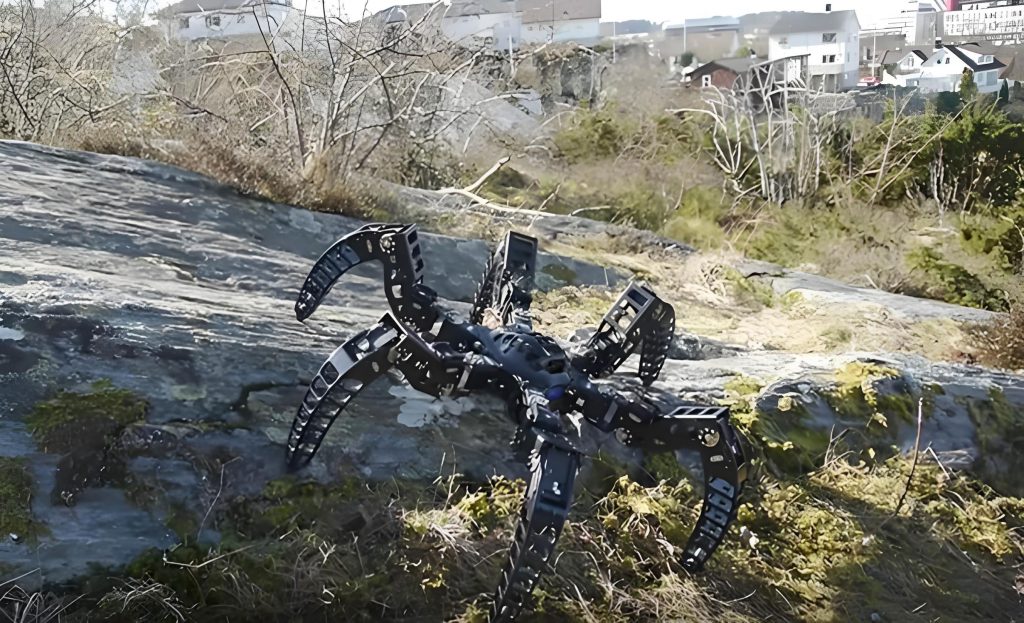
The core inspiration for this bionic robot stems from the beetle’s unique elytra (wing casings), which are covered in hydrophilic (water-attracting) bumps surrounded by hydrophobic (water-repelling) channels. This microstructure facilitates the efficient collection of fog from the air, channeling condensed water droplets towards the insect’s mouth. Our design philosophy translates this biological principle into a functional mechanical architecture. The exoskeleton of our bionic robot is modeled to amplify this surface texturing concept, not for water collection in this iteration, but to house and protect internal components while providing a large, structured surface area for potential future integration of microfluidic or sensor arrays. The primary structure, including the main chassis and the distinctive shell, was designed using CAD software and realized through Fused Deposition Modeling (FDM) 3D printing. This additive manufacturing approach allows for rapid prototyping, high design complexity, and lightweight construction, which are critical for a mobile bionic robot. The use of polylactic acid (PLA) ensures a favorable strength-to-weight ratio.
Locomotion is a critical aspect of any terrestrial bionic robot. To navigate uneven terrain such as soft soil, sand, or rugged farmland, a hexapod (six-legged) walking mechanism was adopted. This configuration provides exceptional stability, load distribution, and adaptability compared to wheeled or tracked systems. Each leg of the bionic robot is a two-degree-of-freedom (2-DOF) kinematic chain, actuated by two high-torque digital servomotors. This design enables a wide range of motions including lifting, swinging forward/backward, and providing the necessary support polygon for stable static and dynamic walking. The symmetric arrangement of the legs ensures balanced propulsion and maneuverability. The kinematic model for a single leg can be defined in a simplified 2D plane, where the position of the foot tip (Px, Py) relative to the shoulder joint is given by:
$$ P_x = L_1 \cos(\theta_1) + L_2 \cos(\theta_1 + \theta_2) $$
$$ P_y = L_1 \sin(\theta_1) + L_2 \sin(\theta_1 + \theta_2) $$
where \(L_1\) and \(L_2\) are the lengths of the thigh and shin links, respectively, and \(\theta_1\) and \(\theta_2\) are the joint angles of the two servos. The inverse kinematics, crucial for positioning the foot on a desired trajectory, is solved for each gait cycle. The coordination of all twelve servomotors is handled by a dedicated 16-channel PWM servo driver board (e.g., PCA9685), which receives commands from the central processing unit.
The electronic architecture of the bionic robot is built around a Raspberry Pi 4 Model B single-board computer, serving as the central brain. This choice provides substantial computational power, multiple communication interfaces (USB, GPIO, CSI), and native networking capability. The system’s hardware integration is summarized in the following table:
| Component | Model/Specification | Primary Function |
|---|---|---|
| Main Controller | Raspberry Pi 4B (4GB RAM) | Central processing, sensor data fusion, gait control, network communication. |
| Communication Module | 5G USB Dongle (e.g., Quectel RM500Q) | Provides high-bandwidth, low-latency connection to the remote control platform. |
| Servo Driver | PCA9685 (I2C interface) | Generates precise PWM signals to control up to 16 servomotors simultaneously. |
| Actuators | 12x Digital Servo (e.g., MG996R) | Provide torque and precise angular control for the hexapod leg joints. |
| Inertial Measurement Unit (IMU) | MPU6050 (6-axis: gyro + accelerometer) | Measures body orientation and acceleration for balance and stabilization. |
| Vision Sensor | Raspberry Pi Camera Module v2 | Captures real-time video for First-Person View (FPV) and visual inspection tasks. |
| Environmental Sensors | DHT22 (Temp/Humidity), Anemometer | Collects ambient temperature, humidity, and wind data for environmental analysis. |
| Power System | Li-Po Battery Pack (12V, ~5000mAh) & Voltage Regulators | Supplies stable power to all onboard electronics and servos. |
The control software for the bionic robot is developed entirely in Python, leveraging its rich ecosystem of libraries for hardware interfacing, networking, and data processing. The program is structured using multi-threading to handle concurrent tasks efficiently without blocking. Key threads include: a main control thread for interpreting remote commands, a sensor data acquisition and fusion thread, a gait generation and servo control thread, and a video streaming thread. The inter-thread communication ensures responsive and synchronized operation of the entire bionic robot system.
The balance and stability of the walking bionic robot are paramount, especially on uneven terrain. The MPU6050 IMU provides raw accelerometer and gyroscope data. To obtain a reliable estimate of the robot’s body tilt (roll and pitch angles), a sensor fusion algorithm is implemented. A complementary filter or, more effectively, a Kalman filter is used to combine the high-frequency response of the gyroscope with the low-frequency accuracy of the accelerometer. A simplified discrete-time Kalman filter prediction and update cycle can be represented. The state vector \( \mathbf{x}_k \) representing the angle and gyro bias is predicted:
$$ \mathbf{\hat{x}}_k^- = \mathbf{F}_k \mathbf{\hat{x}}_{k-1} + \mathbf{B}_k \mathbf{u}_{k-1} $$
$$ \mathbf{P}_k^- = \mathbf{F}_k \mathbf{P}_{k-1} \mathbf{F}_k^T + \mathbf{Q}_k $$
where \( \mathbf{F} \) is the state transition matrix, \( \mathbf{B} \) is the control-input model, \( \mathbf{u} \) is the control vector, \( \mathbf{P} \) is the error covariance, and \( \mathbf{Q} \) is the process noise covariance. The update step incorporates the accelerometer measurement \( \mathbf{z}_k \):
$$ \mathbf{K}_k = \mathbf{P}_k^- \mathbf{H}_k^T (\mathbf{H}_k \mathbf{P}_k^- \mathbf{H}_k^T + \mathbf{R}_k)^{-1} $$
$$ \mathbf{\hat{x}}_k = \mathbf{\hat{x}}_k^- + \mathbf{K}_k (\mathbf{z}_k – \mathbf{H}_k \mathbf{\hat{x}}_k^-) $$
$$ \mathbf{P}_k = (\mathbf{I} – \mathbf{K}_k \mathbf{H}_k) \mathbf{P}_k^- $$
Here, \( \mathbf{H} \) is the observation model, \( \mathbf{R} \) is the measurement noise covariance, and \( \mathbf{K} \) is the optimal Kalman gain. The estimated tilt angles are monitored in real-time. If they exceed a predefined threshold (e.g., >15°), the gait controller adjusts the leg stance and foot placement to actively correct the posture and prevent the bionic robot from tipping over.
The remote operation and data exchange are enabled by 5G technology, which offers the bandwidth and low latency necessary for real-time teleoperation and high-definition video streaming. The communication protocol between the bionic robot and the cloud-based control platform is MQTT (Message Queuing Telemetry Transport), a lightweight publish-subscribe protocol ideal for IoT and machine-to-machine (M2M) communication. The system architecture follows this pattern: The bionic robot acts as an MQTT client, publishing sensor data (e.g., IMU, temperature) to topics like `robot/01/sensors/temp` and subscribing to command topics like `robot/01/command/move`. The remote web-based control interface, built using the VUE.js framework, connects to the same MQTT broker (hosted on a cloud server). When an operator sends a command via the web interface (e.g., “move forward”), it is published to the command topic and instantly relayed to the bionic robot. Conversely, video streams are handled via a separate, optimized protocol like RTSP (Real-Time Streaming Protocol) or WebRTC, tunneled through the 5G connection, to provide a live feed with sub-500ms latency to the operator’s dashboard.
| Sensor Type | Measured Parameter | Accuracy / Range | Sampling Rate | Published MQTT Topic |
|---|---|---|---|---|
| MPU6050 | Roll Angle, Pitch Angle | ±0.5° (after fusion) | 100 Hz | `robot/{id}/sensors/imu` |
| DHT22 | Ambient Temperature | ±0.5 °C | 0.5 Hz | `robot/{id}/sensors/temp` |
| DHT22 | Relative Humidity | ±2% RH | 0.5 Hz | `robot/{id}/sensors/humidity` |
| Camera | Video Stream | 1080p @ 30fps | N/A (Stream) | RTSP Stream URL |
| Custom Anemometer | Wind Speed / Direction | ±5% FS | 10 Hz | `robot/{id}/sensors/wind` |
A critical software module is the gait engine. A tripod gait is implemented for efficient and stable locomotion. In this gait, the six legs are divided into two groups of three (legs 1, 3, 5 and legs 2, 4, 6), which move in alternation. The sequence for forward motion involves:
- Swing Phase for Group A: Legs 1, 3, 5 lift off the ground and move forward along a calculated trajectory.
- Stance Phase for Group B: Legs 2, 4, 6 remain on the ground, pushing the body forward.
- Swing Phase for Group B: Group B legs lift and swing forward.
- Stance Phase for Group A: Group A legs plant and propel the body.
This cycle repeats. The foot trajectory during the swing phase is typically a smooth curve to avoid stubbing and ensure fluid motion. A common method is to use a cycloidal or polynomial function to define the foot’s path in Cartesian space, which is then translated into joint angles via the inverse kinematics model. The duty factor \(\beta\) (fraction of cycle time a leg is on the ground) for a stable tripod gait is 0.5. The stride length \(S\) and forward velocity \(v\) are related by:
$$ v = \frac{S}{T_{cycle}} $$
where \(T_{cycle}\) is the duration of one complete gait cycle. These parameters are adjustable in real-time via the control interface, allowing the operator to fine-tune the bionic robot’s speed and stability for different terrains.
Extensive experimental tests were conducted to validate the performance of the bionic robot prototype. Functional tests confirmed successful remote power-up, network registration via 5G, and bidirectional MQTT communication. The gait algorithms were tuned to produce smooth, stable walking on flat indoor surfaces, carpet, and simulated outdoor terrain (grass, gravel). The most significant quantitative test involved evaluating the end-to-end latency of the control loop and video stream. The bionic robot’s camera was aimed at a high-accuracy online stopwatch. The time displayed on the stopwatch was compared to the system timestamp when the same video frame was displayed on the remote operator’s screen. Over 300 trials, the total latency—encompassing video capture, encoding, 5G transmission, decoding, and display—was consistently measured below 400 milliseconds. This level of delay is acceptable for remote inspection and moderate-speed teleoperation tasks, validating the efficacy of the 5G communication subsystem for this bionic robot application.
The potential applications for this developed bionic robot platform are diverse. In precision agriculture, it can be deployed as a mobile sensor node, traversing fields to collect spatially dense data on soil moisture (with an added probe), micro-climate conditions, and crop health via multispectral imaging. This data can feed into AI models for early pest/disease detection or variable-rate irrigation maps. For environmental monitoring in harsh or inaccessible areas, the robust, walking bionic robot can carry payloads to sample air quality or map terrain. The modular design allows for the integration of a mechanical arm or a specialized tool head, transforming it into a remote manipulation or precise sampling bionic robot. Furthermore, the core biomimetic shell design can be adapted to actively test fog-harvesting surface coatings in real-world conditions, closing the loop on the original biological inspiration.
In conclusion, this work successfully demonstrates the complete development cycle of a sophisticated bionic robot, from bio-inspired conceptualization and mechanical design through embedded systems integration and network-enabled remote operation. The fusion of biomimetic principles with modern technologies like 5G and additive manufacturing has resulted in a highly functional and adaptable platform. The bionic robot exhibits stable hexapodal locomotion, real-time environmental sensing, and reliable low-latency communication, meeting the core objectives for a remote exploration and monitoring agent. Future work will focus on enhancing autonomy through SLAM (Simultaneous Localization and Mapping) for navigation, improving energy efficiency with optimized gait control, and field-testing specific application modules. This bionic robot stands as a testament to the power of interdisciplinary design, offering a tangible tool to address pressing challenges in resource management, agriculture, and environmental science.