
The evolution of robotics has consistently pushed the boundaries of how machines can integrate into and augment human endeavors. Among various morphologies, the bipedal humanoid robot stands out due to its structural affinity with humans, enabling operation in environments built for human form and facilitating more intuitive human-robot interaction. This inherent versatility makes it a pivotal platform for applications ranging from hazardous environment exploration to advanced research in artificial intelligence and embodied cognition. However, realizing a stable, autonomous, and intelligent humanoid robot presents a confluence of challenges in mechanical design, real-time control, sensor fusion, and on-board computation. This work details the comprehensive design and implementation of a compact, intelligent bipedal humanoid robot that addresses these challenges through a synergistic integration of custom mechanical design, a powerful embedded AI computing core, and a suite of multimodal perception algorithms.
Our primary objective was to develop a humanoid robot platform capable of stable bipedal locomotion, environmental perception, and interactive behaviors, all processed on-board to ensure autonomy. The core of our system is the NVIDIA Jetson Nano, a compact yet computationally potent module that provides the necessary horsepower for running modern neural networks and complex control algorithms in real-time. The mechanical structure is meticulously designed with 17 degrees of freedom (DoF) to mimic human kinematics, driven by precise digital servos. Perception is achieved through a multi-sensor suite including a high-definition camera, infrared proximity sensors, a laser rangefinder, and a 9-axis inertial measurement unit (IMU). The entire software stack is built upon the Robot Operating System (ROS), providing a robust framework for modular development, communication, and control. This article systematically presents the mechanical architecture, hardware control system, intelligent perception and decision-making algorithms, and the integrated performance of our humanoid robot.
Mechanical Design and Kinematic Modeling
The mechanical design of a humanoid robot is fundamentally constrained by the need to balance stability, range of motion, weight, and power consumption. Our design philosophy prioritized a biomimetic approach to replicate key human joint configurations while accounting for the torque and range limitations of off-the-shelf servo motors.
The robot stands approximately 25 cm tall, with a torso width of 20 cm and a depth of 11 cm. The structure is primarily fabricated using Polylactic Acid (PLA) via 3D printing, offering an excellent strength-to-weight ratio and design flexibility. The kinematic chain comprises a total of 17 Degrees of Freedom (DoF), strategically distributed to enable walking, arm movement, and head panning.
| Body Part | Joint | Degrees of Freedom (DoF) | Primary Function |
|---|---|---|---|
| Leg (x2) | Ankle | 1 (Roll) | Medio-lateral balance during stance |
| Knee | 1 (Pitch) | Leg flexion/extension for step height | |
| Hip | 2 (Pitch & Roll) | Leg swing forward/backward and lateral movement | |
| Arm (x2) | Shoulder | 2 (Pitch & Yaw) | Arm elevation and horizontal flexion |
| Elbow | 1 (Pitch) | Forearm flexion/extension | |
| Head | Neck | 1 (Yaw) | Horizontal panning for visual perception |
| Total DoF | 17 | ||
The leg design is critical for bipedal gait. Each leg features 5 DoF. The hip joint is modeled with two perpendicular servos providing pitch (forward/backward swing) and roll (lateral swing) motions. The knee is a single-pitch joint, and the ankle is a single-roll joint. This configuration, while simplified compared to the human ankle’s pitch and roll, provides sufficient control for balance on flat and moderately uneven surfaces. The forward kinematics for a leg can be described using the Denavit-Hartenberg (D-H) convention. For a leg segment with a joint angle $\theta_i$, link length $a_i$, link twist $\alpha_i$, and link offset $d_i$, the homogeneous transformation matrix from frame {i-1} to frame {i} is:
$$
^{i-1}T_i = \begin{bmatrix}
\cos\theta_i & -\sin\theta_i \cos\alpha_i & \sin\theta_i \sin\alpha_i & a_i \cos\theta_i \\
\sin\theta_i & \cos\theta_i \cos\alpha_i & -\cos\theta_i \sin\alpha_i & a_i \sin\theta_i \\
0 & \sin\alpha_i & \cos\alpha_i & d_i \\
0 & 0 & 0 & 1
\end{bmatrix}
$$
The full pose of the foot relative to the pelvis is obtained by cascading these transformations: $^{Pelvis}T_{Foot} = ^{Pelvis}T_{Hip} \cdot ^{Hip}T_{Knee} \cdot ^{Knee}T_{Ankle} \cdot ^{Ankle}T_{Foot}$. Inverse kinematics, necessary for positioning the foot given a desired step location, is solved using geometric and algebraic methods, considering the planar simplifications of our leg structure.
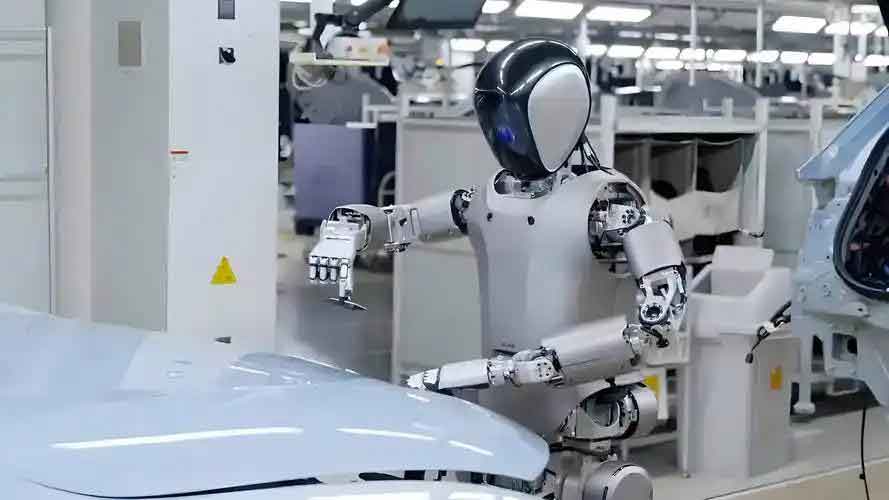
The design process involved extensive simulation of joint angles and torque requirements against standard human gait cycle data. Servo motors were selected based on their stall torque, operating speed, physical dimensions, and PWM control interface. Key specifications for the primary actuators are summarized below:
| Servo Model | Stall Torque (kg·cm) | Operating Speed (s/60°) | Weight (g) | Typical Use Case |
|---|---|---|---|---|
| High-Torque Servo A | 25.0 | 0.15 | 55 | Hip Pitch, Knee |
| Standard Servo B | 15.0 | 0.12 | 45 | Hip Roll, Ankle |
| Micro Servo C | 4.5 | 0.10 | 20 | Shoulder, Elbow, Neck |
Control System Hardware Architecture
The intelligence and real-time responsiveness of the humanoid robot are governed by its electronic control system. We adopted a hierarchical architecture with a high-level AI processor handling perception and decision-making, and a low-level dedicated controller managing real-time servo actuation.
At the apex is the NVIDIA Jetson Nano developer kit. This module was chosen for its exceptional balance of AI compute performance, power efficiency, and I/O capabilities in a compact form factor. Its key attributes include a quad-core ARM Cortex-A57 CPU, a 128-core NVIDIA Maxwell GPU, and 4 GB of LPDDR4 RAM. This hardware provides 472 GFLOPS of computational power, enabling the humanoid robot to run multiple neural networks concurrently on sensor data streams. The Jetson Nano runs a customized Ubuntu 18.04 LTS operating system with ROS Melodic installed as the middleware. ROS provides essential tools for message passing, device drivers, and package management, creating a modular software environment where perception, planning, and control nodes can communicate seamlessly.
| Component | Specification / Model | Primary Function |
|---|---|---|
| Main Controller | NVIDIA Jetson Nano (4GB) | High-level perception, AI inference, gait planning, system orchestration via ROS. |
| Servo Controller | Custom PCB based on STM32 MCU | Low-level PWM generation for up to 32 servos, trajectory interpolation, communication with main controller via UART. |
| Vision Sensor | Raspberry Pi IMX219 Camera Module | 8MP color imaging for object detection, gesture recognition, and pose estimation. |
| Distance Sensing | VL53L0X Time-of-Flight Laser Sensor | Precise ranging (up to 2m) for obstacle detection and navigation. |
| Proximity Sensing | GP2Y0A21YK0F Analog IR Sensors (x4) | Short-range (10-80cm) obstacle detection on sides and front. |
| Inertial Measurement | MPU-9250 9-Axis IMU | 3-axis accelerometer, gyroscope, and magnetometer for torso attitude estimation. |
| Power Management | 5V/4A DC-DC Regulator, 7.4V LiPo Battery | Provides stable 5V power for logic/servos and manages battery input. |
The low-level servo control is handled by a dedicated microcontroller board (based on an STM32 series chip) to ensure jitter-free, timely pulse generation. This board receives high-level joint angle trajectories or direct commands from the Jetson Nano via a UART serial protocol. It handles the interpolation between setpoints to ensure smooth motion and can operate a failsafe routine if communication is lost. This two-tiered architecture offloads the computationally intensive tasks to the Jetson Nano while guaranteeing the hard real-time requirements of servo control are met.
Intelligent Perception and Decision Algorithms
The autonomy and interactivity of our humanoid robot are derived from its ability to perceive the environment and make informed decisions. We implemented several algorithmic modules on the Jetson Nano, leveraging its GPU for accelerated inference.
1. Visual Perception Pipeline
The IMX219 camera feeds visual data to a pipeline running multiple computer vision models. For general object detection and recognition, we employ a lightweight version of the YOLO (You Only Look Once) algorithm, such as YOLOv4-tiny. This model, optimized for edge devices, allows the humanoid robot to identify common objects in its field of view in real-time. The detection output includes class labels and bounding boxes, enabling interactive behaviors like approaching a specific object.
For human-robot interaction, we integrated the MediaPipe framework. Specifically, the MediaPipe Hands solution provides 21 3D landmark points for a detected hand, enabling robust gesture recognition. A simple classifier (e.g., a Support Vector Machine) trained on these landmarks allows the robot to interpret commands like “stop,” “come,” or “wave.” Furthermore, we utilize OpenPose or a similar pose estimation model to detect human body keypoints. By analyzing the angles between keypoint vectors (e.g., shoulder-elbow-wrist), the humanoid robot can mirror human arm poses. The joint angle $\phi$ between vectors $\vec{AB}$ and $\vec{BC}$ is calculated using the dot product:
$$
\phi = \arccos\left(\frac{\vec{AB} \cdot \vec{BC}}{\|\vec{AB}\|\|\vec{BC}\|}\right)
$$
These calculated angles are then mapped to the robot’s own joint space and sent to the servo controller for imitation.
2. Navigation, Obstacle Avoidance, and Path Planning
The robot constructs a local perceptual map using its suite of distance sensors. The front-facing laser rangefinder provides accurate depth for the immediate path ahead, while the four IR sensors monitor the left, right, and frontal proximity at shorter ranges. This multi-sensor data is fused in a ROS node to create a polar histogram or a simple cost map around the robot.
For global path planning towards a user-defined target in a known or partially known environment, we implemented a Particle Swarm Optimization (PSO) algorithm. The objective is to find a path that minimizes a cost function $C$ combining path length $L$, obstacle proximity $O$, and smoothness $S$:
$$
C = w_1 \cdot L + w_2 \cdot O + w_3 \cdot S
$$
where $w_1$, $w_2$, and $w_3$ are weighting coefficients. Each particle in the swarm represents a potential path, and their positions are updated iteratively based on personal and global best solutions.
For local, reactive obstacle avoidance, we designed a neural network-based controller. A shallow Multi-Layer Perceptron (MLP) takes a 9-dimensional input vector $I$:
$$
I = [d_{fr}, d_{fl}, d_{r}, d_{l}, \Delta x_{fr}, \Delta y_{fr}, \Delta x_{fl}, \Delta y_{fl}, \theta_{goal}]
$$
where $d_{*}$ are the four IR sensor distances, $(\Delta x_{fr}, \Delta y_{fr})$ and $(\Delta x_{fl}, \Delta y_{fl})$ are the vectors from the front-right and front-left sensor endpoints to the goal position, and $\theta_{goal}$ is the heading error to the goal. The network outputs a commanded turning rate $\omega$. The network was trained in simulation using supervised learning from examples generated by a potential field method, allowing the humanoid robot to smoothly avoid obstacles while progressing towards its target.
3. Attitude Estimation and Stabilization
Bipedal stability is paramount. The MPU-9250 IMU provides raw accelerometer ($a_x, a_y, a_z$) and gyroscope ($g_x, g_y, g_z$) data. A complementary filter or a more advanced Kalman filter is used to fuse these noisy measurements to obtain a robust estimate of the robot’s torso orientation (roll $\phi$ and pitch $\theta$). The complementary filter update step is:
$$
\theta_{est} = \alpha \cdot (\theta_{est} + g_y \cdot \Delta t) + (1-\alpha) \cdot \atan2(a_x, \sqrt{a_y^2 + a_z^2})
$$
where $\alpha$ is a tuning parameter close to 1, and $\Delta t$ is the sampling period. If the estimated pitch or roll exceeds a predefined threshold, a corrective gait adjustment is triggered. This can involve modifying the step placement during the swing phase or adjusting the ankle roll/pitch to shift the Center of Pressure (CoP). The error $e_{\theta}$ between desired pitch (usually zero) and estimated pitch is fed into a Proportional-Derivative (PD) controller to generate an ankle correction angle $\tau_{ankle}$:
$$
\tau_{ankle} = K_p \cdot e_{\theta} + K_d \cdot \frac{de_{\theta}}{dt}
$$
System Integration and Gait Generation
Integrating all subsystems requires a coherent software architecture. We use ROS nodes for sensor drivers (camera, IMU, distance sensors), perception nodes (YOLO, MediaPipe, OpenPose), planning nodes (PSO path planner, neural network obstacle avoider), and control nodes (gait engine, stabilizer). The gait generation node is central to locomotion. It uses a predefined trajectory for the Center of Mass (CoM) and foot placements for stable walking. For a simple static gait, the Zero Moment Point (ZMP) criterion is approximated by ensuring the vertical projection of the CoM remains within the support polygon formed by the foot/feet on the ground. The foot trajectory in the sagittal plane for a step of length $S$ and height $H$ can be modeled as a cycloid or a polynomial. For example, the swing foot’s forward position $x_f(t)$ and height $z_f(t)$ over step time $T$ can be given by:
$$
x_f(t) = \frac{S}{2} \left(1 – \cos\left(\pi \frac{t}{T}\right)\right), \quad z_f(t) = H \sin\left(\pi \frac{t}{T}\right)
$$
These reference trajectories for all joints are calculated offline or online and streamed to the servo controller. The stabilizer node monitors the IMU data and can modulate these trajectories in real-time by adding small offsets to the foot placement or torso attitude.
| Functional Module | Key Algorithm/Technique | Performance Metric (On Jetson Nano) |
|---|---|---|
| Object Detection | YOLOv4-tiny | ~15-20 FPS at 416×416 resolution |
| Gesture Recognition | MediaPipe Hands + SVM | ~25 FPS, >95% accuracy on trained gestures |
| Human Pose Mirroring | OpenPose (lightweight model) | ~10 FPS, successful angle mapping for upper body |
| Local Obstacle Avoidance | Neural Network Controller (MLP) | Reactive response time < 50 ms |
| Attitude Estimation | Complementary Filter | Stable estimation at 100 Hz update rate |
| Bipedal Gait | Static Walking based on ZMP principle | Stable walking speed of ~0.1 m/s |
Conclusion and Future Directions
This paper presented the full-stack development of an intelligent, autonomous bipedal humanoid robot built around the NVIDIA Jetson Nano. The platform successfully demonstrates the integration of sophisticated mechanical design, a powerful embedded AI compute unit, and a suite of perception and control algorithms to achieve stable locomotion, environmental awareness, and human interaction. The use of ROS as the software backbone proved essential for managing system complexity and enabling modular testing and development. The humanoid robot can walk stably, avoid obstacles using neural network-based reactive control, plan paths using PSO, recognize objects and gestures, and even mimic human poses, all processing autonomously on board.
The current implementation provides a robust foundation for further research and enhancement. Future work will focus on several key areas: First, implementing a dynamic walking gait using more advanced control theories like Model Predictive Control (MPC) to achieve faster and more robust locomotion. Second, integrating Simultaneous Localization and Mapping (SLAM) to allow the humanoid robot to build a map of its environment and navigate more complex spaces. Third, enhancing the dexterity of the manipulators (arms) to enable basic object manipulation tasks. Finally, exploring more advanced human-robot interaction paradigms, such as natural language processing for voice commands and more nuanced emotional or social feedback through expressive movements. The developed humanoid robot platform stands as a versatile testbed for advancing the capabilities of intelligent embodied agents.