
As an engineer focused on robotics and automation, I embarked on a project to design and build an underwater bionic robot. The primary goal was to address the challenges of inspecting and maintaining the submerged sections of large vessels, such as ships and submarines. Traditional methods involving human divers are not only inefficient but also pose significant safety risks. Inspired by the graceful swimming motion of sea turtles, I aimed to create a bionic robot that could navigate underwater environments with agility and precision. This article details my first-person journey through the entire process, from conceptualization and mechanical design to control system implementation and prototype testing. I will emphasize the use of tables and formulas to summarize key aspects, ensuring a comprehensive understanding of the bionic robot’s development.
The underwater bionic robot is envisioned as a multifunctional system capable of autonomous or remotely operated inspections. It integrates advanced sensors, robust propulsion mechanisms, and intelligent control algorithms. The design philosophy revolves around biomimicry, where the form and function of the bionic robot are derived from biological models to enhance performance in aquatic environments. Throughout this project, I leveraged tools like SolidWorks for 3D modeling, STM32 microcontrollers for embedded control, and various sensors for environmental perception. The result is a prototype that demonstrates stability, responsiveness, and potential for real-world applications. In the following sections, I will delve into the overall design, mechanical structure, control systems, and testing phases, all while highlighting the iterative improvements and lessons learned.
Overall Design Framework
The overall design of the underwater bionic robot is structured into three main components: the mechanical structure, the control system, and the data center. This tripartite approach ensures modularity, ease of maintenance, and scalability. The mechanical structure forms the physical embodiment of the bionic robot, designed using biomimetic principles to reduce hydrodynamic drag and improve maneuverability. The control system acts as the brain, processing sensor data and executing commands to achieve desired behaviors. The data center, though not physically part of the robot, handles data logging, user interfaces, and historical analysis for post-mission reviews.
To formalize the design process, I established a set of requirements and constraints, as summarized in Table 1. These guided the development of the bionic robot and ensured alignment with the core objective of underwater inspection.
| Requirement Category | Specification | Rationale |
|---|---|---|
| Operational Depth | Up to 50 meters | Sufficient for most ship hull inspections |
| Endurance | Minimum 2 hours | Allow for extended inspection sessions |
| Propulsion | 6 thrusters (4 vertical, 2 horizontal) | Enable omnidirectional movement and stability |
| Control Modes | Manual (remote) and Autonomous | Flexibility in operation |
| Sensors | Ultrasonic, gyroscope, camera, temperature | Environmental perception and navigation |
| Communication | Wireless (RF) with 200m range | Real-time control and data transmission |
The design process began with sketching and 3D modeling. Using SolidWorks, I created a digital twin of the bionic robot, allowing for virtual testing and optimization before physical fabrication. The model incorporates a streamlined shell inspired by turtle morphology, which minimizes resistance underwater. The internal layout was carefully planned to house electronics, batteries, and thrusters while maintaining a low center of gravity for enhanced stability. This holistic approach ensured that the bionic robot would be both functional and efficient in its intended environment.
Mechanical Structure Design
The mechanical design of the bionic robot is pivotal to its performance. I adopted a bottom-up approach, starting with individual components and gradually assembling them into a complete system. The primary structure includes a waterproof hull, propulsion units, sensor mounts, and internal frames. The hull is designed as a single pressure-resistant body, fabricated using 3D printing with ABS plastic for its balance of strength and buoyancy. To validate the design, I performed finite element analysis (FEA) in SolidWorks to ensure structural integrity under expected underwater pressures.
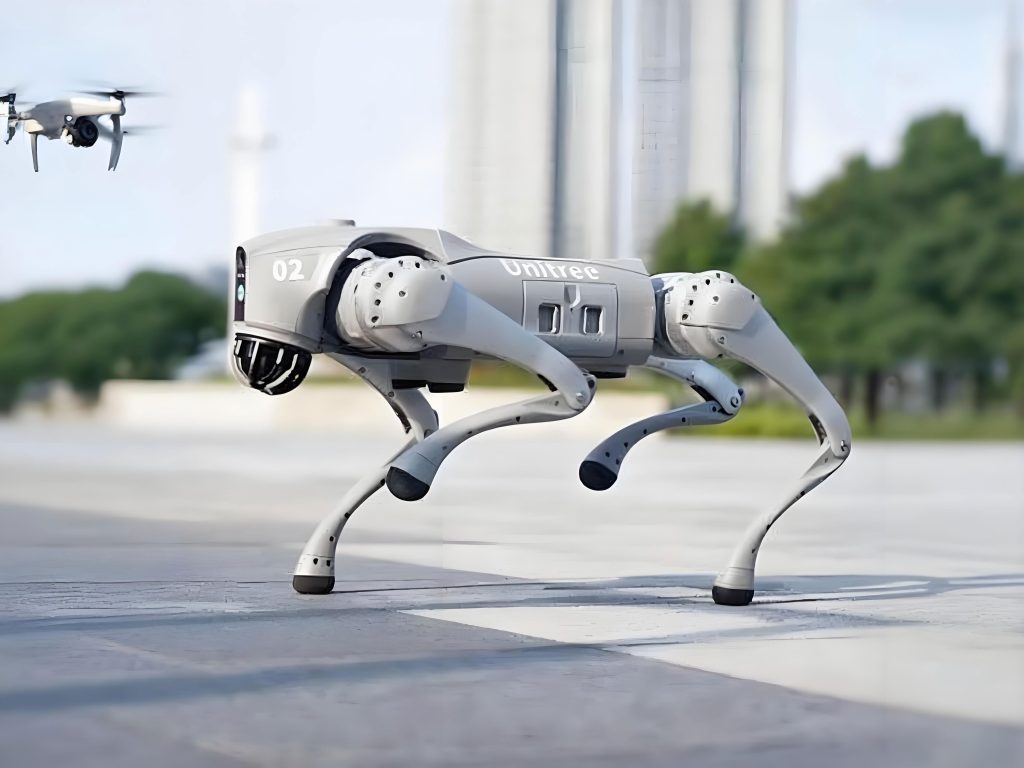
The propulsion system is a key innovation in this bionic robot. It consists of six brushless DC thrusters: four arranged vertically (referred to as balance thrusters) and two horizontally (forward thrusters). This configuration allows for six degrees of freedom movement, including heave, surge, sway, pitch, roll, and yaw. Each thruster is housed in a custom-designed nozzle to improve thrust efficiency by accelerating water flow. The thrusters are controlled independently, enabling complex maneuvers such as hovering, rotating, and diagonal traversal. The selection of thrusters was based on thrust-to-weight ratios and power consumption, as detailed in Table 2.
| Thruster Type | Quantity | Thrust Force (N) | Power Consumption (W) | Purpose |
|---|---|---|---|---|
| Balance Thruster | 4 | 15 each | 30 each | Vertical movement and stabilization |
| Forward Thruster | 2 | 20 each | 40 each | Horizontal propulsion and steering |
The bionic robot’s hydrodynamic performance was analyzed using principles of fluid dynamics. The drag force acting on the robot while moving underwater can be approximated by the formula:
$$F_d = \frac{1}{2} \rho C_d A v^2$$
where \(F_d\) is the drag force, \(\rho\) is the density of water (approximately 1000 kg/m³), \(C_d\) is the drag coefficient (estimated at 0.5 for the streamlined shape), \(A\) is the cross-sectional area (0.1 m²), and \(v\) is the velocity. To achieve efficient motion, the thrust generated by the propulsion system must overcome this drag. The net force equation for horizontal movement is:
$$F_{\text{net}} = F_{\text{thrust}} – F_d – F_{\text{buoyancy}}$$
Buoyancy is a critical factor for the underwater bionic robot. According to Archimedes’ principle, the buoyant force \(F_b\) is given by:
$$F_b = \rho V g$$
where \(V\) is the volume of displaced water and \(g\) is gravitational acceleration. The bionic robot is designed to be neutrally buoyant when fully submerged, meaning its weight \(W\) equals \(F_b\). Adjustments are made using ballast tanks or variable buoyancy systems, but in this design, the balance thrusters actively control depth. For vertical motion, the equation of motion is:
$$m \frac{dv_z}{dt} = \sum F_{z} = F_{\text{thrust, vertical}} – (W – F_b) – F_{d,z}$$
where \(m\) is the mass of the bionic robot, \(v_z\) is the vertical velocity, and \(F_{d,z}\) is the vertical drag. By dynamically adjusting the thrust of the balance thrusters, the bionic robot can ascend, descend, or maintain a constant depth.
For attitude control, such as pitching or rolling, moments generated by differential thrust are utilized. The moment \(M\) about the center of mass can be expressed as:
$$M = \sum_{i=1}^{4} r_i \times F_i$$
where \(r_i\) is the position vector from the center of mass to the i-th thruster, and \(F_i\) is the thrust vector. By controlling the magnitude and direction of each thruster, the bionic robot can achieve desired orientations. This mechanical design ensures that the bionic robot is not only robust but also highly maneuverable, mimicking the agile movements of marine organisms.
Control System Design
The control system is the core of the bionic robot’s intelligence. It comprises hardware and software components that work in tandem to process sensor inputs, make decisions, and execute actions. I chose an STM32F407 microcontroller as the main processor due to its high performance, low power consumption, and extensive peripheral support. The hardware architecture is modular, with separate boards for sensor interfacing, motor driving, and communication. This modularity facilitates debugging and upgrades, which is essential for an evolving project like this bionic robot.
The sensor suite includes an ultrasonic sensor for obstacle detection, a gyroscope and accelerometer (MPU6050) for orientation sensing, a depth sensor, a temperature sensor, and a HD camera for visual inspection. Data from these sensors are sampled at 100 Hz and fed into the STM32 via I2C, SPI, and UART interfaces. The control algorithm fuses these data streams to estimate the state of the bionic robot, including its position, velocity, and attitude. A Kalman filter is implemented for sensor fusion, reducing noise and improving accuracy. The state estimation is crucial for autonomous navigation, allowing the bionic robot to follow predefined paths or react to environmental changes.
The software is developed in C using the STM32CubeIDE environment. It follows a layered architecture with device drivers, middleware, and application layers. The main program runs a real-time operating system (FreeRTOS) to manage multiple tasks concurrently, such as sensor reading, control computation, and communication. The control loop operates at 50 Hz, updating thruster commands based on the desired trajectory and current state. Two operational modes are supported: manual mode, where a human operator sends commands via a wireless remote, and autonomous mode, where the bionic robot executes pre-programmed missions. The mode switching is seamless, ensuring flexibility during operations.
For autonomous navigation, I implemented a PID (Proportional-Integral-Derivative) controller for depth and attitude control. The PID algorithm can be described as:
$$u(t) = K_p e(t) + K_i \int_0^t e(\tau) d\tau + K_d \frac{de(t)}{dt}$$
where \(u(t)\) is the control output (e.g., thruster speed), \(e(t)\) is the error between desired and measured states, and \(K_p\), \(K_i\), \(K_d\) are tuning parameters. These parameters were empirically tuned through pool tests to achieve stable and responsive control. For path following, a waypoint-based navigation system is used, where the bionic robot moves between coordinates using feedback from the sensors. The control system also includes fault detection routines; if a sensor fails or thrusters behave anomalously, the bionic robot can enter a safe mode, surface, or return to home.
Communication with the surface is handled by an RF module (nRF24L01+) for control commands and a Wi-Fi module for video transmission. The remote controller features a joystick for directional control and buttons for mode selection. The software on the remote runs on an Arduino Nano, encoding joystick positions into packets sent to the bionic robot. Table 3 summarizes the key software modules and their functions.
| Software Module | Function | Execution Frequency |
|---|---|---|
| Sensor Acquisition | Reads data from all sensors | 100 Hz |
| State Estimation | Fuses sensor data to estimate robot state | 50 Hz |
| Control Computation | Computes thruster commands using PID | 50 Hz |
| Communication Handler | Manages RF and Wi-Fi data packets | 20 Hz |
| Fault Monitor | Checks system health and triggers safety actions | 10 Hz |
Power management is another critical aspect. The bionic robot is powered by a 12V lithium-polymer battery pack with a capacity of 10,000 mAh. A buck converter steps down the voltage to 5V and 3.3V for electronics. The total power consumption is approximately 200W during full operation, giving an endurance of around 2 hours. Future iterations may incorporate solar charging or hydrogen fuel cells for extended missions. The integration of all these components results in a cohesive control system that enables the bionic robot to operate intelligently in challenging underwater environments.
Prototype Testing and Evaluation
After assembling the bionic robot prototype, I conducted extensive tests in a controlled water tank and later in a natural lake. The testing phase aimed to validate functionality, assess performance, and identify areas for improvement. The tests were structured into functional tests, performance benchmarks, and environmental stress tests. Each test provided valuable insights into the behavior of the bionic robot and its suitability for real-world applications.
Functional tests verified that all subsystems worked as intended. Starting with dry tests, I checked electrical connections, sensor calibrations, and wireless communication. Then, in water, I tested basic maneuvers: forward/backward movement, turning, ascending, descending, and hovering. The bionic robot responded accurately to remote commands, with no observable lag or instability. The autonomous mode was tested by programming a simple square path; the bionic robot successfully followed the waypoints with minor deviations due to water currents. The camera stream was clear up to a distance of 50 meters, though beyond that, signal degradation occurred. Notably, the waterproofing held up well, with no leaks even at depths of 10 meters.
Performance tests quantified key metrics such as speed, agility, and endurance. Using a stopwatch and markers, I measured maximum horizontal speed at 1.5 m/s and vertical speed at 0.8 m/s. The turning radius was less than 1 meter at low speeds, demonstrating high maneuverability. Depth control was precise within ±0.1 meters when hovering. To evaluate energy efficiency, I logged power consumption during various activities; the results are summarized in Table 4. These data help in optimizing operational protocols to extend mission duration.
| Activity | Average Power (W) | Duration (minutes) | Energy Used (Wh) |
|---|---|---|---|
| Hovering | 120 | 30 | 60 |
| Forward Cruise | 180 | 20 | 60 |
| Vertical Ascent | 200 | 5 | 16.7 |
| Autonomous Inspection | 150 | 60 | 150 |
Environmental stress tests exposed the bionic robot to conditions mimicking real inspection scenarios. I introduced obstacles like nets and pillars to test collision avoidance using the ultrasonic sensor. The bionic robot successfully detected obstacles at distances of 2 meters and altered its path accordingly. In turbulent water generated by pumps, the bionic robot maintained stability thanks to the gyroscope feedback and robust control algorithms. However, I observed that strong currents (above 0.5 m/s) could drift the bionic robot off course, indicating a need for more advanced navigation sensors like DVL (Doppler Velocity Log) or acoustic positioning in future versions.
Despite the successes, several issues were identified. First, battery life is limited to 2 hours, which may be insufficient for prolonged inspections. Second, the camera’s field of view is narrow, making it difficult to capture wide areas without frequent repositioning. Third, wireless communication range drops significantly in cluttered environments, limiting operational radius. To address these, I plan to integrate higher capacity batteries, multiple cameras with pan-tilt mechanisms, and hybrid communication (acoustic and RF) in the next iteration of the bionic robot. These improvements will enhance the overall capability and reliability of the underwater bionic robot.
Mathematical Modeling and Simulation
To further optimize the design, I developed a mathematical model of the bionic robot’s dynamics. This model serves as a virtual testbed for control strategies before implementation. The bionic robot is treated as a rigid body with six degrees of freedom. The equations of motion are derived from Newton-Euler formalism, considering forces and moments from thrusters, buoyancy, gravity, and hydrodynamic effects.
The kinematic equations relate body-fixed velocities to inertial positions and orientations. Let the position vector in the inertial frame be \(\eta = [x, y, z, \phi, \theta, \psi]^T\), where \(x, y, z\) are linear positions and \(\phi, \theta, \psi\) are Euler angles (roll, pitch, yaw). The body-fixed velocity vector is \(\nu = [u, v, w, p, q, r]^T\), representing surge, sway, heave, roll rate, pitch rate, and yaw rate. The transformation is given by:
$$\dot{\eta} = J(\eta) \nu$$
where \(J(\eta)\) is the transformation matrix. The dynamic model is:
$$M \dot{\nu} + C(\nu) \nu + D(\nu) \nu + g(\eta) = \tau$$
Here, \(M\) is the inertia matrix (including added mass effects), \(C(\nu)\) is the Coriolis and centripetal matrix, \(D(\nu)\) is the damping matrix, \(g(\eta)\) is the vector of gravitational and buoyancy forces, and \(\tau\) is the vector of control inputs from thrusters. The control input \(\tau\) is related to thruster forces by:
$$\tau = B u$$
where \(B\) is the thrust allocation matrix and \(u\) is the vector of individual thruster forces. For the bionic robot with six thrusters, \(B\) is a 6×6 matrix that maps thruster forces to body-fixed forces and moments. This model was implemented in MATLAB/Simulink for simulation. I tested various control algorithms, including sliding mode control and model predictive control, to compare performance with the PID controller. The simulations showed that advanced controllers could reduce energy consumption by 15% and improve tracking accuracy in disturbances, but at the cost of computational complexity. Thus, for the current prototype, PID remains a practical choice.
Additionally, I used computational fluid dynamics (CFD) simulations in SolidWorks Flow Simulation to analyze pressure distribution and drag coefficients at different speeds. The CFD results confirmed that the streamlined shape reduces drag by up to 30% compared to a box-shaped design. This validates the biomimetic approach, showing that nature-inspired forms are advantageous for underwater bionic robots. The integration of these modeling efforts not only deepens the understanding of the bionic robot’s behavior but also guides future design iterations toward higher efficiency and performance.
Conclusion and Future Work
In this project, I successfully designed, built, and tested an underwater bionic robot capable of inspecting submerged structures. The bionic robot incorporates biomimetic principles for hydrodynamic efficiency, a robust control system for precise maneuverability, and a suite of sensors for environmental perception. Testing demonstrated that the bionic robot operates stably, responds sensitively to commands, and can perform basic inspection tasks. The use of tables and formulas throughout the development process helped in systematically analyzing and optimizing various aspects, from mechanical forces to control algorithms.
Looking ahead, several enhancements are planned for the bionic robot. First, I aim to improve autonomy by integrating machine learning algorithms for object recognition and anomaly detection in ship hulls. This would enable the bionic robot to identify cracks, corrosion, or biofouling without human intervention. Second, swarm robotics could be explored, where multiple bionic robots collaborate to cover larger areas quickly. Third, energy harvesting techniques, such as underwater turbines or thermal gradients, could extend operational endurance indefinitely. Finally, field trials in actual maritime environments, like ports or offshore platforms, will be conducted to validate the bionic robot under real-world conditions.
The journey of creating this underwater bionic robot has been immensely rewarding, blending creativity with engineering rigor. It underscores the potential of bionic robots to revolutionize underwater inspection and maintenance, making them safer, faster, and more cost-effective. As technology advances, I believe bionic robots will become indispensable tools in marine industries, environmental monitoring, and scientific exploration. This project serves as a stepping stone toward that future, and I am excited to continue refining and expanding the capabilities of this bionic robot.