
In recent years, the field of robotics has seen a surge in interest toward humanoid robots, which mimic human form and movement. As a researcher deeply involved in this domain, I find that gait control remains one of the most challenging aspects of humanoid robot development. The ability to walk stably and adapt to complex terrains is crucial for these robots to transition from laboratory settings to real-world applications, such as assisting in daily tasks or operating in hazardous environments. This paper presents a comprehensive approach to designing and implementing gait experiments for humanoid robots, focusing on posture control and gait planning. I will delve into the hardware selection, mathematical foundations for attitude calculation, and practical step-by-step gait design, all validated through experimental teaching. The goal is to provide a robust framework that enhances the stability, reliability, and effectiveness of humanoid robot locomotion, ultimately contributing to advancements in robotics education and application.
The core of humanoid robot locomotion lies in two key technologies: posture control and gait planning. Posture control enables the robot to perceive its orientation—whether it is tilting, turning, or balanced—using inertial sensors. Gait planning, on the other hand, involves orchestrating leg movements to achieve walking, turning, or other motions. In my work, I emphasize an integrated system that combines sensor data with algorithmic processing to achieve dynamic balance. This is particularly important for humanoid robots, as their bipedal structure requires precise coordination to avoid falls. By leveraging inertial measurement units (IMUs) and advanced quaternion-based calculations, I have developed methods that allow humanoid robots to maintain equilibrium even on uneven surfaces. This approach not only addresses technical hurdles but also serves as an educational tool, helping students grasp fundamental concepts in robotics through hands-on experimentation.
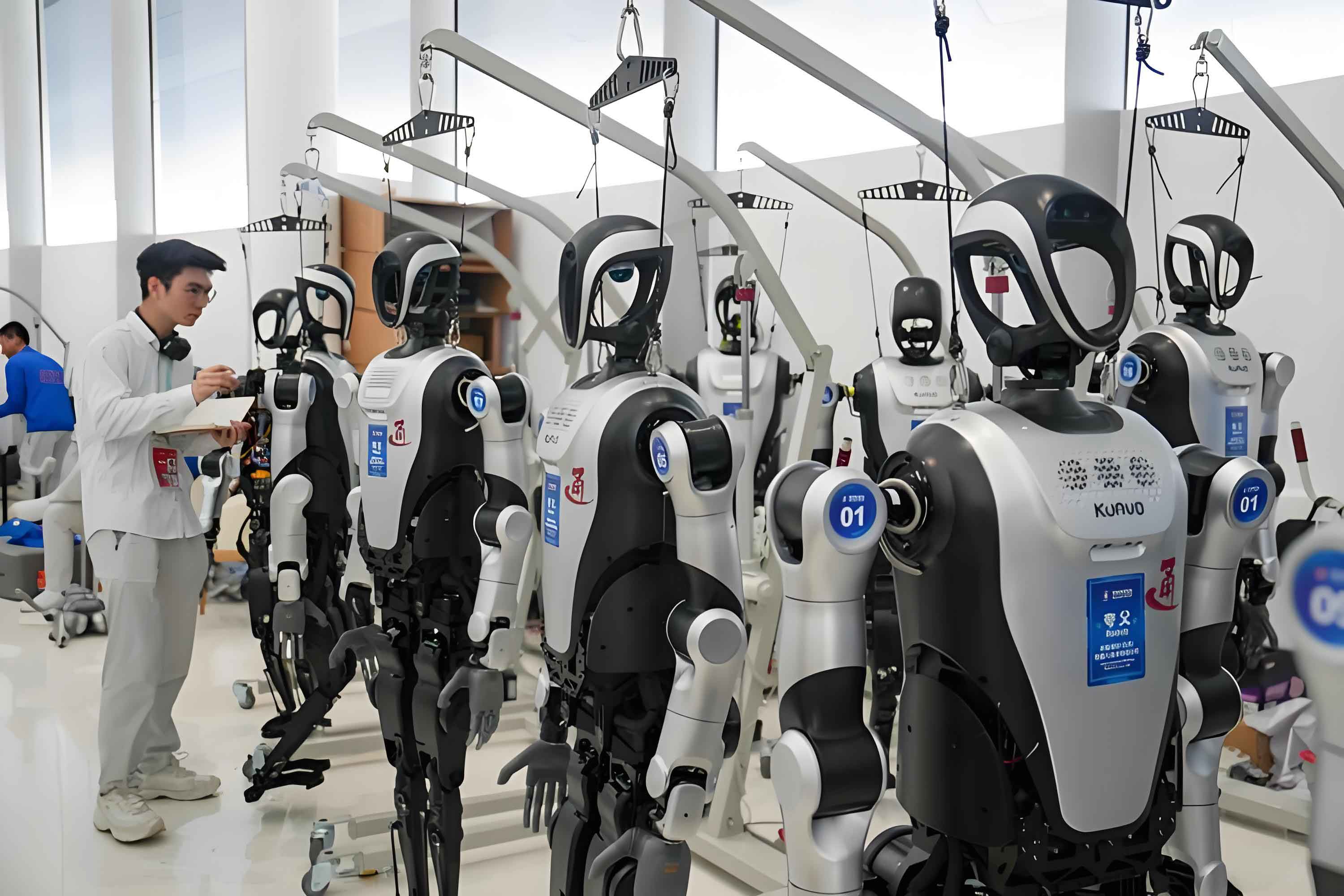
To achieve accurate posture sensing, I selected the JY901 attitude and heading reference system (AHRS), which integrates a high-precision gyroscope, accelerometer, and magnetometer. This sensor fusion provides comprehensive data on the robot’s orientation, transmitted to a control board for real-time processing. The connection setup is straightforward: the JY901 communicates via a serial interface, feeding raw sensor data into the main controller. This hardware choice is critical because relying on a single sensor type, such as an accelerometer alone, often leads to drift or inaccuracies due to noise and external disturbances. By combining multiple sensors, the system can compensate for individual shortcomings, offering a more reliable estimate of the humanoid robot’s attitude. The figure below illustrates the integration of this sensor into the robot’s control architecture, highlighting its role in capturing dynamic movements.
The mathematical foundation for attitude calculation revolves around quaternions and Euler angles. Quaternions are hypercomplex numbers that efficiently represent three-dimensional rotations, avoiding the gimbal lock issues associated with traditional Euler angles. The JY901 sensor outputs quaternion data directly, which I then process to derive Euler angles—specifically, pitch, roll, and yaw—that intuitively describe the humanoid robot’s posture. The transformation from quaternions to Euler angles involves several steps. First, consider a quaternion defined as: $$Q = q_0 + q_1 i + q_2 j + q_3 k$$ where \(q_0, q_1, q_2, q_3\) are real numbers, and \(i, j, k\) are the imaginary units. The rotation matrix from the body frame to the navigation frame, denoted as \(C_b^n\), can be expressed in terms of quaternions:
$$C_b^n = \begin{bmatrix}
q_0^2 + q_1^2 – q_2^2 – q_3^2 & 2(q_1q_2 – q_0q_3) & 2(q_1q_3 + q_0q_2) \\
2(q_1q_2 + q_0q_3) & q_0^2 – q_1^2 + q_2^2 – q_3^2 & 2(q_2q_3 – q_0q_1) \\
2(q_1q_3 – q_0q_2) & 2(q_2q_3 + q_0q_1) & q_0^2 – q_1^2 – q_2^2 + q_3^2
\end{bmatrix}$$
To obtain the inverse rotation matrix \(C_n^b\), which maps from the navigation frame to the body frame, I compute the transpose (since rotation matrices are orthogonal):
$$C_n^b = \begin{bmatrix}
q_0^2 + q_1^2 – q_2^2 – q_3^2 & 2(q_1q_2 + q_0q_3) & 2(q_1q_3 – q_0q_2) \\
2(q_1q_2 – q_0q_3) & q_0^2 – q_1^2 + q_2^2 – q_3^2 & 2(q_2q_3 + q_0q_1) \\
2(q_1q_3 + q_0q_2) & 2(q_2q_3 – q_0q_1) & q_0^2 – q_1^2 – q_2^2 + q_3^2
\end{bmatrix}$$
By comparing this with the standard Euler angle rotation matrix, I derive the pitch (\(\gamma\)), roll (\(\theta\)), and yaw (\(\phi\)) angles:
$$\gamma = \sin^{-1}(2(q_1q_3 – q_0q_2))$$
$$\theta = \tan^{-1}\left(-\frac{2(q_2q_3 + q_0q_1)}{q_0^2 – q_1^2 – q_2^2 + q_3^2}\right)$$
$$\phi = \tan^{-1}\left(\frac{2(q_1q_2 + q_0q_3)}{q_0^2 + q_1^2 – q_2^2 – q_3^2}\right)$$
These equations form the backbone of the attitude estimation algorithm. In practice, I implement this on the control board, where the quaternion data from the JY901 is continuously processed to update the Euler angles. This real-time feedback allows the humanoid robot to adjust its posture dynamically. For instance, if the roll angle exceeds a threshold, indicating a lateral tilt, the system triggers corrective actions by adjusting servo motors in the legs. This closed-loop control is essential for maintaining balance during gait cycles, especially when the humanoid robot encounters obstacles or uneven terrain.
Building on the posture control framework, I designed a humanoid robot model with 18 degrees of freedom (DOFs) to facilitate complex movements. The configuration includes 12 DOFs in the legs—6 per leg—distributed across the ankle, knee, and hip joints. Specifically, each ankle has 2 DOFs for forward and twisting motions, each knee has 1 DOF for forward flexion, and each hip has 3 DOFs for forward, lateral, and rotational movements. This arrangement mirrors human biomechanics, enabling a wide range of motions such as walking, turning, and climbing. The table below summarizes the DOF distribution for the humanoid robot, referred to as Model CCNU-1 in my experiments.
| Joint | DOFs per Leg | Total DOFs (Both Legs) | Function |
|---|---|---|---|
| Ankle | 2 | 4 | Forward flexion and twist |
| Knee | 1 | 2 | Forward flexion |
| Hip | 3 | 6 | Forward, lateral, and rotation |
| Total | 6 | 12 |
In addition to the legs, the upper body includes 6 DOFs for torso and arm movements, though this paper focuses primarily on gait. The high degree of freedom in the humanoid robot allows for nuanced control but also increases computational complexity. To manage this, I developed a gait planning algorithm that breaks down walking into discrete phases: weight shifting, leg lifting, stepping, and balancing. Each phase involves coordinated movements of multiple servos, programmed using a graphical interface where servo angles can be adjusted via sliders. For example, to shift the robot’s center of gravity to the right leg before taking a left step, I modify the servo corresponding to the hip’s lateral movement (e.g., servo 13 in the software). This gradual weight transfer mimics human walking and prevents sudden imbalances that could topple the humanoid robot.
The continuous gait design follows a systematic workflow. Initially, the humanoid robot stands upright with its center of gravity aligned vertically. Then, it enters a loop where sensor data is acquired, Euler angles are computed, and the current posture is evaluated against target conditions. If deviations are detected—say, an unwanted tilt—the control system sends commands to specific servos to correct the posture. Once stabilized, the robot proceeds to execute step sequences. The flowchart below outlines this process, emphasizing the iterative nature of posture adjustment and gait execution.
Gait Control Flowchart: Start → Acquire sensor data (quaternions) → Compute Euler angles (pitch, roll, yaw) → Compare with target posture → If mismatch, adjust servos based on error; if match, maintain posture → Execute step sequence (e.g., lift left leg, move forward) → Loop back to data acquisition. This cycle repeats throughout the walking process, enabling the humanoid robot to adapt in real-time. The servo adjustments are predefined in a lookup table, mapping posture errors to specific servo actions. For instance, a positive roll error might trigger an increase in the right hip servo angle to lean the robot leftward. This table-driven approach simplifies programming and ensures consistent performance across different terrains.
To illustrate the servo mapping, here is a table detailing the control actions for a basic forward walking gait. Each action corresponds to a phase in the step cycle, with servo numbers referencing the software interface. Note that the humanoid robot uses digital servos for precise angular control, typically operating in a range of 0 to 180 degrees.
| Gait Phase | Action Description | Servo Numbers Involved | Target Angle Adjustment |
|---|---|---|---|
| Weight shift right | Shift center of gravity to right leg | 13 (right hip lateral) | +10 degrees |
| Left leg lift | Lift left leg forward and upward | 14 (left hip forward), 16 (left knee) | +15°, +20° |
| Left leg placement | Lower left leg to ground | 14, 16 | -15°, -20° |
| Weight shift left | Shift center to left leg | 13 | -10 degrees |
| Right leg lift | Lift right leg forward | 15 (right hip forward), 17 (right knee) | +15°, +20° |
| Right leg placement | Lower right leg | 15, 17 | -15°, -20° |
Implementing this gait sequence requires careful timing and synchronization. I use a microcontroller to send pulse-width modulation (PWM) signals to the servos, with delays between actions to mimic natural walking speeds. The humanoid robot’s step length and height are adjustable parameters, allowing customization for different scenarios. For example, on rough terrain, I reduce step height to minimize instability, while on flat surfaces, I increase stride for faster locomotion. This flexibility is key to making the humanoid robot versatile. Additionally, the inertial sensor data feeds into a feedback loop: if the Euler angles indicate excessive pitching during a step, the system can abort the movement and revert to a balanced stance. This fail-safe mechanism enhances safety during experiments.
Beyond forward walking, I extended the gait design to include turning and backward movements. Turning involves differential leg movements—for a left turn, the right leg takes a larger step forward while the left leg pivots. The yaw angle from the Euler calculations guides this process: if the target heading is 30 degrees left, the control system iteratively adjusts leg servos until the desired yaw is achieved. This demonstrates how posture control and gait planning intertwine. In backward walking, the sequence reverses, with the robot shifting weight and stepping rearward. These capabilities underscore the humanoid robot’s adaptability, a critical factor for real-world deployment where navigation in confined spaces is common.
The experimental validation of this gait design was conducted in a laboratory setting, focusing on stability and repeatability. I tested the humanoid robot on various surfaces: flat floors, slight inclines, and padded mats to simulate uneven ground. Using the JY901 sensor, I logged Euler angles during walks, analyzing data for oscillations or drifts. The results showed that the quaternion-based attitude estimation maintained accuracy within ±2 degrees for pitch and roll, sufficient for stable gait. The table below summarizes key performance metrics from these tests, highlighting the humanoid robot’s responsiveness to different conditions.
| Test Condition | Average Pitch Error (degrees) | Average Roll Error (degrees) | Step Success Rate (%) | Comments |
|---|---|---|---|---|
| Flat floor | 0.5 | 0.3 | 98 | Smooth gait, minimal corrections |
| Incline (5° slope) | 1.2 | 1.0 | 95 | Increased servo adjustments needed |
| Uneven mat | 1.8 | 1.5 | 92 | Occasional stumbles, recoverable |
| Turning at 90° | 0.7 | 0.9 | 96 | Yaw control effective |
These outcomes confirm the effectiveness of the integrated system. The humanoid robot consistently maintained balance, with step success rates above 90% even on challenging surfaces. This reliability stems from the robust sensor fusion and algorithmic processing. Moreover, the experiment served as an educational tool in robotics courses, where students could modify gait parameters and observe real-time effects. By engaging with the humanoid robot’s control software, learners gained insights into kinematics, dynamics, and feedback systems—core topics in robotics engineering. This hands-on approach aligns with modern pedagogical trends, emphasizing experiential learning over passive instruction.
In terms of computational efficiency, the attitude calculation algorithm runs efficiently on embedded hardware. The quaternion to Euler conversion involves basic arithmetic operations, minimizing processor load. For a humanoid robot with 18 servos, the control loop operates at 50 Hz, providing timely updates to prevent lag-induced falls. I optimized the code by precomputing trigonometric functions and using fixed-point arithmetic where possible. This ensures that the humanoid robot can operate in real-time without external computing support, a necessity for autonomous applications. The software framework is modular, allowing easy integration of additional sensors or gait patterns. For instance, adding foot pressure sensors could enhance terrain adaptation, feeding data into the posture control loop for finer adjustments.
Looking ahead, there are several avenues for improvement. First, machine learning techniques could be incorporated to optimize gait parameters dynamically. By training a neural network on sensor data from successful walks, the humanoid robot could learn to adjust step patterns for unseen terrains. Second, enhancing the upper body coordination could improve overall stability—for example, using arm swings to counterbalance leg movements. Third, energy efficiency is a concern; optimizing servo motions to minimize power consumption would extend operational time. These ideas represent future work that builds on the current foundation. Nevertheless, the present system already offers a solid platform for research and education, demonstrating that humanoid robots can achieve stable locomotion with relatively low-cost components.
In conclusion, this paper detailed the design and implementation of gait experiments for humanoid robots, from hardware selection to algorithmic development. By leveraging inertial sensors and quaternion-based attitude estimation, I achieved precise posture control that enables dynamic balance. The 18-DOF humanoid robot model, coupled with a systematic gait planning approach, allows for versatile movements including walking, turning, and adapting to uneven surfaces. Experimental results validate the method’s effectiveness, showing high success rates and stability across diverse conditions. This work not only advances technical capabilities in humanoid robotics but also serves as a valuable educational resource, fostering hands-on learning in robotics labs. As humanoid robots continue to evolve, such integrated systems will be crucial for bridging the gap between laboratory prototypes and practical, real-world assistants.
The implications extend beyond academia. In industries like manufacturing or healthcare, humanoid robots with robust gait control could perform tasks in human-centric environments, from carrying loads to assisting the elderly. The key is reliability, and this project contributes by demonstrating a reliable framework. I encourage further exploration into sensor fusion and adaptive algorithms to push the boundaries of what humanoid robots can achieve. Ultimately, the goal is to create machines that move as naturally as humans, expanding their utility and integration into society. Through continuous experimentation and innovation, the vision of humanoid robots as everyday companions grows closer to reality.
To support reproducibility, I provide the core equations and tables in this paper. The quaternion to Euler conversion formulas are essential for anyone working with IMU data in robotics. Additionally, the servo control tables offer a practical reference for implementing gait sequences. These resources, combined with open-source software tools, can lower the barrier to entry for humanoid robot development. In educational settings, instructors can use this material to design lab exercises that cover topics from sensor calibration to gait optimization. By engaging students in the entire process—from mathematical derivation to physical implementation—we cultivate a deeper understanding of robotics principles. This holistic approach is vital for training the next generation of engineers who will drive innovation in humanoid robotics and beyond.