
The human hand, a masterpiece of biological engineering, possesses an extraordinary combination of dexterity, adaptability, and sensory feedback. Replicating these capabilities in a mechanical form, a dexterous robotic hand, represents a significant frontier in robotics with profound implications for prosthetics, industrial manipulation, and human-robot interaction. Traditional prosthetic solutions often struggle to restore the nuanced and varied grasp patterns required for activities of daily living, offering limited degrees of freedom and unreliable control. This work aims to bridge this functional gap by presenting the design and analysis of a novel, fully actuated dexterous robotic hand inspired by human anatomy and kinematics. Our primary objective is to develop a hand mechanism that moves beyond simple pinching to enable more complex and useful motions, such as stable power grasps and rhythmic tapping, thereby enhancing the functional repertoire available to users.
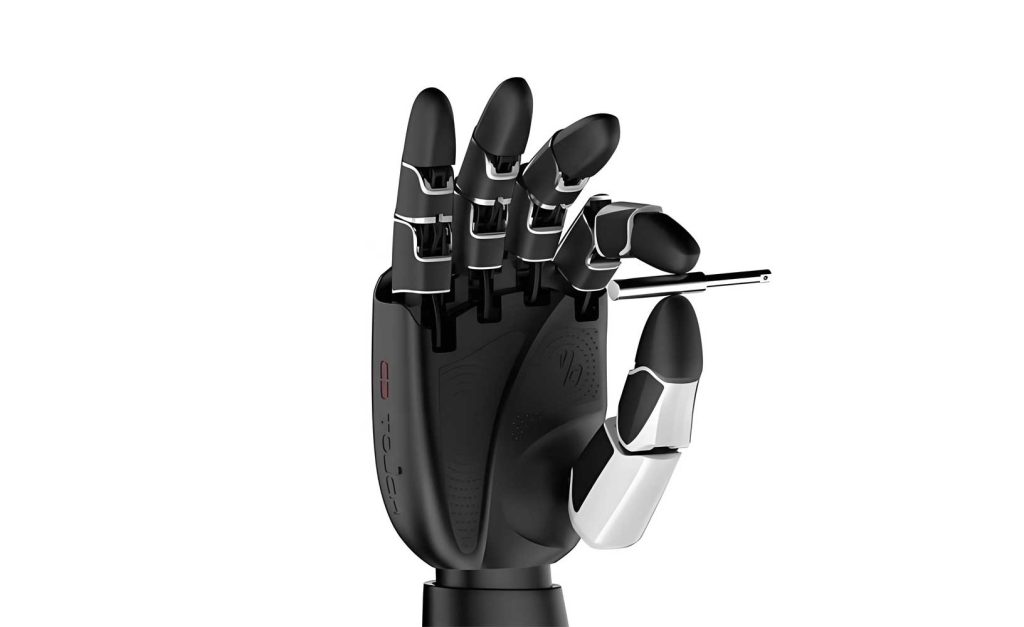
The pursuit of a functional dexterous robotic hand has been a long-standing challenge. Early prosthetic devices were often simple, single-degree-of-freedom hooks or claws. The advent of myoelectric control allowed for more intuitive operation using muscle signals from the residual limb. Subsequent research has led to sophisticated multi-fingered hands, such as the HIT/DLR series, which feature multiple actuators per finger and integrated sensing. However, many contemporary designs, particularly for prosthetics, employ underactuation—where one motor drives multiple joints through tendons or linkages. While this reduces weight and control complexity, it limits independent control of individual joints and can compromise grasp stability on irregular objects. Our design philosophy prioritizes full actuation for the critical degrees of freedom, granting superior control authority and the ability to execute a wider range of precisely defined gestures, including independent finger motion for tasks like typing or playing a musical instrument.
Finger Design and Anthropometric Data
The mechanical design of our dexterous robotic hand is fundamentally guided by the kinematics and proportions of the human hand. The hand consists of a central palm structure and five independently articulated fingers: one thumb and four identical fingers (index, middle, ring, and little). This configuration mirrors the human layout to maximize grasp versatility and object compatibility.
The four fingers share an identical kinematic structure. Each finger is composed of two primary phalangeal links, analogous to the proximal and intermediate phalanges in a human finger (the distal phalange is simplified into the second link’s tip). These two links are connected by a revolute joint, providing one degree of freedom (DOF) for flexion/extension. This joint is actively and independently driven. Furthermore, the entire finger assembly is attached to the palm via another active revolute joint, providing an additional DOF for abduction/adduction (spreading the fingers) or, in a more simplified base configuration, for flexion at the metacarpophalangeal (MCP) joint. Therefore, each of the four fingers possesses two active degrees of freedom. The thumb is designed with a similar two-link structure but is attached to the palm with a different orientation to enable opposition, a key feature for power and precision grasps. For the initial model, the thumb’s carpometacarpal (CMC) joint provides one active DOF for opposition/reposition.
To ensure the dexterous robotic hand has anthropomorphic proportions, its dimensions are based on statistical averages of human finger segment lengths. The following table presents averaged data from anthropometric studies, which directly informed the length parameters (denoted as L) of each finger link in our design.
| Finger | Segment 1 (Proximal) – L1 (mm) | Segment 2 (Intermediate) – L2 (mm) | Segment 3 (Distal)* – L3 (mm) |
|---|---|---|---|
| Index | 49.3 | 30.3 | 23.8 |
| Middle | 51.7 | 32.5 | 24.4 |
| Ring | 42.9 | 25.2 | 22.2 |
| Little | 34.5 | 24.9 | N/A |
| Thumb (Metacarpal & Proximal) | 48.3 | 38.5 | N/A |
*Note: In our current two-link finger design, the Distal segment length is conceptually integrated into the second link.
The palm is designed as a rigid, polygonal base structure that houses the actuators for the finger base joints and provides a stable mounting platform. Each finger module is designed with internal bays for micro-actuators (e.g., geared DC motors or micro servos) and transmission elements like gears or tendons. The second phalangeal link terminates in a semi-spherical fingertip to promote stable contact during grasping.
Kinematic Modeling of the Dexterous Robotic Hand
A precise kinematic model is essential for controlling the dexterous robotic hand. We employ the Denavit-Hartenberg (D-H) convention to systematically describe the geometry and motion of each finger. For brevity and clarity, we derive the kinematics for a single, representative finger of the four identical ones, as the thumb follows a similar but coordinate-transformed model.
We assign coordinate frames to each link of the finger. Frame {0} is fixed to the palm at the base of the finger. Frame {1} is attached to the first (proximal) link at its base joint. Frame {2} is attached to the second (distal) link at the interphalangeal joint. Frame {E} is assigned to the fingertip. The D-H parameters for this two-link, two-DOF finger are summarized below:
| Link i | αi-1 (twist) | ai-1 (link length) | di (offset) | θi (joint angle) |
|---|---|---|---|---|
| 1 | 0° | 0 | 0 | θ1 (variable) |
| 2 | 0° | L1 | 0 | θ2 (variable) |
Where L1 is the length of the first phalangeal link.
The homogeneous transformation matrix i-1Ti, which transforms coordinates from frame {i} to frame {i-1}, is given by the standard D-H formula:
$$ ^{i-1}T_i = \begin{bmatrix}
\cos\theta_i & -\sin\theta_i\cos\alpha_{i-1} & \sin\theta_i\sin\alpha_{i-1} & a_{i-1}\cos\theta_i \\
\sin\theta_i & \cos\theta_i\cos\alpha_{i-1} & -\cos\theta_i\sin\alpha_{i-1} & a_{i-1}\sin\theta_i \\
0 & \sin\alpha_{i-1} & \cos\alpha_{i-1} & d_i \\
0 & 0 & 0 & 1
\end{bmatrix} $$
For our parameters (αi-1=0, di=0), this simplifies to:
$$ ^{0}T_1 = \begin{bmatrix}
\cos\theta_1 & -\sin\theta_1 & 0 & 0 \\
\sin\theta_1 & \cos\theta_1 & 0 & 0 \\
0 & 0 & 1 & 0 \\
0 & 0 & 0 & 1
\end{bmatrix}, \quad ^{1}T_2 = \begin{bmatrix}
\cos\theta_2 & -\sin\theta_2 & 0 & L_1 \\
\sin\theta_2 & \cos\theta_2 & 0 & 0 \\
0 & 0 & 1 & 0 \\
0 & 0 & 0 & 1
\end{bmatrix} $$
The forward kinematics, giving the position and orientation of the fingertip (frame {E}) relative to the palm base (frame {0}), is found by consecutive multiplication. Assuming the fingertip offset from the second joint is L2 along the local x-axis:
$$ ^{0}T_E = ^{0}T_1 \cdot ^{1}T_2 \cdot ^{2}T_E = \begin{bmatrix}
\cos(\theta_1+\theta_2) & -\sin(\theta_1+\theta_2) & 0 & L_1\cos\theta_1 + L_2\cos(\theta_1+\theta_2) \\
\sin(\theta_1+\theta_2) & \cos(\theta_1+\theta_2) & 0 & L_1\sin\theta_1 + L_2\sin(\theta_1+\theta_2) \\
0 & 0 & 1 & 0 \\
0 & 0 & 0 & 1
\end{bmatrix} $$
From this matrix, we can extract the crucial forward kinematic equations that define the dexterous robotic hand finger’s endpoint position (x, y) in the plane of motion and its orientation φ:
$$ x = L_1 \cos\theta_1 + L_2 \cos(\theta_1 + \theta_2) $$
$$ y = L_1 \sin\theta_1 + L_2 \sin(\theta_1 + \theta_2) $$
$$ \phi = \theta_1 + \theta_2 $$
The velocity kinematics are described by the geometric Jacobian matrix J, which maps joint velocities ( \dot{\theta}_1, \dot{\theta}_2 ) to the Cartesian fingertip linear velocity ( \dot{x}, \dot{y} ) and angular velocity \dot{\phi}. For this planar finger:
$$ \begin{bmatrix} \dot{x} \\ \dot{y} \\ \dot{\phi} \end{bmatrix} = \mathbf{J} \begin{bmatrix} \dot{\theta}_1 \\ \dot{\theta}_2 \end{bmatrix} = \begin{bmatrix}
-L_1 \sin\theta_1 – L_2 \sin(\theta_1+\theta_2) & -L_2 \sin(\theta_1+\theta_2) \\
L_1 \cos\theta_1 + L_2 \cos(\theta_1+\theta_2) & L_2 \cos(\theta_1+\theta_2) \\
1 & 1
\end{bmatrix} \begin{bmatrix} \dot{\theta}_1 \\ \dot{\theta}_2 \end{bmatrix} $$
This Jacobian is fundamental for force control, singularity analysis, and trajectory planning of the dexterous robotic hand. The dynamics of the finger, governing the relationship between joint torques τ, positions θ, and velocities \dot{θ}, can be derived using the Euler-Lagrange formulation. The dynamic equation has the standard form:
$$ \boldsymbol{\tau} = \mathbf{M}(\boldsymbol{\theta})\ddot{\boldsymbol{\theta}} + \mathbf{C}(\boldsymbol{\theta}, \dot{\boldsymbol{\theta}})\dot{\boldsymbol{\theta}} + \mathbf{G}(\boldsymbol{\theta}) $$
where M is the mass/inertia matrix, C is the Coriolis and centrifugal matrix, and G is the gravity vector. Accurate modeling of these terms is crucial for high-performance, model-based control of the dexterous robotic hand.
Functional Simulation and Analysis
To validate the design and kinematic model of the dexterous robotic hand, a detailed multi-body dynamics simulation was performed. The simulation environment models the hand as a system of rigid links connected by ideal revolute joints, with actuators modeled as ideal torque sources. The primary goals were to demonstrate two key functional modes: adaptive grasping and rhythmic tapping.
1. Adaptive Power Grasp Simulation:
This test simulates the hand enveloping a cylindrical object. All four fingers and the thumb are coordinated. The base joint of each finger is commanded to flex to a predetermined position to wrap around the object’s curvature. Subsequently, the distal joints of each finger are independently driven to close upon the object surface, ensuring a stable, form-closed grip. The simulation confirms that the fully actuated design allows each finger segment to make contact independently, distributing contact forces and preventing object slip, a significant advantage over many underactuated designs. The independent control of the thumb’s opposition joint is critical for completing the enveloping grasp and providing counter-force.
2. Rhythmic Tapping Simulation:
This test demonstrates the ability of the dexterous robotic hand to perform fine, rhythmic motions, such as typing or drumming fingers. A single finger (e.g., the index) is actuated in a specific pattern. The base joint (θ1) is driven with a harmonic motion profile, while the distal joint (θ2) is held at a fixed, slightly flexed angle relative to the first link. This creates a tapping motion where the fingertip trajectory is an arc. The simulation parameters for a sample tap sequence are outlined below:
| Joint | Motion Type | Amplitude / Position | Frequency (Hz) |
|---|---|---|---|
| Base Joint (θ1) | Harmonic Oscillation | ±30° from neutral | 2.0 |
| Distal Joint (θ2) | Fixed Position | 45° (flexed) | N/A |
The simulation successfully shows the periodic, controlled motion of the fingertip. The ability to independently control the phase and amplitude of different fingers would allow for complex rhythmic patterns, showcasing the dexterity potential of this dexterous robotic hand architecture.
Conclusion
This work presented the comprehensive design, kinematic analysis, and functional simulation of a biologically inspired dexterous robotic hand. The five-fingered, fully actuated design prioritizes independent joint control to achieve a broader spectrum of grasp types and non-prehensile manipulations compared to conventional underactuated prosthetics. The finger dimensions were derived from anthropometric data to ensure an ergonomic and functional form factor. A detailed kinematic model was established using the D-H convention, providing the essential mathematical foundation for position, velocity, and dynamic analysis. Forward kinematic equations and the manipulator Jacobian were explicitly derived, which are critical for subsequent control algorithm development.
Simulation studies validated two core functional paradigms: stable, adaptive grasping and fine, rhythmic tapping. These results demonstrate that the proposed dexterous robotic hand mechanism can fulfill fundamental activities of daily living while also offering the potential for more nuanced tasks. The fully actuated scheme, while potentially more complex in terms of actuator count and control, provides a level of deliberate motion control that is essential for advanced prosthetic applications and general-purpose robotic manipulation. Future work will focus on the detailed mechanical design of the actuator housing and transmission system, the implementation of tactile sensing at the fingertips, and the development of robust control strategies that leverage the complete kinematic and dynamic models presented here to bring this dexterous robotic hand concept to physical reality.