
As an engineer deeply immersed in the field of precision mechanics, I have always been fascinated by the elegant principles and remarkable capabilities of strain wave gear systems. Often referred to as harmonic drives, these mechanisms represent a paradigm shift in power transmission, offering solutions where conventional gears fall short. In this comprehensive exploration, I will delve into the fundamental principles, distinctive characteristics, technological evolution, and future prospects of strain wave gear transmission. My aim is to provide a detailed, first-person account that leverages mathematical formulations and comparative tables to elucidate this sophisticated technology. The core term, ‘strain wave gear’, will be frequently emphasized to underscore its centrality in this discourse.
The fundamental allure of the strain wave gear lies in its ingenious use of controlled elastic deformation. Unlike traditional rigid-body gear trains, a strain wave gear system operates by generating a traveling wave of deflection in a flexible component. This simple yet profound concept enables exceptional performance metrics. The system typically comprises three primary elements: the wave generator (H), the flexspline (a thin-walled, flexible external gear with slight deflection), and the circular spline (a rigid internal gear). When assembled, the wave generator, often an elliptical cam or a set of bearings on an eccentric, is inserted into the flexspline, forcing it into a non-circular, elliptical shape. This deformation causes the teeth of the flexspline to engage with those of the circular spline at two diametrically opposite regions along the major axis, while disengaging at the minor axis. As the wave generator rotates, the locus of engagement travels circumferentially, creating a relative motion between the flexspline and the circular spline.
To quantify this motion, let’s establish the kinematic relationships. Let \( Z_f \) be the number of teeth on the flexspline and \( Z_c \) be the number of teeth on the circular spline. The key to the strain wave gear’s high reduction ratio is the tooth difference. For the most common configuration, \( Z_c – Z_f = 2N \), where \( N \) is the wave number (typically \( N=2 \) for a double-wave generator). The basic speed reduction ratio, \( i \), when the circular spline is fixed, the wave generator is input, and the flexspline is output, is given by:
$$ i = -\frac{Z_f}{Z_c – Z_f} = -\frac{Z_f}{2N} $$
The negative sign indicates reversal of rotation direction. Conversely, if the flexspline is fixed and the circular spline is output, the ratio becomes:
$$ i = +\frac{Z_c}{Z_c – Z_f} = +\frac{Z_c}{2N} $$
These formulas reveal the inherent capability for high single-stage reduction ratios from 50:1 to over 300:1, a hallmark of strain wave gear design.
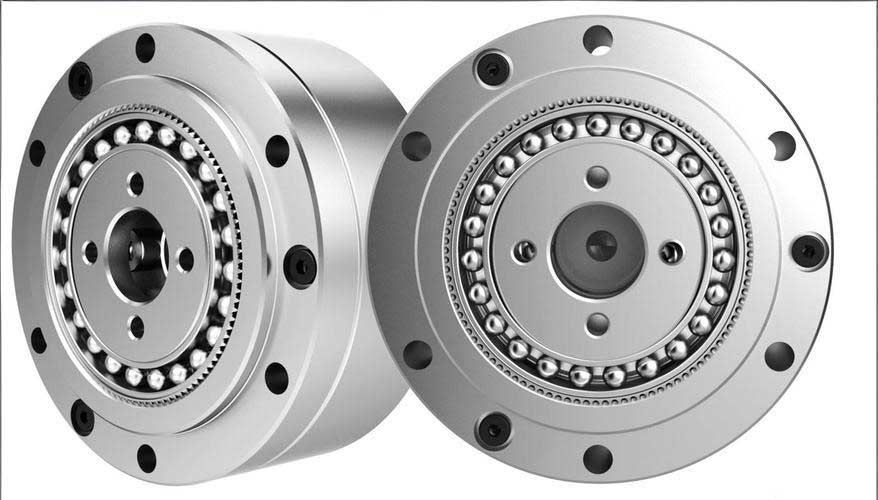
The deformation of the flexspline is not a simple elliptical shape but can be described more precisely by a harmonic function. For a double-wave strain wave gear, the radial displacement \( w(\theta, t) \) of the flexspline’s neutral surface from its original circular position can be modeled as a traveling wave:
$$ w(\theta, t) = w_0 \cos(N\theta – \omega_h t) $$
where \( w_0 \) is the amplitude of deformation (controlled by the wave generator’s eccentricity), \( \theta \) is the angular coordinate, \( \omega_h \) is the angular velocity of the wave generator, and \( t \) is time. This equation highlights the ‘wave’ in strain wave gear, a continuous harmonic strain wave propagating through the flexible component. The engagement mechanics can be further analyzed using conjugate action theory. The condition for continuous contact between the flexspline and circular spline teeth, considering the deflection, leads to specific tooth profile requirements. Common profiles include the S-shaped tooth or the recently developed conjugate arc profiles. The transmission error \( \Delta \phi \) can be minimized by optimizing the profile geometry, a critical aspect for high-precision strain wave gear applications.
The stress state within the flexspline is paramount for reliability. As a thin-walled cylinder undergoing cyclic elastic deformation, it experiences complex stress concentrations. Using thick-walled cylinder theory and superposition of loading states, the principal stresses can be approximated. For a flexspline with mean radius \( R_m \), wall thickness \( h \), and deformation amplitude \( w_0 \), the maximum circumferential bending stress \( \sigma_\theta \) near the major axis is proportional to:
$$ \sigma_\theta \propto E \frac{w_0}{R_m^2} h $$
where \( E \) is the Young’s modulus of the flexspline material. Finite Element Analysis (FEA) is indispensable for detailed stress analysis, especially at the tooth root and the critical stress relief groove. The fatigue life \( N_f \) of the strain wave gear flexspline under alternating stress \( \sigma_a \) is often governed by an S-N curve relation:
$$ \sigma_a = \sigma_f’ (2N_f)^b $$
where \( \sigma_f’ \) is the fatigue strength coefficient and \( b \) is the fatigue strength exponent. Material selection, typically high-strength alloy steels like 30CrMnSiA or maraging steel, and advanced surface treatments like nitriding are crucial to enhance \( \sigma_f’ \) and ensure longevity.
| Feature | Strain Wave Gear | Planetary Gear | Spur Gear Pair |
|---|---|---|---|
| Single-Stage Reduction Ratio Range | 50 to 320+ | 3 to 12 | 1 to 10 |
| Backlash (typical, arc-min) | < 1 (can be near zero) | 3 – 10 | 5 – 15 |
| Torque-to-Weight Ratio | Very High | High | Moderate |
| Simultaneous Tooth Engagement | ~30% of total teeth | 3-6 teeth (depends on planets) | 1-2 teeth |
| Kinematic Error (Positioning Accuracy) | Very Low (< 1 arc-min) | Moderate | Lower (depends on quality) |
| Efficiency (at rated torque) | 80% – 90% | 85% – 97% | 95% – 98% |
| Overload Capacity | Good (limited by flexspline fatigue) | Excellent | Good |
| Noise & Vibration | Very Low | Moderate | Can be High |
From my design experience, the advantages of strain wave gear systems are multifaceted and compelling. The compactness and high reduction ratio stem directly from the kinematic principle. A single-stage strain wave gear can replace a multi-stage planetary or worm gear train, drastically saving space and weight – a critical factor in aerospace and robotics. The high positional accuracy and low backlash, often configurable to near-zero levels, arise from the multi-tooth engagement; with 30% or more of the teeth in contact at any time, errors average out. This makes the strain wave gear an ideal candidate for servo systems in CNC machines and telescopes. The coaxial input-output configuration simplifies mechanical layout. Furthermore, the hermetic sealing capability is inherent because the motion is transmitted via a sealed flexible diaphragm, allowing operation in vacuum or contaminated environments without external seals. The strain wave gear also exhibits remarkable torsional stiffness, though slightly lower than equivalent-sized planetary gears due to the flexspline’s compliance, which is a necessary trade-off for its function.
The application spectrum of strain wave gear technology is vast and growing. In my work, I have seen strain wave gear reducers become the de facto standard for robotic joint actuators. Their compact high torque, zero-backlash performance, and high stiffness are perfect for precise, dynamic motion. In aerospace, strain wave gear mechanisms are used in satellite antenna pointing systems, solar array drives, and even in actuator systems for aircraft control surfaces. The ability to transmit motion into sealed compartments is invaluable in chemical processing or underwater equipment. Medical robotics leverages the smooth, precise motion of strain wave gears for surgical assistants. High-precision manufacturing equipment, such as wafer steppers and coordinate measuring machines, utilize strain wave gear drives for nanometer-level positioning.
The historical development of strain wave gear technology is a testament to sustained innovation. The fundamental patent was filed in the late 1950s. Since then, intensive research has focused on several fronts. Tooth geometry optimization has evolved from simple involute profiles to specialized conjugate profiles that minimize sliding friction and wear, thereby improving the efficiency and torque capacity of the strain wave gear. Material science has played a pivotal role; advanced alloys and composites are being explored for flexsplines to push the boundaries of power density and fatigue life. Manufacturing processes, particularly for the critical flexspline, have seen advances from traditional hobbing and shaping to sophisticated skiving and electrochemical machining to achieve the required precision and surface integrity. Dynamic modeling has progressed from simple linear torsional models to complex nonlinear models incorporating time-varying mesh stiffness, damping, and hysteresis losses inherent in the strain wave gear system. A simplified equation of motion for a single-degree-of-freedom model connecting input (wave generator) inertia \( J_h \) to output (flexspline) inertia \( J_f \) can be written as:
$$ J_h \ddot{\theta}_h + c_h \dot{\theta}_h + T_m(\theta_h, \theta_f, \dot{\theta}_h, \dot{\theta}_f) = T_{in} $$
$$ J_f \ddot{\theta}_f + c_f \dot{\theta}_f – i^{-1} T_m(\theta_h, \theta_f, \dot{\theta}_h, \dot{\theta}_f) = -T_{out} $$
where \( T_m \) is the nonlinear mesh torque function dependent on the relative displacement and velocity, encapsulating the elastic deformation and contact mechanics of the strain wave gear teeth.
| Size Designation | Rated Output Torque (Nm) | Max Momentary Torque (Nm) | Reduction Ratio (i) | Weight (kg) | Torsional Stiffness (Nm/arc-min) |
|---|---|---|---|---|---|
| CSF-14 | 8 | 24 | 50, 80, 100, 120, 160 | 0.15 | 5.9 |
| CSF-32 | 98 | 294 | 50, 80, 100, 120, 160 | 1.6 | 49 |
| CSF-100 | 980 | 2940 | 50, 80, 100, 120, 160 | 18.5 | 245 |
| Custom High-Torque | 5000+ | 15000+ | Custom (50-300) | ~100 | 1000+ |
Despite these advances, challenges remain in pushing the boundaries of strain wave gear technology. Thermal management under high continuous torque is a concern due to hysteresis and sliding friction losses concentrated in the flexspline. Developing accurate lifetime prediction models that account for complex multi-axial stress states and variable loading is an ongoing research area. The quest for higher power density drives the exploration of new materials like carbon fiber reinforced composites for the flexspline, though their manufacturability and long-term fatigue behavior require extensive study. Another frontier is the development of miniaturized strain wave gear systems for micro-robotics and medical devices, where precision manufacturing at micro-scales poses significant hurdles. Furthermore, the integration of strain wave gear reducers with direct-drive motors and advanced sensors for smart, condition-monitoring actuators is a growing trend, creating integrated mechatronic systems.
From a design optimization perspective, the strain wave gear presents a multi-objective problem. Key design variables include wave generator eccentricity \( e \) (which relates to \( w_0 \)), flexspline wall thickness \( h \), tooth module \( m \), and profile parameters. Objectives often include maximizing torsional stiffness \( K_t \), minimizing weight \( W \), and maximizing fatigue life \( N_f \), subject to constraints on stress \( \sigma \leq \sigma_{allow} \), geometry, and manufacturability. This can be formulated as:
$$ \text{Find } \mathbf{x} = [e, h, m, \ldots] $$
$$ \text{Minimize } f_1(\mathbf{x}) = -K_t(\mathbf{x}), \quad f_2(\mathbf{x}) = W(\mathbf{x}), \quad f_3(\mathbf{x}) = -N_f(\mathbf{x}) $$
$$ \text{Subject to } g_1(\mathbf{x}) = \sigma_{max}(\mathbf{x}) – \sigma_{allow} \leq 0, \quad g_2(\mathbf{x}) \ldots $$
Computational tools like Finite Element Analysis (FEA) and multi-objective genetic algorithms are indispensable for navigating this complex design space for an optimal strain wave gear.
Looking ahead, the future of strain wave gear technology is intertwined with the evolution of robotics, aerospace, and high-precision automation. The demand for lighter, stronger, and more efficient strain wave gear reducers will continue to drive material and process innovation. Digital twin technology, where a virtual replica of the strain wave gear system simulates performance under various operating conditions, will enhance predictive maintenance and design validation. Additive manufacturing (3D printing) holds promise for creating complex, topology-optimized flexspline structures that were previously impossible to machine, potentially revolutionizing strain wave gear design. Furthermore, research into alternative wave generation methods, such as piezoelectric actuators for ultra-precise micro-motion, could open new application domains for the core strain wave gear principle.
In conclusion, my immersion in the world of strain wave gear transmission has convinced me of its transformative potential. From its elegant kinematic principle rooted in controlled elasticity to its impressive performance metrics and wide-ranging applications, the strain wave gear stands as a pinnacle of mechanical innovation. While challenges in modeling, materials, and manufacturing persist, the relentless pace of research and development promises even more capable and versatile strain wave gear systems in the years to come. For any engineer seeking compact, precise, and reliable motion control solutions, a deep understanding of the strain wave gear is not just beneficial—it is essential.