
In modern agriculture, the mechanization of harvesting processes is crucial for improving efficiency and addressing labor shortages. For premium tea, which requires selective picking of tender buds, traditional methods rely heavily on manual labor, leading to challenges during peak seasons. To tackle this, we focus on developing an advanced end effector for tea harvesting robots. This end effector is designed to overcome the interference from tea stems during lateral bud picking, utilizing a split-cutter mechanism that adapts through blade tooth deformation. In this article, I will detail the design, simulation, optimization, and experimental validation of this end effector, emphasizing key parameters and performance metrics. The goal is to create a reliable end effector that enhances harvesting success rates for both terminal and lateral buds.
The harvesting of premium tea involves precise selection of one-bud-two-leaf shoots, where terminal buds are at the top of stems and lateral buds grow along the sides. Manual picking is time-consuming and labor-intensive, prompting the need for robotic solutions. The end effector, as the critical component of a harvesting robot, must perform cutting actions while navigating complex tea garden environments. Existing end effector designs often fail to harvest lateral buds due to stem interference, as rigid cutters cannot adapt to obstacles. Our approach introduces a split-cutter end effector that allows blade teeth to bend under stem pressure, enabling lateral bud harvesting without compromising terminal bud performance. This innovation addresses a significant gap in tea harvesting robotics, and we explore its optimization through systematic experiments.
To inform the design, we first measured geometric and physical parameters of tea shoots and stems. For tea shoots, including terminal and lateral buds, we collected data on stem diameter, internode distance, and growth angles. For tea stems, we measured diameter and mechanical properties. These parameters are essential for ensuring the end effector can handle natural variations in tea plants. The measurements were conducted using precision tools, and results are summarized in the following table, which provides average values and standard deviations to guide our design specifications.
| Parameter | Maximum | Minimum | Average | Standard Deviation |
|---|---|---|---|---|
| Stem Diameter (mm) | 2.30 | 1.80 | 2.00 | 0.13 |
| Internode Distance (mm) | 13.00 | 8.00 | 8.60 | 2.33 |
| Growth Angle (°) | 30.00 | 14.00 | 26.40 | 6.25 |
| Stem Diameter (mm) | 3.20 | 2.80 | 3.02 | 0.12 |
Physical parameters, such as shear force and elastic modulus, were measured using universal testing machines. The shear force for tea stems averaged 2.89 N, while for tea stems, it was 10.70 N. The elastic modulus for tea stems was 2.55 MPa, and for tea stems, it was 58.67 MPa. Density measurements showed tea shoots at 804.6 kg/m³ and tea stems at 931.15 kg/m³. These values inform the material interactions in our finite element simulations. The elastic modulus is calculated using the formula:
$$ E = \frac{F L}{\Delta L A} $$
where \( E \) is the elastic modulus, \( F \) is the applied force, \( L \) is the original length, \( \Delta L \) is the deformation length, and \( A \) is the cross-sectional area. This formula helps us model the mechanical behavior during cutting. Density is derived from:
$$ \rho = \frac{m}{V_2 – V_1} $$
where \( \rho \) is density, \( m \) is mass, and \( V_1 \) and \( V_2 \) are volumes before and after immersion, respectively. These parameters ensure our simulations reflect real-world conditions.
Based on these measurements, we designed the end effector with a focus on lightweight and integrated components. The end effector includes a servo motor, linkage transmission, cutting mechanism, and a vacuum tube for collection. The servo motor provides torque for cutting, with specifications of 1.7 N·m torque and 6.5 rad/s angular velocity. The linkage mechanism converts rotational motion into linear movement of the cutters, using aluminum parts for reduced weight. The cutting mechanism features a split-cutter on one side and a solid cutter on the other. The split-cutter is created via wire cutting, with teeth that can bend when encountering tea stems, allowing the end effector to harvest lateral buds without jamming. This design enables the end effector to perform top-down harvesting, minimizing interference from surrounding foliage.
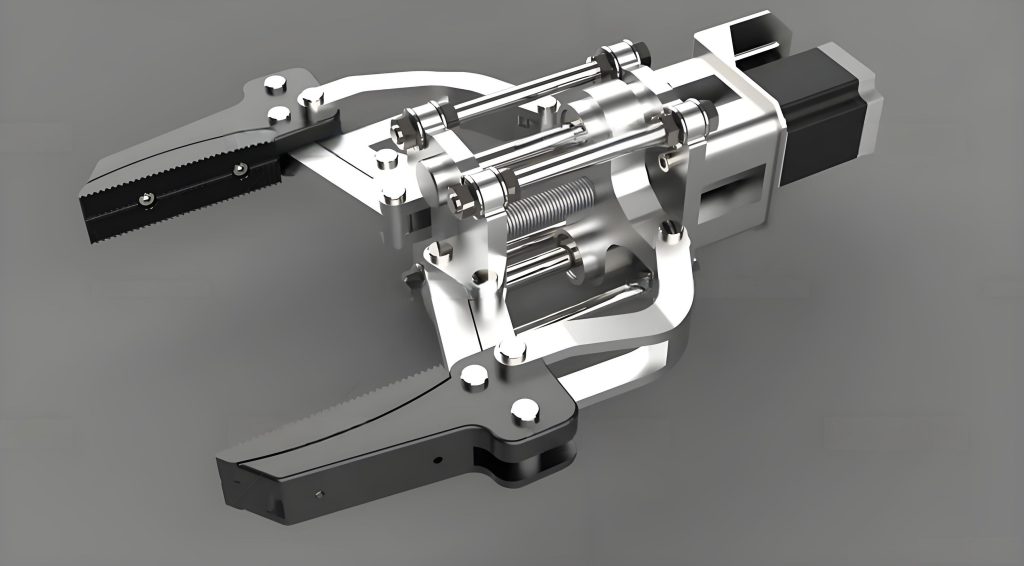
The split-cutter works by deforming its teeth upon stem contact, while the solid cutter remains rigid. This adaptability is key for lateral bud harvesting, as the end effector can navigate around stems. For terminal buds, the end effector operates without deformation, as stems are absent. The cutting action is driven by the servo motor through a linkage system that ensures synchronized movement. We optimized the linkage geometry to achieve a 30° rotation from initial to cutting position, maximizing force transmission. The end effector’s vacuum tube aids in collecting harvested shoots, improving efficiency. This design represents a significant advancement in end effector technology for selective harvesting.
To analyze the cutting process, we conducted finite element simulations using ANSYS software. These simulations model the interaction between the cutters and tea stems, focusing on stress distribution and deformation. We built 3D models of the end effector cutting terminal and lateral buds, incorporating material properties from our measurements. For lateral buds, we included tea stems to account for interference. Assumptions included zero initial stress and constant environmental conditions. The simulations used contact erosion control to handle element failure during cutting, with mesh refinement in contact areas for accuracy. Gravity was included to mimic real-world conditions.
The simulation results show that during lateral bud harvesting, the split-cutter teeth experience bending deformation when contacting tea stems. The maximum stress occurs at the tooth roots, propagating as stress waves. The tea stem undergoes elastic deformation initially, followed by yield and fracture as cutting progresses. The equivalent stress on the tea stem increases until failure, with the stem bending slightly. For the split-cutter, stress concentrates at the bending points, but the design prevents permanent damage. The solid cutter shows stress near the blade edge. These insights validate the end effector’s ability to harvest lateral buds through adaptive deformation. The success of harvesting depends on parameters like tooth width, length, and thickness, which we explore further.
From the simulations, we identified key factors affecting harvesting success: cutter tooth width \( d \), cutter tooth length \( l \), and cutter thickness \( b \). Tooth width must satisfy \( D_0 \leq d \leq D \), where \( D_0 \) is stem diameter and \( D \) is stem diameter, to ensure complete cutting without interference. Tooth length influences bending deflection, calculated as:
$$ w_b = -\frac{F_1 l^3}{3 E_1 I} $$
where \( w_b \) is deflection, \( F_1 \) is stem reaction force, \( E_1 \) is cutter elastic modulus, and \( I \) is moment of inertia. Longer teeth increase deflection, aiding adaptation but reducing rigidity. Cutter thickness affects the section modulus \( W \), given by:
$$ W = \frac{b d^2}{6} $$
which impacts bending resistance. Thinner cutters bend more easily but may lack strength. We derived parameter ranges: \( d \) from 2.3 to 3.1 mm, \( l \) from 20 to 26 mm, and \( b \) from 0.5 to 0.9 mm, based on simulation outcomes.
To optimize these parameters, we performed a Box-Behnken design with three factors and three levels. The factors were coded for analysis, as shown in the table below.
| Code | Tooth Width \( d \) (mm) | Cutter Thickness \( b \) (mm) | Tooth Length \( l \) (mm) |
|---|---|---|---|
| 1 | 3.1 | 0.9 | 26.0 |
| 0 | 2.7 | 0.7 | 23.0 |
| -1 | 2.3 | 0.5 | 20.0 |
We conducted harvesting experiments for both terminal and lateral buds, with 20 shoots per test and three repetitions. Success rates were recorded as the percentage of successfully cut shoots. The experimental results are summarized in the following table, showing variations based on parameter combinations.
| Run | \( d \) (mm) | \( b \) (mm) | \( l \) (mm) | Terminal Bud Success (%) | Lateral Bud Success (%) |
|---|---|---|---|---|---|
| 1 | 2.3 | 0.7 | 26.0 | 90 | 40 |
| 2 | 3.1 | 0.7 | 26.0 | 72 | 43 |
| 3 | 2.3 | 0.5 | 23.0 | 93 | 50 |
| 4 | 2.7 | 0.7 | 23.0 | 78 | 47 |
| 5 | 2.7 | 0.5 | 20.0 | 90 | 50 |
| 6 | 2.3 | 0.7 | 20.0 | 88 | 37 |
| 7 | 3.1 | 0.9 | 23.0 | 60 | 23 |
| 8 | 2.7 | 0.5 | 26.0 | 93 | 60 |
| 9 | 3.1 | 0.5 | 23.0 | 90 | 57 |
| 10 | 2.7 | 0.9 | 20.0 | 63 | 37 |
| 11 | 2.7 | 0.7 | 23.0 | 82 | 47 |
| 12 | 2.3 | 0.9 | 23.0 | 67 | 28 |
| 13 | 3.1 | 0.7 | 20.0 | 73 | 42 |
| 14 | 2.7 | 0.9 | 26.0 | 60 | 27 |
| 15 | 2.7 | 0.7 | 23.0 | 80 | 43 |
Using response surface methodology, we developed regression models for harvesting success rates. For terminal buds, the model was linear, with the equation:
$$ \phi_1 = 78.67 – 5.42A – 14.58B + 0.0013C $$
where \( \phi_1 \) is terminal bud success rate, and \( A \), \( B \), and \( C \) are coded factors for tooth width, cutter thickness, and tooth length, respectively. The model showed significance with \( P < 0.05 \), and the lack of fit was not significant. The factors’ influence order was cutter thickness, tooth width, then tooth length. For lateral buds, a quadratic model was fitted:
$$ \phi_2 = 45.56 + 1.25A – 12.71B + 0.6237C – 2.92AB – 0.4175AC – 5.00BC – 4.45A^2 – 1.53B^2 – 0.6933C^2 $$
where \( \phi_2 \) is lateral bud success rate. This model was also significant, with interactions between factors affecting success. The influence order was cutter thickness, tooth width, then tooth length, with interaction effects between tooth width and length, and tooth length and thickness being notable. The model’s determination coefficient \( R^2 \) was 0.9839, indicating good fit.
We analyzed response surfaces to understand factor interactions. For lateral buds, when tooth width is fixed at 2.7 mm, success rate increases with cutter thickness at shorter tooth lengths but decreases at longer lengths. At constant cutter thickness, success rate decreases with increasing tooth length, due to excessive bending. When cutter thickness is 0.7 mm, success rate peaks at moderate tooth widths and decreases with longer teeth. These insights guided our optimization.
To maximize success rates, we used optimization tools, targeting high values for both terminal and lateral buds. The optimal parameters were found to be: tooth width \( d = 2.63 \) mm, cutter thickness \( b = 0.90 \) mm, and tooth length \( l = 20.03 \) mm, with predicted success rates of 94% for terminal buds and 60% for lateral buds. We simplified these to \( d = 2.6 \) mm, \( b = 0.9 \) mm, and \( l = 20.0 \) mm for practical fabrication.
We validated the optimized end effector through field tests in a tea garden. The end effector was integrated into a robotic system with a binocular camera, robotic arm, and control unit. The system identified tea shoots using deep learning, positioned the end effector, and performed cutting with vacuum collection. Tests involved multiple repetitions, and success rates were averaged. Results showed terminal bud success at 93% and lateral bud success at 63%, with relative errors below 5% compared to predictions, confirming model reliability.
The end effector demonstrated robust performance in real-world conditions. The split-cutter design effectively adapted to stem interference, allowing lateral bud harvesting where previous end effector designs failed. The optimization process, combining finite element analysis and response surface methodology, proved effective for parameter tuning. This end effector contributes to advancing agricultural robotics, particularly for selective harvesting tasks. Future work could explore automation of the entire harvesting cycle, including real-time adjustment of cutting parameters based on plant variability.
In conclusion, we developed a split-cutter end effector for premium tea harvesting, addressing lateral bud picking challenges. Through parameter measurement, simulation, and experimental optimization, we achieved high success rates. The end effector’s design highlights the importance of adaptive mechanisms in robotic harvesting. This research paves the way for more efficient and reliable end effector solutions in agriculture, reducing labor dependence and improving productivity.