
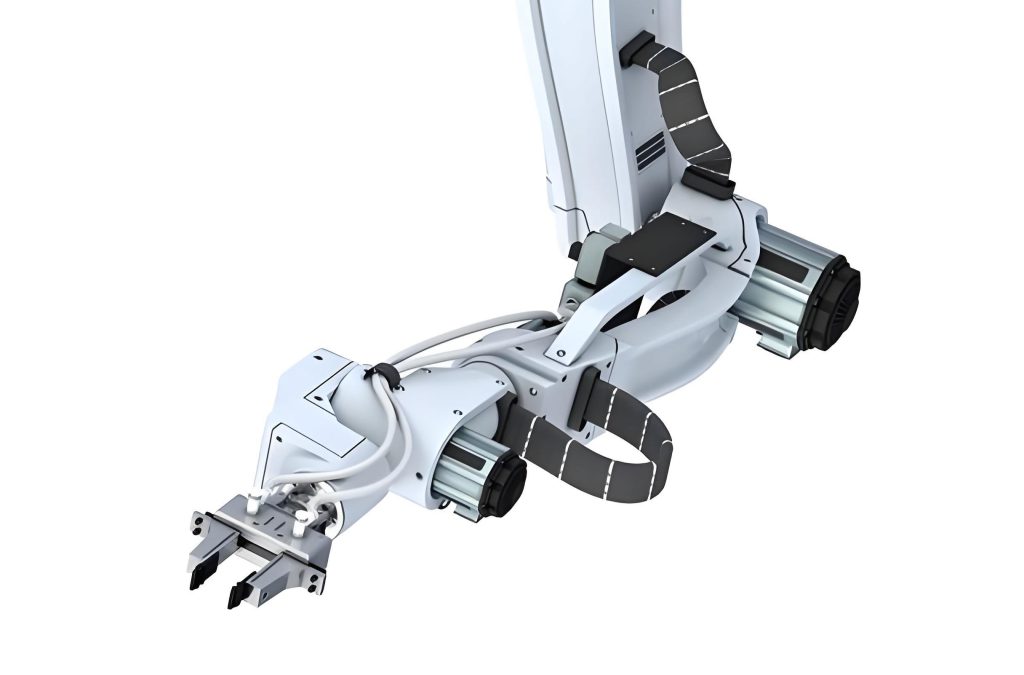
In the context of large-scale space facility construction, such as space telescopes, solar power stations, and antennas, on-orbit assembly has become a critical technology due to limitations in rocket launch mass, volume, and payload constraints. Traditional methods relying on astronauts are costly and risky, prompting the development of space robotic systems for safer, more economical, and high-precision tasks. The end effector, as a crucial component of space robots, plays an indispensable role in module manipulation, on-orbit climbing, environmental exploration, and other missions. To address the demands of on-orbit construction, we designed an end effector and three adaptation interfaces for multi-branch space robots, enabling tasks like recognition, positioning, capture, transport, assembly, climbing, and detection. This article presents the design process, including requirements analysis, mechanical and electrical system planning, tolerance and locking mechanism optimization, and verification through simulations and ground tests.
Our work focuses on developing a standardized interface system that ensures reliability, flexibility, and cost-effectiveness. The end effector incorporates vision systems, lighting, and modular interfaces, while the adaptation interfaces include active, passive, and lightweight variants to reduce system mass and complexity. By employing heteronomous and 90° rotationally symmetric designs, we enhance docking flexibility and promote interface standardization. Below, we outline the design specifications, detailed schemes, and validation results, emphasizing the use of formulas and tables to summarize key parameters and performance metrics.
Design Specifications
Based on the requirements of on-orbit construction tasks, we derived design indicators from assembly object parameters and robot performance. For instance, reference projects like OPIIX, ALMOST, and MoDEST involve module diameters around 0.3–0.5 m, and robots like KUKA LBR iiwa14 have repeatability of ±0.01 mm. Considering overload conditions and visual recognition accuracy, we established the following specifications:
| Design Parameter | Value | Design Parameter | Value |
|---|---|---|---|
| End Effector Size | < φ200 mm × 80 mm | Adaptation Interface Size | < φ100 mm × 80 mm |
| End Effector Mass | < 3 kg | Adaptation Interface Mass | < 1 kg |
| Radial Distance Tolerance | ±10 mm | Axial Rotation Tolerance | ±10° |
| Axial Load Capacity | 1000 N |
These indicators ensure that the end effector can handle misalignments during docking, support substantial loads, and maintain compactness for integration with space robots.
End Effector Overall Scheme
The end effector features a centralized standardized interface for docking and locking with adaptation interfaces, providing mechanical connection, power transfer, data communication, and other functions. On both sides of the interface, we installed Intel Realsense D405 cameras to capture color and depth images, enhancing detection capabilities and recognition accuracy. Additionally, integrated light sources enable operation in low-light conditions. The standardized interface internally consists of docking, locking, electrical connection, and control modules. The docking module corrects misalignments and transfers loads, while the locking module secures the connection after successful docking, and the electrical connection module establishes electrical links.
The electrical system employs a dedicated control board powered by a 5 V DC supply. It integrates an ESP32 controller, signal processing circuits, and driver circuits to manage data/power transmission, sensor data acquisition, motor and LED driving, and communication with an upper computer. This design supports redundancy in electronic components to ensure functionality even if some elements fail.
Adaptation Interface Scheme
To address diverse task requirements without excessive mass, we proposed three adaptation interfaces: active, passive, and lightweight. The active interface mirrors the end effector’s standardized interface, offering active locking, electrical connection, and passive unlocking. The passive interface is a simplified version without driving mechanisms, relying on the counterpart for locking. The lightweight interface is designed for tasks requiring only mechanical connection, such as on-orbit climbing, omitting electrical components. This variety allows optimized deployment based on mission needs, reducing overall system mass. The functionalities are summarized below:
| Interface Type | Mechanical Connection | Electrical Connection | Passive Unlocking | Visual Recognition |
|---|---|---|---|---|
| End Effector | Yes | Yes | Yes | Yes |
| Active Interface | Yes | Yes | Yes | No |
| Passive Interface | Yes | Yes | No | No |
| Lightweight Interface | Yes | No | No | No |
Docking Module Design
The docking module adopts a heteronomous and 90° rotationally symmetric design, comprising guide rings, Hall sensors, and magnets. During docking, guide rings correct pose errors, and Hall sensors detect magnetic field strength to confirm successful engagement. After docking, the guide rings transmit loads and restrict five degrees of freedom (except translation along the Z-axis). The guide ring consists of guide lobes, guide slots, and anti-torsion surfaces, which enhance resistance to torque around Z. The geometric parameters were optimized to meet tolerance requirements. Key parameters include outer radius \(R_o\), inner radius \(R_i\), height difference \(H\), anti-torsion width \(h\), radial guide angle \(\beta\), and circumferential guide angle \(\alpha\), defined as:
$$ \alpha = 4 \arctan\left(\frac{H – h}{\pi R_o}\right) $$
For successful docking, the radial tolerance region’s inscribed circle radius for two docking modules is approximated by:
$$ r_a = R_o – \frac{(R_o – R_i) \sin(\phi_r/2) \sin(\pi/4)}{\cos(\pi/4) \cos(\phi_r/2)} $$
where \(\phi_r\) is the central angle corresponding to the radial guide surface:
$$ \phi_r = \frac{\pi}{4} – \arctan\left(\frac{H – (R_o – R_i) \tan \beta – h}{R_i \tan \alpha}\right) $$
For docking between a docking module and a lightweight interface, the inscribed circle radius is:
$$ r_b = R_o – R_i $$
To avoid frictional self-locking under axial forces, the contact angles must satisfy:
$$ \alpha, \beta > \arctan \mu $$
where \(\mu\) is the static friction coefficient. Based on these conditions, we optimized parameters as shown below:
| Parameter | Value | Parameter | Value |
|---|---|---|---|
| \(R_o\) | 47.5 mm | \(R_i\) | 30 mm |
| \(H\) | 30 mm | \(h\) | 4 mm |
| \(\alpha\) | 34.88° | \(\beta\) | 30° |
| \(r_a\) | 27.89 mm | \(r_b\) | 17.5 mm |
This design ensures radial tolerance of ±10 mm and axial rotation tolerance exceeding ±10°, meeting the specifications.
Locking Module Design
The locking module uses a cylindrical cam mechanism to achieve rotational locking, allowing passive unlocking for redundancy. It consists of a cylindrical cam, cylindrical rollers, inner and outer rings, drive gears, an encoder gear, a DC brushed motor, and an absolute encoder. After successful docking, the motor rotates the outer ring, which drives the inner ring via rollers constrained in the cam groove, producing axial motion for hook engagement. The process includes reverse unlocking, extension, holding, and contraction biting phases. To ensure smooth operation and self-locking, we modeled the kinematics and forces.
For the cylindrical cam, the follower motion is described by \(s = f(\phi)\), where \(s\) is displacement and \(\phi\) is rotation angle. The cam groove is divided into intervals based on locking steps. To avoid interference during hook crossing, the following conditions apply for hook central angle \(\theta_s\), axial distance \(\Delta H\), and hook thickness \(\delta_s\):
$$ \phi_1 > \theta_s $$
$$ f(\phi_1 + \theta_s) < \Delta H $$
$$ f\left(\phi_1 + \frac{\pi}{2} – \theta_s\right) > \Delta H + 2\delta_s $$
For self-locking under axial load \(F\), the cam groove inclination \(\theta\) must satisfy:
$$ \tan \theta < \frac{\delta}{R} $$
where \(\delta\) is the rolling resistance coefficient and \(R\) is the roller radius. We used a combined motion law for the cam groove: cosine acceleration for extension and contraction phases, and constant velocity for others. With an angular velocity of 3 rpm (locking time 10 s), the follower motion characteristics—displacement \(s\), velocity \(v\), and acceleration \(a\)—are continuous, avoiding rigid or flexible impacts. The optimized cam profile ensures reliable locking and stable motion.
Simulation and Experimental Verification
We conducted tolerance simulations using ADAMS software to validate the docking module’s performance. A fixed constraint was applied to the adaptation interface, while the end effector was given torsional and linear spring-dampers along X, Y, and Z, with an approaching force \(F_d\) along Z. Contact forces used an impact function model with stiffness \(k = 10^8\) N/m, shape exponent \(e = 1.3\), maximum penetration \(d_{\text{max}} = 10^{-6}\) m, damping \(c_{\text{max}} = 10^6\) N·s/m, static friction \(\mu_k = 0.15\), and dynamic friction \(\mu_j = 0.1\). Simulations showed successful docking with radial misalignment of 10 mm and axial rotation of 12°, exceeding the design targets.
Ground tests mirrored these conditions. The end effector was fixed to a robotic arm, and adaptation interfaces were placed on movable sliders. For both docking modes, radial errors of 10 mm and axial rotations of 12° were successfully corrected, confirming the simulations. The tolerance regions are summarized below:
| Docking Mode | Radial Tolerance Radius | Axial Rotation Tolerance |
|---|---|---|
| Docking Module to Docking Module | 27 mm | ±12° |
| Docking Module to Lightweight Interface | 17 mm | ±12° |
We also performed ground simulation tests for on-orbit assembly and climbing tasks. For assembly, the end effector captured a module with passive interfaces and assembled it onto another with an active interface, using vision for pose calculation. For climbing, lightweight interfaces simulated truss points, and the end effector successfully docked, lifted, and released. These tests demonstrated the end effector’s capability in key on-orbit construction missions.
Compared to existing interfaces like iSSI, HOTDOCK, and SIROM, our end effector and adaptation interfaces offer smaller diameter, lower mass, and more flexible docking modes, as shown:
| Interface | Diameter (mm) | Types (Docking Modes) | Mass (kg) | Functions |
|---|---|---|---|---|
| iSSI | 119 | Active/Passive | 0.9/0.4 | Mechanical |
| HOTDOCK | 148 | Active/Passive/Mechanical | 1.55/0.5/0.25 | Mechanical |
| SIROM | 128 | Active | 1.5 | Mechanical |
| Our Design | 95 | Active/Passive/Lightweight | 1/0.35/0.08 | Mechanical + Vision |
Conclusion
We designed an end effector and adaptation interfaces for space robots targeting on-orbit construction of large facilities. The system features heteronomous, 90° rotationally symmetric docking modules with optimized tolerance capabilities, and locking modules with cylindrical cams for reliable securing. Simulations and ground tests validated radial tolerances up to ±10 mm, axial rotation tolerances of ±12°, and successful performance in assembly and climbing scenarios. This work reduces system mass and complexity through varied interface types, enhancing flexibility for future missions in space construction, spacecraft maintenance, and planetary exploration. Future efforts will focus on refining software, hardware, and algorithms for system-level testing in space-like environments.