
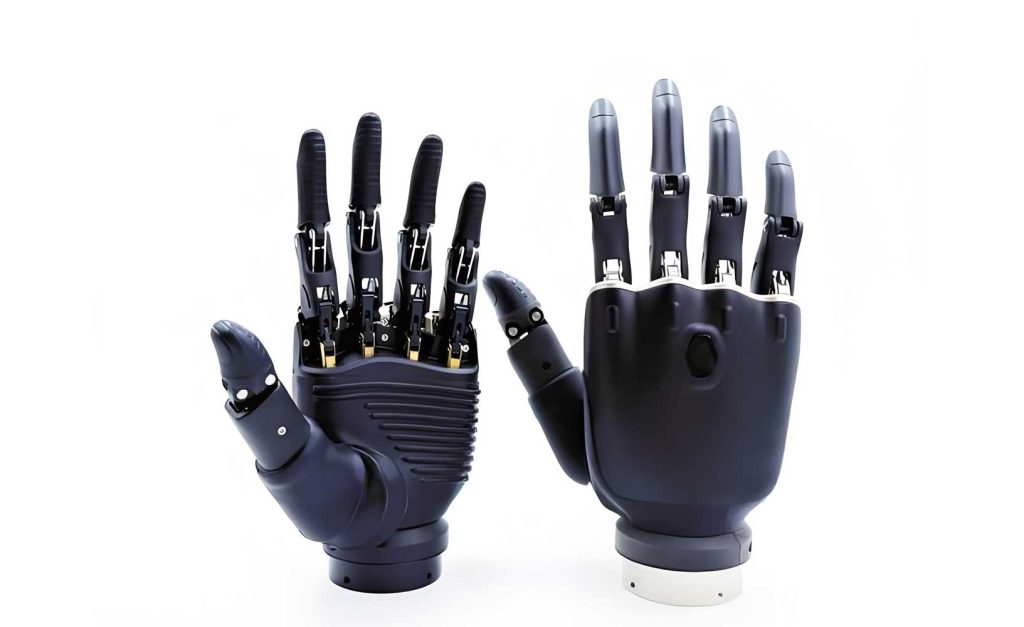
In the realm of robotics, the development of a truly dexterous robotic hand remains a formidable challenge, yet it is crucial for enabling machines to interact with the world in a human-like manner. As a researcher focused on biomechanical systems, I embarked on a project to design a five-fingered, motor-driven dexterous robotic hand that aims to replicate the versatility and subtlety of the human hand. This dexterous robotic hand must possess multiple degrees of freedom (≥15), integrate various sensors for position and force/torque feedback, and achieve high levels of miniaturization, reliability, and practicality for real-world applications. The core of this endeavor lies in the mechanical architecture and dimensional synthesis of the hand, which I will detail from a first-person perspective, emphasizing the kinematic analysis and mechanism design that underpin this complex system.
My design process began with a thorough biomechanical analysis of the human hand. Observing natural hand movements, I noted significant differences in joint mobility. The metacarpophalangeal (MCP) joints, corresponding to the proximal phalanges, allow for both flexion/extension and abduction/adduction, granting them two degrees of freedom. In contrast, the proximal interphalangeal (PIP) and distal interphalangeal (DIP) joints primarily permit flexion/extension, each contributing one degree of freedom. However, for fingers other than the thumb, the PIP and DIP joints often move in a coupled manner during flexion, meaning their combined motion can be considered as a single degree of freedom from a mechanistic standpoint. Consequently, each of the four fingers (index, middle, ring, and little) effectively possesses three degrees of freedom. The thumb, with its unique carpometacarpal (CMC) joint allowing for rotation, presents a more complex case; for design simplicity and to align with the other fingers, I simplified its base motion to flexion and abduction, though it requires a dedicated design due to its placement within the palm.
Based on this analysis, I derived several key conclusions for structuring the dexterous robotic hand. First, the index and middle fingers exhibit similar kinematics, with their proximal phalanges having two degrees of freedom (flexion and abduction), while the intermediate and distal phalanges feature coupled flexion. Therefore, I treated the index and middle fingers as a single design template. Second, the ring and little fingers primarily demonstrate flexion at the proximal phalanx, with the intermediate and distal phalanges coupled to this motion, leading me to group them under another design template. Third, the thumb, with its simplified two-degree-of-freedom base, was designed separately to accommodate its distinct role in grasping and manipulation. This segmentation streamlined the design process for this multi-fingered dexterous robotic hand.
To realize the coupled motion between the intermediate and distal phalanges, I evaluated several transmission mechanisms. Among classical mechanical systems, gear trains immediately came to mind due to their precise speed ratio control, governed by the formula for the gear ratio \( i \):
$$ i = \frac{\omega_{\text{driver}}}{\omega_{\text{driven}}} = -\frac{z_{\text{driven}}}{z_{\text{driver}}} $$
where \( \omega \) represents angular velocity and \( z \) denotes the number of teeth. By adjusting the tooth counts, one can achieve the desired coupling ratio between joints. However, for a compact dexterous robotic hand, gear trains can increase bulk. An alternative is the crossed tendon-driven mechanism, which uses flexible cables wound around pulleys. This approach significantly reduces part dimensions, allowing the finger thickness to approximate that of a human finger—a vital aspect for a realistic dexterous robotic hand. The transmission ratio for such a system is given by:
$$ i_{12} = -\frac{\theta_2}{\theta_1} = -\frac{d_1}{d_2} $$
where \( \theta_1 \) and \( \theta_2 \) are the angular ranges of the intermediate and distal phalanges, respectively, and \( d_1 \) and \( d_2 \) are the pulley diameters. For my design, I set \( \theta_1 = 90^\circ \) and \( \theta_2 = 60^\circ \), yielding \( i_{12} = 1.5 \). While tendon drives offer miniaturization, they suffer from elastic slip and limited force transmission due to friction. Given the relatively low loads expected for this dexterous robotic hand, I deemed this acceptable for the index and middle fingers. For the ring and little fingers, which are secondary and require less precise coupling, I opted for a planar four-bar linkage mechanism, which is lightweight, reliable, and integrates seamlessly with the joint structure, albeit providing only approximate motion ratios.
The proximal phalanx design posed a greater challenge, as it must accommodate both flexion/extension and abduction/adduction motions within a confined space. After researching various configurations, I selected a differential gear train scheme, illustrated in the diagram below. This compact assembly enables independent control of the two degrees of freedom through coordinated motor inputs.
In this mechanism, a cross-shaped shaft (Component 6) serves as the core. Bevel gear 2 meshes with bevel gear 1, forming a gear pair for abduction/adduction. When a motor drives gear 2, gear 1 rotates, causing the shaft to swing laterally. Simultaneously, bevel gears 3, 4, and 5 constitute a planetary gear system for flexion/extension. Gear 4 is connected to the shaft via a bearing, while gear 5 is linked to a perpendicular cross-axis on the shaft and fixed to the proximal phalanx. Driving gear 3 induces rotation in gears 4 and 5, with gear 5 ultimately flexing the finger. To prevent unwanted coupling—such as flexion during pure abduction—the motors driving gears 2 and 3 must operate synchronously. Through kinematic analysis, I derived the relationships between the angular velocities. Let \( \omega_1 \) be the angular speed of the shaft (abduction), \( \omega_2 \) be the speed of gear 5 (flexion), \( \omega_3 \) be the speed of gear 2, and \( \omega_4 \) be the speed of gear 3. The gear ratios are defined as:
$$ \omega_1 = \frac{z_2}{z_1} \omega_3 $$
and for the planetary system:
$$ \omega_2 = \omega_4 + \frac{z_3 z_5}{z_4 z_6} \omega_3 $$
In my design, I standardized gear teeth counts: \( z_1 = z_2 = z_3 = z_4 = z_5 = 20 \). Substituting these values simplifies the equations to:
$$ \omega_1 = \omega_3 $$
$$ \omega_2 = \omega_4 + 0.5 \omega_3 $$
Thus, for pure abduction (\( \omega_1 \neq 0, \omega_2 = 0 \)), the motors must run at equal speeds but in opposite directions (\( \omega_3 = -\omega_4 \)). This precise coordination is essential for the dexterous robotic hand to achieve any position in its workspace, mimicking human finger dexterity.
To summarize the kinematic parameters and design choices for this dexterous robotic hand, I have compiled the following tables. Table 1 outlines the degree-of-freedom allocation per finger, based on my biomechanical analysis:
| Finger | Proximal Phalanx (MCP) | Intermediate Phalanx (PIP) | Distal Phalanx (DIP) | Total DOFs |
|---|---|---|---|---|
| Index | 2 (Flexion, Abduction) | 1 (Coupled Flexion) | 1 (Coupled Flexion) | 3 |
| Middle | 2 (Flexion, Abduction) | 1 (Coupled Flexion) | 1 (Coupled Flexion) | 3 |
| Ring | 1 (Flexion) | Coupled to Proximal | Coupled to Proximal | 1 |
| Little | 1 (Flexion) | Coupled to Proximal | Coupled to Proximal | 1 |
| Thumb | 2 (Simplified Flexion, Abduction) | 1 (Flexion) | 1 (Flexion) | 4 |
Table 2 provides the key transmission ratios and design parameters for the coupling mechanisms across different finger types:
| Finger Group | Coupling Mechanism | Transmission Ratio (i) | Angular Range (θ) | Pulley/Diameter Ratio |
|---|---|---|---|---|
| Index & Middle | Crossed Tendon Drive | \( i_{12} = -\frac{d_1}{d_2} \) | θ₁=90°, θ₂=60° | \( d_1/d_2 = 1.5 \) |
| Ring & Little | Planar Four-Bar Linkage | Approximate | θ≈90° (combined) | N/A |
| Thumb | Independent Actuation | N/A | Custom | N/A |
The dimensional synthesis of the dexterous robotic hand involved scaling the finger segments to match human proportions while ensuring mechanical feasibility. For the palm and phalanges, I used anthropometric data to set lengths, with the proximal phalanx averaging 40 mm, the intermediate phalanx 30 mm, and the distal phalanx 20 mm for the index and middle fingers. The ring and little fingers were scaled down by 10-15%, and the thumb was designed with a longer proximal segment (45 mm) to enhance its opposability. These dimensions were optimized through iterative calculations to avoid interference and maximize the workspace, a critical step for a functional dexterous robotic hand.
Motor selection and integration posed another significant challenge. Each degree of freedom in this dexterous robotic hand requires a dedicated micro-motor, leading to at least 15 motors for the entire hand. I chose brushless DC motors for their high torque density and reliability, embedding them within the palm and proximal finger links to maintain a compact form factor. The control system must manage these motors simultaneously, using feedback from position encoders and force sensors at the fingertips. The kinematic equations derived earlier, such as those for the differential gear train, are implemented in the control algorithm to decouple motions and achieve smooth trajectories. For instance, the relationship \( \omega_2 = \omega_4 + 0.5 \omega_3 \) is used to compute motor commands for desired finger poses, ensuring the dexterous robotic hand moves with precision.
In terms of sensing, the dexterous robotic hand incorporates multiple modalities. Each joint includes potentiometers or optical encoders to measure angular position, while strain gauges or piezoelectric sensors at the phalanges provide force and torque feedback. This multi-sensory integration enables the hand to perform delicate tasks, such as grasping fragile objects or applying controlled forces, mirroring the haptic capabilities of a human hand. The data from these sensors are processed in real-time to adjust grip strength and posture, enhancing the autonomy of the dexterous robotic hand.
Reliability and miniaturization were paramount throughout the design. I utilized lightweight materials like aluminum alloys and carbon-fiber-reinforced polymers for links, and employed precision bearings at all joints to reduce friction and wear. The tendon-driven mechanisms for the index and middle fingers were meticulously calibrated to minimize slack and elastic deformation, though periodic maintenance may be required. For the ring and little fingers, the four-bar linkages were designed with tight tolerances to ensure consistent motion despite their approximate nature. Overall, this dexterous robotic hand achieves a balance between performance and practicality, with a total weight under 500 grams and dimensions comparable to an adult male hand.
Looking ahead, the potential applications of such a dexterous robotic hand are vast. In industrial settings, it could handle complex assembly tasks or operate in hazardous environments. In healthcare, it might assist in surgery or rehabilitation, providing gentle and precise manipulation. For service robots, this dexterous robotic hand could enable more natural human-robot interaction, from household chores to eldercare. The integration of advanced AI with the sensory feedback will further enhance its capabilities, allowing it to learn and adapt to new tasks autonomously. As robotics technology evolves, I envision that dexterous robotic hands will become increasingly sophisticated, bridging the gap between machines and humans.
In conclusion, the design of this five-fingered dexterous robotic hand represents a comprehensive approach to replicating human hand functionality through mechanical ingenuity. From the biomechanical analysis that informed the degree-of-freedom allocation to the detailed mechanism design involving differential gear trains and tendon couplings, every aspect was tailored to achieve dexterity, compactness, and reliability. The formulas and tables presented here encapsulate the core kinematic and dimensional parameters, providing a blueprint for future iterations. While challenges remain in areas like energy efficiency and cost reduction, this dexterous robotic hand lays a solid foundation for practical deployment. As I reflect on this project, I am convinced that continued innovation in this field will yield dexterous robotic hands that not only mimic but extend human abilities, transforming how we interact with technology and the world around us.