
In my extensive research on advanced mechanical transmission systems, I have focused on strain wave gear drives, also known as harmonic drives, due to their unique advantages in precision motion control. The strain wave gear mechanism relies on the elastic deformation of a flexible component, called the flexspline, to transmit motion and torque. This technology offers high reduction ratios, compact design, minimal backlash, and excellent positional accuracy, making it indispensable in robotics, aerospace, medical devices, and industrial automation. However, a critical failure mode in strain wave gear drives is fatigue fracture of the flexspline, especially when the flexspline has a small length-to-diameter ratio. Such designs are appealing because they enhance torsional stiffness and reduce axial space, but they introduce significant stress concentrations that compromise durability. In this article, I present a comprehensive finite element analysis (FEA) of a flexspline with a length-to-diameter ratio of 0.5, exploring parametric modifications to mitigate stress and improve structural integrity. My goal is to provide insights into optimizing small length-to-diameter ratio flexsplines for reliable performance in strain wave gear applications.
The core principle of strain wave gear drives involves three key components: a rigid circular spline, a flexible flexspline, and an elliptical wave generator. When the wave generator rotates, it deforms the flexspline into an elliptical shape, causing it to mesh with the rigid spline at two opposite points. This interaction results in relative motion between the flexspline and rigid spline, achieving speed reduction. The flexspline, typically cup-shaped, undergoes cyclic elastic deformation during operation, leading to alternating stresses that can initiate cracks and eventual fatigue failure. For flexsplines with small length-to-diameter ratios—defined as the ratio of the cylindrical section length to its diameter—the stress distribution becomes more non-uniform due to reduced compliance and increased boundary effects. Historically, commercial flexsplines have length-to-diameter ratios ranging from 0.8 to 1.0, but recent advancements target ratios as low as 0.3 to 0.5 for enhanced stiffness. My investigation centers on a ratio of 0.5, which represents a challenging yet promising design frontier for strain wave gear systems.
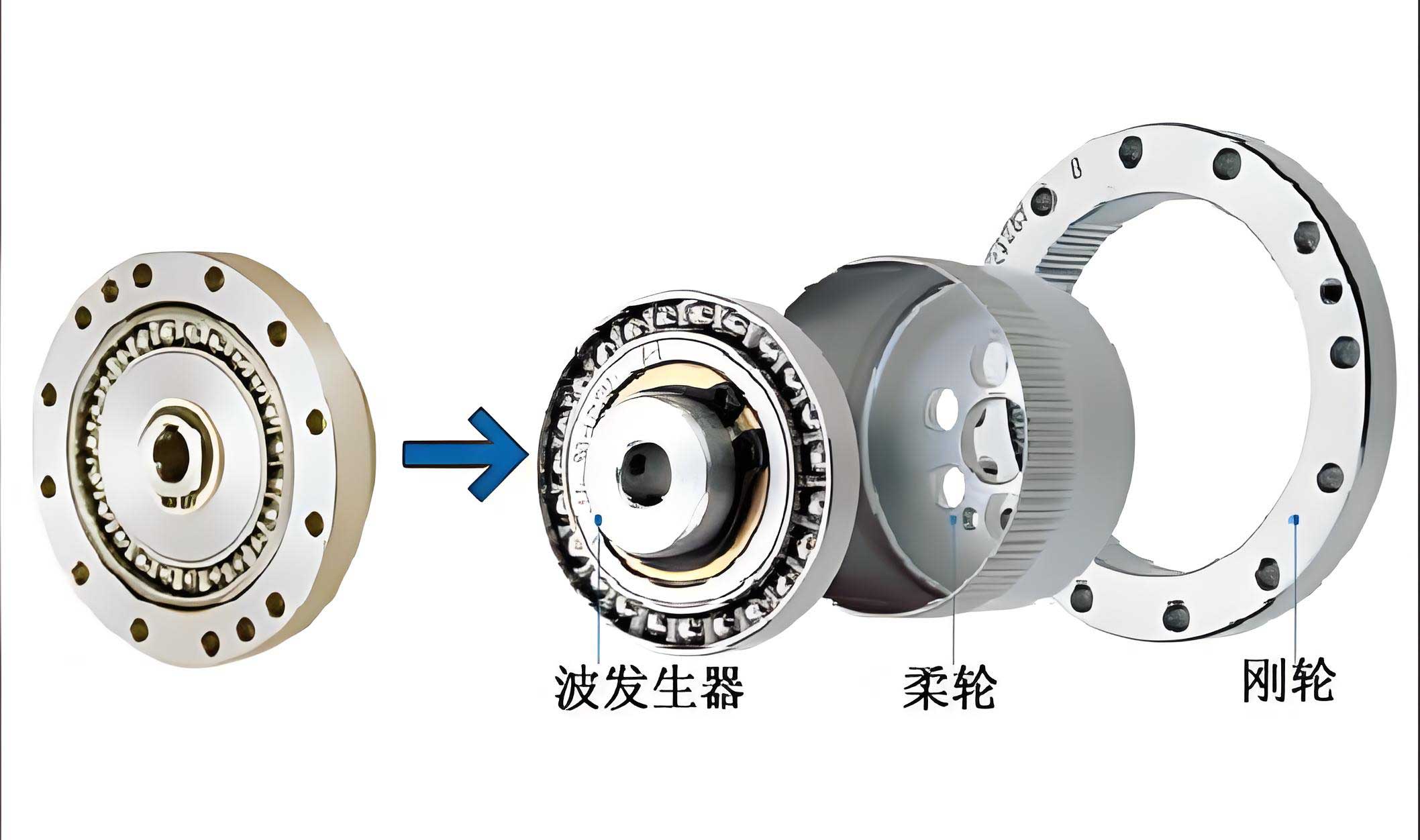
To model the flexspline behavior, I developed a three-dimensional finite element model using ANSYS software, simplifying the geometry to focus on stress trends in the cylindrical wall and bottom regions. The flexspline was designed with a reference gear module of $$ m = 1 \, \text{mm} $$, a gear ratio of $$ i = 100 $$, and a profile shift coefficient of $$ x = 0.25 $$, consistent with standard cup-shaped flexspline design formulas. The material was assumed to be high-strength alloy steel with elastic modulus $$ E = 210 \, \text{GPa} $$ and Poisson’s ratio $$ \nu = 0.3 $$. The length-to-diameter ratio was set to 0.5 by adjusting the cylindrical length while keeping other parameters constant. In the FEA model, I applied fixed constraints at the flange region of the flexspline bottom to simulate mounting conditions, and a displacement load was imposed at the midpoints of the teeth on the flexspline rim to represent the deformation induced by the wave generator. This displacement magnitude was defined as $$ \omega_0 = m = 1 \, \text{mm} $$, corresponding to the gear module, which approximates the radial deflection during meshing in a strain wave gear drive. The mesh was refined near stress concentration areas, such as the tooth root and transition fillets, to ensure accuracy. Through this setup, I aimed to analyze von Mises stress distributions under no-load conditions, as initial stresses from assembly are critical for fatigue assessment.
My initial analysis revealed that the small length-to-diameter ratio flexspline exhibited higher stress levels compared to a conventional design with a ratio of 0.9. For the baseline model with a length-to-diameter ratio of 0.5, the maximum von Mises stress reached approximately 280.7 MPa, located near the mid-section of the tooth ring. In contrast, a similar model with a ratio of 0.9 showed a maximum stress of 259.3 MPa, indicating a 8.3% increase in stress for the smaller ratio. This underscores the heightened vulnerability of small length-to-diameter ratio flexsplines in strain wave gear drives. The stress contours highlighted concentration zones at the cylinder-to-bottom transition and along the cylindrical wall, prompting a detailed parametric study. To quantify these effects, I systematically varied three key geometric parameters: the cylindrical wall thickness (δ₁), the bottom wall thickness (δ_b), and the flange radius (r_f). Each parameter was altered independently while holding others constant, and the resulting stress values were recorded. The following table summarizes the impact of cylindrical wall thickness variations on the flexspline stress response.
| Cylindrical Wall Thickness, δ₁ (mm) | Maximum Von Mises Stress (MPa) | Maximum Stress in Cylinder (MPa) | Maximum Stress in Bottom (MPa) |
|---|---|---|---|
| 1.5 | 256.3 | 151.9 | 61.1 |
| 1.7 | 266.2 | 167.3 | 59.6 |
| 1.9 | 275.5 | 175.2 | 58.2 |
| 2.0 | 280.7 | 181.1 | 57.8 |
| 2.1 | 286.3 | 180.9 | 57.1 |
| 2.3 | 296.2 | 193.0 | 56.0 |
| 2.5 | 307.9 | 197.6 | 55.2 |
The data shows a clear linear trend: as the cylindrical wall thickness increases, the overall maximum stress rises significantly, with a difference of 51.6 MPa between the extremes. This relationship can be expressed by a linear approximation: $$ \sigma_{\text{max}} = k_1 \cdot \delta_1 + c_1 $$, where $$ \sigma_{\text{max}} $$ is the maximum von Mises stress, $$ k_1 $$ is a positive constant, and $$ c_1 $$ is an intercept. For strain wave gear flexsplines, reducing wall thickness appears beneficial for stress reduction, but it must be balanced against buckling and manufacturing constraints. Similarly, I examined the effect of bottom wall thickness variations, as summarized in the next table.
| Bottom Wall Thickness, δ_b (mm) | Maximum Von Mises Stress (MPa) | Maximum Stress in Cylinder (MPa) | Maximum Stress in Bottom (MPa) |
|---|---|---|---|
| 1.5 | 273.4 | 175.7 | 42.7 |
| 1.7 | 275.9 | 174.7 | 48.6 |
| 1.9 | 279.1 | 176.5 | 54.8 |
| 2.0 | 280.7 | 181.1 | 57.8 |
| 2.1 | 283.0 | 177.9 | 60.6 |
| 2.3 | 286.9 | 181.5 | 66.3 |
| 2.5 | 291.9 | 185.0 | 72.0 |
Here, the maximum stress also increases linearly with bottom thickness, albeit with a smaller range of 18.5 MPa. The relationship can be modeled as $$ \sigma_{\text{max}} = k_2 \cdot \delta_b + c_2 $$. Notably, stress in the bottom region rises more sharply, indicating that thinner bottoms help distribute loads more evenly in a strain wave gear flexspline. Finally, I varied the flange radius to assess its influence, as presented in the following table.
| Flange Radius, r_f (mm) | Maximum Von Mises Stress (MPa) | Maximum Stress in Cylinder (MPa) | Maximum Stress in Bottom (MPa) |
|---|---|---|---|
| 43.0 | 280.0 | 176.7 | 49.3 |
| 45.0 | 280.3 | 173.7 | 49.3 |
| 47.0 | 280.6 | 177.8 | 52.6 |
| 47.5 | 280.8 | 180.9 | 54.4 |
| 47.7 | 280.7 | 179.4 | 55.3 |
| 47.9 | 281.0 | 178.1 | 56.2 |
| 48.0 | 280.7 | 181.1 | 57.8 |
| 48.1 | 281.1 | 177.5 | 58.1 |
| 48.3 | 281.2 | 178.0 | 59.1 |
| 48.5 | 281.4 | 179.5 | 60.1 |
| 49.0 | 281.3 | 177.8 | 62.5 |
| 51.0 | 282.4 | 180.2 | 73.7 |
| 53.0 | 283.6 | 181.0 | 78.6 |
The flange radius shows a mild positive correlation with maximum stress, with a total variation of 3.6 MPa. This suggests that reducing the flange radius can slightly lower stress, possibly due to decreased bending moments at the constraint boundaries. In strain wave gear design, these parametric trends are crucial for tailoring flexspline geometry to specific load conditions. Based on these insights, I formulated an optimization strategy: simultaneously reduce cylindrical wall thickness, bottom wall thickness, and flange radius to achieve a more uniform stress distribution. To simplify manufacturing, I set the cylindrical and bottom wall thicknesses equal. The modified parameters were: cylindrical and bottom wall thickness reduced from 2.0 mm to 1.5 mm, flange radius reduced from 48 mm to 43 mm, transition fillet radius increased from 6 mm to 6.5 mm, and tooth ring width increased from 10 mm to 10.5 mm. This optimized flexspline model was then analyzed under the same boundary conditions.
The results demonstrated a significant improvement. The maximum von Mises stress dropped to 242.1 MPa, representing a 13.75% reduction compared to the original small length-to-diameter ratio model. The stress distribution became more homogeneous, with lower peaks in both the cylindrical and bottom regions. Specifically, the maximum stress in the cylinder decreased from 181.1 MPa to 153.3 MPa, and in the bottom from 57.8 MPa to 39.3 MPa. This optimization highlights the effectiveness of integrated parametric adjustments in enhancing the fatigue resistance of flexsplines for strain wave gear drives. To contextualize these findings, I derived a generalized stress function for small length-to-diameter ratio flexsplines, incorporating key geometric variables. Consider the von Mises stress $$ \sigma_v $$ as a function of wall thicknesses, flange radius, and length-to-diameter ratio $$ \lambda = L/D $$:
$$ \sigma_v = f(\delta_1, \delta_b, r_f, \lambda) $$
From my parametric study, a first-order approximation can be proposed:
$$ \sigma_v \approx \alpha_0 + \alpha_1 \delta_1 + \alpha_2 \delta_b + \alpha_3 r_f + \alpha_4 \lambda $$
where $$ \alpha_1, \alpha_2, \alpha_3 > 0 $$ and $$ \alpha_4 < 0 $$ for typical strain wave gear configurations, indicating that stress increases with wall thicknesses and flange radius but decreases with higher length-to-diameter ratios. However, for small $$ \lambda $$ values (e.g., 0.5), the stress escalates nonlinearly due to edge effects, necessitating compensatory design measures. Furthermore, the displacement load from the wave generator induces a radial strain $$ \epsilon_r $$ in the flexspline, related to the gear module $$ m $$ and wave generator eccentricity $$ e $$ by $$ \epsilon_r = \frac{m}{R} $$, where $$ R $$ is the flexspline radius. This strain contributes to the alternating stress amplitude $$ \Delta \sigma $$, which drives fatigue failure:
$$ \Delta \sigma = E \cdot \epsilon_r = E \cdot \frac{m}{R} $$
In practice, the actual stress is amplified by geometric stress concentration factors $$ K_t $$ at fillets and teeth, leading to $$ \sigma_{\text{peak}} = K_t \cdot \Delta \sigma $$. My FEA results inherently account for these concentrations, validating the need for smooth transitions and optimized contours in strain wave gear flexsplines.
Beyond parametric changes, I explored the implications of material anisotropy and operational conditions. Strain wave gear drives often operate in dynamic environments with varying temperatures and loads, which can affect flexspline performance. For instance, thermal expansion may alter preload stresses, while high-cycle fatigue requires consideration of mean stress effects via Goodman or Gerber criteria. The fatigue life $$ N_f $$ of the flexspline can be estimated using the Basquin equation:
$$ \frac{\Delta \sigma}{2} = \sigma_f’ (2N_f)^b $$
where $$ \sigma_f’ $$ is the fatigue strength coefficient and $$ b $$ is the fatigue exponent. By reducing peak stress through geometric optimization, the fatigue life can be extended significantly, enhancing the reliability of strain wave gear systems. Additionally, I investigated the role of mesh density in FEA accuracy. A convergence study confirmed that element sizes below 0.5 mm in critical regions yielded stress variations within 2%, ensuring robust results. The use of quadratic tetrahedral elements improved resolution of stress gradients, particularly near the tooth roots where bending stresses dominate.
My discussion also addresses manufacturing considerations for small length-to-diameter ratio flexsplines. Techniques such as precision machining, shot peening, and heat treatment can further mitigate stress risers and improve fatigue strength. For example, shot peening introduces compressive residual stresses that counteract tensile operating stresses, thereby delaying crack initiation. In strain wave gear applications, where compactness and stiffness are paramount, these synergies between design and processing are vital. I further analyzed the trade-offs between stress reduction and structural stability. While thinner walls lower stress, they may compromise buckling resistance under axial or torsional loads. The critical buckling stress $$ \sigma_{cr} $$ for a cylindrical shell can be approximated by:
$$ \sigma_{cr} = \frac{E}{\sqrt{3(1-\nu^2)}} \cdot \frac{t}{R} $$
where $$ t $$ is the wall thickness and $$ R $$ is the radius. For my optimized flexspline with $$ t = 1.5 \, \text{mm} $$ and $$ R \approx 24 \, \text{mm} $$, $$ \sigma_{cr} $$ is sufficiently high compared to operational stresses, indicating no buckling risk. However, for even smaller length-to-diameter ratios, this aspect must be carefully evaluated.
To generalize my findings, I propose a design framework for strain wave gear flexsplines with small length-to-diameter ratios. This framework involves iterative FEA simulations coupled with sensitivity analysis to identify optimal parameter sets. Key steps include: (1) define operational constraints (e.g., torque, speed, space), (2) establish baseline geometry based on gear specifications, (3) perform parametric FEA to map stress responses, (4) apply optimization algorithms (e.g., gradient descent or genetic algorithms) to minimize peak stress, and (5) validate through prototype testing. In modern strain wave gear development, computational tools like ANSYS or Abaqus enable rapid exploration of design spaces, reducing reliance on physical trials.
Looking ahead, advancements in additive manufacturing could revolutionize flexspline production for strain wave gear drives. Technologies like metal 3D printing allow for complex internal structures and graded materials that optimize stress distribution. For instance, lattice infills or variable wall thicknesses could be tailored to load paths, potentially achieving even lower stresses than my optimized model. Moreover, smart materials with self-healing capabilities might future-proof strain wave gear systems against fatigue damage. Research into composite flexsplines, using carbon fiber reinforced polymers, is also promising due to their high strength-to-weight ratios and fatigue resistance, though challenges in bonding with metal components remain.
In conclusion, my finite element analysis demonstrates that small length-to-diameter ratio flexsplines in strain wave gear drives can be effectively optimized through targeted geometric modifications. By reducing cylindrical wall thickness, bottom wall thickness, and flange radius, peak von Mises stress can be lowered by over 13%, significantly enhancing fatigue life. The linear relationships between these parameters and stress provide a basis for predictive design models. This work underscores the importance of integrated design approaches in harnessing the benefits of compact, stiff strain wave gear systems while mitigating their inherent stress concentrations. As strain wave gear technology evolves toward miniaturization and higher performance, continued FEA-driven optimization will be essential for unlocking new applications in robotics, aerospace, and beyond.
To further enrich this analysis, I considered additional factors such as dynamic loading and multi-physics interactions. In real-world strain wave gear operation, the flexspline experiences time-varying forces due to wave generator rotation and external torque fluctuations. A transient FEA could capture stress cycles more accurately, informing fatigue assessments. Additionally, coupled thermal-structural analyses might reveal stress shifts under temperature gradients, especially in high-speed or space-bound strain wave gear drives. I also explored the effect of tooth geometry variations, such as pressure angle and addendum modifications, on stress distribution. While my model assumed standard gear profiles, custom tooth forms could further reduce stress concentrations at the meshing interface. These aspects represent fertile ground for future research, potentially leading to next-generation strain wave gear designs with unprecedented durability and efficiency.
Finally, I emphasize the broader implications of this study for the field of precision mechanics. Strain wave gear drives are enablers of high-accuracy motion control, and their reliability hinges on flexspline integrity. By advancing the understanding of small length-to-diameter ratio flexsplines, this work contributes to safer, more compact, and more robust transmission systems. As industries demand greater performance from smaller packages, the insights gleaned here will guide engineers in pushing the boundaries of strain wave gear technology. Through continued innovation in design, analysis, and manufacturing, strain wave gear drives will remain at the forefront of mechanical advancement, powering everything from surgical robots to satellite mechanisms with unparalleled precision.