
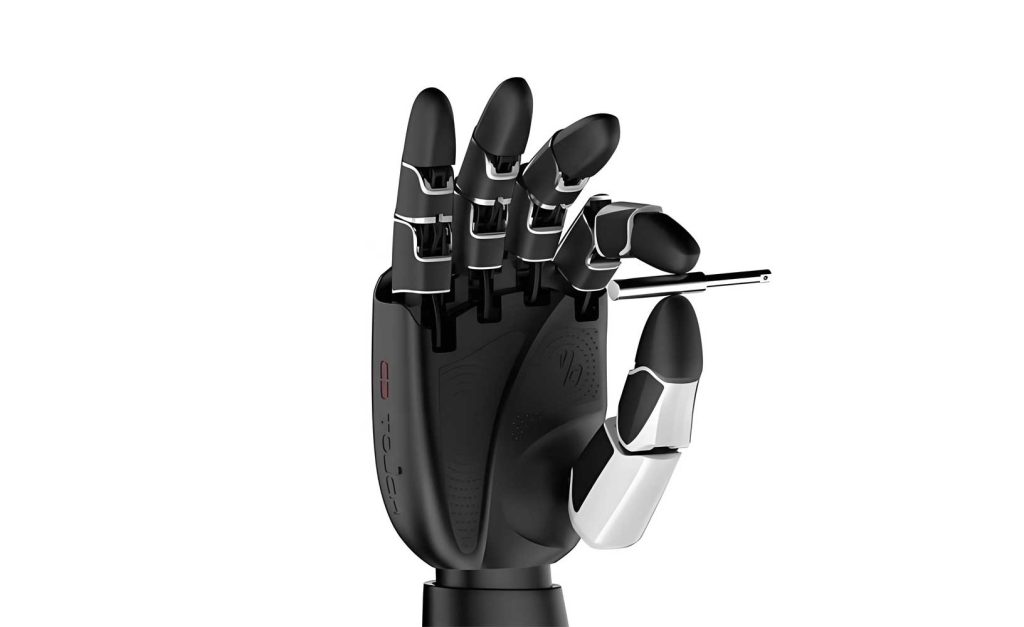
The development of advanced robotic manipulation systems, particularly those mimicking the human hand’s capabilities, remains a focal point in robotics research. A dexterous robotic hand, with its multi-fingered, multi-degree-of-freedom architecture, is essential for performing complex, unstructured tasks. The core challenge lies not only in its mechanical design but also in developing intelligent, adaptive, and efficient control strategies. This article presents the design and implementation of a sophisticated control system for a pneumatic dexterous robotic hand, which innovatively integrates two primary control paradigms: master-slave teleoperation and autonomous, sensor-based control. This hybrid approach leverages human intelligence for high-level task planning and spatial guidance while employing the dexterous robotic hand’s own sensory apparatus for precise, compliant, and stable low-level execution, especially during contact interactions. The system aims to enhance both the operational efficiency and the grasping safety of the dexterous robotic hand.
1. System Architecture Overview
The proposed control system for the dexterous robotic hand is built upon a hierarchical and distributed architecture. It consists of a three-tier controller network, a sensory suite comprising both external and internal sensors, and a unique pneumatic actuation system. The overarching goal is to seamlessly transition control authority based on the operational phase of a grasping task.
1.1 Hierarchical Control Structure
The control hierarchy is divided into three distinct levels:
- High-Level Planner & Master Interface (PC): A personal computer serves as the primary interface and planner. It runs software for communicating with the data glove, processing human hand motion data, performing the master-to-slave mapping calculations, and generating the initial trajectory for the dexterous robotic hand. It is also responsible for initiating the transition from master-slave to autonomous control.
- Mid-Level Coordinator (DSP): A digital signal processor (DSP, e.g., TMS320LF2407A) acts as the system coordinator. Its primary functions include distributing control references to individual finger controllers via a communication bus, managing system synchronization, and handling overall load balancing for the dexterous robotic hand.
- Low-Level Finger Controllers (MCU): Each finger of the dexterous robotic hand is governed by its own dedicated microcontroller unit (e.g., C8051F040). These controllers are responsible for the real-time, closed-loop control of their respective finger joints. They read local sensor data (joint angles, fingertip force), execute control algorithms (like impedance control), and generate Pulse-Width Modulation (PWM) signals to drive the pneumatic valves.
The communication between the DSP coordinator and the multiple finger MCUs is efficiently managed through a Controller Area Network (CAN) bus, ensuring robust and deterministic data exchange.
1.2 Pneumatic Actuation and Underactuated Mechanism
The dexterous robotic hand is powered by a pneumatic system, chosen for its high power-to-weight ratio, inherent compliance, and cleanliness. The key actuation elements are custom-made Pneumatic Artificial Muscles (PAMs). These PAMs contract when inflated and extend when exhausted, providing a muscle-like pulling force. For compactness and dexterity, a tendon-driven transmission is employed to transfer the force from the PAMs to the finger joints.
To reduce weight, complexity, and the number of actuators while maintaining functional dexterity, an underactuated design with compliant motion coupling is adopted for the distal joints. In this configuration, a single actuator (a pair of antagonistic PAMs) primarily drives the proximal joint, while the motion of the distal joint is coupled through a passive, compliant element (like a spring or elastic tendon). This allows the finger to naturally conform to an object’s shape upon contact. The fundamental control principle for a single joint is summarized by the following relationship between the controller output, valve state, and joint motion:
$$ \text{MCU} \rightarrow \text{PWM Signal} \rightarrow \text{High-Speed Valve State} \rightarrow \text{PAM Pressure/Length} \rightarrow \text{Tendon Tension} \rightarrow \text{Joint Angle } \theta $$
1.3 Sensory System
The control system relies on feedback from two primary sensor systems:
- External Master Sensors (Data Glove): A 5DT Data Glove 14 Ultra is used as the master input device. It contains 14 flex sensors that measure the bend of finger joints and the abduction between fingers. This provides real-time posture data of the human operator’s hand.
- Internal Slave Sensors (On-board): The dexterous robotic hand itself is equipped with joint angle sensors (e.g., potentiometers or encoders) at each actively controlled joint and force/tactile sensors at the fingertips. These are crucial for the autonomous, closed-loop control phase.
The integration of these components creates a robust framework for controlling the dexterous robotic hand. The following table summarizes the system’s key components and their functions.
| Component | Type/Model | Primary Function |
|---|---|---|
| High-Level Controller | Personal Computer (PC) | Data glove interface, trajectory planning, master-slave mapping, system initiation. |
| Mid-Level Controller | DSP (TMS320LF2407A) | System coordination, reference distribution via CAN bus. |
| Low-Level Controller | MCU (C8051F040 per finger) | Real-time joint-level control (PID, Impedance), PWM generation, local sensor reading. |
| Master Input Device | 5DT Data Glove 14 Ultra | Capture human hand posture (14 joint angles). |
| Actuator | Pneumatic Artificial Muscle (PAM) | Provide contractile force for tendon-driven finger motion. |
| Joint Sensor | Potentiometer/Encoder | Measure real-time joint angle of the dexterous robotic hand. |
| Fingertip Sensor | Force/Tactile Sensor | Measure contact forces during grasping. |
| Final Control Element | High-Speed Pneumatic Valve | Control airflow into and out of PAMs based on PWM signal. |
| Communication Bus | CAN Bus | Reliable data communication between DSP and finger MCUs. |
2. Master-Slave Control via Data Glove
The master-slave control mode is employed for the initial phase of operation, guiding the dexterous robotic hand from its starting position to a “near point” close to the target object. This leverages human intuition for spatial reasoning and path planning.
2.1 Control Flow and Phase Transition
The master-slave control operates in a real-time, online manner. The human operator wears the data glove, and their hand movements are captured, processed, and mapped to the dexterous robotic hand. The system continuously monitors the position of the dexterous robotic hand. When the fingertips of the dexterous robotic hand reach a predefined proximity threshold relative to the target object—the “near point”—the system triggers a critical transition. At this moment, control authority is gracefully transferred: the data glove input is disabled, and the system switches to the autonomous control mode, where the dexterous robotic hand uses its own sensors to complete the final approach and grasp. This hybrid strategy mitigates the limitations of pure teleoperation (fatigue, tremor) and pure autonomy (complex planning for unstructured environments).
2.2 Data Acquisition and Preprocessing from the Data Glove
The raw data from the data glove requires significant preprocessing to be useful for controlling the dexterous robotic hand.
Calibration: Due to anatomical differences between users, the data glove must be calibrated for each operator. Calibration involves recording the sensor values when the hand is fully extended ($\text{Raw}_{min}$) and when it is making a tight fist ($\text{Raw}_{max}$). The scaled value for any subsequent raw reading ($\text{Raw}$) is calculated as:
$$ \text{Scaled} = \frac{\text{Raw} – \text{Raw}_{min}}{\text{Raw}_{max} – \text{Raw}_{min}} = \frac{\text{Raw} – \text{Raw}_{min}}{\text{Range}} $$
The corresponding joint angle $\theta_{\text{current}}$ is then obtained by mapping this scaled value to the known physiological range of the human joint ($\theta_{\text{min}}, \theta_{\text{max}}$):
$$ \theta_{\text{current}} = \theta_{\text{min}} + \text{Scaled} \times (\theta_{\text{max}} – \theta_{\text{min}}) $$
Jitter Filtering & Motion Detection: Human hand naturally exhibits micro-tremors. To prevent these from causing jittery movements in the dexterous robotic hand, a software filter is implemented. A movement is only registered and transmitted if the change in a joint angle exceeds a certain threshold (e.g., 5°). Furthermore, the system requires the new hand posture to be maintained for a short, stable period before accepting it as an intentional command. This ensures smooth and deliberate motion of the dexterous robotic hand.
Distal Joint Estimation: The specific data glove model used provides direct measurements only for the proximal and medial joints of each finger. The distal joint angle ($\theta_{DIP}$) is estimated from the medial joint angle ($\theta_{PIP}$) based on the typical kinematic coupling observed in the human hand:
$$ \theta_{DIP} = k \cdot \theta_{PIP} $$
where the coupling factor $k$ is often taken as approximately $2/3$.
2.3 Kinematic Mapping from Human Hand to Dexterous Robotic Hand
A critical component of master-slave control is establishing a mapping function $K_i$ that translates the human hand’s fingertip position into a target position for the corresponding fingertip of the dexterous robotic hand. A simple yet effective Cartesian mapping based on proportional scaling is adopted.
Let the position of a human (master) fingertip $i$ in its palm coordinate frame $\{H\}$ be denoted as $^H\mathbf{r}_i^M = [^Hx_i^M, \, ^Hy_i^M, \, ^Hz_i^M]^T$.
Similarly, let the desired position of the corresponding dexterous robotic hand (slave) fingertip in its palm frame $\{R\}$ be $^R\mathbf{r}_i^S = [^Rx_i^S, \, ^Ry_i^S, \, ^Rz_i^S]^T$.
The mapping is defined by:
$$ ^R\mathbf{r}_i^S = K_i \cdot {}^H\mathbf{r}_i^M $$
where $K_i$ is a 3×3 mapping matrix. For an intuitive and straightforward control experience, $K_i$ is chosen as a simple scaling matrix, assuming the motion from one sampled point to the next is small and the primary relationship is a size difference. Thus,
$$ K_i = \begin{bmatrix}
s & 0 & 0 \\
0 & s & 0 \\
0 & 0 & s
\end{bmatrix}, \quad \text{where } s = \frac{L^R}{L^H} $$
Here, $L^H$ and $L^R$ represent the characteristic lengths (e.g., the length of the index finger) of the human hand and the dexterous robotic hand, respectively. This yields the mapped coordinates:
$$ ^Rx_i^S = s \cdot {}^Hx_i^M, \quad ^Ry_i^S = s \cdot {}^Hy_i^M, \quad ^Rz_i^S = s \cdot {}^Hz_i^M $$
Once the target fingertip positions for the dexterous robotic hand are calculated, an inverse kinematics solver (running on the PC) computes the desired joint angle trajectories, which are then sent to the mid-level DSP controller.
The table below illustrates a short sequence of sampled and processed data from the data glove’s index finger sensors during a steady posture, demonstrating the calibration and stability.
| Sample # | Raw Proximal | Raw Medial | Scaled Prox. | Scaled Med. | $\theta_{Prox}$ (deg) | $\theta_{Med}$ (deg) | $\theta_{Dist}$ (est., deg) |
|---|---|---|---|---|---|---|---|
| 1 | 363 | 853 | 0.006 | 0.021 | 5.4 | 18.9 | 12.6 |
| 2 | 363 | 852 | 0.006 | 0.020 | 5.4 | 18.0 | 12.0 |
| 3 | 363 | 854 | 0.006 | 0.021 | 5.4 | 18.9 | 12.6 |
| 4 | 363 | 853 | 0.006 | 0.021 | 5.4 | 18.9 | 12.6 |
3. Autonomous Compliant Control
Upon reaching the “near point,” the dexterous robotic hand enters the autonomous control phase. This phase is responsible for the final approach, contact, and stable grasp execution. The key requirement here is compliance—the ability to interact gently with the environment and adapt to uncertainties in object position and stiffness.
3.1 Impedance Control Strategy
Impedance control is implemented at the finger controller level to achieve this compliant behavior. Instead of directly controlling either position or force, impedance control regulates the dynamic relationship between the position error and the contact force—the mechanical impedance. The desired behavior is often modeled as a mass-spring-damper system:
$$ \mathbf{M}_d \ddot{\mathbf{e}} + \mathbf{B}_d \dot{\mathbf{e}} + \mathbf{K}_d \mathbf{e} = \mathbf{F}_{ext} $$
Where:
- $\mathbf{e} = \mathbf{x}_d – \mathbf{x}$ is the position error vector (desired vs. actual).
- $\mathbf{M}_d$, $\mathbf{B}_d$, $\mathbf{K}_d$ are the desired inertia, damping, and stiffness matrices, respectively.
- $\mathbf{F}_{ext}$ is the vector of external forces measured by the fingertip sensors.
The objective of the controller is to make the dexterous robotic hand exhibit this target impedance. By setting $\mathbf{K}_d$ to a low value, the finger becomes compliant, allowing it to yield upon contact. $\mathbf{B}_d$ is tuned to provide critical damping for stable, oscillation-free contact transitions. A simplified computed-torque-like implementation for a single joint can be expressed as:
$$ \tau = \tau_{ff} + J^T \left( \mathbf{K}_d (\mathbf{x}_d – \mathbf{x}) + \mathbf{B}_d (\dot{\mathbf{x}}_d – \dot{\mathbf{x}}) \right) + \tau_{ext} $$
where $\tau$ is the commanded joint torque (converted to a PAM pressure command), $\tau_{ff}$ is a feedforward term, $J$ is the Jacobian, and $\tau_{ext}$ is the joint torque due to external force. The finger MCU continuously reads joint angles $\mathbf{x}$ and fingertip forces (to estimate $\mathbf{F}_{ext}$ and $\tau_{ext}$) to compute this command, enabling the dexterous robotic hand to grasp objects with a gentle and adaptive touch.
3.2 Distributed Control Execution
In this phase, the PC or DSP provides the final desired grasp configuration (a set of joint angles or a fingertip pose) as a setpoint. Each finger’s MCU independently runs its impedance control loop. The CAN bus is used to broadcast common commands (like “initiate grasp”) and to allow the DSP to monitor the overall status of the dexterous robotic hand. This distributed architecture increases robustness and computational efficiency, as the processing load for high-frequency control loops is offloaded to the dedicated finger controllers.
4. Experimental Validation and System Performance
The performance of the hybrid control system for the dexterous robotic hand was evaluated through a series of grasping experiments. The tasks involved picking up objects of various shapes, sizes, and stiffness (e.g., a plastic bottle, a cardboard box, a foam ball).
Procedure: The operator used the data glove to guide the dexterous robotic hand to a position approximately 5-10 cm from the target object. The system then switched to autonomous mode. The impedance parameters were tuned to provide a soft touch ($\mathbf{K}_d$ set low).
Observations: The master-slave phase allowed for rapid and intuitive positioning of the dexterous robotic hand. The transition to autonomous control was seamless. During the final grasp, the impedance controller successfully allowed the fingers to conform to the object geometry, as evidenced by the gradual increase in fingertip force readings without causing object slip or excessive deformation. The underactuated distal joints contributed significantly to this enveloping grasp. The following table summarizes key metrics from a sample grasping trial.
| Metric | Value / Observation |
|---|---|
| Object | Plastic Cylinder (Diameter: 70mm, Weight: 200g) |
| Master-Slave Approach Time | ~3.5 seconds |
| Autonomous Grasp Execution Time | ~1.8 seconds |
| Max Fingertip Force Recorded | ~4.2 N |
| Steady-State Holding Force | ~2.5 N |
| Object Displacement during Grasp | < 2 mm |
| Grasp Stability | Stable lift, no slip observed |
| Control Mode Transition | Smooth, without perceptible jerk |
5. Conclusion
This article has detailed the design and implementation of a sophisticated hybrid control system for a pneumatically actuated dexterous robotic hand. The system’s strength lies in its synergistic integration of two fundamental control paradigms. The master-slave control, facilitated by a calibrated and filtered data glove interface, leverages human intelligence for efficient gross motion planning and positioning of the dexterous robotic hand in task space. The autonomous, sensor-based control—centered on distributed impedance control—endows the dexterous robotic hand with the essential capabilities of compliance, adaptability, and precise force regulation during the critical contact and grasping phases.
The hierarchical and distributed architecture, linking a PC, a DSP coordinator, and multiple finger MCUs via a CAN bus, provides a robust and scalable framework. The use of pneumatic artificial muscles and underactuated mechanisms contributes to a system that is both powerful and naturally compliant. Experimental validation confirms that this hybrid approach successfully enhances the overall operational efficiency of the dexterous robotic hand by simplifying high-level decision-making while simultaneously ensuring the safety and reliability of physical interactions through low-level autonomous compliance. This work provides a concrete reference model for the development of intelligent control systems aimed at bridging the gap between human teleoperation and full autonomy for complex robotic manipulators like the dexterous robotic hand.