
In modern warehousing and logistics, the automation of unpacking corrugated boxes remains a significant challenge due to the variability in box sizes, packaging materials, and the need for delicate handling. As a researcher in robotics and automation, I have focused on developing a versatile robotic system that can efficiently perform tasks such as cutting straps, sealing tapes, flipping box flaps, and retrieving items. Traditional manual methods are labor-intensive and prone to errors, while existing automated solutions often lack flexibility or require complex mechanisms. This article presents a comprehensive design of a multi-end effector system integrated with a quick-change device, enabling a single robot to adaptively handle diverse unpacking operations. The system employs vision guidance and emphasizes the role of the end effector in enhancing automation.
The core innovation lies in the design of specialized end effectors and a novel quick-change device that facilitates seamless switching between tools. The end effector is crucial for executing precise tasks, and our approach ensures that each end effector is optimized for specific functions, such as cutting or gripping. By incorporating multiple end effectors, the robot can perform a sequence of operations without human intervention, significantly improving efficiency and reducing operational costs. In this work, I will detail the design principles, mechanical structures, and operational workflows, supported by mathematical models and comparative tables to underscore the system’s advantages.
The robotic operation flow, guided by vision systems, involves several steps. First, the robot uses a cutting end effector to sever straps and remove them, then cuts sealing tapes. Next, a two-suction-cup end effector with moving palms flips the box flaps. Finally, the same end effector or other tools retrieve items and place them into containers. This process requires the end effector to be highly adaptable, and the quick-change device allows for rapid tool switching to accommodate different tasks. The end effector design must account for factors like force distribution, speed, and precision, which I will explore through formulas and tables.
To begin, let’s consider the quick-change device, which is essential for integrating multiple end effectors. The device uses a driverless locking mechanism based on a umbrella-shaped fixed component and a changeable component. The fixed component attaches to the robot’s end, while the changeable component is fixed to each end effector. The locking relies on steel balls pushed by pistons via toggle links, amplified by spring force. This design ensures secure attachment without external power during operation. The mathematical model for the locking force can be expressed as:
$$ F_{\text{lock}} = \frac{k \cdot x}{\sin(\alpha)} $$
where \( F_{\text{lock}} \) is the locking force, \( k \) is the spring constant, \( x \) is the compression distance, and \( \alpha \) is the angle between the toggle link and the push rod. When \( \alpha \) approaches 90°, the force amplification is maximized, providing self-locking. This principle allows the end effector to remain firmly attached during tasks. The device also incorporates three pneumatic circuits for vacuum and compressed air, and two electrical circuits for power, enabling the end effector to perform driven actions. Table 1 summarizes the components of the quick-change device and their functions.
| Component | Function | Key Feature |
|---|---|---|
| Umbrella-shaped Fixed Part | Attaches to robot end, houses locking mechanism | Steel ball locking with toggle links |
| Changeable Part | Connects to end effector, interfaces with fixed part | Pneumatic and electrical connectors |
| Steel Balls | Provide radial locking force | Six balls for even distribution |
| Toggle Links | Amplify spring force for locking | Mechanical advantage up to 2× |
| Pneumatic Circuits | Deliver vacuum/compressed air to end effector | Three independent channels |
| Electrical Circuits | Supply power to end effector motors/sensors | Two channels with sliding contacts |
The automatic installation and separation process is controlled by an electromagnet. When the robot positions the fixed part over the changeable part, the steel balls align with grooves, and upon electromagnetic deactivation, the spring drives the locking. Separation occurs by activating the electromagnet to retract the push rod. This design minimizes energy consumption since power is only needed during changes, making the end effector system efficient. The end effector connectivity is vital for functionality, and the quick-change device ensures reliable transmission of both pneumatic and electrical signals to the end effector.
Next, I will describe the cutting end effector for straps and sealing tapes. This end effector is a pneumatic tool that combines a fixed blade and a moving blade to cut straps, along with a separate knife for tapes. The end effector’s structure includes a flat斜面定刀 (flat斜面定刀) and a斜刃动刀 (斜刃动刀), which I refer to as the fixed blade and moving blade, respectively. The cutting force is generated by a cylinder, and the motion can be modeled using kinematics. For the cutting action, the force required to sever a strap depends on material properties and blade geometry. The cutting force \( F_{\text{cut}} \) can be estimated as:
$$ F_{\text{cut}} = \tau \cdot A \cdot \mu $$
where \( \tau \) is the shear strength of the strap material, \( A \) is the cross-sectional area, and \( \mu \) is a friction coefficient. The end effector’s cylinder provides this force, and the design ensures that the blades engage precisely under visual guidance. Additionally, a压夹紧打包带 mechanism holds the strap during cutting to prevent slippage, enhancing the end effector’s reliability. Table 2 outlines the key components of this end effector.
| Component | Description | Role in End Effector |
|---|---|---|
| Fixed Blade | Stationary blade with flat斜面 design | Guides strap and initiates cut |
| Moving Blade | Actuated blade with斜刃 for shearing | Completes cut via cylinder motion |
| Cylinder | Pneumatic actuator | Drives moving blade and holding mechanism |
| Holding Mechanism | Spring-loaded杆 with毛面 | Secures strap during cutting |
| Tape Knife | Adjustable blade on a separate mount | Cuts sealing tapes after strap removal |
| Mounting Plate | Connects end effector to quick-change device | Ensures stability and alignment |
The end effector operates in a sequence: first, the robot lowers the end effector to insert the fixed blade under the strap; then, the cylinder extends to clamp and cut the strap. After removal, the tape knife is positioned to cut sealing tapes. This end effector exemplifies how a specialized tool can handle multiple subtasks, reducing the need for manual intervention. The integration with the quick-change device allows the robot to switch to other end effectors seamlessly, such as the two-suction-cup end effector for flipping flaps and retrieving items.
The two-suction-cup end effector with moving palms is an electric tool designed for handling box flaps and items. It features two suction cups mounted on L-shaped sliders that move symmetrically via a bidirectional lead screw driven by a motor. This end effector enables adjustable spacing between suction cups, allowing it to handle items of varying sizes or to separate items during retrieval. The motion of the sliders can be described by the lead screw kinematics:
$$ \Delta x = \frac{p \cdot \theta}{2\pi} $$
where \( \Delta x \) is the linear displacement of each slider, \( p \) is the lead screw pitch, and \( \theta \) is the motor rotation angle in radians. Since the screw has reverse threads, the sliders move in opposite directions, making this end effector versatile for grasping and flipping tasks. The suction cups connect to pneumatic circuits for vacuum, and the end effector can use multiple cups simultaneously for heavier loads. This design highlights the adaptability of the end effector in robotic systems.
In application, this end effector first uses the suction cups to吸附 and flip box flaps after unpacking. Then, it can retrieve one or two items, adjusting the distance between them if needed to place into different containers. The force analysis for suction adhesion is critical for the end effector’s performance. The holding force \( F_{\text{hold}} \) can be expressed as:
$$ F_{\text{hold}} = P_{\text{vac}} \cdot A_{\text{cup}} \cdot C $$
where \( P_{\text{vac}} \) is the vacuum pressure, \( A_{\text{cup}} \) is the cup area, and \( C \) is a safety factor accounting for surface conditions. By optimizing these parameters, the end effector ensures reliable item handling. Table 3 compares the two main end effectors in terms of functions and specifications.
| End Effector Type | Primary Function | Actuation Method | Key Features |
|---|---|---|---|
| Cutting End Effector | Cut straps and sealing tapes | Pneumatic (cylinder) | Integrated blades, holding mechanism |
| Two-Suction-Cup End Effector | Flip flaps and retrieve items | Electric (motor-driven screw) | Adjustable cup spacing, multi-cup support |
The robotic system’s overall performance relies on the synergy between the end effectors and the quick-change device. Vision systems guide the robot to identify box dimensions, strap positions, and item locations, enabling precise end effector operations. The end effector selection is based on real-time data, and the quick-change device facilitates rapid swaps. To quantify the efficiency, we can model the total time \( T_{\text{total}} \) for unpacking a box as:
$$ T_{\text{total}} = T_{\text{change}} + \sum_{i=1}^{n} T_{\text{task},i} $$
where \( T_{\text{change}} \) is the time for end effector changes, and \( T_{\text{task},i} \) is the time for each task (e.g., cutting, flipping). The quick-change device minimizes \( T_{\text{change}} \) due to its fast locking mechanism, typically under 2 seconds. This efficiency gain underscores the importance of a robust end effector system in automation.
Furthermore, the design of the end effectors incorporates safety and reliability considerations. For instance, the cutting end effector includes fail-safe mechanisms to prevent accidental damage, while the suction cup end effector uses redundant vacuum sources. The end effector materials are selected for durability and lightweight properties, ensuring long-term operation in industrial environments. The end effector’s compatibility with various box sizes is achieved through adjustable components, such as the movable blades and suction cup positions, making the system highly adaptable.
In conclusion, this multi-end effector system represents a significant advancement in robotic unpacking technology. The end effector designs address specific challenges like strap cutting and item retrieval, while the quick-change device enables flexible tool management. The end effector plays a central role in automating complex tasks, and our approach demonstrates how mechanical innovation can enhance robotic capabilities. Future work may involve integrating advanced sensors or machine learning to further optimize end effector performance. Overall, this system offers a scalable solution for logistics automation, with the end effector being key to its success.
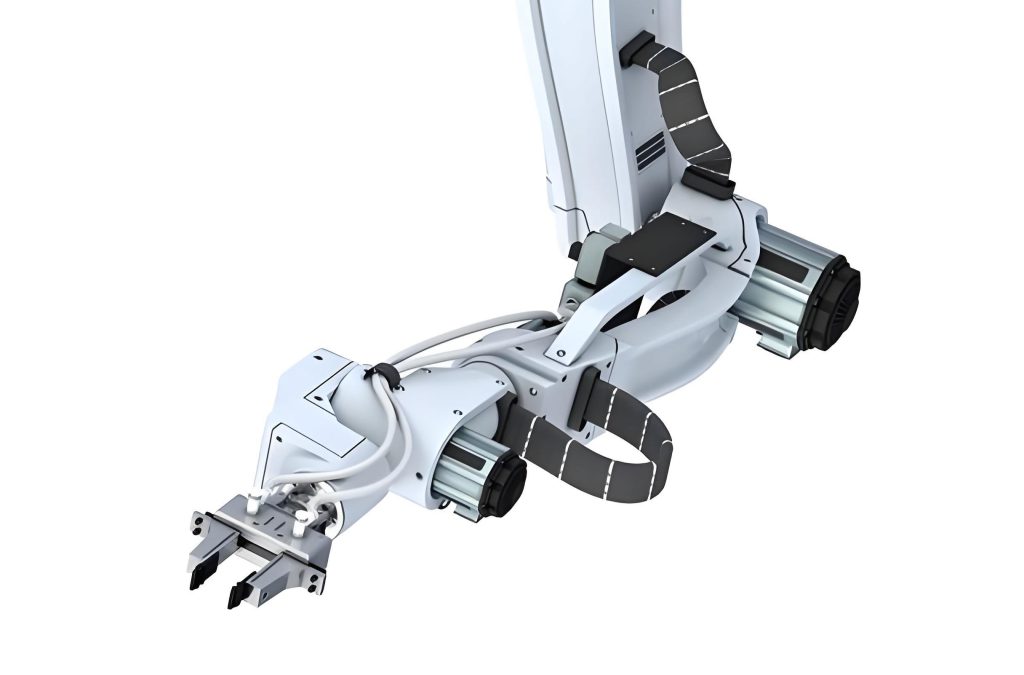
To summarize the technical contributions, I have detailed the design and analysis of each end effector and the quick-change device. The end effector system not only improves operational efficiency but also reduces reliance on manual labor, particularly in harsh environments. By repeatedly emphasizing the end effector, I highlight its critical function in robotic applications. The tables and formulas provided offer a clear framework for understanding the system’s mechanics, and the inserted image illustrates a typical end effector setup. This work paves the way for more intelligent and adaptable robotic systems in the future.