
As an educator deeply immersed in the field of robotics, I have witnessed firsthand the transformative impact that humanoid robots can have on learning environments. Over the years, my engagement with humanoid robots in classrooms and workshops has revealed their unparalleled potential to reshape how we teach and learn. This article delves into the multifaceted applications of humanoid robots in robotics education, exploring their value, challenges, and future trajectories. Through my perspective, I aim to elucidate why these advanced machines are not just tools but catalysts for innovation in education.
The essence of robotics education lies in fostering skills that are critical for the 21st century: problem-solving, logical thinking, creativity, and collaboration. Humanoid robots, with their anthropomorphic design and complex functionalities, serve as ideal platforms for this purpose. Unlike simpler robotic kits, a humanoid robot embodies a convergence of disciplines—artificial intelligence, mechanics, computer science, and control systems. This interdisciplinary nature allows students to engage with real-world challenges in a structured yet exploratory manner. In my practice, I have observed that students are inherently drawn to humanoid robots; their human-like appearance and movements spark curiosity and motivation, making learning more engaging and effective.
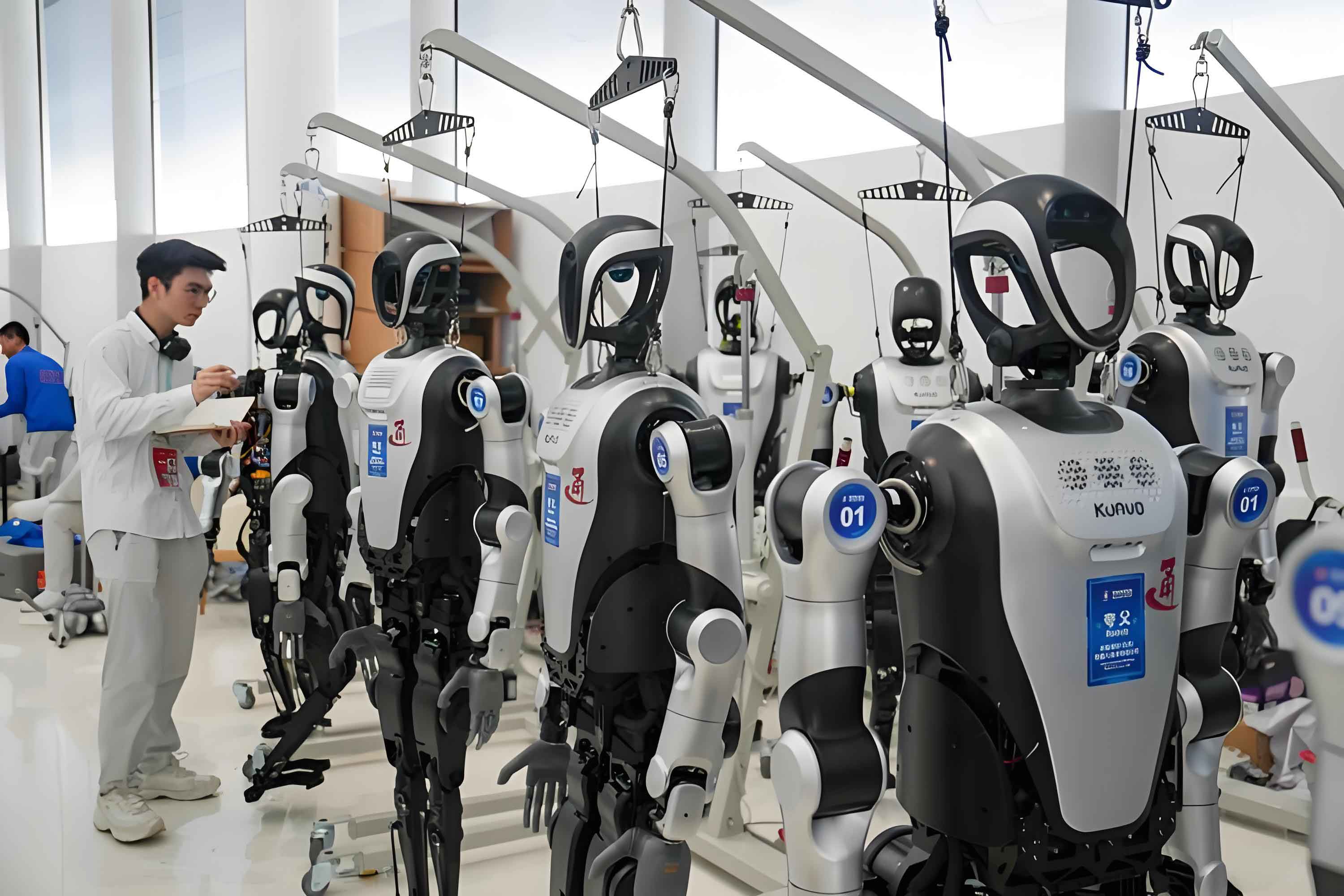
One of the primary applications of humanoid robots in education is enhancing students’ analytical and problem-solving abilities. When students work with a humanoid robot, they are tasked with programming it to perform specific actions, such as walking, speaking, or recognizing objects. This process requires meticulous attention to detail and a deep understanding of cause-and-effect relationships. For instance, programming a humanoid robot to navigate a maze involves algorithms that can be expressed mathematically. Consider a simple pathfinding algorithm like A* search, which can be formalized as:
$$f(n) = g(n) + h(n)$$
Here, \(f(n)\) represents the total cost, \(g(n)\) is the cost from the start node to node \(n\), and \(h(n)\) is the heuristic estimate from \(n\) to the goal. By implementing such algorithms for a humanoid robot, students not only learn coding but also grasp fundamental concepts in optimization and logic. This hands-on experience with a humanoid robot forces learners to debug and iterate, thereby sharpening their analytical skills. In my classes, I often see students who initially struggle with abstract programming concepts become proficient after interacting with a humanoid robot, as the tangible outcomes of their code—such as the robot’s movements—provide immediate feedback.
Beyond problem-solving, humanoid robots are instrumental in cultivating creativity and innovation. The design and customization of a humanoid robot encourage students to think outside the box. For example, in a project where students modify a humanoid robot to perform a dance routine, they must consider aspects like balance, kinematics, and timing. The kinematics of a humanoid robot can be described using transformation matrices. For a robotic arm with multiple joints, the forward kinematics equation might be:
$$T = A_1 \times A_2 \times \cdots \times A_n$$
Where \(A_i\) represents the transformation matrix for each joint. By experimenting with these parameters, students can create unique motions, fostering an innovative mindset. Moreover, the open-ended nature of humanoid robot projects allows for endless possibilities—from integrating sensors for environmental interaction to developing AI-based decision-making systems. In my workshops, I have encouraged students to prototype their own attachments for humanoid robots, such as grippers or cameras, leading to remarkable inventions that solve practical problems. This creative engagement with a humanoid robot not only builds technical skills but also instills a sense of ownership and pride in learners.
Collaboration is another key area where humanoid robots excel. Robotics education often involves team-based projects, and humanoid robots naturally require collective effort due to their complexity. In a typical classroom scenario, students might be divided into groups, each responsible for a different aspect of the humanoid robot’s functionality—hardware assembly, software programming, or sensor integration. This division of labor mirrors real-world engineering teams, teaching students the importance of communication and teamwork. To illustrate, I have compiled a table summarizing the roles in a humanoid robot project and the corresponding skills developed:
| Role in Humanoid Robot Project | Key Skills Developed | Example Tasks |
|---|---|---|
| Hardware Engineer | Mechanical design, soldering, assembly | Building the frame and joints of the humanoid robot |
| Software Developer | Programming, algorithm design, debugging | Coding the gait pattern for the humanoid robot |
| Systems Integrator | Interdisciplinary knowledge, testing, optimization | Ensuring sensors and actuators work harmoniously in the humanoid robot |
| Project Manager | Leadership, scheduling, resource allocation | Coordinating the team to complete the humanoid robot on time |
This collaborative environment around a humanoid robot not only enhances technical proficiency but also soft skills like empathy and conflict resolution. Students learn to appreciate diverse perspectives, as each member contributes to the humanoid robot’s success. In my experience, groups that work on humanoid robot projects often report higher levels of engagement and camaraderie compared to traditional assignments.
Despite these benefits, the integration of humanoid robots in education faces several hurdles. One significant challenge is the insufficient investment in technological research and development. The field of humanoid robotics is still nascent, with many systems lacking maturity and reliability. From my observations, this stems from a global focus on industrial and military applications, leaving educational humanoid robots underfunded. For instance, while countries like Japan excel in bipedal locomotion for humanoid robots, and the United States prioritizes intelligent humanoid robots for defense, educational models often lag behind. This disparity can be quantified by comparing R&D expenditures. Consider the following table, which hypothetically outlines R&D allocation for humanoid robots across sectors:
| Sector | Estimated R&D Investment (in billions USD) | Primary Focus of Humanoid Robot Development |
|---|---|---|
| Industrial Automation | 50 | Precision and efficiency in manufacturing |
| Military and Defense | 30 | Autonomous combat and surveillance humanoid robots |
| Healthcare | 15 | Assistive humanoid robots for rehabilitation |
| Education | 5 | Interactive and programmable humanoid robots for learning |
As shown, education receives a fraction of the funding, which stifles innovation in humanoid robots designed for classrooms. This underinvestment results in humanoid robots that are often expensive, prone to malfunctions, or limited in functionality. In my work, I have encountered schools that cannot afford high-quality humanoid robots, forcing them to rely on outdated models that fail to inspire students. To address this, I advocate for increased public and private funding specifically targeted at educational humanoid robots, with incentives for open-source platforms that reduce costs.
Another issue is the lack of institutional support in educational settings. Many schools and universities treat humanoid robot education as an extracurricular activity rather than a core curriculum component. From my consultations with educators worldwide, I have found that humanoid robot programs are frequently relegated to after-school clubs or optional workshops, denying access to a broader student population. This marginalization stems from misconceptions about the relevance of humanoid robots in academic development. To counteract this, I have promoted the integration of humanoid robots into STEM subjects, using them to teach concepts like physics and computer science. For example, the dynamics of a humanoid robot’s movement can illustrate Newton’s laws. The force balance for a walking humanoid robot can be expressed as:
$$\sum F = m \cdot a$$
Where \(F\) is the force, \(m\) is the mass of the humanoid robot, and \(a\) is its acceleration. By incorporating such equations into lessons, humanoid robots become powerful pedagogical tools. However, without formal curriculum adoption, these opportunities remain untapped. I urge educational policymakers to recognize the value of humanoid robots and mandate their inclusion in syllabi, supported by teacher training programs.
The slow pace of innovation in the humanoid robot industry also poses a barrier. Many companies produce humanoid robots with incremental updates, lacking breakthrough features that could revolutionize education. In my reviews of commercial humanoid robots, I have noted a trend of repetitive designs and proprietary software that limits customization. This stagnation can be attributed to risk-averse business models and fragmented markets. To foster faster development, I propose collaborative frameworks where academia and industry co-create humanoid robots for education. Such partnerships could accelerate advancements in areas like artificial intelligence for humanoid robots, enabling more adaptive and responsive machines. For instance, improving the AI of a humanoid robot to facilitate personalized tutoring involves machine learning algorithms, such as reinforcement learning:
$$Q(s, a) \leftarrow Q(s, a) + \alpha [r + \gamma \max_{a’} Q(s’, a’) – Q(s, a)]$$
Here, \(Q(s, a)\) is the value of taking action \(a\) in state \(s\), \(\alpha\) is the learning rate, \(r\) is the reward, and \(\gamma\) is the discount factor. Implementing this in a humanoid robot could allow it to tailor educational content based on student interactions. Yet, without rapid prototyping and testing, such features remain theoretical. By encouraging agile development cycles for humanoid robots, we can bring cutting-edge technology to classrooms sooner.
Looking ahead, the potential of humanoid robots in education is boundless. As technology evolves, I envision humanoid robots becoming ubiquitous in schools, serving as tutors, lab assistants, and creativity partners. The key lies in addressing the current challenges through concerted efforts. From my perspective, this involves three strategic actions: boosting R&D for educational humanoid robots, integrating them into formal education systems, and promoting open innovation. To illustrate the envisioned progress, consider a future scenario where humanoid robots are used across grade levels. The table below outlines a proposed integration framework:
| Education Level | Role of Humanoid Robot | Expected Learning Outcomes |
|---|---|---|
| Primary School | Interactive companion for basic coding and storytelling | Early exposure to logic and sequencing through the humanoid robot |
| Secondary School | Platform for advanced programming and science experiments | Mastery of STEM concepts via hands-on projects with the humanoid robot |
| University | Research tool for AI, robotics, and human-robot interaction studies | Innovation and publication in fields involving humanoid robots |
| Vocational Training | Simulator for technical skills in maintenance and operation | Job-ready expertise in managing humanoid robots |
This structured approach ensures that every student benefits from exposure to humanoid robots, regardless of their academic path. Moreover, as humanoid robots become more affordable and capable, they will democratize access to high-quality education, bridging gaps in underserved communities. In my outreach programs, I have piloted low-cost humanoid robot kits in rural schools, and the results have been inspiring—students who previously had limited interest in technology are now aspiring engineers.
In conclusion, humanoid robots represent a paradigm shift in robotics education. Through my journey as an educator, I have seen how these machines can ignite passion, deepen understanding, and prepare learners for a future dominated by technology. While obstacles like funding shortages and institutional resistance persist, the collective efforts of innovators, educators, and policymakers can overcome them. By embracing humanoid robots as essential educational tools, we can unlock a new era of learning where creativity and collaboration thrive. The humanoid robot is not merely a device; it is a partner in shaping the minds of tomorrow, and its role in education will only grow more profound with time.