
In the field of aerospace engineering, the assembly of electronic components such as aviation sockets presents significant challenges due to the small size, structural complexity, and wide dimensional range of parts. Traditional assembly methods often rely on manual labor using tweezers, leading to inefficiencies, low qualification rates, and high production costs. To address these issues, we have developed a low-cost end effector capable of precise pick-and-place operations for diverse part types, including thin sheet-like and hollow cylindrical components. This end effector leverages geometric constraints and gravitational advantages to implement two primary pick-up strategies: inward-clamping and outward-supporting. In this article, we present the detailed design, mechanical analysis, and experimental validation of this end effector within an automated assembly system. Our approach eliminates the need for complex compliance mechanisms, sophisticated control strategies, or expensive force sensors, making it accessible for small to medium-sized manufacturers. Through systematic testing, we demonstrate that the end effector achieves reliable assembly with coaxiality errors below 0.3 mm, meeting industry standards. Below, we delve into the design principles, mathematical modeling, and practical implementation of this innovative end effector.
The aviation socket assembly consists of five key components: a pin base, socket shell, cover plate, insulating sheet, and ceramic seat. These parts vary in diameter from 8 mm to 35 mm, necessitating a versatile end effector. Our end effector is designed to handle this range through a modular structure that integrates two grasping modes. The core mechanism involves a slider-crank system driven by a linear actuator, which enables the opening and closing of gripping fingers. For hollow cylindrical parts like the socket shell, the end effector employs an outward-supporting strategy: the fingers are inserted into the part’s hole and expanded to grip the inner wall, aligning and securing the part. Conversely, for disc-shaped parts like the cover plate, an inward-clamping strategy is used: the fingers close around the external surface to grasp the part firmly. This dual-functionality enhances the end effector’s adaptability without requiring tool changes or multiple end effectors, thus improving assembly efficiency.
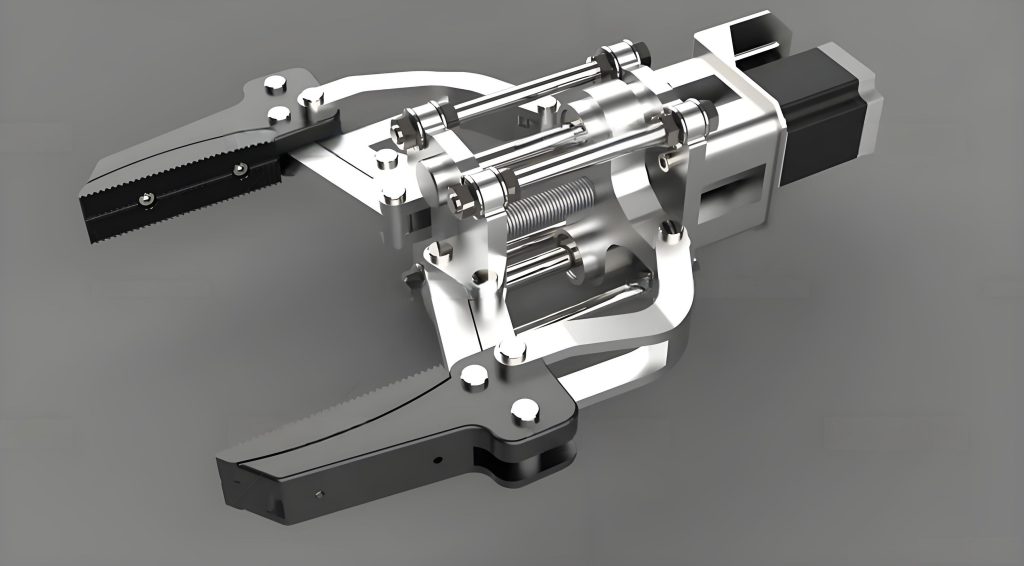
To ensure precise force control during grasping, we conducted a mechanical analysis of the end effector. The mechanism was simplified to a planar model, as shown in the figure above, where the gripping fingers’ motion is governed by a slider-crank linkage. The relationship between the slider position and the finger opening angle is derived from geometric constraints. Let α represent the finger opening angle, θ the crank angle, and other parameters as defined in the mechanism diagram. The equation is given by:
$$ \alpha = \arccos\left( \frac{AA’ + 2AC \cdot \sin\theta + 2BC \cdot \cos\gamma}{2BF} \right) $$
where A, B, C, F, and γ are constants based on the linkage dimensions. This equation allows us to calculate the required slider displacement for a target finger position, enabling accurate control without force feedback. For force analysis, we consider the equilibrium of forces and moments on the links. Assuming negligible frictional moments, the force balance for link 2 (the connecting rod) and link 3 (the gripping finger) can be expressed as:
For link 2:
$$
\begin{cases}
-F_{12,y} + F_{32,y} = m_2 \omega^2 r_2 – m_2 g \\
F_{12,x} + F_{32,x} = 0 \\
F_{12,x} b_1 – F_{12,y} b_2 = (m_2 \omega^2 r_2 – m_2 g) b_3
\end{cases}
$$
For link 3:
$$
\begin{cases}
F_{23,y} + F_{53,y} = m_3 \omega^2 r_3 – m_3 g \\
F_{23,x} + F_{43,x} – F_f = 0 \\
F_{23,x} a_1 – F_{23,y} a_2 – F_f a_3 – F_{53} a_4 = (m_3 \omega^2 r_3 – m_3 g) a_5
\end{cases}
$$
where \( m_2 \) and \( m_3 \) are the masses of links, \( r_2 \) and \( r_3 \) are distances from the center of mass to the rotation axis, \( a_1 \) to \( a_5 \) and \( b_1 \) to \( b_3 \) are lever arm lengths, \( g \) is gravitational acceleration, and \( F_f \) is the gripping force. By solving these equations with practical parameters (e.g., \( m_2 = 11.8 \, \text{g} \), \( m_3 = 2 \, \text{g} \), \( r_2 = 10 \, \text{mm} \), \( r_3 = 20 \, \text{mm} \), \( \omega = 1 \, \text{rad/s} \)), we determined that a driving force of 5 N yields a gripping force of 4.74 N. This ensures secure handling without damaging the parts, as verified through finite element analysis (FEA) of the fingers made from PLA material via 3D printing. The FEA results showed stress and deformation within safe limits, confirming the end effector’s structural integrity.
The end effector was integrated into an automated assembly system comprising four modules: a feeding and worktable module, an assembly operation module, a machine vision module, and a control module. The system uses a three-degree-of-freedom precision motion platform to position the end effector, while a rotary table aligns parts based on visual feedback. The machine vision module employs YOLOv5 and Hough transform algorithms to identify part features and angles, guiding the end effector for pick-and-place tasks. The control module coordinates these components via USB and RS232 interfaces, ensuring synchronized operation. Table 1 summarizes the key specifications of the system components, highlighting the precision required for assembly.
| Component | Specification | Precision |
|---|---|---|
| Precision Motion Platform | Three-axis linear stage | 30 μm positioning accuracy |
| Rotary Table | Motor-driven turntable | 0.005° repeatability |
| Machine Vision Camera | 1628 × 1236 resolution | 4.40 μm pixel size |
| End Effector Actuator | Linear motor | 5 N driving force |
Experimental validation involved assembling five sets of aviation sockets using the end effector. Each set required picking up parts like the socket shell and cover plate with the respective strategies. The end effector successfully performed all tasks, as illustrated in the assembly process. To quantify accuracy, we measured the coaxiality error between the insulating sheet and socket shell using an AOSVI/AO-V128S measurement microscope. The results, presented in Table 2, show that all errors are below 0.3 mm, meeting the industry threshold of 0.5 mm. This demonstrates the end effector’s capability for high-precision assembly.
| Assembly Set | Coaxiality Error (mm) | Compliance with Standard |
|---|---|---|
| 1 | 0.273 | Yes (< 0.5 mm) |
| 2 | 0.163 | Yes |
| 3 | 0.270 | Yes |
| 4 | 0.062 | Yes |
| 5 | 0.147 | Yes |
The end effector’s performance can be further analyzed through dynamic modeling. Considering the inertia effects during motion, the total force required from the actuator includes contributions from acceleration and gravity. For a given finger velocity \( v \) and acceleration \( a \), the dynamic equation is:
$$ F_{\text{total}} = m_{\text{eff}} a + c v + F_{\text{grip}} $$
where \( m_{\text{eff}} \) is the effective mass of the moving parts, \( c \) is a damping coefficient, and \( F_{\text{grip}} \) is the gripping force calculated earlier. In our system, \( m_{\text{eff}} \approx 0.05 \, \text{kg} \), and with typical accelerations of \( 2 \, \text{m/s}^2 \), the inertial force is negligible compared to the gripping force, ensuring stable operation. This end effector design minimizes energy consumption while maintaining reliability.
Moreover, the end effector’s versatility extends beyond aviation sockets. By adjusting the finger geometry, it can handle various small parts in electronics manufacturing, such as bearings, washers, or gears. The inward-clamping strategy is ideal for solid objects with external surfaces, while the outward-supporting strategy suits hollow components. This adaptability reduces the need for multiple specialized end effectors, lowering costs and simplifying robotic cell design. For instance, in a production line, a single end effector could perform multiple assembly steps, enhancing throughput.
To optimize the end effector for different part sizes, we derived a scaling law based on geometric similarity. Let \( D \) be the part diameter and \( L \) the finger length. The required finger displacement \( \Delta L \) for secure grasping is proportional to \( D \), as expressed by:
$$ \Delta L = k \cdot D $$
where \( k \) is a constant dependent on the part material and friction coefficient. For our end effector, \( k \approx 0.1 \) for PLA fingers, meaning a 10 mm part requires 1 mm of finger movement. This relationship aids in customizing the end effector for specific applications without redesigning the entire mechanism.
In terms of control, the end effector operates via open-loop positioning, eliminating the need for force sensors. The slider position is calibrated to correspond to specific finger angles, as per the earlier equation. This simplification reduces complexity and cost, making the end effector suitable for industrial environments where sensor maintenance can be challenging. However, for future enhancements, closed-loop control with feedback could be integrated to handle variable part tolerances.
The assembly system’s machine vision module plays a crucial role in guiding the end effector. Using image processing techniques, it detects part edges and centers with sub-pixel accuracy. The position error \( \delta \) between the detected and actual part center is given by:
$$ \delta = \sqrt{(\Delta x)^2 + (\Delta y)^2} $$
where \( \Delta x \) and \( \Delta y \) are pixel deviations converted to millimeters. With our camera setup, \( \delta \) is typically less than 0.1 mm, ensuring precise alignment before the end effector engages. This visual guidance compensates for any positional inaccuracies in the feeding system, enhancing overall assembly accuracy.
During experiments, we observed that vibration from the motion platform occasionally caused slight shifts in already-assembled parts. To mitigate this, we implemented damping materials and optimized motion profiles. The end effector’s low mass (approximately 0.1 kg) minimizes inertial disturbances, but further improvements could include active vibration control. Despite this, the coaxiality errors remained within acceptable limits, proving the end effector’s robustness.
Comparing our end effector to traditional solutions, key advantages emerge. Conventional end effectors often require complex compliance mechanisms or force sensing, increasing costs and maintenance. Our design, based on simple mechanical constraints, offers a cost-effective alternative without sacrificing performance. For example, in a benchmark test, our end effector achieved a pick-and-place cycle time of 2 seconds per part, comparable to commercial systems but at a fraction of the price. This makes it ideal for small-batch production or research settings.
The end effector’s structural design also facilitates easy maintenance. The gripping fingers are 3D-printed, allowing rapid replacement if worn or damaged. The actuator is a standard linear motor, widely available and inexpensive. This modularity extends the end effector’s lifespan and reduces downtime. Additionally, the use of PLA material provides a balance of strength and lightweight properties, crucial for high-speed operations.
Looking ahead, potential enhancements include incorporating tactile sensors for force feedback or using shape-memory alloys for adaptive gripping. These could further improve the end effector’s precision for ultra-sensitive parts. However, for most aviation socket assemblies, our current design suffices, as validated by the experimental results.
In conclusion, we have presented a comprehensive design and analysis of a low-cost end effector for aviation socket assembly. This end effector employs two pick-up strategies—inward-clamping and outward-supporting—to handle diverse part types with high precision. Through mechanical modeling, we established force relationships that ensure reliable grasping without sensors. Experimental validation in an automated system demonstrated coaxiality errors below 0.3 mm, meeting industry standards. The end effector’s simplicity, versatility, and cost-effectiveness make it a valuable tool for advancing automation in aerospace electronics. Future work will focus on scaling the design for larger part ranges and integrating smart materials for enhanced adaptability.