
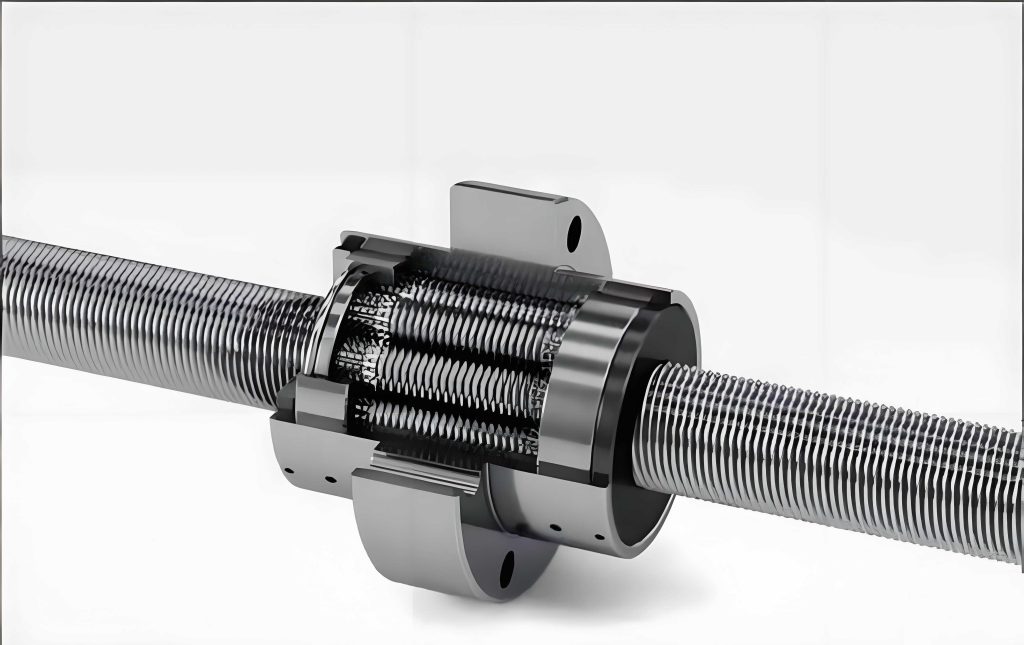
As a high-end transmission component, the planetary roller screw holds significant application value in critical fields such as robotics, CNC machine tools, and aerospace. The performance metrics of the planetary roller screw, including its precision, load-bearing capacity, and production efficiency, are directly determined by the design of its core processing equipment—the planetary roller screw grinding machine. This article delves into the key design points of the planetary roller screw grinder from perspectives such as structural design, precision control, and process optimization, analyzing the current domestic and international technological landscape. Through case analysis, it proposes directions for innovation, aiming to provide a reference for the research and development of domestically produced high-end grinding machines.
Analysis of Design Requirements for Planetary Roller Screw Grinding Machines
The manufacturing of the planetary roller screw imposes stringent requirements on grinding equipment, which can be categorized into three primary areas: precision, adaptability to complex conditions, and production economics.
High-Precision Machining Requirements
The lead accuracy of a planetary roller screw is typically graded according to international standards (e.g., ISO 3408-3). Achieving high grades is paramount for applications in precision machinery. The requirements extend beyond simple lead accuracy to encompass dynamic and geometric accuracies of the machine tool itself.
| Precision Grade (ISO 3408-3) | Lead Error over 300 mm | Typical Application |
|---|---|---|
| G1 | ≤ 6 μm | Ultra-high precision CNC machines, semiconductor equipment |
| G3 | ≤ 12 μm | High-end industrial robots, aerospace actuators |
| G5 | ≤ 23 μm | General precision automation |
To consistently produce G1 or higher-grade planetary roller screws, the grinding machine must exhibit exceptional kinematic performance. The workpiece spindle (C-axis) requires a rotational repeatability of ≤ ±2 arcseconds. Linear axes (e.g., Z-axis for longitudinal motion) demand nanometer-level positioning resolution and high dynamic stability to accurately generate long threads and complex profiles like modified involutes. The synchronization error between coupled axes (e.g., C and Z for thread grinding) must be minimized, often requiring compensation algorithms.
Adaptability to Complex Working Conditions
Planetary roller screws are commonly manufactured from hardened materials such as alloy structural steels (e.g., 42CrMo) or high-carbon chromium bearing steels (e.g., GCr15). After heat treatment, their hardness can reach HRC 58-62. Grinding such hard materials generates substantial heat, posing risks of thermal damage to the workpiece (e.g., burns, micro-cracks) and inducing thermal deformation in the machine tool structure. Therefore, the machine must integrate a high-efficiency cooling system and, more critically, a robust thermal error compensation mechanism to negate the effects of temperature drift on machining accuracy. Furthermore, the machine must handle various screw geometries, including multi-start threads and varying pitches.
Production Efficiency and Cost Control
Traditional manufacturing methods for planetary roller screws, such as single-point grinding or lapping, suffer from low efficiency and high cost. While rolling processes are suitable for mass production, they present high technical barriers, especially for large or high-precision screws. Therefore, a modern planetary roller screw grinding machine must enhance productivity without compromising precision. This is achieved through features like multi-axis interpolation, automatic in-process gauging, and automated loading/unloading systems, which reduce cycle times, minimize human intervention, and lower the per-unit cost.
Core Design Elements of a Planetary Roller Screw Grinding Machine
Structural Design: Multi-Axis Interpolation and Modular Integration
The structural design forms the foundation for precision and flexibility. A state-of-the-art machine features a multi-axis configuration tailored for the complex kinematics of planetary roller screw thread grinding.
- Multi-Axis Servo Mechanism: A typical configuration includes:
- C-axis: High-torque direct-drive rotary table for workpiece rotation.
- Z-axis: Longitudinal axis for workpiece feed along the screw length.
- X-axis: Transverse axis for infeed of the grinding wheel.
- A-axis/B-axis: Optional tilting/swiveling axes for the wheelhead to grind modified flank angles or perform dressing.
The X and Z axes often employ linear motors for high-speed, high-acceleration motion with minimal backlash. To ensure perfect synchronization between the C and Z axes during thread grinding, cross-coupling control algorithms are implemented in the CNC. These algorithms actively compensate for following errors between the axes. A simplified representation of such a control law is:
$$
u_{comp} = K_p (e_1 – e_2) + K_i \int (e_1 – e_2) dt
$$
where \(K_p\) and \(K_i\) are the proportional and integral gains for synchronization, and \(e_1\) and \(e_2\) are the tracking errors of the two axes (e.g., C and Z). This allows synchronization errors to be controlled within 0.8 μm over a 300 mm travel.
- High-Speed High-Precision Electospindle: The wheel spindle is a critical component. A high-frequency electrospindle with liquid cooling is standard, offering speeds up to 6,000-10,000 rpm. Key specifications include radial/axial runout ≤ 1 μm, vibration levels below 0.8 mm/s, and high static stiffness (axial ≥ 100 N/μm, radial ≥ 150 N/μm) to maintain wheel integrity under load.
- High-Precision Workpiece Spindle (C-axis): A direct-drive torque motor is preferred for the C-axis to eliminate backlash from gear trains. This setup achieves exceptional rotational accuracy: radial/axial runout ≤ 1-1.5 μm, positioning accuracy ≤ 3 arcseconds, and repeatability ≤ 2 arcseconds.
- Automated Tailstock with In-Process Measurement: An automated tailstock incorporates a precision length gauge. It not only provides consistent workpiece clamping but also in-situ measurement of workpiece thermal elongation during grinding. The CNC system uses this real-time data to automatically compute and compensate for thermal growth, ensuring consistent lead accuracy over long machining cycles.
- In-Process Gauging System: A touch-trigger probe or laser profile scanner integrated into the machine allows for automatic on-machine inspection of thread profile, lead, and major/minor diameters. This enables closed-loop machining adjustments and reduces setup times.
- CNC System and Grinding Software: A high-end CNC platform (e.g., Siemens 840D sl) is essential. It must support complex multi-axis interpolation, high-speed data processing, and seamless integration with peripheral units. Specialized grinding software is paramount. Modern software uses a modular architecture and adaptive algorithms. It can import CAD models (STEP/IGES), automatically recognize thread features from a database, and generate optimized grinding paths. For complex profiles like variable-diameter or interrupted threads, the software employs real-time path compensation techniques, achieving contour accuracy within ±2 μm. Intelligent process optimization modules can use sensor data (temperature, vibration, power) and machine learning models to adapt grinding parameters dynamically, improving surface finish (e.g., achieving Ra 0.2 μm) and boosting efficiency by over 40% for difficult materials like titanium alloys.
Precision Control: Dynamic Compensation and Closed-Loop Systems
Sustained micron-level accuracy requires active compensation for various error sources.
| Error Source | Compensation Strategy | Key Technology / Component |
|---|---|---|
| Thermal Deformation | Real-Time Thermal Error Compensation | PT100/PT1000 sensor network, Thermal error model, CNC compensation cycles |
| Geometric/Backlash Errors | Laser Calibration & Volumetric Compensation | Laser interferometer, Ballbar, Volumetric compensation software |
| Servo Following/ Synchronization Error | Advanced Feedforward & Cross-Coupling Control | High-resolution encoders, CNC advanced control packages |
| External Vibration | Passive Damping & High Rigidity Structure | Polymer concrete/marble bed, Tuned mass dampers, Air isolation mounts |
The thermal compensation workflow is a critical closed-loop:
Sensor Data (from machine structure) → Temperature Field Analysis → Thermal Error Calculation (via model) → CNC Compensation (applying offsets to X, Z, and possibly C-axis). This loop can reduce thermally induced errors by 80-95%.
Furthermore, a full closed-loop feedback system using linear scales (glass or laser) on all major axes provides the CNC with the true axis position, bypassing errors from mechanical transmission elements like ball screws.
Process Optimization: Grinding Parameters and Tooling Selection
The grinding process itself must be finely tuned for the planetary roller screw material and finish requirements.
- Grinding Wheel Selection: Cubic Boron Nitride (CBN) wheels are predominantly used for their high hardness, thermal stability, and long life, especially for hardened steels. The bond type (vitrified, metal, resin) and abrasive concentration are selected based on the required balance between material removal rate and surface quality. For alloy steels, vitrified bonded CBN wheels are common.
- Parameter Matching: Optimal grinding parameters prevent thermal damage and ensure profile accuracy. Key parameters include:
- Wheel speed (\(v_s\)): Typically 80-120 m/s for CBN.
- Workpiece speed (\(v_w\)): Dictates the lead.
- Depth of cut (\(a_e\)): Very small for finish grinding, often in microns.
- Coolant flow rate and pressure: High-pressure coolant (up to 100 bar) is essential for efficient chip evacuation and heat removal.
- In-Process Monitoring: Integrating acoustic emission sensors or spindle power monitors can help detect wheel wear or process irregularities, enabling condition-based dressing or parameter adjustment.
Technical Challenges and Future Innovation Pathways
Current Technological Bottlenecks
The development of domestic high-end planetary roller screw grinding machines faces several hurdles:
| Challenge Category | Specific Bottleneck | Consequence |
|---|---|---|
| Core Components | Dependence on imported CNC systems, high-precision linear guides/encoders, high-speed electrospindles, and torque motors. | High machine cost, long lead times, supply chain vulnerabilities. |
| Material & Process | Limited performance of domestic specialty steels; immature cold-rolling工艺 for high-precision, large-size planetary roller screws. | Restricts product quality and limits mass production efficiency. |
| System Integration & Software | Lack of deeply integrated, intelligent grinding software with advanced adaptive control and digital twin capabilities. | Lower automation level, reliance on operator skill, sub-optimal process efficiency. |
Future Innovation Pathways
To achieve technological independence and leadership, the development of planetary roller screw grinding technology should focus on the following pathways:
- Intelligentization and Digitalization:
- Integrate AI algorithms for optimizing grinding paths, predicting wheel wear, and suppressing chatter vibration.
- Develop comprehensive Digital Twin models of the machine and process. This enables virtual commissioning, process simulation, and predictive maintenance, reducing downtime and optimizing performance before physical cuts are made.
- Process Compounding and Hybridization:
- Research and develop Turn-Grind or Mill-Grind hybrid machines. Such platforms could perform rough turning/milling and finish grinding of the planetary roller screw in a single setup, dramatically reducing process chain time (e.g., from 72 hours to 48 hours) and improving relative positional accuracy between features.
- Domestication and Cost Reduction:
- Accelerate the R&D and industrialization of domestic high-precision core components: nano-resolution encoders, high-DN value spindle bearings (DN ≥ 3×10^6), and direct-drive motors.
- Promote the scaled application of near-net-shape processes like precision cold rolling for suitable planetary roller screw sizes, followed by finishing grinding. This can reduce material waste and lower unit costs by over 30%.
- Green and Sustainable Manufacturing:
- Adopt Minimum Quantity Lubrication (MQL) or cryogenic cooling techniques to reduce coolant consumption and environmental impact.
- Implement CBN wheel regeneration/reconditioning technologies to extend wheel life, further reducing consumable costs and energy consumption per part.
Conclusion and Outlook
The planetary roller screw grinding machine is a cornerstone in the manufacturing of high-performance transmission components. Its design sophistication directly dictates the performance ceiling and market competitiveness of the final planetary roller screw product. This analysis leads to several key conclusions:
1. High-Precision Multi-Axis Cooperative Control is the Technological Core. The synergistic use of linear motor drives (achieving synchronization errors ≤ 0.8 μm) and direct-drive torque motors (with C-axis repeatability ≤ 2 arcseconds), governed by advanced cross-coupling algorithms, is essential for mastering the complex interpolation required for planetary roller screw threads. This approach is proven to consistently achieve lead accuracies of G1 grade or better.
2. Dynamic Compensation of Thermo-Mechanical Errors is Key to Breaking the Micron Barrier. A multi-sensor thermal monitoring network combined with adaptive compensation algorithms integrated into the CNC can suppress machine tool thermal deformation errors to within 5 μm. Coupling this with laser interferometer-based closed-loop feedback paves the way for nano-level real-time correction, meeting the extreme precision demands (e.g., ≤ 2 μm/m error) for aerospace-grade planetary roller screws.
3. Domestic Substitution Requires a Dual-Driven Strategy of “Technology Chain” and “Industrial Chain.” Overcoming dependence on imported core components is crucial for cost control and supply chain security. Concurrent breakthroughs in high-rigidity materials, ultra-precision bearings, and innovative processes like AI-optimized grinding and precision forming are necessary to enhance the overall competitiveness of the domestic planetary roller screw manufacturing ecosystem.
The global market for planetary roller screws is projected to experience significant growth, fueled by emerging demands in humanoid robot joints, semiconductor positioning stages, and advanced aerospace systems. For domestic grinding machine innovation to capture this opportunity, the focus must be steadfastly on intelligentization (leveraging AI and digital twins), compounding (integrating processes), and sustainable domestication of the entire technology stack. This strategic path will ensure the development of planetary roller screw grinding machines that are not only precise and reliable but also efficient, cost-effective, and environmentally conscious.