
In my extensive experience with precision transmission systems, the rotary vector reducer stands out as a cornerstone technology for modern industrial robotics. This sophisticated device, often abbreviated as RV reducer, is a hybrid planetary transmission mechanism that combines a first-stage involute planetary gear set with a second-stage cycloidal pin-wheel drive. Its compact design, high reduction ratio, exceptional torsional stiffness, and remarkably low noise and vibration characteristics make it the preferred choice for heavy-duty robotic joints, such as those found in the base, arm, and shoulder of multi-axis industrial manipulators. The development of a reliable digital twin—a comprehensive three-dimensional model—is paramount for advanced design, performance simulation, and manufacturing optimization. In this article, I will share my methodology for the parametric modeling and virtual assembly of a rotary vector reducer, delving into the mathematical foundations of its critical components and the systematic process of bringing them together in a digital environment. This model serves as the essential precursor for finite element analysis, dynamic simulation, and transmission error prediction.
The fundamental architecture of a rotary vector reducer is ingeniously layered. It operates on a two-stage reduction principle to achieve its high single-stage reduction ratios, typically ranging from 30 to over 150. The first stage is a conventional involute spur gear planetary transmission. The input rotation is delivered to a sun gear, which meshes with multiple planet gears (usually two or three) uniformly distributed around it. In the classic RV configuration, the carrier of this planetary stage is not fixed; instead, it functions as the output member for this stage and is integrally connected to the input mechanism of the second stage. This first-stage carrier is often referred to as the crankshaft housing or simply the output wheel in the context of the complete reducer. The second stage is the heart of the rotary vector reducer: a cycloidal drive. The planet gears from the first stage are rigidly connected to eccentric crankshafts. These crankshafts drive cycloidal disks (RV gears) through eccentric bearings. The cycloidal disks mesh with a stationary ring of pins housed in the针齿壳 (pin housing). The relative motion forces the cycloidal disks to undergo a compound movement—planetary revolution around the central axis and a slow rotation about their own centers. This slow rotation is then extracted as the final output. The kinematic chain is elegant, but its physical realization requires meticulous design and precise assembly.
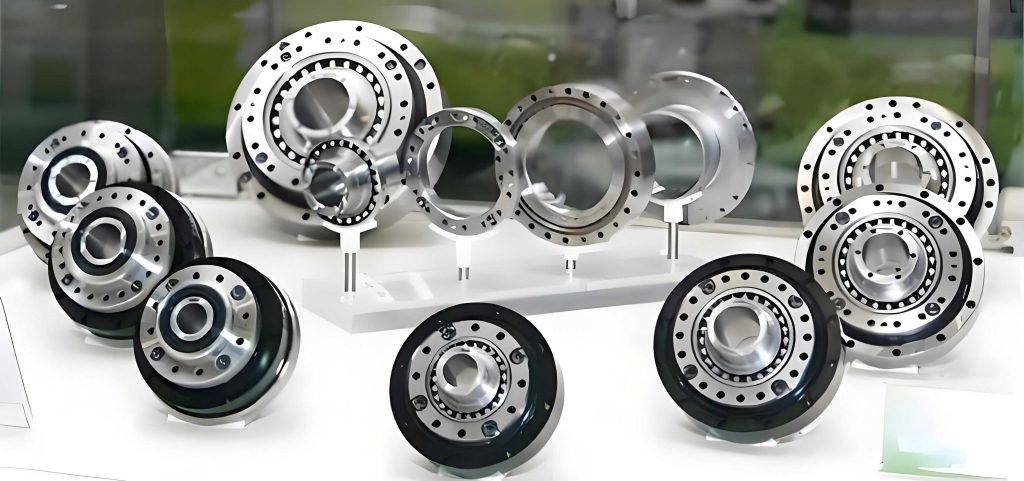
To model this system accurately, one must start with the mathematical definitions of its core components. Let’s begin with the first-stage planetary gears. The sun and planet gears are standard involute spur gears. Their tooth profile is defined by the involute of a circle. The base circle radius $r_b$ is fundamental:
$$r_b = \frac{m \cdot z \cdot \cos(\alpha)}{2}$$
where $m$ is the module, $z$ is the number of teeth, and $\alpha$ is the pressure angle (typically 20°). The parametric equations for the involute curve in the Cartesian coordinate system, starting from the base circle, are given by:
$$x = r_b (\cos \varphi + \varphi \sin \varphi)$$
$$y = r_b (\sin \varphi – \varphi \cos \varphi)$$
where $\varphi$ is the roll angle parameter. In my modeling workflow, I use these equations directly within the CAD software’s equation-driven curve tool to generate a single tooth profile. This profile is then mirrored about the tooth centerline and circularly patterned to create the full gear. This parametric approach allows for quick iteration by simply changing the variables $m$, $z$, and $\alpha$.
The most critical and complex component in a rotary vector reducer is undoubtedly the cycloidal disk (RV gear). Its tooth profile is not an involute but a shortened epicycloid. The profile generation can be visualized as a point on a rolling circle (generating circle) that rolls without slipping on the outside of a fixed base circle (pin circle). The standard tooth profile for an RV reducer is derived from this principle but incorporates a shortening factor to improve contact conditions and load distribution. The parametric equations defining the theoretical tooth flank of the cycloidal disk are as follows:
Let $R_p$ be the radius of the pin center circle (where the centers of the stationary pins lie), $r_r$ be the radius of the rolling circle, $a$ be the eccentricity (distance between the center of the rolling circle and the point generating the curve), and $z_p$ be the number of pins (which is one more than the number of teeth on the cycloidal disk, $z_c$, i.e., $z_p = z_c + 1$). The transmission ratio for the cycloidal stage, $i_{cv}$, is $i_{cv} = z_c / (z_p – z_c) = z_c$. The fundamental parametric equations are:
$$x = (R_p – r_r) \sin \theta – a \sin((1 – i_{cv}) \theta) = (R_p – r_r) \sin \theta – a \sin( (1 – z_c) \theta )$$
$$y = (R_p – r_r) \cos \theta – a \cos((1 – i_{cv}) \theta) = (R_p – r_r) \cos \theta – a \cos( (1 – z_c) \theta )$$
Here, $\theta$ is the parameter representing the rotation angle of the crankshaft. However, for manufacturing and to ensure proper backlash, the theoretical profile is often modified through various correction methods (e.g., equidistant correction, isometric correction). A common practical form that includes a shortening coefficient $K_1$ ($K_1 = a \cdot z_p / R_p$, where $0 < K_1 < 1$) is used. The modified coordinates become:
$$x = R_p \left[ \sin \theta – \frac{K_1}{z_p} \sin(z_p \theta) \right]$$
$$y = R_p \left[ \cos \theta – \frac{K_1}{z_p} \cos(z_p \theta) \right]$$
These equations define the locus of the center of a grinding wheel or cutter. The actual tooth profile is then the equidistant curve offset by the radius of the pin $r_{pin}$. Modeling this precisely requires careful implementation of these equations. I create a sketch driven by these parametric relations to define a single tooth valley, then pattern it around the disk. The two cycloidal disks in an rotary vector reducer are identical but assembled 180° out of phase on their respective crankshaft eccentrics to balance radial forces.
| Component | Parameter | Symbol | Value (Example) |
|---|---|---|---|
| Planetary Stage (Involute Gears) | Module | $m_1$ | 1.5 mm |
| Sun Gear Teeth | $z_s$ | 21 | |
| Planet Gear Teeth | $z_p$ | 42 | |
| Cycloidal Stage | Pin Center Circle Radius | $R_p$ | 65 mm |
| Pin Radius | $r_{pin}$ | 3 mm | |
| Number of Pins | $Z_p$ | 40 | |
| Number of Cycloid Disk Teeth | $Z_c$ | 39 | |
| Eccentricity | $a$ | 1.5 mm | |
| Shortening Coefficient | $K_1$ | 0.8 | |
| Overall Reducer | First Stage Ratio | $i_1$ | $(1 + z_p/z_s) = 3$ |
| Total Reduction Ratio | $i_{total}$ | $i_1 \times Z_c = 3 \times 39 = 117$ |
The crankshaft is another vital component. It is a stepped shaft with two eccentric sections (often 180° apart) that carry the bearings for the cycloidal disks. The main journals at each end align with the central axis of the reducer. The eccentricity $e$ of these sections must match the design eccentricity $a$ used in the cycloidal disk equations. Its modeling is relatively straightforward using concentric extrusions and revolves, but precision in the eccentric dimensions is critical. The pin housing (针齿壳) is modeled as a rigid ring with a precise circular pattern of holes to accommodate the pin sleeves or directly modeled pins. The output flange and the planet carrier (often combined into a single complex part) require careful design to integrate bearing seats, bolt patterns, and sealing surfaces.
Once all individual parts are digitally created, the virtual assembly process begins. I adhere to a bottom-up strategy, creating sub-assemblies before the final top-level assembly. This mirrors the actual manufacturing and assembly process and simplifies constraint management. The first sub-assembly I create is the crankshaft module. For each of the three crankshafts, I insert the crankshaft part and then assemble the necessary bearings onto its journals and eccentric sections. Typically, four bearings are used per crankshaft: two on the eccentric portions for the cycloidal disks and two on the central journals for support in the carrier and output flange. The planet gear is then fixed (e.g., via a keyway or spline) to the input end of the crankshaft. Proper bearing orientation (especially for angular contact bearings) must be ensured. The mating conditions are concentricity between bearing bores and shaft journals, and coincident alignment of bearing side faces with shaft shoulders.
The next logical step is assembling the cycloidal disk sub-assembly. I start by placing one cycloidal disk as a fixed component in a new assembly file. Then, I insert the three pre-assembled crankshaft modules. The mating conditions are applied: the outer cylindrical face of the bearing on the first eccentric section of each crankshaft is made concentric with the corresponding bore in the cycloidal disk. Additionally, the side face of the bearing is made coincident with the side face of the disk’s bore. After all three crankshaft modules are mated to the first disk, I insert the second, identical cycloidal disk. The same concentric and coincident mates are applied, but it is crucial to ensure that the two disks are oriented 180° out of phase. This is typically controlled by aligning specific reference geometry, such as a keyway or a marked tooth, between the two disks relative to the crankshaft eccentrics.
Now, the core transmission module needs its output structure. I insert the output flange (which also acts as the second-stage carrier). The inner bores of the output flange are mated concentrically with the outer races of the bearings on the central journals of the crankshafts that protrude towards the output side. A face-to-face coincident mate aligns the output flange with the side of these bearings. At this point, I change the fixed component from the initial cycloidal disk to the output flange, as in the final mechanism, the output flange is the moving output member. Following this, the output-side support bearing is assembled onto the outer diameter of the output flange.
On the input side, the planet carrier (or input-side housing) is assembled similarly. Its inner bores are mated concentrically with the bearings on the input-side central journals of the crankshafts, and its face is aligned accordingly. The carrier-side support bearing is also added. The planet carrier and output flange are then rigidly connected. In practice, this is done using several bolts and dowel pins for precise alignment. In the virtual assembly, I model these connecting bolts and apply concentric mates between the bolt shanks and holes, and coincident mates between bolt heads and the carrier surface.
The stationary pin housing is now introduced. This component houses the ring of pins that mesh with the cycloidal disks. The primary mate is a concentric condition between the large central bore of the pin housing and the outer diameter of the output-side support bearing that is already assembled on the output flange. A coincident mate aligns the pin housing’s inner face with a shoulder on the output flange or its bearing. A critical additional mate is required to ensure proper meshing of the cycloidal teeth with the pins. I apply a tangential mate between the cylindrical surface of one representative pin in the housing and the tooth flank of one of the cycloidal disks. This ensures the correct relative rotational position between the pin ring and the cycloidal disks, simulating the meshed condition. The pins themselves can be modeled as a circular pattern of cylinders within the pin housing part or as separate parts inserted into a patterned set of holes.
Finally, the sun gear (input gear) is assembled. It is placed concentrically with the central axis of the reducer. A coincident mate aligns its back face with the input side of the planet carrier. The most important kinematic mate is the gear mate between the sun gear and the three planet gears. In CAD software like SolidWorks, this is achieved by defining a mechanical mate (gear mate) that specifies the ratio based on the number of teeth or by using a tangent mate between the involute tooth profiles. For accurate simulation, defining the gear ratio is essential. The theoretical ratio for this first stage, assuming a fixed ring gear (which is the case here as the pin housing is fixed), is given by:
$$i_1 = 1 + \frac{N_r}{N_s}$$
where $N_r$ is the number of teeth on the ring gear (conceptually infinite in this RV layout, but the planets orbit the fixed sun) – actually, in this planetary set, the carrier is the output, so the formula is $i_1 = \frac{N_s + N_p}{N_s}$ where $N_p$ is planet teeth? Let’s clarify. In the standard RV configuration, the first stage is a star-type planetary: the sun is input, the ring gear is fixed (connected to the housing), and the planet carrier is output. Therefore, the reduction ratio is:
$$i_1 = 1 + \frac{N_r}{N_s}$$
Since there is no physical internal ring gear in an rotary vector reducer’s first stage, the planets mesh only with the sun and their axes are held by the carrier. This is essentially a mechanism where the “ring gear” has an infinite number of teeth, forcing the planets to orbit. The effective ratio for this stage is simply the ratio of angular velocities: $\omega_{input} / \omega_{carrier} = 1 + (N_{planet} / N_{sun})$, but since the planets don’t mesh with a ring, the kinematics rely on the crankshaft connections. In practical modeling, I often use a simplified approach by fixing the rotational degree of freedom between the sun and the carrier based on the designed ratio.
The last step is to insert all remaining standard components, such as seals, fasteners (bolts, nuts, washers) for housing closures, and any locknuts on the crankshafts. These are added using standard concentric and coincident mates. The complete virtual assembly of the rotary vector reducer now serves as a digital prototype.
| Assembly Step | Components Involved | Primary Mating Constraints | Kinematic Purpose |
|---|---|---|---|
| 1. Crankshaft Module | Crankshaft, Bearings, Planet Gear | Concentricity (shafts & bearings), Coincidence (faces), Keyway alignment. | Creates a rigid unit connecting 1st and 2nd stages. |
| 2. Cycloidal Disk & Crankshafts | Cycloidal Disk (1), 3 Crankshaft Modules | Bearing outer race to disk bore concentricity; Bearing side face to disk face coincidence. | Establishes eccentric revolution of disks around main axis. |
| 3. Dual Disk Assembly | Cycloidal Disk (2), Previous sub-assembly | Same as Step 2, plus 180° phasing constraint between disks. | Balances radial forces; completes 2nd stage driving element. |
| 4. Output Flange Integration | Output Flange, Previous sub-assembly | Flange bores to crankshaft bearing ODs concentric; Flange face to bearing face coincidence. | Connects crankshaft revolution to final output member. |
| 5. Pin Housing Assembly | Pin Housing, Previous assembly | Housing bore to output bearing OD concentric; Tangential mate between one pin and one cycloid tooth. | Defines the fixed reaction member for the cycloidal drive, enforcing the reduction. |
| 6. Sun Gear & Final Assembly | Sun Gear, Planet Carrier, Fasteners | Sun gear concentric with main axis; Gear mate (or ratio constraint) with planet gears. | Introduces the input motion and completes the kinematic chain. |
This digital model is far more than a static visual representation. It forms the basis for a multitude of engineering analyses. For instance, the contact forces between the cycloidal disk teeth and the pins can be studied using finite element analysis (FEA) to verify strength and predict fatigue life. The transmission error, a critical metric for precision in robotics, can be estimated by simulating the kinematic motion with tolerances applied to the parts. Dynamic simulation can reveal vibration modes and torsional stiffness characteristics of the assembled rotary vector reducer. Furthermore, the parametric nature of the model allows for rapid design exploration and optimization. By linking the driving equations and dimensions to a spreadsheet or configuration table, one can automatically generate new reducer variants with different reduction ratios or torque capacities. This integrated digital approach significantly reduces the time and cost associated with physical prototyping and testing.
In conclusion, the process of digitally modeling and assembling a rotary vector reducer is a detailed and systematic engineering endeavor that bridges theoretical kinematics with practical design. The accuracy of the model hinges on the correct implementation of the mathematical profiles for the gears, particularly the cycloidal disk. The assembly sequence and mating constraints must faithfully replicate the physical interactions and kinematic relationships within the reducer. The resulting comprehensive digital twin is an indispensable tool for advancing the design, analysis, and manufacture of these high-precision transmission systems. As demands for robotic speed, precision, and payload continue to increase, the role of such sophisticated digital models in developing the next generation of rotary vector reducers will only become more central to innovation in the field.