
As a researcher in robotics and embodied intelligence, I have witnessed the rapid evolution of humanoid robots from experimental platforms to practical applications. The integration of artificial intelligence, servo control, environmental perception, and new materials has propelled humanoid robots into an unprecedented era of development. These robots, characterized by their human-like structure and behavior, represent a paradigm shift in how machines interact with unstructured environments. The essence of a humanoid robot lies in its ability to mimic human form and function, offering superior adaptability, task versatility, and natural human-robot interaction compared to traditional industrial robots. In real-world settings, where infrastructure and tools are designed around human dimensions, a humanoid robot seamlessly integrates to perform diverse tasks, from social services like elderly care to complex industrial operations.
However, despite advancements, achieving full autonomy in humanoid robots remains a challenge due to limitations in general artificial intelligence. In high-risk, high-complexity scenarios—such as space exploration, nuclear decommissioning, or surgical procedures—relying solely on autonomous systems is impractical. Errors can be costly, and environments are often dynamic and poorly modeled. This is where dual-arm teleoperation emerges as a critical enabler. By incorporating human judgment and intent, dual-arm teleoperation allows precise control of a humanoid robot’s arms, bridging the gap between human expertise and robotic execution. This technology not only compensates for autonomy gaps but also paves the way for human-robot collaboration, where machines learn from human demonstrations to enhance their own intelligence.
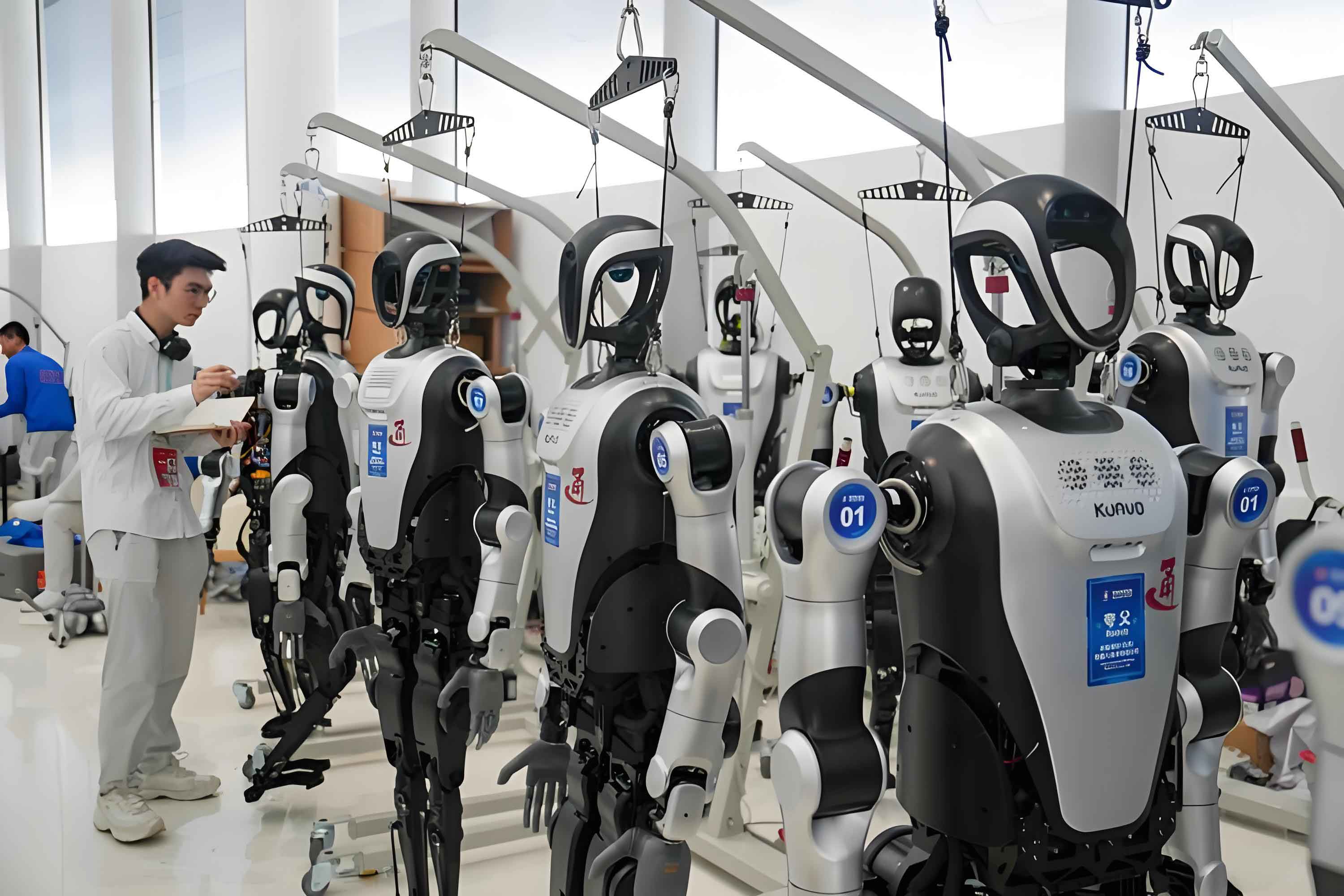
In this article, I will delve into the development of humanoid robots, their core technologies, and the intricacies of dual-arm teleoperation. I will emphasize key aspects through tables and formulas to provide a structured understanding. The goal is to explore how dual-arm teleoperation can drive the practical deployment of humanoid robots, addressing challenges and future trends in the field.
Evolution of Humanoid Robots: A Historical Perspective
The journey of humanoid robots spans over half a century, marked by incremental breakthroughs in mechanics, control, and intelligence. I categorize this evolution into three distinct phases, each contributing to the maturation of humanoid robot capabilities. Below is a table summarizing these phases with key milestones:
| Phase | Time Period | Focus | Key Developments | Representative Humanoid Robots |
|---|---|---|---|---|
| Early Structural Imitation | 1960s-1990s | Mimicking human anatomy and basic locomotion | Rigid structures, bipedal gait, stability control | WABOT series, MIT leg robots |
| Perception and Interaction | 2000s-2010s | Integrating sensors for environment awareness and human-robot interaction | Camera, microphone, force sensor integration; voice and image recognition | ASIMO, NAO |
| Embodied Intelligence | 2010s-Present | Cognitive decision-making, autonomous operation, and learning | AI-driven control, dynamic motion, large language models, cost reduction | Atlas, Optimus, Walker X, Unitree H1 |
The early phase centered on mechanical design, with pioneers like WABOT-1 achieving basic bipedal walking. This era laid the foundation for kinematics and dynamics in humanoid robots. The second phase introduced perception modules, enabling humanoid robots to sense and respond to environments. ASIMO, for instance, could navigate obstacles and recognize faces, though its intelligence was predefined. The current phase leverages artificial intelligence to create embodied intelligent agents. Humanoid robots now exhibit dynamic behaviors—such as Atlas performing backflips—and integrate large language models for task understanding. The shift toward affordable, high-performance platforms, like Unitree H1, indicates a move toward commercialization.
Core Technologies Enabling Humanoid Robots
For a humanoid robot to function effectively, it relies on a synergistic trio of technologies: environment perception, cognition and decision-making, and motion control. Each component is essential for translating sensory input into purposeful action.
Environment Perception in Humanoid Robots
Perception systems in humanoid robots fuse data from multimodal sensors to construct a coherent understanding of the surroundings. Key sensors include cameras, RGB-D depth sensors, LiDAR, inertial measurement units (IMUs), and force-tactile sensors. Visual perception allows for object recognition and spatial mapping, while force and tactile feedback ensure safe interaction. A recent advancement, the HumanoidPano framework, combines 360° spherical vision with LiDAR point clouds to generate bird’s-eye-view semantic maps, mitigating occlusion issues in complex environments. For tactile sensing, flexible electronic skins based on electrical impedance tomography (EIT) provide millimeter-scale resolution for contact localization, enhancing the humanoid robot’s dexterity.
Multimodal fusion is critical for robustness. In unstructured settings, a single sensor may fail due to lighting or obstructions. Fusion algorithms integrate visual, tactile, and auditory data to maintain perception reliability. This can be modeled as an optimization problem:
$$ \text{Fused Perception} = \arg\max_{S} \sum_{i=1}^{N} w_i \cdot \text{Confidence}(S_i) $$
where \( S_i \) represents data from sensor \( i \), \( w_i \) is a weight based on reliability, and the output is a consolidated perception state \( S \). This approach enables humanoid robots to operate in diverse conditions, from industrial floors to outdoor terrains.
Cognition and Decision-Making in Humanoid Robots
Cognition bridges perception and action, involving task understanding, planning, and strategy generation. Modern humanoid robots employ AI models to interpret natural language commands and generate appropriate behaviors. For example, RT-2 models integrate vision-language-action capabilities, allowing a humanoid robot to perform novel tasks like “pick up the fallen tool” without explicit training. Similarly, the ELLMER framework uses GPT-4 to parse instructions and plan multi-step tasks based on real-time feedback.
Decision-making often relies on reinforcement learning (RL) and imitation learning. In RL, a humanoid robot learns policies through trial-and-error in simulated environments. The policy \( \pi \) maps states \( s \) to actions \( a \), maximizing cumulative reward \( R \):
$$ \pi^* = \arg\max_{\pi} \mathbb{E} \left[ \sum_{t=0}^{T} \gamma^t R(s_t, a_t) \right] $$
where \( \gamma \) is a discount factor. Imitation learning, on the other hand, leverages human demonstrations to accelerate learning. These cognitive abilities allow humanoid robots to adapt to dynamic tasks, such as assembling objects or navigating crowded spaces.
Motion Control in Humanoid Robots
Motion control translates cognitive decisions into physical movements, addressing challenges like balance, coordination, and precision. Humanoid robots typically have over 30 degrees of freedom, requiring sophisticated control strategies. Model predictive control (MPC) is widely used for whole-body motion planning. It optimizes a trajectory over a horizon while satisfying constraints:
$$ \min_{u_{0:N-1}} \sum_{k=0}^{N-1} \left( x_k^T Q x_k + u_k^T R u_k \right) + x_N^T P x_N $$
$$ \text{subject to: } x_{k+1} = f(x_k, u_k), \quad g(x_k, u_k) \leq 0 $$
where \( x_k \) is the state, \( u_k \) is the control input, \( Q, R, P \) are weighting matrices, and \( f \) represents dynamics. For dynamic actions like jumping, approaches like bio-inspired hierarchical learning embed RL into MPC, enabling robust performance. In dual-arm operations, impedance control ensures compliance:
$$ F = K_p (x_d – x) + K_d (\dot{x}_d – \dot{x}) $$
where \( F \) is the force, \( K_p \) and \( K_d \) are gains, and \( x_d, x \) are desired and actual positions. This allows a humanoid robot to handle delicate objects safely.
Dual-Arm Teleoperation for Humanoid Robots: Applications and Drivers
Dual-arm teleoperation has become a pivotal technology for deploying humanoid robots in real-world scenarios. It allows human operators to remotely control the robot’s arms, leveraging human intuition for tasks that are too complex for full autonomy. Below, I outline key application areas and the technical drivers behind this technology.
| Application Area | Challenges | Role of Dual-Arm Teleoperation | Examples |
|---|---|---|---|
| Nuclear Decommissioning | High radiation, confined spaces, low visibility | Remote manipulation for debris removal and equipment handling | Fukushima cleanup, robotic arms in hazardous zones |
| Space Exploration | Communication delays, unstructured environments, high stakes | Astronaut-controlled robots for sample collection and maintenance | ESA’s Surface Avatar project, Rollin’ Justin robot |
| Power Grid Maintenance | High voltage, outdoor variability, safety risks | Teleoperated robots for live-line work, reducing human exposure | 10 kV带电作业 robots with shared control |
| Offshore Energy | Harsh weather, remote locations, costly downtime | Remote inspection and repair of platforms using humanoid robots | NASA Valkyrie in offshore operations |
| Medical Surgery | Precision requirements, delicate tissues, real-time feedback | Surgeon-guided robotic arms for minimally invasive procedures | Head-neck surgical assistants with force feedback |
In these applications, dual-arm teleoperation enhances safety and efficiency. For instance, in space missions, operators on Earth or in orbit control humanoid robots to perform tasks like collecting samples, avoiding the risks of human extravehicular activity. The shared control paradigm is crucial here: humans handle high-level decision-making, while the humanoid robot manages low-level execution autonomously. This synergy reduces cognitive load and improves task success rates.
Moreover, teleoperation serves as a data source for machine learning. By recording human demonstrations, we can train humanoid robots to perform tasks autonomously over time. The RoboCopilot framework, for example, uses interactive imitation learning to refine robot policies during teleoperation, accelerating skill acquisition.
Key Technologies in Dual-Arm Teleoperation for Humanoid Robots
Implementing effective dual-arm teleoperation involves three core technologies: human-robot mapping, multimodal feedback, and master-slave control strategies. Each addresses specific challenges in translating human intent to robotic action.
Human-Robot Mapping Mechanisms
Mapping refers to the process of converting human movements into commands for a humanoid robot’s arms. Common approaches include motion capture (e.g., optical or IMU-based), wearable exoskeletons, and intent prediction via electromyography (EMG) or electroencephalography (EEG). For humanoid robots, isomorphic skeleton mapping is prevalent due to structural similarity. This involves aligning human and robot joint topologies to ensure natural motion replication.
Mathematically, mapping can be expressed as a transformation \( T \) from human joint angles \( \theta_h \) to robot joint angles \( \theta_r \):
$$ \theta_r = T(\theta_h) + \epsilon $$
where \( \epsilon \) accounts for errors or adaptations. Advanced methods like the TWIST framework use reinforcement learning to adapt this mapping in real-time, minimizing latency. In terms of hardware, cost-effective solutions like SPARK-Remote have emerged, offering bimanual teleoperation platforms for under $200 per arm, making the technology more accessible.
A table comparing mapping techniques is provided below:
| Mapping Technique | Principles | Advantages | Limitations | Suitability for Humanoid Robots |
|---|---|---|---|---|
| Motion Capture | Optical or inertial tracking of body markers | High accuracy, low latency | Expensive, requires line-of-sight | High for research and precise tasks |
| Wearable Exoskeletons | Direct measurement of joint angles via sensors | Immersion, force feedback capability | Bulky, may limit mobility | Moderate for industrial applications |
| Intent Prediction (EMG/EEG) | Decoding muscle or brain signals for commands | Hands-free, useful for disabilities | Low signal-to-noise ratio, requires training | Emerging for specialized humanoid robot control |
| Isomorphic Skeleton Mapping | Kinematic matching of human and robot structures | Intuitive, reduces cognitive load | Assumes similar morphology, may not generalize | High for humanoid robots due to design similarity |
Multimodal Perceptual Feedback
Feedback is essential for operators to feel “present” in the remote environment. It encompasses visual, force, tactile, auditory, and even physiological channels. Visual feedback often uses VR headsets to display 3D reconstructions from the humanoid robot’s cameras. Force feedback devices, such as haptic controllers, provide resistance based on robot-environment interactions, enhancing precision.
The concept of whole-body bilateral feedback extends this to include posture and cognitive state. For example, operators might wear EEG headsets to monitor mental workload, with the system adjusting control autonomy accordingly. This can be modeled as a feedback loop:
$$ u_{\text{total}} = \alpha \cdot u_{\text{human}} + (1 – \alpha) \cdot u_{\text{robot}} $$
where \( \alpha \) is a weighting factor derived from operator state metrics like attention or fatigue. Studies show that multimodal feedback improves task performance by up to 30% in complex manipulations, such as suturing or assembly with a humanoid robot.
Master-Slave Cooperative Control Strategies
Control strategies ensure stability and efficiency in teleoperation. They often employ shared control architectures, where humans and the humanoid robot collaborate based on task demands. In high-latency scenarios, such as space communications, the robot may handle local path planning while the operator sets goals.
A prominent approach is whole-body control (WBC), which coordinates arms and legs to maintain balance during manipulation. WBC formulates a quadratic programming problem:
$$ \min_{\tau, f} \| J \tau + f – F_{\text{des}} \|^2 $$
$$ \text{subject to: } A \tau + B f \leq c $$
where \( \tau \) are joint torques, \( f \) are contact forces, \( J \) is the Jacobian, and \( F_{\text{des}} \) is the desired wrench. This allows a humanoid robot to, for instance, reach for an object while adjusting its stance to prevent tipping.
Another strategy is confidence-based intent prediction, used in surgical teleoperation. It fuses visual and force data to estimate operator intent \( I \):
$$ I = \beta_v \cdot I_v + \beta_f \cdot I_f $$
where \( \beta_v, \beta_f \) are confidences from vision and force sensors, modeled via Beta distributions. The humanoid robot then blends human inputs with autonomous corrections, smoothing the control transition.
Mathematical Modeling and Formulas in Humanoid Robot Teleoperation
To deepen understanding, I present key formulas that underpin dual-arm teleoperation for humanoid robots. These cover dynamics, control, and optimization aspects.
1. Dynamics of a Humanoid Robot: The equations of motion for a humanoid robot with \( n \) joints can be expressed using the Lagrangian formulation:
$$ M(q) \ddot{q} + C(q, \dot{q}) \dot{q} + G(q) = \tau + J^T F_{\text{ext}} $$
where \( q \) is the joint angle vector, \( M \) is the inertia matrix, \( C \) represents Coriolis and centrifugal forces, \( G \) is gravity, \( \tau \) is the torque input, and \( F_{\text{ext}} \) are external forces from contacts.
2. Teleoperation Transparency: Ideal transparency means the operator feels as if directly manipulating the environment. This is measured by impedance matching:
$$ Z_h = Z_t + Z_e $$
where \( Z_h \) is human impedance, \( Z_t \) is teleoperator impedance, and \( Z_e \) is environment impedance. In practice, delays and mismatches degrade transparency, requiring compensation algorithms.
3. Shared Control Optimization: In shared control, the objective is to minimize a cost function combining human and robot inputs:
$$ \min_{u_r} \int_0^T \left( \| u_h – u_r \|^2 + \lambda \cdot \text{TaskError}(x) \right) dt $$
where \( u_h \) is human command, \( u_r \) is robot command, and \( \lambda \) adjusts autonomy level. This is used in humanoid robots for tasks like grasping, where the robot assists in alignment.
4. Multimodal Fusion Formula: For sensor fusion in perception, a Bayesian approach can be applied:
$$ P(S | D) = \frac{ \prod_{i=1}^{N} P(D_i | S) P(S) }{ P(D) } $$
where \( S \) is the state (e.g., object position), \( D_i \) is data from sensor \( i \), and \( P(S | D) \) is the posterior probability used by the humanoid robot for decision-making.
Challenges and Future Directions in Dual-Arm Teleoperation for Humanoid Robots
Despite progress, dual-arm teleoperation for humanoid robots faces several hurdles. Addressing these will be crucial for widespread adoption.
| Challenge | Description | Potential Solutions |
|---|---|---|
| Autonomy-Teleoperation Integration | Dynamic allocation of control between human and robot based on task complexity and risk | Adaptive shared control frameworks using real-time intent recognition and AI models |
| Multimodal Feedback Standardization | Lack of unified protocols for combining visual, force, tactile, and physiological feedback | Development of open-source interfaces and benchmarking datasets for humanoid robot teleoperation |
| Latency and Communication Issues | Delays in data transmission, especially in space or remote operations, destabilizing control | Predictive algorithms and local autonomy at the humanoid robot side to compensate for lag |
| Cost and Generalization | High expense of teleoperation platforms and difficulty in adapting to diverse tasks | Modular, low-cost hardware designs and simulation-based training for rapid deployment |
| Human Factors and Ergonomics | Operator fatigue, cognitive overload, and training requirements for effective teleoperation | Ergonomic interface design and AI-assisted guidance to reduce mental strain |
Looking ahead, I anticipate trends toward more intelligent collaboration. Humanoid robots will increasingly learn from teleoperation sessions, building libraries of skills that enhance autonomy. The integration of large language models will enable natural language command interpretation, making teleoperation more intuitive. Additionally, advancements in materials, such as soft robotics, may lead to more dexterous humanoid robot arms, improving manipulation capabilities.
In conclusion, dual-arm teleoperation is a transformative technology for humanoid robots, enabling them to tackle real-world challenges that exceed current autonomous capabilities. By leveraging human expertise, it not only ensures task success but also accelerates the learning curve for robots. As research progresses, we can expect humanoid robots to become more adept partners in fields ranging from healthcare to exploration, ultimately blurring the line between human and machine collaboration.