
In this comprehensive study, we delve into the dynamics formulation of rotary vector reducers, a critical component in precision machinery due to their high reduction ratios, compact size, efficiency, and load-bearing capacity. The rotary vector reducer, often abbreviated as RV reducer, has garnered significant attention globally, yet its dynamic behavior remains underexplored, necessitating robust models for predicting system stiffness and performance evaluation. Our work focuses on developing a torsional dynamic model for a rotary vector reducer, specifically the RV-6AⅡ variant, by integrating stiffness models for both cycloid-pin gear pairs and involute gear pairs. We validate the model through dynamic characteristic experiments and compare the performance of traditional cycloid-pin designs with alternative involute variable tooth thickness configurations. This research aims to provide a practical framework for engineers to optimize rotary vector reducer designs, ensuring reliability and efficiency in applications such as robotics and industrial automation.
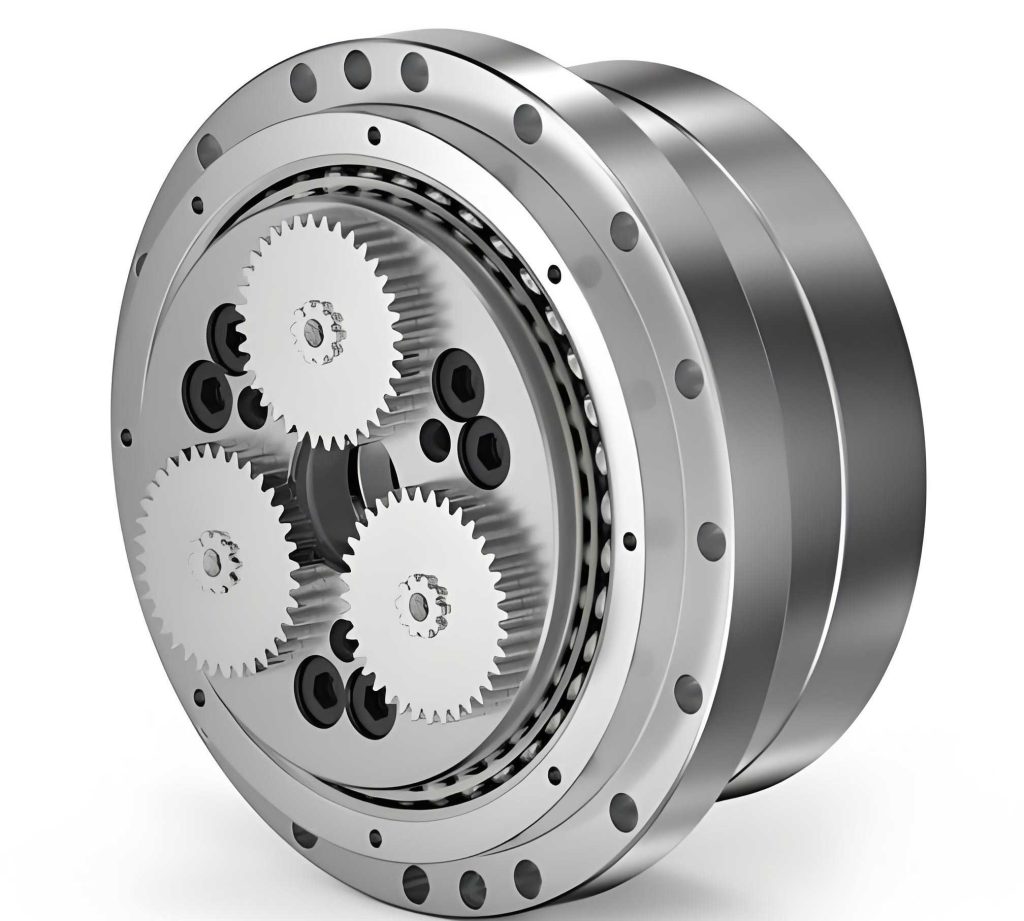
The rotary vector reducer operates through a two-stage transmission: the first stage involves involute gears for initial speed reduction, and the second stage employs cycloid-pin gears for further reduction and torque amplification. This dual-stage mechanism contributes to the rotary vector reducer’s exceptional performance but introduces complexity in dynamic analysis. Prior studies have addressed aspects like force distribution and efficiency, but a unified dynamic model accounting for stiffness variations and vibrational modes is lacking. Our approach bridges this gap by deriving stiffness models from first principles and integrating them into a multi-degree-of-freedom system. The significance of this work lies in its potential to enhance the design and selection of rotary vector reducers, minimizing resonance risks and improving operational stability. Throughout this article, we will emphasize the term “rotary vector reducer” to underscore its centrality in our analysis, reinforcing key concepts for practitioners and researchers alike.
To model the rotary vector reducer, we start with the cycloid-pin gear pair, which is characterized by line contact under ideal conditions. However, elastic deformations transform this into a small area contact, describable using Hertzian theory. For a rotary vector reducer, the cycloid wheel and pin gear are typically made of similar materials, simplifying the analysis. Consider the contact between a cycloid tooth and a pin, as illustrated in Figure 1. The deformation region is approximated as an elliptical area with length \(2a\) and width \(b\). According to Hertz formula, the semi-contact length \(a\) is given by:
$$ a = \sqrt{ \frac{4F_i d_i (1 – \nu^2)}{\pi b E} } $$
where \(F_i\) is the contact force, \(d_i\) is the effective curvature radius at the contact point, \(\nu\) is Poisson’s ratio, \(E\) is Young’s modulus, and \(b\) is the contact width. For a rotary vector reducer, the curvature radius of the cycloid tooth is negative when convex, so we define:
$$ \frac{1}{d_i} = \frac{1}{r_z} – \frac{1}{d_{bi}} $$
Here, \(r_z\) is the pin radius, and \(d_{bi}\) is the curvature radius of the cycloid tooth at contact. Substituting into the equation and assuming material homogeneity (\(\nu_1 = \nu_2 = \nu\), \(E_1 = E_2 = E\)), we simplify to:
$$ a = \sqrt{ \frac{8F_i d_i (1 – \nu^2)}{\pi b E} } $$
The radial deformation of the pin, denoted \(t_z\), can be derived from geometric relations. Using a Taylor expansion for small \(a/r_z\), we obtain:
$$ t_z = \frac{4F_i d_i (1 – \nu^2)}{\pi b E r_z} $$
Thus, the stiffness of a single pin in a rotary vector reducer is:
$$ K_{zi} = \frac{F_i}{t_z} = \frac{\pi b E r_z}{4 d_i (1 – \nu^2)} $$
Substituting for \(d_i\), we express this in terms of design parameters:
$$ K_{zi} = \frac{\pi b E r_z S^{3/2}}{4(1 – \nu^2)(R_z S^{3/2} + r_z T)} $$
where \(S = 1 + K_1^2 – 2K_1 \cos \theta_b\), \(T = K_1 (1 + Z_b) \cos \theta_b – (1 + Z_b K_1^2)\), \(K_1\) is the cycloid design parameter, \(Z_b\) is the number of cycloid teeth, and \(R_z\) is the pitch radius of the pin gear. Similarly, the stiffness of a single cycloid tooth in a rotary vector reducer is:
$$ K_{bi} = \frac{\pi b E R_z S^{3/2}}{4(1 – \nu^2) r_z T} $$
The contact stiffness for a single tooth pair in the cycloid-pin engagement of a rotary vector reducer is then the series combination:
$$ K_{si} = \frac{K_{bi} K_{zi}}{K_{bi} + K_{zi}} = \frac{\pi b E R_z S^{3/2}}{4(1 – \nu^2)(R_z S^{3/2} + 2 r_z T)} $$
For the overall cycloid-pin gear pair in a rotary vector reducer, we must account for multiple simultaneous contacts. The equivalent torsional stiffness \(K_{bz}\) is obtained by summing contributions from all engaged teeth, adjusted for factors like manufacturing errors and incomplete meshing. With \(\lambda\) as an adjustment coefficient (typically 0.6–0.7), and \(L_i’\) as the effective lever arm for the \(i\)-th contact point, we have:
$$ K_{bz} = \lambda \sum_{i=1}^{Z_b/2} K_{si} L_i’^2 $$
This stiffness varies periodically with the rotation of the crankshaft in a rotary vector reducer, at a frequency \(f = n_2 Z_b / 60\), where \(n_2\) is the crankshaft speed. However, for simplicity in dynamic modeling, we approximate \(K_{bz}\) as constant, using its mean value over a cycle. This approximation is justified as fluctuations are less than 5% for typical rotary vector reducer designs.
Next, we model the involute gear pair stiffness in a rotary vector reducer using the Ishikawa formula. The tooth is approximated as a combination of trapezoidal and rectangular sections, as shown in Figure 4. Key geometric parameters include the addendum radius \(r_k\), root radius \(r_r\), effective root radius \(r_F\), and operating pressure angle \(T_x\). The stiffness components—bending, shear, and geometric—are computed for both gears. For a single tooth pair in a rotary vector reducer, the mesh stiffness \(K_s’\) is:
$$ K_s’ = \frac{1}{ \frac{1}{K_{Br1}} + \frac{1}{K_{Bt1}} + \frac{1}{K_{S1}} + \frac{1}{K_{G1}} + \frac{1}{K_{Br2}} + \frac{1}{K_{Bt2}} + \frac{1}{K_{S2}} + \frac{1}{K_{G2}} + \frac{1}{K_{PV}} } $$
where the subscripts 1 and 2 refer to the driving and driven gears, respectively. The terms are defined as:
$$ K_{Br} = \frac{E b S_F^3}{12 \cos^2 k_x h_x h_r} \left( \frac{h_x – h_r}{3} + \frac{h_r^3}{3} \right) $$
$$ K_{Bt} = \frac{E b S_F^3}{6 \cos^2 k_x} \left[ \left( \frac{h_i – h_x}{h_i – h_r} \right)^4 – \frac{h_i – h_x}{h_i – h_r} – 2 \ln \frac{h_i – h_x}{h_i – h_r} – 3 \right] (h_i – h_r)^{-3} $$
$$ K_S = \frac{E b S_F}{2(1 + \nu) \cos^2 k_x} \left[ h_r + (h_i – h_r) \ln \frac{h_i – h_r}{h_i – h_x} \right] $$
$$ K_G = \frac{\pi E b S_F^2}{24 h_x^2 \cos^2 k_x} $$
$$ K_{PV} = \frac{\pi E b}{4(1 – \nu^2)} $$
Here, \(h\) is the tooth height, \(h_r\) is the root height, \(h_x\) is the distance from the root to the load point, \(S_F\) is the tooth thickness at the root, and \(k_x\) is the pressure angle. For practical purposes in a rotary vector reducer, we use the ISO draft standard to approximate single-tooth stiffness at the pitch point, simplifying calculations. The total mesh stiffness for involute gears in a rotary vector reducer is then:
$$ K_d = K_s’ (0.65 X_a + 0.35) $$
where \(X_a\) is the contact ratio. This formulation provides a reliable stiffness estimate for the first stage of a rotary vector reducer.
With stiffness models established, we construct a torsional dynamic model for the rotary vector reducer. Focusing on the RV-6AⅡ reducer, we identify five primary degrees of freedom: input gear, two planetary gears (mounted on crankshafts), cycloid wheel, and output pin gear shell. An inertial disk simulates the workload, and minor elements like bearings are neglected. The planetary carrier is fixed, and the pin gear shell serves as the output. The stiffness matrix \([K]_{5 \times 5}\) for this rotary vector reducer system is:
$$ [K] = \begin{bmatrix}
2K_d R_1^2 & -K_d R_1 R_2 & -K_d R_1 R_2 & 0 & 0 \\
-K_d R_1 R_2 & K_d R_2^2 + K_{n1} & 0 & -K_{n1} & 0 \\
-K_d R_1 R_2 & 0 & K_d R_2^2 + K_{n1} & -K_{n1} & 0 \\
0 & -K_{n1} & -K_{n1} & 2K_{n1} + 2K_{bz} & -2K_{bz} \\
0 & 0 & 0 & -2K_{bz} & 2K_{bz}
\end{bmatrix} $$
where \(R_1\) and \(R_2\) are base circle radii of input and planetary gears, \(K_d\) is involute gear stiffness, \(K_{n1}\) is crankshaft torsional stiffness, and \(K_{bz}\) is cycloid-pin equivalent stiffness. The equation of free vibration for the rotary vector reducer is:
$$ [J]_{5 \times 5} [\ddot{\theta}]_{5 \times 1} + [C]_{5 \times 5} [\dot{\theta}]_{5 \times 1} + [K]_{5 \times 5} [\theta]_{5 \times 1} = [0]_{5 \times 1} $$
Here, \([J]\) is the inertia matrix, \([C]\) is the damping matrix, and \([\theta]\) is the angular displacement vector. Using parameters from the RV-6AⅡ rotary vector reducer, we compute natural frequencies, as summarized in Table 1.
| Mode | 1 | 2 | 3 | 4 | 5 |
|---|---|---|---|---|---|
| Frequency (Hz) | 135 | 973 | 2857 | 4939 | 5837 |
To validate the model, we conducted dynamic characteristic experiments on the rotary vector reducer. The setup involved mounting the RV-6AⅡ reducer on a rigid base with an inertial disk attached to the output to simulate load. Steady-state sinusoidal excitation was applied horizontally at the disk’s outer edge, with vertical response measurement to isolate torsional vibrations. Data analysis utilized specialized software for frequency response functions, yielding static stiffness, dynamic stiffness, and first-mode natural frequency. Results for the cycloid-pin rotary vector reducer showed a static torsional stiffness of 75–85 Nm/rad, dynamic stiffness of 4.83 Nm/rad, and a first-mode frequency of 128 Hz, closely matching model predictions. This confirms the accuracy of our stiffness formulations for the rotary vector reducer.
We also tested an alternative involute variable tooth thickness rotary vector reducer to compare performance. This design replaces cycloid-pin gears with involute gears to reduce manufacturing costs. Experimental results indicated a static stiffness of 40–50 Nm/rad, dynamic stiffness of 4.85 Nm/rad, and a first-mode frequency of 85 Hz. While lower than the cycloid-pin version, this rotary vector reducer offers economic advantages and suitability for low-speed applications. Further refinement could enhance its stiffness, making it a viable option for broader use.
The dynamics of a rotary vector reducer are influenced by design parameters. For instance, increasing the first-stage reduction ratio and decreasing the second-stage ratio can reduce the frequency of stiffness variations in the cycloid-pin pair, mitigating resonance risks. Our model provides a tool for such optimizations, enabling designers to tailor rotary vector reducers for specific operational conditions. Additionally, the use of adjustment coefficients like \(\lambda\) accounts for real-world imperfections, improving model robustness.
In terms of applications, the rotary vector reducer is pivotal in robotics, where precise motion control and high torque are essential. By understanding its dynamic behavior, engineers can prevent vibrational issues that compromise accuracy. For example, in robotic arms, a poorly designed rotary vector reducer might exhibit torsional resonances at operating speeds, leading to positioning errors. Our modeling approach helps identify critical frequencies and stiffness thresholds, guiding selection and integration.
To further elaborate on the stiffness modeling, consider the error analysis for the cycloid-pin deformation approximation. The relative error in radial deformation \(t_z\) is bounded by 3.08% when \(a \leq r_z/4\), which is acceptable for engineering purposes. This justifies our use of simplified formulas in the rotary vector reducer analysis. Moreover, the periodic nature of stiffness in a rotary vector reducer arises from the time-varying contact points, as described by the engagement frequency. For a rotary vector reducer with a pin count \(Z_b = 40\) and crankshaft speed \(n_2 = 1000\) rpm, the stiffness variation frequency is approximately 667 Hz, which may interact with system modes if not properly managed.
The involute gear stiffness model also benefits from parametric studies. Table 2 shows how contact ratio \(X_a\) affects total stiffness \(K_d\) for a typical rotary vector reducer involute pair.
| Contact Ratio \(X_a\) | Single-Tooth Stiffness \(K_s’\) (N/m) | Total Stiffness \(K_d\) (N/m) |
|---|---|---|
| 1.2 | 1.5e8 | 1.43e8 |
| 1.5 | 1.5e8 | 1.58e8 |
| 2.0 | 1.5e8 | 1.78e8 |
This highlights the importance of gear design in optimizing a rotary vector reducer’s dynamic response. Higher contact ratios generally improve stiffness but may increase complexity.
Damping in a rotary vector reducer is another critical factor, though often challenging to quantify. In our model, the damping matrix \([C]\) is typically derived from experimental data or estimated as a percentage of critical damping. For the rotary vector reducer, material damping and lubricant effects contribute to energy dissipation, influencing resonance amplitudes. Future work could incorporate nonlinear damping models to enhance prediction accuracy.
The experimental validation process for the rotary vector reducer involved repeated trials to ensure reliability. Using force and acceleration sensors, we collected data under varying excitation frequencies. The transfer functions revealed peaks corresponding to natural frequencies, with the first mode at 128 Hz aligning with the calculated 135 Hz. Discrepancies are attributed to simplifications in the model, such as neglecting housing flexibility. Nonetheless, the close agreement supports the model’s utility for preliminary design of rotary vector reducers.
Comparing the two types of rotary vector reducers, the cycloid-pin design excels in stiffness and frequency response, making it ideal for high-precision applications. However, its manufacturing demands specialized equipment, raising costs. The involute alternative, while less stiff, leverages existing gear production lines, offering a cost-effective solution for moderate requirements. This trade-off underscores the need for context-specific selection in rotary vector reducer applications.
In conclusion, our dynamic modeling framework for rotary vector reducers integrates stiffness calculations from Hertz and Ishikawa formulas into a torsional system. The model’s validation through experiments confirms its effectiveness in predicting natural frequencies and stiffness characteristics. For designers, we recommend prioritizing first-stage reduction in rotary vector reducers to minimize stiffness variation effects. The involute variable tooth thickness rotary vector reducer presents a promising avenue for cost-sensitive applications, though further research is needed to boost its dynamic performance. This work contributes to the growing body of knowledge on rotary vector reducers, facilitating their optimal use in advanced mechanical systems.
Looking ahead, future studies could explore nonlinear dynamics, thermal effects, and wear in rotary vector reducers. Incorporating finite element analysis might refine stiffness estimates, while real-time monitoring could enable adaptive control. As the demand for efficient compact drives grows, the rotary vector reducer will remain a focal point of innovation, driven by models like ours that balance accuracy and practicality.