
In the field of precision linear actuation systems, the planetary roller screw mechanism has emerged as a critical component due to its high accuracy, long service life, substantial load capacity, and smooth operation. As demand grows in aerospace, defense, industrial machinery, and process control applications, understanding the dynamic behavior of planetary roller screw mechanisms becomes paramount. Traditional studies often focus on kinematics, static load distribution, or friction analysis, but dynamic characteristics, which affect performance and stability, require more comprehensive modeling approaches. This article presents a detailed dynamic analysis model for planetary roller screw mechanisms based on bond graph theory, incorporating multiple factors such as transmission clearances, contact deformations, torsional and compressive stiffness, machining errors, load distribution, friction, and inertias. The model aims to provide a versatile tool for analyzing dynamic responses and improving design and control strategies.
The planetary roller screw mechanism operates by converting rotary motion into linear motion through threaded engagements between the screw, rollers, and nut. Its unique configuration allows for high load transmission with minimal backlash, but dynamic interactions among components can lead to vibrations, noise, and reduced accuracy. To address these issues, we develop a bond graph model that captures the nonlinear and segmented characteristics of contact forces and damping due to clearances and errors. Additionally, we integrate the LuGre friction model to account for stick-slip phenomena and velocity-dependent friction effects. By deriving state equations and simulating various operational conditions, we explore the influences of screw speed, slide-roll ratio, clearances, and machining errors on dynamic stiffness and friction response. This work extends existing research by offering a holistic dynamic model that facilitates multi-domain simulations and enhances the understanding of planetary roller screw mechanism behavior under realistic conditions.
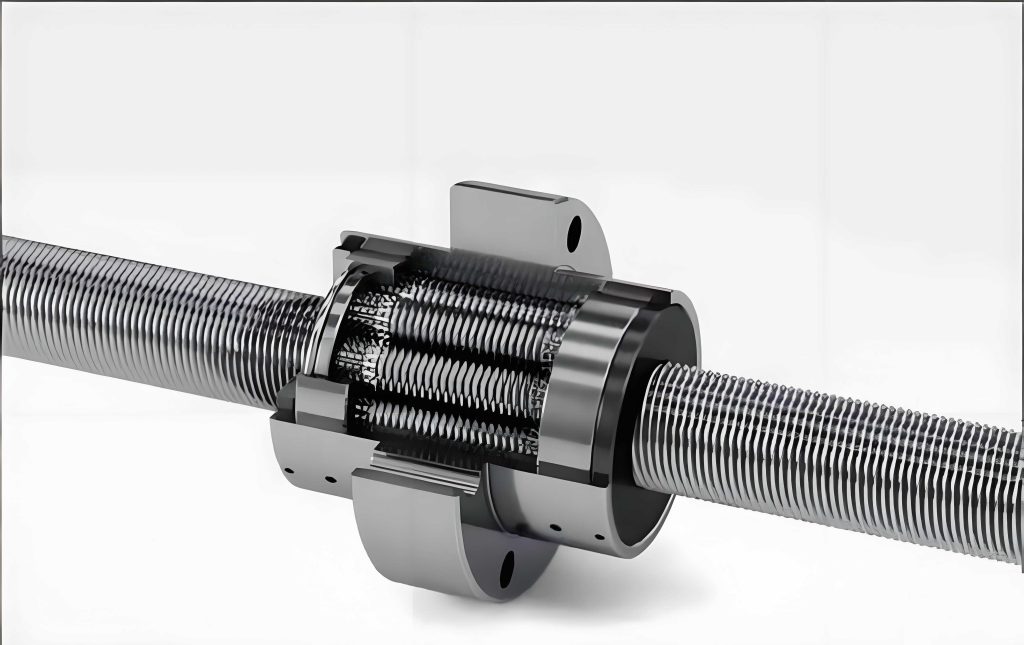
Before delving into the dynamic model, it is essential to review the fundamental kinematic relationships of the planetary roller screw mechanism. The mechanism consists of a central screw, multiple planetary rollers, and a nut, all with triangular thread profiles typically having a 90-degree included angle. The screw rotates but does not translate axially, while the nut translates axially without rotation. The rollers both revolve around the screw axis and rotate about their own axes, driven by the screw’s rotation. To ensure proper meshing and avoid sliding, specific geometric conditions must be met. For instance, the diameters at the contact points satisfy: $$d_N = d_S + 2d_R$$ where \(d_N\), \(d_S\), and \(d_R\) are the nut, screw, and roller diameters, respectively. If the roller has a single-start thread, the number of starts for the screw and nut are given by: $$n_S = n_N = t + 2$$ with \(t = d_S / d_R\). All threads are typically right-handed. Under these conditions, the kinematic relations are derived. The angular velocity of roller revolution (around the screw) is: $$\omega_e = \frac{\omega_S t}{2(t + 1)}$$ and the angular velocity of roller rotation (about its own axis) is: $$\omega_R = \frac{\omega_S t(t + 2)}{2(t + 1)}$$ where \(\omega_S\) is the screw angular velocity. The axial velocity of the nut and rollers is: $$v = \frac{n_S p \omega_S}{2\pi}$$ where \(p\) is the roller pitch. These equations form the basis for analyzing motion transmission in the planetary roller screw mechanism.
Friction plays a significant role in the dynamic performance of planetary roller screw mechanisms, affecting efficiency, heat generation, and stick-slip behavior. To accurately model friction, we adopt the LuGre model, which describes static friction, Coulomb friction, viscous friction, and the Stribeck effect. The model uses an internal state variable \(\beta\) representing the average deflection of asperities between contacting surfaces. The dynamics are given by: $$\dot{\beta} = v_r – \frac{k_0 |v_r|}{g(v_r)} \beta$$ where \(v_r\) is the relative sliding velocity, \(k_0\) is the bristle stiffness, and \(g(v_r)\) is a function that captures the Stribeck curve: $$g(v_r) = F_n \left[ \mu_c + (\mu_s – \mu_c) e^{-(v_r/v_s)^2} \right]$$ Here, \(F_n\) is the normal contact force, \(\mu_c\) and \(\mu_s\) are the dynamic and static friction coefficients, and \(v_s\) is the Stribeck characteristic velocity. The total friction force \(F_L\) is: $$F_L = k_0 \beta + k_1 \dot{\beta} + k_2 v_r$$ with \(k_1\) as a damping coefficient and \(k_2\) as a viscous friction coefficient. In planetary roller screw mechanisms, friction arises not only from sliding but also from rolling due to material hysteresis. The rolling friction force is approximated as: $$F_{rr} = \mu_r F_n$$ where \(\mu_r\) is the rolling friction coefficient. The relative sliding velocity between the screw and roller threads is critical for applying the LuGre model. Based on geometry and kinematics, the sliding velocity at the screw-roller interface is primarily axial: $$v_{SR} = r_S \omega_S \tan(\lambda) \mathbf{k}$$ where \(r_S\) is the screw contact radius, \(\lambda\) is the helix angle, and \(\mathbf{k}\) is the unit vector in the axial direction. In contrast, the roller-nut interface exhibits pure rolling with negligible sliding, so \(v_{RN} = 0\). These friction characteristics are integrated into the bond graph model using modulated resistive elements, with the normal force as a modulating signal.
Transmission clearances and machining errors introduce nonlinearities that significantly impact the dynamic stiffness and vibration response of planetary roller screw mechanisms. The contact force between threads, considering Hertzian deformation, follows a nonlinear relationship: $$F_k = K \delta_j^{3/2}$$ where \(K\) is the axial contact stiffness derived from material properties and geometry, and \(\delta_j\) is the axial contact deformation (with \(j = s\) for screw-roller or \(n\) for roller-nut). When a unilateral clearance \(b\) exists, the force becomes piecewise: $$F_k = \begin{cases} K(z – b)^{3/2}, & z \geq b \\ 0, & -b < z < b \\ K(z + b)^{3/2}, & z \leq -b \end{cases}$$ where \(z\) is the relative axial displacement. Machining errors \(\sigma\) can be treated as additional clearance, making the effective clearance \(b + \sigma\). Damping forces also exhibit分段特性: $$F_R = \begin{cases} c \dot{z}, & z \geq b \\ 0, & z < b \end{cases}$$ with \(c\) as the viscous damping coefficient. To model these分段 behaviors in bond graph theory, we employ switched power junctions, which allow dynamic activation and deactivation of bonds based on displacement conditions. This approach enables accurate representation of contact loss and re-engagement during operation. Furthermore, load distribution across multiple engaged threads is considered by extending the bond graph model to parallel paths, each representing a thread pair. The total force is the sum of individual contact forces, and the deformations are coupled through the nut’s rigid body motion. This detailed modeling ensures that the dynamic response reflects the actual load-sharing characteristics of planetary roller screw mechanisms.
The torsional and compressive stiffness of the screw shaft also contribute to the overall dynamic behavior of planetary roller screw mechanisms. Torsional deformation affects the transmission of rotary motion, while axial compression or extension influences the positioning accuracy of the nut. The torque-deformation relation for torsion is: $$T_S = \frac{\pi G d_S^4}{32 l} \phi$$ where \(T_S\) is the torque, \(G\) is the shear modulus, \(\phi\) is the twist angle, \(l\) is the effective length, and \(d_S\) is the screw diameter. The torsional stiffness is: $$K_1 = \frac{\pi G d_S^4}{32 l}$$ Similarly, the axial force-deformation relation for compression/extension is: $$F_S = \frac{\pi d_S^2 E}{4 l} \epsilon$$ where \(F_S\) is the axial force, \(E\) is the elastic modulus, \(\epsilon\) is the axial strain, and the axial stiffness is: $$K_2 = \frac{\pi d_S^2 E}{4 l}$$ In the bond graph model, these stiffnesses are represented by capacitive elements with appropriate parameters. The torsional stiffness connects the screw’s input angular velocity to the transmitted torque, while the axial stiffness links the nut’s motion to the external load. Incorporating these elements allows the model to account for energy storage and release due to elastic deformations, which is crucial for predicting resonance frequencies and transient responses in planetary roller screw mechanisms.
Integrating all the aforementioned aspects, we construct a comprehensive bond graph model for the planetary roller screw mechanism. The model is divided into several zones corresponding to different energy domains and physical interactions. Zone a includes the screw’s rotational inertia, torsional stiffness, and friction at the screw-roller interface. Zone b represents the screw-roller contact forces with clearances and errors. Zone c accounts for the roller’s rotational and revolutionary inertias. Zone d covers the roller-nut contact forces. Zone e comprises the nut’s translational inertia, axial stiffness of the screw, and friction at the roller-nut interface. The bond graph utilizes standard elements: inertial elements (I) for masses and moments of inertia, capacitive elements (C) for stiffnesses, resistive elements (R) for damping and friction, transformer elements (TF) for kinematic conversions, and modulated elements for nonlinearities. The state equations are derived from the bond graph structure, describing the dynamics of velocities, displacements, and internal friction states. For instance, the equation for screw rotation balances input torque, inertial torque, friction torque, and contact forces: $$\dot{P}_S + F_{Sr} \left(1 – \frac{2\pi r_S \tan \lambda}{n_S p}\right) \frac{\pi t(t+2)}{2(t+1)} + F \frac{2\pi}{n_S p} + F_L r_S \tan \lambda – T_S = 0$$ where \(P_S\) is the angular momentum of the screw. Similar equations govern other state variables. The model’s modularity permits easy extension or simplification based on specific analysis needs, such as adding more rollers or incorporating thermal effects. This flexibility makes the bond graph approach highly suitable for dynamic studies of planetary roller screw mechanisms.
To validate the bond graph model, we compare its simulation results with those from a multi-body dynamics software, Adams. The planetary roller screw mechanism parameters used for validation are listed in Table 1. For fairness, the bond graph model is simplified to a rigid-body case by neglecting clearances, errors, and elastic deformations, matching the Adams model conditions. A step input of angular velocity \(\omega_S = 62.8 \, \text{rad/s}\) is applied to the screw, with an axial load \(F_a = 16,000 \, \text{N}\). The nut’s axial velocity response from both models is plotted over time. The results show close agreement: the rise phases nearly overlap, and the steady-state velocities differ by only 0.5%. The bond graph model exhibits slightly smoother transients due to inherent damping from contact compliance modeling, whereas the Adams model, being purely rigid, shows sharper oscillations. This validation confirms the bond graph model’s accuracy in capturing the fundamental dynamics of planetary roller screw mechanisms. Further validation under varying conditions, such as different loads or speeds, reinforces its reliability for dynamic analysis.
| Parameter | Value |
|---|---|
| Screw pitch diameter, \(d_S\) (mm) | 19.5 |
| Roller pitch diameter, \(d_R\) (mm) | 6.5 |
| Nut pitch diameter, \(d_N\) (mm) | 32.5 |
| Pitch, \(p\) (mm) | 2 |
| Number of screw starts, \(n_S\) | 5 |
| Number of roller starts, \(n_R\) | 1 |
| Number of nut starts, \(n_N\) | 5 |
| Number of engaged threads per roller, \(n\) | 20 |
| Number of rollers, \(N\) | 5 |
With the validated model, we conduct dynamic characteristic simulations to investigate friction response and stiffness behavior in planetary roller screw mechanisms. The friction parameters are set based on typical values: Stribeck velocity \(v_s = 0.001 \, \text{m/s}\), bristle stiffness \(k_0 = 10^5 \, \text{N/m}\), damping \(k_1 = \sqrt{10^5} \, \text{N·s/m}\), viscous coefficient \(k_2 = 0.4 \, \text{N·s/m}\), dynamic friction coefficient \(\mu_c = 0.3\), and static friction coefficient \(\mu_s = 0.5\). The simulations use the Runge-Kutta-Fehlberg solver for numerical integration.
First, we examine the effect of screw input speed on friction force response. With a unilateral clearance \(b = 0.02 \, \text{mm}\) and axial load \(F_a = 1,600 \, \text{N}\), step inputs of screw angular velocity at 12.5, 37.68, and 62.8 rad/s are applied. The friction force at the screw-roller interface is monitored over time. As shown in Figure 9 (simulated data), higher screw speeds lead to faster friction response with increased initial oscillations. The response time decreases by approximately 64% when speed increases from 12.5 to 37.68 rad/s, and by 40% from 37.68 to 62.8 rad/s. At steady state, the friction forces converge to similar values. This behavior is attributed to the velocity-dependent nature of the LuGre model: higher sliding velocities reduce the time for friction coefficients to stabilize. Additionally, faster screw rotation reduces the duration of thread impact, accelerating contact force establishment and thus friction response. These insights highlight the importance of speed control in managing friction-induced vibrations in planetary roller screw mechanisms.
Next, we analyze the influence of slide-roll ratio on friction response. The slide-roll ratio, defined as the ratio of sliding to rolling angular velocities, affects the average sliding velocity at contacts. Keeping \(b = 0.02 \, \text{mm}\), \(F_a = 1,600 \, \text{N}\), and \(\omega_S = 62.8 \, \text{rad/s}\), we vary the slide-roll ratio from 0.1 to 0.5. The friction force response (Figure 10) indicates that higher slide-roll ratios accelerate friction buildup but also amplify initial oscillations. The response time shortens by about 60% when the ratio increases from 0.1 to 0.3, and by 25% from 0.3 to 0.5. Steady-state friction remains unchanged. This trend occurs because increased slide-roll ratio elevates the mean sliding velocity, prompting quicker transitions in the LuGre friction state. Understanding this relationship aids in optimizing thread profiles and lubrication to minimize detrimental friction effects in planetary roller screw mechanisms.
Dynamic stiffness is another critical characteristic, affecting positioning accuracy and vibration resistance. To study stiffness, we fix the screw input (\(\omega_S = 0\)) and apply a harmonic axial load \(F_a = 16,000 \sin(2\pi f t) \, \text{N}\) to the nut, where \(f\) is the frequency. Machining errors are modeled as normally distributed with zero mean and standard deviation \(S_d = 0.44 \, \mu\text{m}\) (corresponding to IT5 grade). The dynamic stiffness is computed as the ratio of load amplitude to nut displacement amplitude. Figure 11 plots dynamic stiffness versus frequency for different clearances \(b = 0.01, 0.02, 0.03 \, \text{mm}\). Results show that larger clearances reduce stiffness significantly, especially at higher frequencies. For each clearance curve, stiffness initially increases with frequency, peaks at a转折点, then slightly decreases. The转折点 frequency shifts higher with smaller clearances: reducing \(b\) from 0.03 to 0.02 mm raises the转折点 by 16.7%, and from 0.02 to 0.01 mm by 35.7%. This indicates that clearances dominate dynamic deformation at higher frequencies, suggesting that planetary roller screw mechanisms should operate below转折点 frequencies to maintain stiffness. Tight manufacturing tolerances are thus essential for high-frequency applications.
Machining errors further impact stiffness by introducing variability in thread engagements. We compare maximum roller contact deformations with and without errors, using the ratio \(\delta_{e max} / \delta_{max}\) under different axial load amplitudes and error standard deviations (\(S_d = 0.44, 0.73, 1.1 \, \mu\text{m}\) for IT5, IT6, IT7 grades). As illustrated in Figure 12, the ratio always exceeds 1, meaning errors reduce effective stiffness. The reduction is more pronounced at lower loads and larger errors. For instance, at light loads, IT7 errors can increase deformation by over 20%, whereas at heavy loads, the effect diminishes to below 5%. This underscores the need for precision machining in planetary roller screw mechanisms, particularly for applications involving variable or light loads where error sensitivity is high.
In summary, this article presents a bond graph-based dynamic model for planetary roller screw mechanisms that comprehensively incorporates transmission clearances, contact deformations, torsional and axial stiffnesses, machining errors, load distribution, friction, and inertias. The model is validated against Adams simulations, showing excellent agreement. Dynamic analyses reveal that screw speed and slide-roll ratio significantly affect friction response times and oscillations, while clearances and machining errors reduce dynamic stiffness, especially at higher frequencies and lighter loads. The bond graph approach offers a flexible and efficient framework for analyzing planetary roller screw mechanism dynamics, enabling multi-domain simulations and performance optimization. Future work could extend the model to include thermal effects, wear progression, and control system integration for advanced mechatronic applications. By leveraging this model, designers and engineers can enhance the dynamic accuracy, stability, and reliability of planetary roller screw mechanisms in demanding operational environments.
The versatility of the bond graph model allows for seamless integration with other system components, such as motors, sensors, and controllers, facilitating holistic design of linear actuation systems. Moreover, the model’s ability to simulate nonlinearities like clearances and friction makes it a valuable tool for predicting real-world behavior under varying conditions. As planetary roller screw mechanisms continue to evolve for high-performance applications, dynamic modeling will remain crucial for innovation and improvement. This work contributes to that ongoing effort by providing a detailed, physics-based approach to understanding and optimizing the dynamic characteristics of planetary roller screw mechanisms.
To further illustrate key parameters and relationships, Table 2 summarizes the main equations used in the bond graph model for planetary roller screw mechanisms. These equations encapsulate the kinematic, force, and friction dynamics that govern system behavior.
| Aspect | Equation | Description |
|---|---|---|
| Kinematics | \(v = \dfrac{n_S p \omega_S}{2\pi}\) | Axial velocity of nut |
| Contact Force | \(F_k = K \delta^{3/2}\) | Hertzian contact force |
| Friction (LuGre) | \(\dot{\beta} = v_r – \dfrac{k_0 |v_r|}{g(v_r)} \beta\) | Internal friction state |
| Torsional Stiffness | \(K_1 = \dfrac{\pi G d_S^4}{32 l}\) | Screw torsional stiffness |
| Axial Stiffness | \(K_2 = \dfrac{\pi d_S^2 E}{4 l}\) | Screw axial stiffness |
| State Equation | \(\dot{P}_S + F \dfrac{2\pi}{n_S p} + \cdots – T_S = 0\) | Screw rotation dynamics |
In conclusion, the dynamic modeling of planetary roller screw mechanisms using bond graph theory offers a powerful methodology for analyzing complex interactions and improving design. By considering factors like clearances, errors, and friction, the model provides insights that help mitigate vibrations, enhance stiffness, and optimize performance. As technology advances, such models will be instrumental in developing next-generation planetary roller screw mechanisms for precision applications across industries.