
In the field of mechanical transmission, the planetary roller screw stands out for its high precision and load capacity. Among its variants, the differential planetary roller screw is particularly notable for its compact structure and the ability to achieve extremely small practical leads, making it indispensable in applications requiring fine motion control, such as aerospace, robotics, and precision manufacturing. However, a persistent issue with the traditional differential planetary roller screw is the inherent slippage phenomenon. Although this slippage can be minimized to less than 1% through measures like preload application, it remains a significant concern in scenarios demanding exact positioning and repeatability. In this article, I explore the root causes of slippage in differential planetary roller screws and propose a systematic solution to eliminate it entirely. By introducing a modified gear-based structure, deriving updated lead calculation formulas, and establishing self-locking conditions, this method fundamentally addresses the slippage problem, enhancing the reliability and accuracy of these mechanisms.
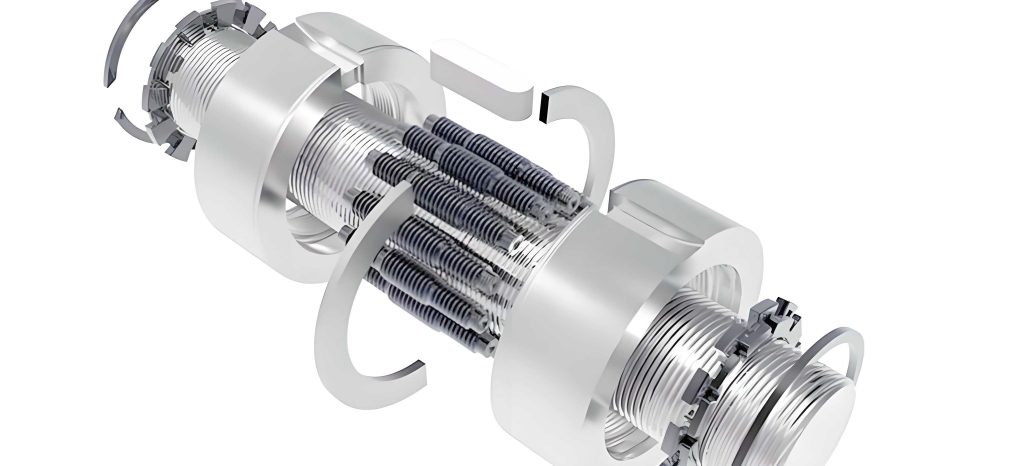
The planetary roller screw mechanism operates on principles similar to planetary gear systems, where multiple rollers interact with a central screw and a surrounding nut. In the differential type, the rollers feature two distinct diameter sections, engaging with correspondingly sized sections on the screw and nut. This design allows for a reduction in practical lead compared to the physical lead of the screw, enabling precise linear motion from rotary input. The motion relationships are derived using instantaneous center methods, considering the rollers as planets, the screw as a sun gear, and the nut as a ring gear. For a standard differential planetary roller screw, the rotational speeds can be expressed as follows, where $\omega_p$ is the orbital speed of the rollers, $\omega_R$ is the rotational speed of the rollers, $\omega_s$ is the input angular velocity of the screw, $r_{RN}$ is the pitch radius at the roller-nut engagement, $r_{Rs}$ is the pitch radius at the roller-screw engagement, and $r_s$ is the pitch radius of the screw:
$$ \omega_p = \omega_s \times \frac{r_{RN} \cdot r_s}{(r_{RN} + r_{Rs})(r_s + r_{Rs})} $$
$$ \omega_R = \omega_s \times \frac{r_s}{r_{RN} + r_{Rs}} $$
The practical lead, denoted as $L_p$, is the axial displacement of the nut per revolution of the screw. Since the rollers have zero helix angle (i.e., their threads are essentially annular grooves), their rotation does not contribute to axial motion. Thus, the practical lead is derived from the screw’s physical lead $L_s$ and the motion reduction factor. For a single-start screw, $L_s$ equals the pitch. The formula for the practical lead in a differential planetary roller screw is:
$$ L_p = L_s \times \left(1 – \frac{r_{RN} \cdot r_s}{(r_{RN} + r_{Rs})(r_s + r_{Rs})}\right) $$
This results in $L_p < L_s$, allowing for fine adjustments. However, the reliance on friction between the annular grooves of the rollers and the screw or nut leads to slippage. Even with precision machining and preload, micro-slip occurs due to the absence of positive engagement, causing deviations in speed and displacement. To illustrate, consider the parameters in the table below, which show how slight variations in friction can affect performance.
| Parameter | Symbol | Typical Value | Effect on Slippage |
|---|---|---|---|
| Screw Lead | $L_s$ | 5 mm | Higher leads may increase slip risk |
| Roller-Nut Radius | $r_{RN}$ | 4 mm | Larger radii reduce slip tendency |
| Roller-Screw Radius | $r_{Rs}$ | 3.5 mm | Smaller radii can exacerbate slip |
| Friction Coefficient | $\mu$ | 0.003 | Critical for self-locking and slip |
In reverse differential planetary roller screws, where the nut is the input and the screw moves axially, the motion relationships differ. The orbital speed $\omega_p$ and roller speed $\omega_R$ are given by, with $\omega_N$ as the nut’s angular velocity and $r_N$ as the nut’s pitch radius:
$$ \omega_p = \omega_N \times \frac{r_{Rs} \cdot r_N}{(r_{Rs} + r_{RN})(r_s + r_{Rs})} $$
$$ \omega_R = \omega_p \times \frac{r_s + r_{Rs}}{r_{Rs}} $$
The practical lead $L_p$ for the reverse configuration, representing screw displacement per nut revolution, is:
$$ L_p = L_N \times \left(1 – \frac{r_{Rs} \cdot r_N}{(r_{Rs} + r_{RN})(r_s + r_{Rs})}\right) $$
Here, $L_N$ is the nut’s lead, often zero for annular grooves. This design further reduces the practical lead, but slippage persists due to the same friction-dependent engagement. The slippage phenomenon arises because the transmission of motion between the rollers and the screw or nut relies solely on tangential friction forces at the annular grooves. Under load, especially in dynamic or high-precision applications, this can lead to relative sliding, degrading accuracy. Studies indicate that even with optimal preload, slippage rates of 0.5% to 1% are common, which is unacceptable in fields like semiconductor manufacturing or medical devices where micron-level precision is required.
To eliminate slippage, I propose modifying the differential planetary roller screw by incorporating gear elements. This approach replaces the friction-based transmission with positive gear engagement, akin to standard planetary roller screws but tailored for differential operation. In this enhanced structure, gears are added to both ends of each roller, meshing with internal gears on the nut or external gears on the screw. These gears ensure kinematic constraint without relying on friction, thereby preventing any relative slip. The gear teeth are designed to be in phase with the roller threads, maintaining synchrony, but they do not engage with the screw threads directly, avoiding complexity. This modification transforms the mechanism into a hybrid system that retains the small practical lead of differential planetary roller screws while achieving the slip-free performance of gear-driven systems.
The mechanical principles of this modified differential planetary roller screw can be analyzed through force diagrams. Consider the forces acting on a roller during operation: an axial force $P$ applied to the nut or screw, resolved into components along the contact surfaces. With the gear engagement, the instantaneous center of rotation shifts to the gear mesh point, ensuring pure rolling without slip. The torque $M_i$ induced by the screw’s rotation on the roller is given by, where $F$ is the tangential force at the screw-roller interface and $\phi$ is the helix angle:
$$ M_i = F \times (r_{Rs} + r_{RN}) $$
$$ F = P \cdot \cos \phi \cdot \mu $$
The resisting torque $M_z$ from friction in the roller supports is:
$$ M_z = T \times r_{RN} $$
Here, $T$ represents frictional forces from bearings or supports. Since $M_i > M_z$ under normal conditions due to the gear constraint, slippage is impossible. This analysis holds for both standard and reverse differential planetary roller screws, as shown in the table below comparing force parameters.
| Force Component | Expression | Role in Slippage |
|---|---|---|
| Tangential Force | $F = P \cos \phi \mu$ | Drives motion; reduced by gears |
| Axial Force | $Q = P \sin \phi$ | Contributes to load; affects self-lock |
| Induced Torque | $M_i = F(r_{Rs} + r_{RN})$ | Must exceed resisting torque |
| Resisting Torque | $M_z = T r_{RN}$ | Minimized in gear-enhanced design |
Self-locking is another critical aspect for planetary roller screws, particularly in applications where back-driving must be prevented. Traditional planetary roller screws are often non-self-locking due to their high efficiency, but differential types can achieve self-locking under certain conditions because of their small leads and annular grooves. For a reverse differential planetary roller screw, the self-locking condition involves the helix angle $\phi$ of the nut threads and the friction coefficient $\mu$. The force balance at the roller-nut interface gives:
$$ Q = P \cdot \sin \phi $$
$$ F = P \cdot \cos \phi \cdot \mu $$
Self-locking occurs when the axial component $Q$ is insufficient to overcome the frictional force $F$, i.e., $Q < F$. This leads to the inequality:
$$ \sin \phi < \mu \cos \phi $$
Simplifying, the self-locking condition is:
$$ \tan \phi < \mu $$
Additionally, to prevent roller rotation independently, the torque condition must hold: $M_i > M_z$. For practical purposes, with $\mu$ ranging from 0.0025 to 0.0035 for rolling contacts, and typical $\phi$ values below 0.5°, self-locking is feasible. For example, with $r_{RN} = 3.79 \text{ mm}$, $r_{Rs} = 3.25 \text{ mm}$, $L_N = 0.67 \text{ mm}$, and $\phi = 0.313^\circ$, we compute $\tan \phi = 0.0056$. Using $\mu = 0.003$, since $\tan \phi > \mu$, self-locking might not occur, but adjusting parameters like roller radii or helix angle can enable it. This highlights the versatility of differential planetary roller screws in design.
The lead calculations for the gear-enhanced differential planetary roller screw remain valid, as the gear engagement does not alter the kinematic relationships derived earlier. However, the elimination of slippage ensures that the theoretical leads are achieved precisely. For instance, in a standard differential planetary roller screw with $L_s = 5 \text{ mm}$, $r_{RN} = 4 \text{ mm}$, $r_{Rs} = 3.5 \text{ mm}$, and $r_s = 10 \text{ mm}$, the practical lead is:
$$ L_p = 5 \times \left(1 – \frac{4 \times 10}{(4 + 3.5)(10 + 3.5)}\right) = 5 \times \left(1 – \frac{40}{7.5 \times 13.5}\right) = 5 \times (1 – 0.395) = 3.025 \text{ mm} $$
Without slippage, this value is exact, whereas in traditional designs, it could vary by up to 1%. The reverse configuration offers even smaller leads. For applications like micro-positioning stages, this precision is crucial. The table below summarizes key formulas for differential planetary roller screws, emphasizing the importance of accurate computation.
| Configuration | Practical Lead Formula | Notes |
|---|---|---|
| Standard Differential | $L_p = L_s \left(1 – \frac{r_{RN} r_s}{(r_{RN} + r_{Rs})(r_s + r_{Rs})}\right)$ | Input: screw rotation |
| Reverse Differential | $L_p = L_N \left(1 – \frac{r_{Rs} r_N}{(r_{Rs} + r_{RN})(r_s + r_{Rs})}\right)$ | Input: nut rotation |
| Gear-Enhanced | Same as above, but slip-free | Adds gear meshing for constraint |
In terms of advantages, the gear-enhanced differential planetary roller screw combines the benefits of both standard and differential types. It offers a practical lead approximately one-tenth that of a standard planetary roller screw with similar dimensions, effectively eliminating the need for external reduction gears in many systems. This simplifies overall design, reduces weight and cost, and improves efficiency. For example, in aerospace actuators, where space and reliability are paramount, this innovation can lead to more compact and dependable mechanisms. Moreover, the self-locking capability enhances safety in applications like elevators or medical lifts, where unintended movement must be prevented.
To further explore the performance, consider the dynamic behavior under varying loads. The gear engagement ensures that the transmission error is minimized, as shown by the following equation for positional accuracy $\Delta x$, where $\Delta \theta$ is angular error and $k$ is a constant dependent on geometry:
$$ \Delta x = k \cdot \Delta \theta \cdot L_p $$
With slippage eliminated, $\Delta \theta$ approaches zero, making $\Delta x$ solely dependent on manufacturing tolerances. This is a significant improvement over traditional differential planetary roller screws, where $\Delta \theta$ includes slip components. Additionally, the load distribution across multiple rollers in a planetary roller screw enhances durability, and the gear modification does not compromise this. In fact, by ensuring positive engagement, it reduces wear on the annular grooves, extending service life.
In conclusion, the proposed method to eliminate slippage in differential planetary roller screws through gear integration represents a substantial advancement in precision mechanical transmission. By deriving accurate lead formulas and establishing self-locking conditions, this approach addresses the fundamental limitations of friction-based engagement. The gear-enhanced differential planetary roller screw achieves exact motion control, retains the small lead characteristic, and can be designed for self-locking, making it ideal for high-precision industries. Future work could focus on optimizing gear tooth profiles for minimal backlash or exploring materials to further reduce friction. As demand for accuracy grows in fields like robotics and renewable energy, such innovations in planetary roller screw technology will continue to drive progress.
The implications of this research extend beyond immediate applications. For instance, in renewable energy systems, such as solar trackers, the precise positioning enabled by slip-free planetary roller screws can improve efficiency by ensuring optimal alignment. Similarly, in automotive steering systems, the reliability and self-locking features enhance safety. The mathematical models presented here provide a foundation for customizing designs based on specific requirements, as summarized in the following table for parameter selection.
| Design Parameter | Influence on Performance | Recommended Range |
|---|---|---|
| Roller Radius Ratio $r_{RN}/r_{Rs}$ | Affects lead reduction and self-locking | 1.1 to 1.5 |
| Helix Angle $\phi$ | Determines self-locking and efficiency | 0.2° to 0.5° |
| Friction Coefficient $\mu$ | Critical for slip prevention | 0.002 to 0.004 |
| Gear Module | Ensures positive engagement without slip | 0.5 to 1 mm |
Ultimately, the planetary roller screw, in its differential form, proves to be a versatile component, and with the elimination of slippage, its potential is fully unlocked. This article has detailed the principles, modifications, and analyses necessary to achieve this goal, contributing to the broader field of mechanical engineering. As I continue to investigate these mechanisms, the focus will remain on enhancing precision and reliability, ensuring that planetary roller screws meet the evolving demands of modern technology.