
In recent years, I have witnessed a remarkable surge in the development and application of robotics, driven largely by advancements in artificial intelligence. Among these, embodied AI has emerged as a pivotal force, igniting what many call the “flame” of robot applications. This concept, which integrates AI with physical bodies to interact with the world, is transforming industries and reshaping our future. In this article, I will delve into the intricacies of embodied AI, exploring its foundations, synergies with large models, and its profound impact on robotics, all while emphasizing the role of embodied AI robots in this revolution.
Embodied AI, or embodied artificial intelligence, refers to intelligent systems that possess a physical form, allowing them to perceive, learn, and act in real-world environments. Unlike traditional AI that processes data in isolation, embodied AI robots engage in interactive learning, akin to how humans develop skills through experience. This paradigm shift is rooted in early ideas from the 1950s, but it has only gained traction recently due to breakthroughs in machine learning and robotics. The core idea is simple yet profound: by embodying intelligence, machines can better understand and navigate the complexities of our physical realm.
The rise of large language models (LLMs) and other AI technologies has been a catalyst for embodied AI. These models, such as GPT-4o, provide the cognitive backbone for embodied AI robots, enabling them to process natural language, vision, and sensory inputs in real-time. The synergy between large models and embodied AI is evident in their complementary roles: large models offer high-level reasoning and generalization, while embodied AI robots provide the means to ground these capabilities in physical interactions. This partnership is accelerating the development of more adaptable and intelligent machines.
To understand the technical underpinnings, let’s consider a basic formula for embodied AI learning. An embodied AI robot learns by minimizing a cost function that combines perception, action, and reward. For instance, in reinforcement learning, the robot aims to maximize cumulative reward through trial and error. The expected return can be expressed as:
$$ J(\theta) = \mathbb{E}_{\tau \sim p(\tau|\theta)} \left[ \sum_{t=0}^{T} \gamma^t r_t \right] $$
where \( \theta \) represents the policy parameters, \( \tau \) is the trajectory, \( \gamma \) is the discount factor, and \( r_t \) is the reward at time step \( t \). This framework allows embodied AI robots to learn complex tasks, such as object manipulation or navigation, by interacting with their surroundings.
The applications of embodied AI robots are vast, spanning from industrial automation to daily life assistance. One prominent area is humanoid robotics, where machines like Tesla’s Optimus or Beijing’s “Tiangong” are designed to mimic human form and function. These embodied AI robots leverage their anthropomorphic structure to integrate seamlessly into human-centric environments, reducing the need for costly adaptations. Below is a table summarizing key examples of embodied AI robots and their capabilities:
| Robot Model | Key Features | Application Scenarios |
|---|---|---|
| Tesla Optimus | 22 degrees of freedom in hands, electric drive, factory automation | Battery sorting, assembly lines |
| Tiangong Humanoid | Pure electric drive, running at 6 km/h, modular design | Stable奔跑, scenario adaptation |
| Walker S (UBTech) | AI-powered vision, dexterous manipulation | Automotive manufacturing, quality inspection |
| Figure 01 | General-purpose base model, learning from demonstrations | Warehouse logistics, human-robot collaboration |
| Boston Dynamics Atlas | Electric actuation, dynamic movement, agility | Search and rescue, industrial tasks |
As shown in the table, embodied AI robots are diversifying into various roles, each leveraging embodied intelligence to handle specific tasks. The embodied AI robot’s ability to learn from interaction, rather than pre-programmed routines, makes it highly versatile. For example, in manufacturing, an embodied AI robot can adapt to new product designs without extensive reprogramming, simply by observing human workers or through simulated training.
From a mathematical perspective, the control of an embodied AI robot often involves kinematics and dynamics equations. Consider a simple robotic arm with joints; its forward kinematics can be described using the Denavit-Hartenberg parameters. The transformation matrix between consecutive links is given by:
$$ T_i^{i-1} = \begin{bmatrix} \cos\theta_i & -\sin\theta_i \cos\alpha_i & \sin\theta_i \sin\alpha_i & a_i \cos\theta_i \\ \sin\theta_i & \cos\theta_i \cos\alpha_i & -\cos\theta_i \sin\alpha_i & a_i \sin\theta_i \\ 0 & \sin\alpha_i & \cos\alpha_i & d_i \\ 0 & 0 & 0 & 1 \end{bmatrix} $$
where \( \theta_i \), \( d_i \), \( a_i \), and \( \alpha_i \) are the joint angle, link offset, link length, and twist angle, respectively. Such formulas are essential for enabling precise movements in embodied AI robots, allowing them to perform delicate tasks like welding or assembly.
The learning process for an embodied AI robot also involves probabilistic models. For instance, in Bayesian inference, the robot updates its beliefs about the world based on sensory data. This can be expressed as:
$$ P(h|e) = \frac{P(e|h) P(h)}{P(e)} $$
where \( P(h|e) \) is the posterior probability of hypothesis \( h \) given evidence \( e \), \( P(e|h) \) is the likelihood, \( P(h) \) is the prior, and \( P(e) \) is the evidence. This Bayesian approach helps embodied AI robots make informed decisions in uncertain environments, such as navigating cluttered spaces or recognizing objects.
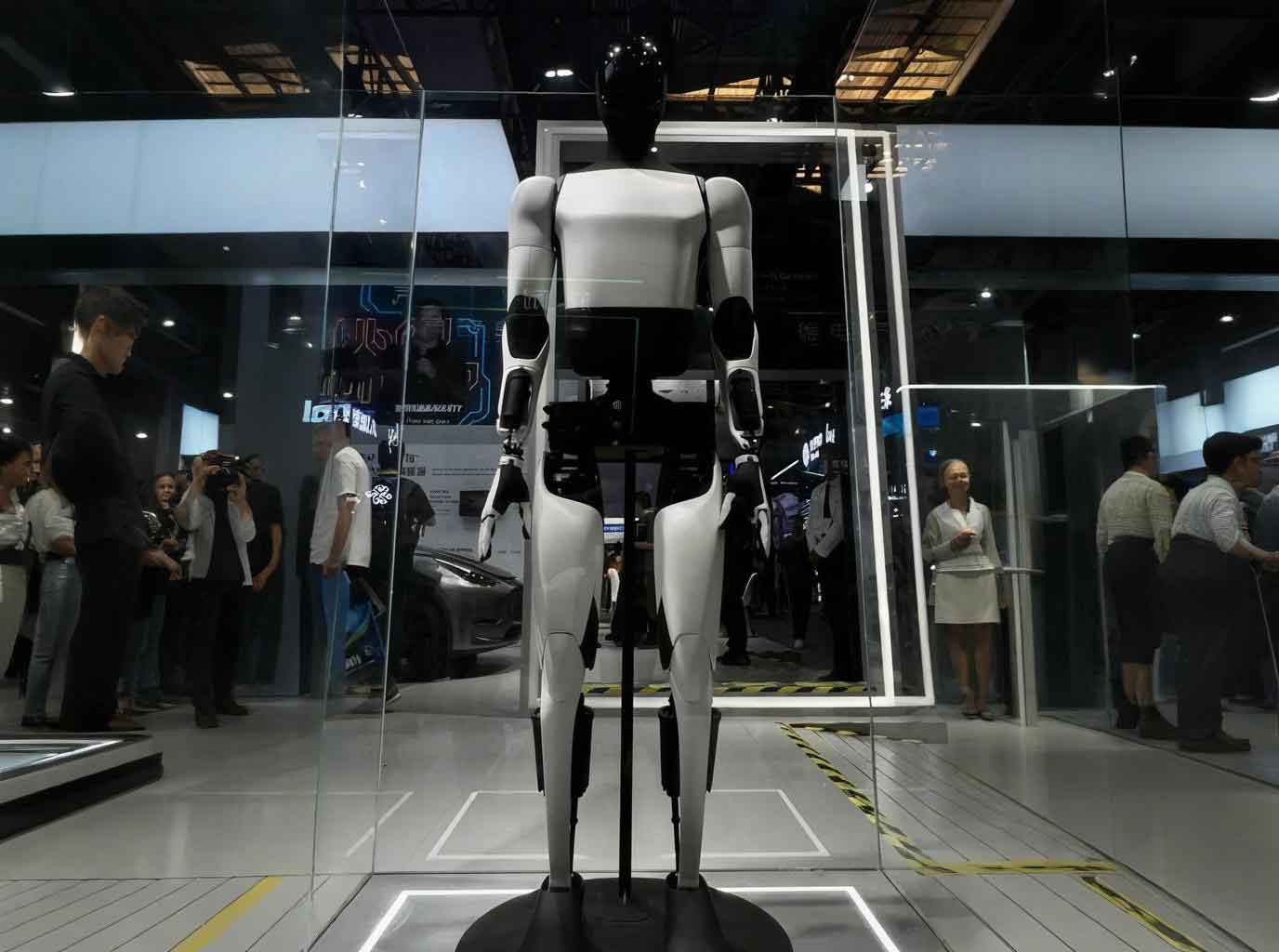
Looking at the image above, we can see an embodied AI robot in action, perhaps in a laboratory or industrial setting. This visual representation underscores the tangible nature of these machines, highlighting how embodied intelligence bridges the digital and physical worlds. The integration of sensors, actuators, and AI algorithms enables such embodied AI robots to perceive and respond to their surroundings in real-time.
Another critical aspect is the economic impact of embodied AI robots. Market projections indicate exponential growth, with some estimates suggesting a global market value of hundreds of billions by 2035. This growth is fueled by investments in R&D and the increasing demand for automation across sectors. To illustrate, here is a table comparing investment trends in robotics over the past decade:
| Time Period | Technology Focus | Investment Highlights | Role of Embodied AI |
|---|---|---|---|
| 2012-2013 | Industrial Robots | Surge in智能制造, traditional automation | Limited, mostly pre-programmed |
| 2016-2017 | Collaborative Robots (Cobots) | Rise of human-robot collaboration, safety features | Early stages, adaptive control |
| 2024 Onwards | Humanoid and General-Purpose Robots | Large-scale funding, over $7B in Q1 2024 alone | Central, with embodied AI enabling versatility |
As the table shows, embodied AI has become central to the latest wave of robotics innovation. The embodied AI robot’s capacity for general-purpose tasks, akin to human-like adaptability, is a key driver. This is further enhanced by foundation models like NVIDIA’s GR00T, which provide a common base for training diverse embodied AI robots on various tasks through few-shot learning.
In terms of technical challenges, embodied AI robots face issues such as energy efficiency, robustness, and safety. For example, the power consumption of an embodied AI robot can be modeled using formulas like:
$$ E = \int_{0}^{T} P(t) \, dt = \sum_{i=1}^{n} (I_i V_i t_i) $$
where \( E \) is the total energy, \( P(t) \) is the power over time, \( I_i \) and \( V_i \) are current and voltage for component \( i \), and \( t_i \) is the operation time. Optimizing this is crucial for延长 battery life and sustainability of embodied AI robots.
Moreover, the control theory behind embodied AI robots often involves linear quadratic regulators (LQR) for optimal control. The cost function minimized is:
$$ J = \int_{0}^{\infty} (x^T Q x + u^T R u) \, dt $$
where \( x \) is the state vector, \( u \) is the control input, and \( Q \) and \( R \) are weighting matrices. This ensures stable and efficient motion for embodied AI robots, whether they are walking, running, or manipulating objects.
The learning algorithms for embodied AI robots also incorporate deep reinforcement learning (DRL), where neural networks approximate the policy or value functions. A common update rule in policy gradient methods is:
$$ \theta_{k+1} = \theta_k + \alpha \nabla_\theta J(\theta_k) $$
with \( \alpha \) as the learning rate. This allows embodied AI robots to continuously improve their skills through interaction, embodying the essence of adaptive intelligence.
Looking ahead, I believe that embodied AI robots will gradually transition from structured industrial settings to more dynamic domestic environments. This mirrors the evolution of autonomous vehicles, which started in controlled areas before expanding to public roads. The embodied AI robot’s ability to learn from human demonstrations and environmental feedback will be pivotal in this journey. For instance, an embodied AI robot in a home could learn to cook or clean by watching videos or practicing in simulation.
To quantify the progress, we can use metrics like task success rate or learning efficiency. Suppose an embodied AI robot is trained on \( N \) tasks; its generalization performance can be measured by the average reward across unseen tasks. Mathematically, this is:
$$ \bar{R} = \frac{1}{M} \sum_{j=1}^{M} R_j $$
where \( M \) is the number of test tasks and \( R_j \) is the reward for task \( j \). Higher \( \bar{R} \) indicates better embodied intelligence, as the embodied AI robot adapts to novel situations.
In conclusion, embodied AI is not just a technological trend; it represents a fundamental shift in how we build and interact with machines. The embodied AI robot, with its fusion of physical presence and cognitive prowess, is poised to revolutionize industries from manufacturing to healthcare. As we continue to innovate, it is crucial to address ethical and safety concerns, ensuring that these embodied AI robots serve humanity’s best interests. The flame ignited by embodied AI is burning brightly, and I am excited to see where this path leads us in the coming decades.
Throughout this discussion, I have emphasized the transformative potential of embodied AI robots. By leveraging formulas, tables, and real-world examples, I hope to have provided a comprehensive view of this exciting field. The journey of embodied AI is just beginning, and as researchers and practitioners, we must foster collaboration to unlock its full potential for a better future.