
As I reflect on the evolution of technology, I am convinced that embodied AI robots represent a profound leap forward, merging artificial intelligence with physical embodiment to create entities that can perceive, interact with, and reshape our world. Unlike traditional AI confined to digital realms, embodied AI robots possess bodies that enable direct physical interaction, blurring the lines between humans and machines and heralding an era of human-robot symbiosis. This shift is not merely incremental; it is a fundamental paradigm change that promises to redefine productivity, daily life, and societal structures. In this article, I will delve into the essence of embodied AI robots, their characteristics, challenges, and the innovative solutions driving their development, all while emphasizing the transformative potential of these intelligent agents.
The journey of technological progress has been marked by several revolutions, each catalyzing monumental shifts. The table below summarizes these epochs, highlighting how embodied AI robots emerge as a pivotal force in the current wave.
| Revolution | Core Innovation | Primary Impact |
|---|---|---|
| First Industrial Revolution | Steam Engine | Mechanization of labor, reducing physical toil |
| Second Industrial Revolution | Electricity | Electrification enabling mass production |
| Third Industrial Revolution | Computers & Internet | Digitalization and global information exchange |
| Fourth Industrial Revolution | Artificial Intelligence | Cognitive automation in virtual spaces |
| Emerging Paradigm | Embodied AI Robots | Direct physical interaction and environmental manipulation |
Today, AI predominantly operates in cognitive domains, offering decision-making and analytical prowess indirectly affecting the physical world. In contrast, embodied AI robots embody intelligence—literally—with bodies that allow them to act directly upon their surroundings. This direct interaction is akin to humans “walking ten thousand miles” beyond just “reading ten thousand books,” enabling these robots to learn from and alter reality in real-time. The embodied AI robot is thus a fusion of symbolic, connectionist, and behaviorist approaches, creating a new AI范式 that is proactive, adaptive, and creative.
To understand the uniqueness of embodied AI robots, consider their defining traits, which I have summarized in the following table.
| Characteristic | Description | Implication for Embodied AI Robots |
|---|---|---|
| Direct Physical Interaction | Ability to perceive and manipulate the environment through sensors and actuators | Enables real-world tasks like object handling and navigation |
| Autonomous Learning | Self-driven acquisition of skills through experience and exploration | Facilitates adaptation to novel scenarios without explicit reprogramming |
| Multimodal Integration | Combination of vision, touch, sound, and force feedback for comprehensive perception | Enhances situational awareness and decision-making accuracy |
| Contextual Embodiment | Operates within specific physical spaces, limiting mobility but deepening environmental engagement | Promotes specialized applications in fields like manufacturing and healthcare |
Despite their promise, the development of embodied AI robots faces significant hurdles. As an observer in this field, I identify four core challenges that must be overcome to realize the vision of “smart robots.”
| Challenge | Current Limitation | Impact on Embodied AI Robots |
|---|---|---|
| High-Performance Embodiment | Deficiencies in sensors, actuators, and robotic structures | Restricts durability, precision, and versatility of physical interactions |
| Motion Capability | Inadequate adaptability to diverse terrains and manipulation tasks | Hinders deployment in complex environments like uneven surfaces or cluttered spaces |
| Embodied Large Models & Algorithms | Underdeveloped multimodal AI tailored for physical embodiment | Limits understanding of environmental contexts and intelligent behavior generation |
| Unified General Datasets | Lack of standardized, rich datasets for physical actions and operations | Slows algorithm training and benchmarking, akin to early AI without big data |
To address these issues, I advocate for a dual-platform approach, focusing on the physical本体 and the intelligent brain of embodied AI robots. One initiative involves a general-purpose robotic platform—let’s call it the “Cosmos” platform—designed for robust, humanoid movement. This platform incorporates multimodal sensors, including RGB-D cameras and tactile hands, enabling an embodied AI robot to perceive and interact with high fidelity. Its motion control leverages a novel algorithm I term “State-Memory Predictive Reinforcement Imitation Learning,” which enhances stability and adaptability. The reward function for such learning can be expressed as: $$R(\tau) = \sum_{t=0}^{T} \gamma^t \left( r_{\text{task}}(s_t, a_t) + \alpha \cdot r_{\text{imitation}}(s_t, a_t) \right)$$ where $\tau$ is a trajectory, $\gamma$ is a discount factor, $r_{\text{task}}$ is task-specific reward, $r_{\text{imitation}}$ encourages human-like motion, and $\alpha$ balances the two. This allows an embodied AI robot to traverse varied terrains like grass or gravel with remarkable agility.
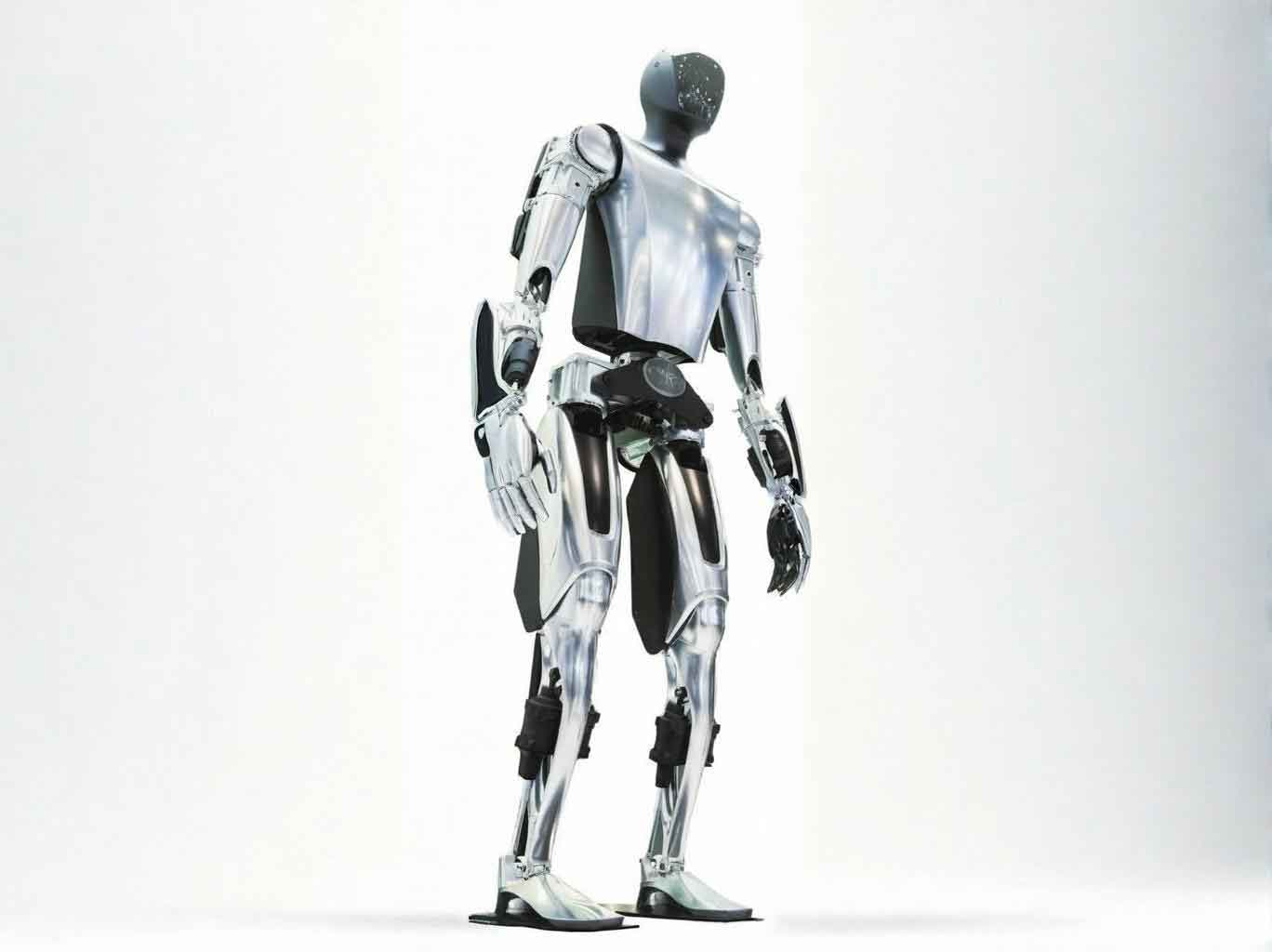
Complementing this, a multifunctional embodied intelligence platform—dubbed the “Genesis” framework—aims for “one-brain, multiple-robots” versatility. It employs a distributed architecture to allocate computational loads efficiently: cloud-based mega-models handle complex reasoning and knowledge queries, edge-side models manage task decomposition, and on-device micro-models execute high-frequency control commands. This setup ensures that an embodied AI robot can perform long-horizon tasks, such as fetching a glass of water through a 20-step sequence, with real-time replanning when obstacles arise. The task planning can be modeled as a partially observable Markov decision process (POMDP): $$P(s_{t+1} | s_t, a_t) = \int O(o_t | s_t) \, ds_t$$ where $s_t$ is the state, $a_t$ the action, and $o_t$ the observation, enabling robust decision-making under uncertainty.
The advancement of embodied AI robots necessitates breakthroughs in several technical areas. I have outlined these in the table below, emphasizing how they interconnect to enhance robotic capabilities.
| Technical Breakthrough | Key Requirement | Mathematical Formulation Example |
|---|---|---|
| Long-Horizon Task Decomposition | Understanding and planning multi-step actions in dynamic settings | $$\max_{\pi} \mathbb{E} \left[ \sum_{k=0}^{N} R(s_{t+k}, a_{t+k}) \right] \text{ subject to } s_{t+k+1} = f(s_{t+k}, a_{t+k})$$ |
| Real-Time Replanning | Adapting to environmental changes with high-frequency updates | $$\Delta a_t = \arg \min_{a} \| g(s_t, a) – g_{\text{goal}} \|^2 \text{ for sudden obstacles}$$ |
| Multi-Scenario Operation | Generalizing across diverse tasks with few or zero examples | $$L_{\text{meta}} = \sum_{i} \mathcal{L}( \theta – \alpha \nabla_{\theta} \mathcal{L}_i(\theta), D_i^{\text{test}} )$$ for meta-learning |
| High-Efficiency Execution | Precise, fast actuation for industrial or delicate tasks | $$\tau = J(q)^T F + b(q, \dot{q})$$ for robotic dynamics, ensuring accurate force control |
To realize these breakthroughs, I emphasize two foundational pillars: data ecosystem construction and virtual-real simulation. For data, we need large-scale, annotated datasets of physical interactions—akin to ImageNet for computer vision—that capture diverse scenarios for embodied AI robots. A unified standard can accelerate data sharing, with metrics for evaluation like success rate $S = \frac{\text{Successful Trials}}{\text{Total Trials}} \times 100\%$. Simultaneously, simulation environments offer a safe, scalable training ground; for instance, using reinforcement learning in simulation can improve motion algorithms a thousandfold compared to real-world trials, as shown by training thousands of virtual embodied AI robots in parallel. The simulation fidelity is crucial, modeled by rendering equations: $$L_o(x, \omega_o) = L_e(x, \omega_o) + \int_{\Omega} f_r(x, \omega_i, \omega_o) L_i(x, \omega_i) (\omega_i \cdot n) \, d\omega_i$$ for realistic visual and physical feedback.
Looking ahead, the integration of embodied AI robots into society is accelerating, with deployments in logistics, healthcare, and domestic settings. As these robots become more prevalent, they may outnumber humans, fostering a silicon-carbon symbiosis. This transition will reshape productivity—imagine embodied AI robots automating complex assembly lines—and daily life, from elderly care to education. However, it also demands cross-disciplinary collaboration, open-source platforms, and ethical frameworks to ensure benefits are widely shared. In conclusion, embodied AI robots are not just tools but partners in our future, embodying intelligence that bridges the digital and physical. As we navigate this journey, I am optimistic that through innovation and cooperation, we will usher in an era where humans and embodied AI robots coexist harmoniously, driving progress for all.
The path forward involves continuous iteration, as encapsulated in the learning cycle for an embodied AI robot: perceive via sensors $$s_t = h(o_t)$$, plan using models $$a_t = \pi(s_t)$$, act through actuators $$x_{t+1} = \phi(x_t, a_t)$$, and learn from outcomes $$\theta \leftarrow \theta – \eta \nabla_{\theta} L(\theta)$$. This loop, repeated across millions of trials, will refine the capabilities of embodied AI robots, making them indispensable allies in our quest for a smarter, more connected world. Let us embrace this evolution with foresight and responsibility, for the age of embodied intelligence is dawning, and its potential is limitless.