
The current wave of artificial intelligence transformation is imminent. From generative AI and embodied intelligence to humanoid robotics, the disruptive innovations in AI technology are driving profound industrial and application revolutions. I believe that embodied AI represents a critical and pragmatic frontier, leveraging the connectionist methodologies of deep learning to forge a viable path toward Artificial General Intelligence (AGI). As a branch of AI that emphasizes tight coupling between an intelligent agent and its physical environment, embodied AI enables perception, decision-making, and action through a physical entity, such as a robot. This integration allows artificial intelligence to understand the world through sensory inputs (like cameras and sensors) and act upon the physical world through actuators (like robotic arms and wheels), thereby learning, adapting, and executing tasks in real space.
The core philosophy of embodied AI stresses the synergy between the brain (or controller), the body, and the environment, with a particular focus on the agent’s interaction with its surroundings. Consequently, the relationship between an agent’s physical state and its cognition and manipulation is paramount. Today, the development of embodied AI synthesizes knowledge from mechanics (form and structure), machine learning (perception and algorithms), and robotics (behavioral control), coalescing into a comprehensive and distinct academic discipline.
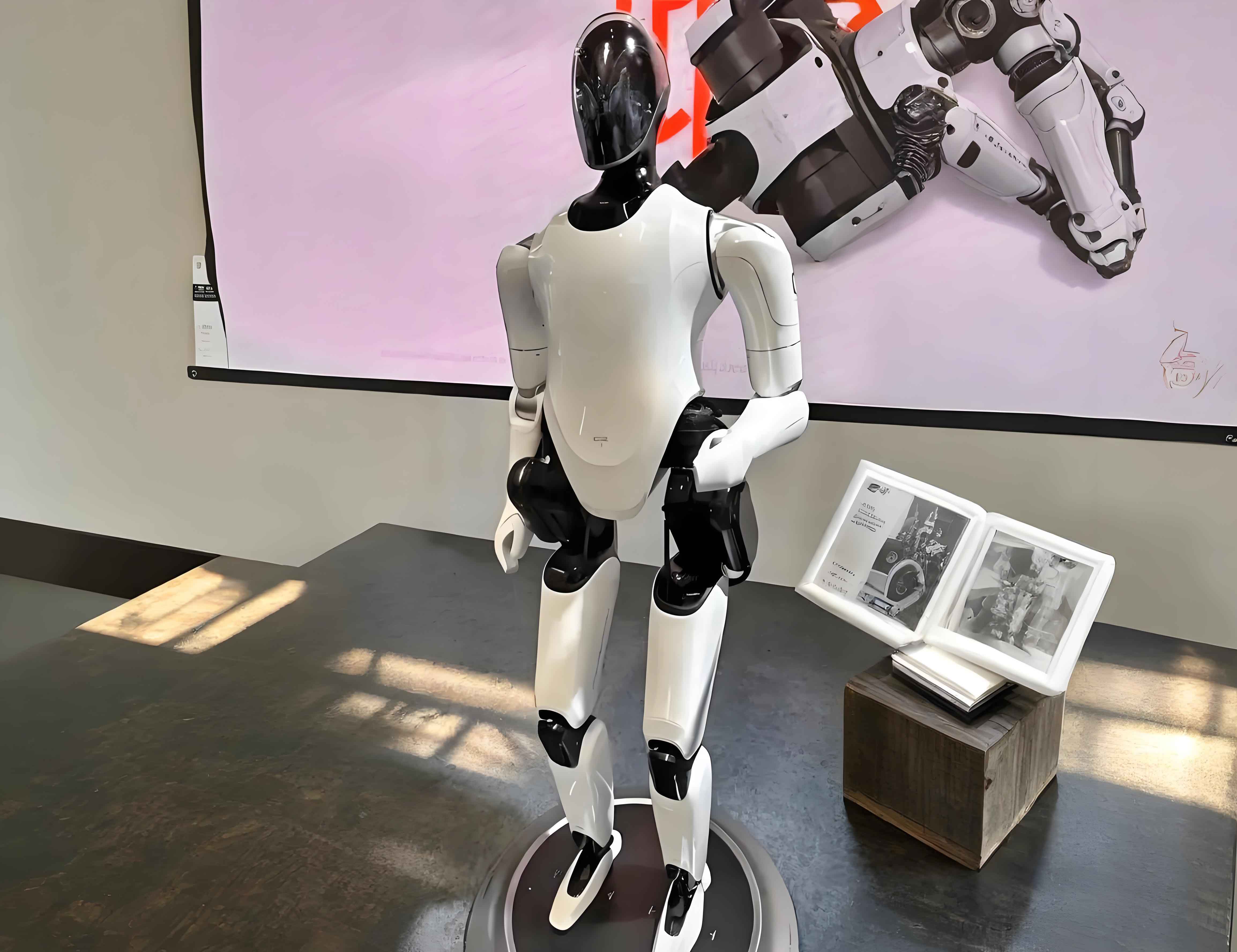
At the heart of this field lies the embodied AI robot, a physical instantiation of these principles. The system architecture of an embodied AI robot can be conceptualized through five intertwined computational cycles, as summarized below:
| Computational Cycle | Core Principle | Key Function |
|---|---|---|
| Morphology to Behavior | Morphological Computation | Using the physical form to generate and simplify control for specific actions, offloading computation from the central controller. |
| Behavior to Learning | Active & Self-Supervised Learning | Using exploratory actions to autonomously gather training data and annotations, enabling closed-loop learning from interaction. |
| Learning to Behavior | Hierarchical Policy Learning & Transfer | Using learned models to improve and generalize low-level control policies across different tasks and robot morphologies. |
| Behavior to Morphology Control | Structured Attention & Graph Networks | Using behavioral context to inform and modulate control signals across the agent’s body, addressing issues like over-smoothing. |
| Learning to Optimize Morphology | Evolutionary & Co-design Optimization | Using learning algorithms (e.g., evolutionary strategies) to co-optimize a robot’s physical structure and control policy. |
1. The Five Pillars of Embodied AI Architecture
1.1 Leveraging Morphology to Generate Behavior
This principle emphasizes using the inherent physical and dynamic properties of an embodied AI robot‘s body to induce desired behaviors, effectively substituting complex central computations. Morphological computation allows the “body” to perform intricate tasks through passive dynamics and environmental interaction. This approach is not only adept at simulating physical world dynamics with high fidelity but also promises energy-efficient and sustainable computing paradigms, making it a cornerstone of embodied intelligence. Advances in precision mechanics and soft robotics are propelling this field into a new era. The control objective can often be simplified from direct trajectory tracking to triggering and stabilizing natural dynamics, which can be framed as an optimization problem:
$$ \min_{u(t)} \int_{0}^{T} (x_{desired} – x_{actual}(u, m))^2 dt $$
where \( u(t) \) is the control input, \( m \) represents the morphological parameters (link lengths, masses, compliances), and \( x \) denotes the state. The key insight is that for a well-designed morphology \( m \), the optimal control \( u(t) \) can be significantly simpler.
1.2 Leveraging Behavior to Achieve Learning
This pillar focuses on the potential of an embodied AI robot to use its capacity for active exploration and manipulation to autonomously collect learning examples and supervisory signals. This facilitates self-supervised and active learning paradigms. While modern machine learning remains data-centric, it often treats data collection as a separate, prior process. Embodied agents break this dichotomy by integrating data acquisition within the learning loop. An agent can formulate actions \( a_t \) to maximize information gain or reduce uncertainty in its model \( M \) of the world:
$$ a_t^* = \arg\max_{a \in A} \mathbb{E}_{s_{t+1}}[U(s_{t+1}) | M, a] $$
Here, \( U \) could be an information-theoretic utility like predictive information or model uncertainty reduction. This creates a virtuous cycle where behavior improves the model, and the improved model guides more intelligent behavior.
1.3 Leveraging Learning to Enhance Behavior
The goal here is to use learned models to refine and generalize low-level control policies. A major challenge is the transfer of policies across different embodied AI robot platforms with distinct state and action spaces. Hierarchical decomposition is a key strategy, where a high-level task planner \( \pi_{high} \) outputs sub-goals \( g \), and a trainable low-level policy \( \pi_{low}(a|s, g) \) executes them. Learning allows the adaptation of \( \pi_{low} \). The problem can be framed as finding a policy that is invariant to certain morphological variations. A useful formulation is meta-learning or domain adaptation:
$$ \min_{\theta} \sum_{i=1}^{N} \mathcal{L}_{task}(\pi_{\theta, \phi_i}, D_i) + \lambda \Omega(\theta) $$
where \( \theta \) are shared parameters across robots, \( \phi_i \) are robot-specific parameters, \( D_i \) is data from robot \( i \), and \( \Omega \) is a regularizer encouraging morphological invariance.
1.4 Leveraging Behavior to Control Morphology
This involves using the context of action and behavior to modulate control across the agent’s body. While architectures like Transformers are powerful for sequence modeling, they can suffer from “over-smoothing” in graph-structured data like robot body schemas, losing fine-grained local information. By incorporating behavioral and spatial priors into graph neural networks or attention mechanisms, we can create more effective controllers. For example, the attention weight \( \alpha_{ij} \) between node \( i \) (e.g., a joint) and node \( j \) in a robot body graph can be conditioned on the ongoing action context \( c \):
$$ \alpha_{ij} = \frac{\exp(\text{LeakyReLU}(a^T[W h_i || W h_j || W_c c]))}{\sum_{k \in \mathcal{N}_i} \exp(\text{LeakyReLU}(a^T[W h_i || W h_k || W_c c]))} $$
This ensures that message passing and control signal generation are dynamically focused based on the task at hand.
1.5 Leveraging Learning to Optimize Morphology
The ultimate expression of embodiment is the co-optimization of body and brain. Evolutionary robotics and gradient-based co-design seek to automatically discover optimal physical structures alongside their controllers. The optimization problem is:
$$ \max_{m \in \mathcal{M}, \theta \in \Theta} \mathbb{E}_{\tau \sim p(\tau|m, \pi_\theta)}[R(\tau)] $$
where \( m \) is the morphology (e.g., parameterized by limb lengths, actuator placements), \( \theta \) are the policy parameters, \( \tau \) is a trajectory, and \( R \) is the reward. Recent methods use indirect encoding (e.g., Compositional Pattern-Producing Networks) to generate complex, regularizable morphologies \( m = \text{CPPN}(z) \) from a latent vector \( z \), making the search space more tractable and producing scalable, modular designs suitable for an advanced embodied AI robot.
2. The Paradigm Shift: Foundation Models and Embodiment
The contemporary paradigm for scaling embodied AI robot intelligence centers on leveraging large pre-trained foundation models for knowledge transfer. The core challenge is bridging the gap between the vast knowledge embedded in these models and the physical grounding required for real-world action.
| Component | Role in Embodied AI | Evolution & State-of-the-Art |
|---|---|---|
| Foundation Model | Provides common-sense knowledge, task understanding, and multimodal reasoning. | Evolution from LLMs (text) to Multimodal Models (text, image, sound). Systems like Gato demonstrated unified training on language, vision, and robotic action sequences, creating a proto-embodied foundation model. |
| Embodied Realization | Translates high-level model output into actionable steps in the physical world. | Split into: 1) High-Level Task Planning (e.g., SayCan: LLM + affordance model for feasible skill selection). 2) Low-Level Skill Realization: Using transformers or other networks to generate executable control policies from demonstrations. 3) Trajectory Generation: Producing smooth, physically-realizable motion paths. |
| Data Processing | Acquires the massive, diverse, and labeled datasets needed for training and fine-tuning. | Transition from purely manual collection to semi-automated paradigms. Concepts like Auto-RT use VLMs and LLMs to guide robots in autonomous exploration, suggesting tasks and judging which can be executed autonomously or via remote operation, vastly improving data collection scale and diversity. |
The current maturity landscape reveals a gradient of feasibility. Algorithms are relatively mature for Sim-to-Real transfer of rigid-body locomotion and simple, single-object manipulation. Foundation models show strong capability in high-level task planning and scene understanding. However, the crucial middle layer—reliable, generalizable low-level skill execution and the seamless integration of these three components for complex tasks—remains a significant challenge, keeping widespread industrial deployment at a distance.
3. Developmental Pathways for the Embodied AI Robot
The evolution of a capable embodied AI robot will follow a structured path of increasing complexity and autonomy.
3.1 Short-Term Path: Modular Integration
- Focus: Combining existing robust components.
- Methods:
- Pure reinforcement learning in simulation for basic mobility and simple manipulation, transferred to reality.
- Using large models (LLMs/VLMs) exclusively for scene understanding and high-level task decomposition.
- Using imitation learning to fine-tune low-level skills based on human demonstrations.
- Outcome: Robots that can perform single, well-defined tasks in structured environments with high reliability.
3.2 Mid-Term Path: The “Realistic Simulator” and Algorithmic Unification
- Focus: Closing the reality gap in simulation and developing end-to-end trainable architectures.
- Advance physics simulators to handle deformation, complex contact, and diverse materials.
- Develop algorithms that learn unified representations for both planning and control, moving beyond strict hierarchy.
- Core Problem to Solve: Generalizable manipulation – the ability for an embodied AI robot to handle novel objects and tasks beyond its direct training data.
- Key Metric: Success rate on a broad, unseen set of manipulation benchmarks in simulation and reality.
3.3 Long-Term Path: Holistic Co-Design and Multi-Agent Synergy
- Focus: Fully integrated systems and collaborative intelligence.
- Foundation models that directly generate precise, context-aware action trajectories (positions, forces, grasp poses).
- Reinforcement learning used not for primary skill learning, but for continuous online refinement and adaptation of these trajectories.
- Co-evolution of morphology, control, and learning algorithms for specific task families.
- Outcome: Systems capable of multi-task learning in complex environments and collaborative problem-solving between multiple embodied AI robot agents.
4. Application Roadmap and Future Outlook
The deployment of embodied AI robot technology will expand from controlled settings to pervasive integration into society, driven by incremental technological readiness.
| Timeframe | Primary Domain | Expected Capabilities & Examples |
|---|---|---|
| Short-Term (Now – ~2-3 years) | Research & Closed-Loop Commercial Pilots |
|
| Mid-Term (~3-7 years) | Industrial Automation |
|
| Long-Term (7+ years) | Commercial & Domestic Service |
|
4.1 Key Future Research Vectors
The trajectory of progress will be shaped by breakthroughs in several interconnected domains:
- Morphological Emergence: Moving beyond pre-defined forms. Future research will focus on systems where optimal physical structure and material properties can emerge automatically from task and environmental constraints, moving towards fully autonomous body-brain co-design. The formula in Section 1.5 provides the mathematical groundwork for this direction.
- Perceptual Evolution: Transitioning from using perception solely for control feedback to creating perception-action loops that co-evolve. Inspired by biology, the sensory apparatus and processing of an embodied AI robot will adapt alongside its motor strategies to maximize task-relevant information acquisition, formalized by optimizing the Information Bottleneck principle in an active loop:
$$ \max_{\pi} I(S; A) – \beta I(S; X) $$
where \( S \) is task-relevant state, \( A \) is action, and \( X \) is raw sensory input, encouraging actions that extract maximal task-relevant information. - Physical Realization: Accelerating the leap from digital optimization to physical instantiation. Advances in rapid prototyping (4D printing, metamaterials), VR/AR for human-in-the-loop design, and novel actuator technologies will drastically reduce the iteration cycle for embodied agent design, making the long-term co-design vision practical.
- Multi-Body Coordination: Scaling from single-agent to collective intelligence. The future challenge lies in developing frameworks for emergent cooperation among swarms of heterogeneous embodied AI robot agents. This involves solving problems in decentralized communication, role allocation, and the emergence of shared goals without centralized command, potentially modeled as a decentralized partially observable Markov decision process (Dec-POMDP).
In conclusion, embodied AI robot technology represents more than just an incremental improvement in robotics; it is a fundamental rethinking of how artificial intelligence must be grounded in the physical world to achieve robust and general capabilities. Its development, through the architectural principles, paradigm shifts, and pathways outlined here, demonstrates immense potential. It is a powerful catalyst for innovation, not only within AI but across all sectors of industry and society. As the technology matures through relentless research and engineering, the embodied AI robot will transition from a research prototype to an indispensable partner, extending its benefits and reshaping our interaction with the digital and physical worlds.