
Guangzhou hosted the 21st China International Small and Medium Enterprises Fair from September 3 to September 6, with artificial intelligence empowerment of small and medium-sized enterprises serving as the organizing theme. More than 2,000 high-quality small and medium-sized enterprises from more than 40 countries and regions participated. Within the fair, the embodied intelligence professional exhibition occupied 15,000 square meters and brought together nearly 100 supply chain enterprises and more than 200 typical application scenarios. The exhibition covered key links in the industrial chain, including core components, complete humanoid robots, artificial intelligence algorithms, and industry applications. The result was a one-stop presentation of technological innovation and application deployment in embodied intelligence.
The term embodied intelligence can sound academic, but at the fair it appeared in scenes that could be seen and touched. Robots walked, swung rackets, smiled, and carried objects. Visitors stopped to watch. Buyers took notes. The exhibits were not static displays on pedestals. They pointed toward real productivity entering shopping malls, factories, hospitals, and campuses. Many of the embodied intelligence companies were young, often founded only three to five years earlier, yet they had already produced globally leading technical indicators and business models in their respective niche tracks.
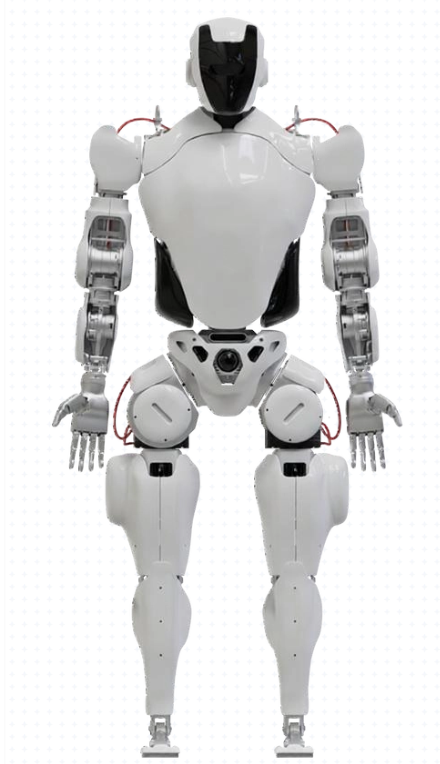
- Embodied Intelligence Takes Center Stage at the Fair
The 21st China International Small and Medium Enterprises Fair placed artificial intelligence at the center of its organizing theme, and embodied intelligence became one of the most visible expressions of that theme. The professional exhibition area for embodied intelligence was 15,000 square meters. Nearly 100 enterprises from the industrial chain participated. More than 200 typical application scenarios were presented. These scenarios covered core components, full humanoid robots, artificial intelligence algorithms, and industry applications. For visitors, the fair offered a rare view of how embodied intelligence is moving from isolated laboratory demonstrations toward coordinated industrial ecosystems.
The scale of participation also mattered. More than 2,000 small and medium-sized enterprises from more than 40 countries and regions attended the fair. That international and cross-sector presence gave the embodied intelligence exhibition a broader context. It was not only a showcase for a few robot makers. It was a meeting point for component suppliers, algorithm developers, system integrators, and end users. In embodied intelligence, progress depends on this kind of convergence because a robot body, a control stack, perception systems, interaction models, and manufacturing capacity must work together.
At the fair, embodied intelligence was presented through motion, interaction, and deployment. A humanoid robot could face a changing badminton serve and respond with forehand, backhand, or smash. Another robot could switch between bipedal walking and wheeled movement. Another could display more than 30 composite expressions through a biomimetic silicone face. Another could claim a high degree of domestic content in core components and a path to mass production. Each example represented a different part of the embodied intelligence value chain, but together they showed an industry moving toward commercial reality.
The fair also highlighted the role of small and medium-sized enterprises in embodied intelligence. Large platforms and large manufacturers often attract headlines, but the fair demonstrated that specialized small and medium-sized enterprises are developing core components, algorithms, interaction systems, and application scenarios. Their size allows them to focus on specific technical bottlenecks and specific customer needs. Their youth allows them to design around new assumptions, including the assumption that artificial intelligence should not simply be added to an existing robot body but should shape the body itself.
For embodied intelligence, the significance of the fair lay in the combination of breadth and specificity. The breadth came from more than 40 countries and regions and more than 2,000 participating small and medium-sized enterprises. The specificity came from nearly 100 supply chain enterprises and more than 200 typical application scenarios inside the embodied intelligence professional exhibition. This combination suggested that embodied intelligence is no longer only a research agenda. It is becoming an industrial agenda with supply chains, product roadmaps, and deployment targets.
Fair Dimension Embodied Intelligence Signal Organizing theme Artificial intelligence empowering small and medium-sized enterprises International participation More than 40 countries and regions Enterprise participation More than 2,000 high-quality small and medium-sized enterprises Embodied intelligence exhibition area 15,000 square meters Supply chain participation Nearly 100 industrial chain enterprises Application scenarios More than 200 typical application scenarios Key industrial links Core components, complete humanoid robots, artificial intelligence algorithms, and industry applications - Technology First: Giving Artificial Intelligence a Body
At the Dongyi Technology booth, a bipedal humanoid robot played badminton with visitors. It handled forehand strokes, backhand strokes, and smashes. Facing changing returns, the robot responded with composure. Crowds around the booth repeatedly responded with surprise. Dongyi Technology described the machine as the world’s first bipedal humanoid robot capable of autonomously playing badminton with humans in the real world. For embodied intelligence, this claim matters because badminton is not a fixed routine. It requires perception, prediction, motion planning, balance, and real-time control in a dynamic environment.
Ren Xiaoyu, founder, chief executive officer, and chief technology officer of Dongyi Technology, explained the company’s approach. Ren became an associate senior engineer at 29 and graduated from Tsinghua University. Before founding Dongyi Technology, Ren served as the humanoid robot technical lead at Fourier Intelligent. Ren led the development of the GR-1 humanoid robot. That project achieved the first domestic implementation of reinforcement learning Sim-to-Real technology in motion control for large-size humanoid robots. This background illustrates how embodied intelligence combines academic research, reinforcement learning, simulation transfer, and hardware engineering.
Dongyi Technology was founded in September 2024. After founding the company, Ren proposed a concept that differed from the mainstream direction of the industry. The concept is called Robot for AI. In the more common approach of AI for Robot, artificial intelligence is placed into an existing robot body. Dongyi Technology reverses the logic. It first defines what kind of body intelligence needs, and then designs the physical platform. This distinction is central to embodied intelligence because the body is not merely a container. The body determines what can be sensed, how fast actions can be executed, what environments can be entered, and what forms of interaction are possible.
The badminton demonstration showed why hardware and intelligence must be co-designed in embodied intelligence. A robot that plays badminton must coordinate high-speed perception with whole-body motion. It must estimate the trajectory of the shuttlecock. It must move its feet, torso, arm, and racket in a coordinated way. It must recover balance after each stroke. It must also operate in the real world, where lighting, background, and human behavior are not perfectly controlled. The Sim-to-Real reinforcement learning heritage described by Ren points to a key method in embodied intelligence: training policies in simulation and transferring them to physical robots.
Yet the Dongyi Technology example also shows that embodied intelligence is not only about algorithms. The robot’s ability to play badminton depends on actuators, joints, sensors, control electronics, and mechanical design. It depends on a body that can move quickly enough and safely enough. It depends on a system architecture that can connect perception to action without delay. The Robot for AI concept therefore represents a broader argument within embodied intelligence: intelligence and morphology should evolve together. If the body is designed around the needs of intelligence, the resulting system may achieve capabilities that are difficult to reach when artificial intelligence is retrofitted onto a generic platform.
At the fair, this technology-first path was one of the clearest expressions of embodied intelligence. It did not rely on a scripted performance. It invited interaction with visitors. It demonstrated a robot responding to unpredictable human play. For the embodied intelligence sector, such demonstrations are important because they translate abstract capabilities into visible performance. They also create a benchmark. If a bipedal humanoid robot can autonomously play badminton in the real world, then the underlying perception, control, and learning stack may be relevant to other dynamic tasks in logistics, manufacturing, inspection, and service.
- Scenario First: Opening the Door to Deployment
If Dongyi Technology represented a technology-driven path, Shenzhen Digital Huaxia and Zhipingfang represented another path: scenario-driven deployment. At the Shenzhen Digital Huaxia exhibition area, three humanoid robots stood in a row: Xialan R03, Xiaqi, and Xingxingxia. Xialan R03 uses a biomimetic silicone facial skin. Its face carries more than 40 degrees of freedom and can accurately present more than 30 composite expressions. Xingxingxia supports switching between bipedal walking and wheeled movement. It can perform high-level motions such as a side somersault and ethnic dance. These capabilities point to embodied intelligence designed for interaction and display, but also for practical service contexts.
Jia Kaichao, product marketing manager at Shenzhen Digital Huaxia, said that most robots on the market can only complete basic actions and find it difficult to take on real business. The company’s core differentiation lies in two self-developed underlying systems. One of these is the Juhao 2.0 embodied intelligence interaction platform. The platform features an original fast-slow dual-brain coordination mechanism. The fast brain is responsible for real-time multimodal interaction. The slow brain carries emotional computing and long-term memory. Together, they aim to understand user emotions and achieve truly empathetic human-robot interaction.
This approach places embodied intelligence at the intersection of motion, perception, and emotion. A robot that can walk, gesture, and display expressions may attract attention, but a robot that can sustain an interaction must remember context and respond to emotional cues. The fast-slow dual-brain mechanism illustrates how embodied intelligence systems are becoming more layered. Real-time interaction requires immediate responses. Emotional computing and long-term memory require slower, more persistent representations. By separating these functions, the system can pursue both responsiveness and depth.
Jia Kaichao defined 2026 as the first year of scaled commercial scenarios for humanoid robots. From the perspective of geography, platform, and industry cycle, participating in the China International Small and Medium Enterprises Fair represented multiple favorable factors for the company. Shenzhen Digital Huaxia can rely on the mature supply chain in the Guangdong-Hong Kong-Macao Greater Bay Area for motors, reducers, and batteries. The company said its complete machines can be assembled and produced locally. For embodied intelligence, this local supply chain is not a minor detail. It affects cost, iteration speed, quality control, and the ability to respond to customer requirements.
The scenario-driven path also highlights why embodied intelligence must be evaluated in context. A robot in a shopping mall, hospital, school, or factory faces different constraints. Lighting, noise, human traffic, safety rules, and task expectations vary. A humanoid robot with expressive facial degrees of freedom may be valuable in service and companionship contexts. A robot that can switch between bipedal and wheeled movement may be valuable where both stairs and smooth floors are present. A robot that can perform a side somersault demonstrates dynamic control, but the commercial value of embodied intelligence will depend on whether such capabilities can be adapted to useful tasks.
Shenzhen Digital Huaxia’s emphasis on empathy and memory suggests that embodied intelligence is not only a physical challenge. It is also an interaction challenge. People may accept robots more readily if the robots can read social cues and maintain continuity across conversations. That requires models for emotion, memory, and multimodal perception. It also requires a body that can express internal states through face, voice, gesture, and movement. In this sense, scenario-driven embodied intelligence treats the robot as a participant in a human environment, not merely a machine that moves through it.
- Mass Production Breakthrough: Industrialization Accelerates
Leju Robotics, based in Shenzhen, showed another path: industrialization. At the fair, Leju brought Kuavo, described as the world’s first 5G-A humanoid robot. Leju’s series of full-size humanoid robots has a core component domestic rate of 95 percent. The company is one of the most industrialized humanoid robot product lines in China. Kuavo has appeared at the Pyeongchang Winter Olympics during the Beijing 8 Minutes segment, at the Asian Winter Games ice and snow venue at minus 20 degrees Celsius, and at the 2025 National Games as a 5G-A torchbearer. These appearances show embodied intelligence operating in high-visibility and sometimes extreme environments.
The most important development, however, is Leju’s industrialization progress. Leju and Dongfang Jinggong jointly built China’s first 10,000-unit-class humanoid robot automated production line. The line has already been put into scaled manufacturing. The arrangement forms a closed loop of Shenzhen research and development pilot production plus Foshan manufacturing mass production. In the first half of this year, Leju humanoid robot shipments reached 650 units. For embodied intelligence, these numbers are significant because they shift discussion from prototypes to production systems, supply chain readiness, and shipment volume.
A 95 percent domestic core component rate is also relevant to embodied intelligence. Humanoid robots depend on motors, reducers, sensors, controllers, batteries, and structural components. A high domestic rate can support faster iteration, easier maintenance, and more resilient supply chains. It can also help companies control costs as they move from small-batch production to larger volumes. The 10,000-unit-class automated production line suggests that Leju and its partner are preparing for a stage in which embodied intelligence products are manufactured with automation, quality control, and repeatability.
The Shenzhen research and development pilot plus Foshan manufacturing mass production model reflects the regional industrial logic of the Greater Bay Area. Shenzhen offers access to talent, software ecosystems, and rapid prototyping. Foshan offers manufacturing depth and scale. For embodied intelligence, this division of labor can shorten the path from design to product. It can also create feedback loops in which manufacturing data informs redesign. The fair’s setting in Guangzhou, within the same broader regional cluster, made this supply chain proximity visible to participants and buyers.
Leju’s public appearances also illustrate how embodied intelligence can function as a platform for national and international events. A robot that appears in an Olympic segment, an Asian Winter Games venue at minus 20 degrees Celsius, and a National Games torch relay must meet reliability expectations. These are not ordinary laboratory conditions. They involve audiences, media, timing, and environmental stress. For embodied intelligence, such deployments provide evidence that humanoid robots can operate outside controlled settings, even if the tasks are carefully managed.
The shipment figure of 650 humanoid robots in the first half of this year provides a concrete commercial signal. It does not mean that embodied intelligence has solved all deployment challenges. It does mean that at least one Chinese humanoid robot producer has moved into meaningful production volume. Combined with the 10,000-unit-class automated production line, the 95 percent domestic core component rate, and the regional manufacturing model, Leju’s case shows that embodied intelligence is entering a phase where industrialization is no longer a distant concept. It is becoming a measurable process.
- How the Three Paths Converge in Embodied Intelligence
The fair presented three distinct paths in embodied intelligence. Dongyi Technology represented a technology-first path, with a focus on body design, reinforcement learning, Sim-to-Real transfer, and dynamic human-robot interaction. Shenzhen Digital Huaxia represented a scenario-first path, with a focus on emotional computing, multimodal interaction, long-term memory, and local supply chain assembly. Leju Robotics represented an industrialization path, with a focus on 5G-A connectivity, domestic core components, automated production, and shipment volume. Each path addressed a different bottleneck in embodied intelligence.
These paths are not mutually exclusive. In fact, they converge. A technology-first embodied intelligence company needs manufacturing partners to turn prototypes into products. A scenario-first embodied intelligence company needs robust control and perception to operate in real environments. An industrialization-focused embodied intelligence company needs advanced interaction and learning capabilities to expand from structured tasks to open-ended service. The fair demonstrated that the embodied intelligence ecosystem is forming around these intersections.
The presence of nearly 100 supply chain enterprises and more than 200 typical application scenarios at the embodied intelligence professional exhibition supports this convergence. Supply chain enterprises provide the components and subsystems that make humanoid robots possible. Application scenarios provide the requirements that shape product design. When component suppliers, robot makers, algorithm developers, and end users meet in one exhibition, embodied intelligence can move faster from concept to deployment.
Another convergence point is the role of young companies. Many embodied intelligence enterprises at the fair were founded only three to five years earlier. Their youth allows them to adopt new architectures and new assumptions. Dongyi Technology’s Robot for AI concept is an example. Shenzhen Digital Huaxia’s fast-slow dual-brain mechanism is another. Leju’s 10,000-unit-class production line and 650 shipments in the first half of this year show that youth does not prevent industrial ambition. In embodied intelligence, young firms can combine research speed with manufacturing partnerships.
The fair also showed that embodied intelligence is not limited to humanoid form. The professional exhibition covered core components, complete humanoid robots, artificial intelligence algorithms, and industry applications. Humanoid robots attract attention because they resemble humans and can operate in human environments, but embodied intelligence also includes perception systems, motion control, manipulation, and interaction platforms. The humanoid robot is one expression of embodied intelligence. The underlying capabilities are broader.
Company Embodied Intelligence Focus Featured Technology or Product Commercial or Deployment Signal Dongyi Technology Technology-first embodied intelligence and body design Bipedal humanoid robot autonomously playing badminton in the real world; Robot for AI philosophy; reinforcement learning Sim-to-Real for large-size humanoid motion control; GR-1 development heritage Founded in September 2024; demonstrates autonomous real-world badminton interaction with visitors Shenzhen Digital Huaxia Scenario-first embodied intelligence and empathetic interaction Xialan R03, Xiaqi, and Xingxingxia; Juhao 2.0 embodied intelligence interaction platform; fast-slow dual-brain mechanism; more than 40 facial degrees of freedom; more than 30 composite expressions; bipedal and wheeled movement switching; side somersault and ethnic dance Defines 2026 as the first year of scaled commercial scenarios for humanoid robots; local assembly supported by Greater Bay Area motor, reducer, and battery supply chain Leju Robotics Industrialization and mass production of embodied intelligence Kuavo 5G-A humanoid robot; full-size humanoid robot series; 95 percent domestic core components; appearances at Pyeongchang Winter Olympics Beijing 8 Minutes, minus 20 degrees Celsius Asian Winter Games ice and snow venue, and 2025 National Games as 5G-A torchbearer China’s first 10,000-unit-class humanoid robot automated production line with Dongfang Jinggong; Shenzhen research and development pilot plus Foshan manufacturing mass production; 650 humanoid robot shipments in the first half of this year - Commercial Signals and Remaining Questions for Embodied Intelligence
The fair did not present a single uniform timeline for embodied intelligence. It did present commercial signals. Shenzhen Digital Huaxia defined 2026 as the first year of scaled commercial scenarios for humanoid robots. Leju reported 650 humanoid robot shipments in the first half of this year and described a 10,000-unit-class automated production line already in scaled manufacturing. Dongyi Technology demonstrated a real-world dynamic task with a bipedal humanoid robot. These signals are different in nature, but together they suggest that embodied intelligence is moving beyond pure demonstration.
At the same time, the fair indicated that challenges remain. Shenzhen Digital Huaxia’s Jia Kaichao noted that most robots on the market can only complete basic actions and find it difficult to take on real business. That statement points to a gap between motion capability and business capability. A robot may walk, wave, or perform a routine, but real business requires reliability, safety, task completion, and integration with workflows. Embodied intelligence must close this gap if it is to scale across hospitals, schools, malls, and factories.
The technology-first path also faces challenges. A robot that plays badminton demonstrates dynamic control, but commercial deployment requires cost control, maintainability, and a clear value proposition. The Robot for AI philosophy may produce better bodies for artificial intelligence, but it also requires new design methods and new supply chain coordination. In embodied intelligence, a compelling demonstration is necessary but not sufficient. The next step is to translate dynamic capability into repeatable service.
The industrialization path faces its own questions. A 10,000-unit-class automated production line and 650 shipments in the first half of this year show progress, but mass production must be matched by mass demand. Customers must find embodied intelligence products useful, safe, and affordable. Supply chains must deliver components at consistent quality. Service networks must support deployed robots. The fair brought together buyers and suppliers, which is one way to accelerate this matching process.
For embodied intelligence, the most important signal may be the integration of hardware, software, and scenarios. Dongyi Technology integrates body design and learning. Shenzhen Digital Huaxia integrates emotional computing, memory, and local assembly. Leju integrates 5G-A connectivity, domestic components, and automated manufacturing. None of these companies is pursuing embodied intelligence as a single invention. They are building systems. That systems perspective is essential because embodied intelligence is inherently multidisciplinary.
The fair also showed that embodied intelligence is becoming an international conversation. More than 40 countries and regions participated in the China International Small and Medium Enterprises Fair. Embodied intelligence companies from China displayed their products to international visitors. Supply chain enterprises met potential partners. Application scenarios attracted buyers from different industries. This international participation can help embodied intelligence companies understand diverse requirements and identify new markets.
- Conclusion: Embodied Intelligence Leaves the Stand and Enters the Workplace
At the embodied intelligence professional exhibition inside the 21st China International Small and Medium Enterprises Fair, humanoid robots walked, swung rackets, smiled, and carried objects. They attracted large numbers of buyers and visitors. They were not static objects on display. They represented a transition toward real productivity in shopping malls, factories, hospitals, and schools. The companies behind them were often young, founded only three to five years earlier, yet they had already achieved globally leading technical indicators and business models in their respective segments.
Embodied intelligence was the central term connecting these exhibits. Dongyi Technology showed embodied intelligence as a technology-first pursuit, with a bipedal humanoid robot playing badminton and a Robot for AI design philosophy. Shenzhen Digital Huaxia showed embodied intelligence as a scenario-first pursuit, with expressive humanoid robots, a fast-slow dual-brain interaction platform, emotional computing, and long-term memory. Leju Robotics showed embodied intelligence as an industrialization pursuit, with Kuavo, 5G-A connectivity, 95 percent domestic core components, a 10,000-unit-class automated production line, and 650 shipments in the first half of this year.
The fair’s structure reflected the breadth of embodied intelligence. The professional exhibition covered 15,000 square meters. Nearly 100 industrial chain enterprises participated. More than 200 typical application scenarios were presented. Core components, complete humanoid robots, artificial intelligence algorithms, and industry applications were all part of the display. More than 2,000 small and medium-sized enterprises from more than 40 countries and regions attended the broader fair. This combination of scale and specialization gave embodied intelligence a platform that connected technology, supply chains, and markets.
For the embodied intelligence sector, the message from Guangzhou was clear. The field is no longer only about proving that robots can move. It is about proving that embodied intelligence can work, scale, and deliver value. The demonstrations at the fair showed that dynamic interaction is possible. The production line and shipment figures showed that manufacturing is advancing. The scenario definitions showed that companies are thinking about commercial deployment. The remaining work is to connect these achievements into reliable products and sustainable businesses.
Young embodied intelligence companies are already competing on a global stage. They are developing core components, humanoid robots, artificial intelligence algorithms, and industry applications. They are using regional supply chains, international exhibitions, and real-world demonstrations to accelerate feedback. The 21st China International Small and Medium Enterprises Fair provided a snapshot of this moment. Embodied intelligence robots are leaving the stand. They are entering the workplace. The next phase will determine how quickly they become ordinary tools in everyday operations.