
Industrial robots are crossing a threshold that many manufacturers have anticipated for years but few have been able to reach in practice. As global production shifts toward high-variety, low-volume and increasingly customized output, the fixed programming and structured workcells that defined robotics for decades are no longer sufficient. A new generation of machines, built around the concept of embodied intelligence, is emerging as the most promising answer to this structural challenge, promising industrial robots that can perceive their surroundings, reason about tasks and act with precision in environments that were never designed to be predictable.
A research team examining the intersection of embodied intelligence and industrial robotics has set out a systematic account of how this transition is unfolding. The work describes the basic concepts and architectural layers of embodied intelligence industrial robots, organizes the enabling technologies along the closed loop of perception, decision-making and execution, and sketches the trajectories that will shape the next phase of industrial automation. The central argument is straightforward: embodied intelligence is not an incremental upgrade to existing automation but a shift in what industrial robots fundamentally are.
1. Manufacturing Pressure Is Pushing Robotics Toward Embodied Intelligence
For most of their industrial history, robots have excelled at repetition. Programmed with fixed instructions and deployed inside structured environments, they deliver high task success rates and dependable performance in large-volume, low-complexity operations. Automotive assembly lines, electronics production and heavy equipment manufacturing have all been built on this model, and it has served those sectors well.
The difficulty is that the surrounding market has changed. Production is moving toward multi-variety, small-batch and customized manufacturing, and the adaptability of standardized, large-scale production models continues to decline. Flexible manufacturing and highly complex production tasks expose a significant bottleneck in conventional robot design, which is why the industry is under pressure to accelerate its digital and intelligent transformation.
Major economies have positioned themselves around this shift. China’s manufacturing power strategy, the United States’ advanced manufacturing partnership and Germany’s Industry 4.0 initiative all reflect the same recognition that intelligent manufacturing is the direction of high-quality industrial development. Industrial robots sit at the center of that agenda as core equipment and technology, deployed across automotive manufacturing, electronic information manufacturing, high-end equipment manufacturing and aerospace.
What has changed more recently is the maturation of artificial intelligence as a practical industrial force. Embodied intelligence breaks through the limitation that prevents conventional AI from interacting with the physical world, allowing it to be embedded in traditional industrial equipment so that machines can exchange information with their real operating environment in real time and generate new productive capacity. For this reason, embodied intelligence industrial robots have become a critical development direction and key technology in the upgrading of conventional industrial robots, and a core technology of the next round of industrial transformation.
Policy activity reflects that assessment. The United States released a national robotics roadmap recommending the establishment of an interagency working group and identifying eight research opportunities, including physical embodiment, edge artificial intelligence and human-robot interaction, with the explicit aim of using robotics to address labor shortages. The European Union’s Digital Europe Programme plans to invest 1.3 billion euros between 2025 and 2027 to support deployment of artificial intelligence, advanced computing and related technologies. China has issued a series of policies to systematically position the embodied intelligence industry, including a joint action plan on artificial intelligence plus manufacturing issued by eight departments, and a dedicated action on real-world training for humanoid robots and embodied intelligence. Those measures explicitly support the adoption of intelligent agents on industrial machine tools, industrial robots and other equipment, with the goal of improving autonomous decision-making, analysis and execution capabilities.
The consequence is a change in the nature of the machine itself. Powered by embodied intelligence, industrial robots evolve from programmable tools into agents that combine perception, decision-making and execution, capable of environmental awareness, autonomous decision-making, dynamic adaptation and precise execution. They can build dynamic models of unstructured industrial environments, optimize strategies in response, and complete industrial tasks of a complexity that fixed automation cannot address.
2. Defining the Embodied Intelligence Industrial Robot
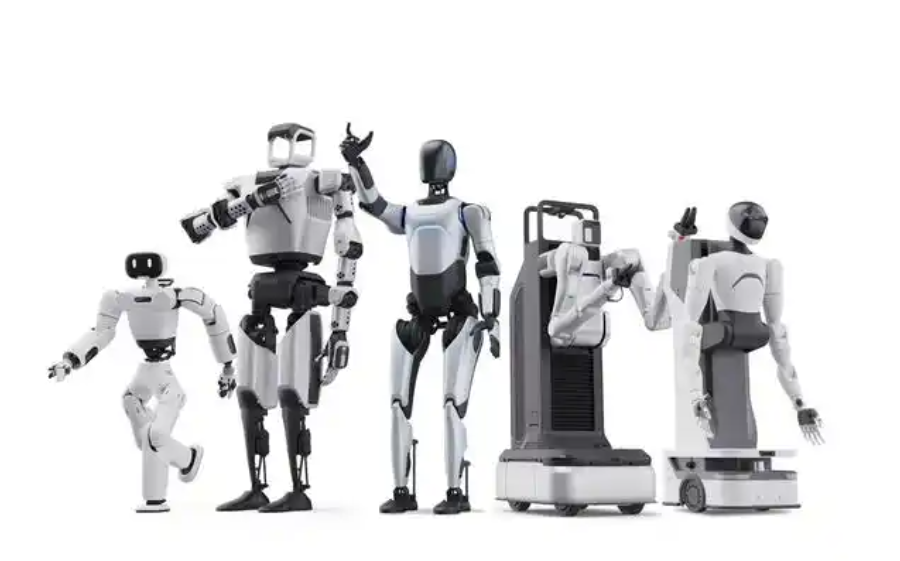
Industrial scenarios are far from uniform. Intelligent manufacturing, warehousing and logistics, and special operations each impose different requirements on form, function, performance and safety. In intelligent manufacturing, embodied intelligence industrial robots are typically found in the shape of multi-joint robotic arms and humanoid robots, performing precision assembly, welding, grinding and mobile quality inspection across automotive, precision equipment and electronics production. In warehousing and logistics, they appear as autonomous mobile robots, unmanned forklifts and quadruped robots, distinguished by autonomous navigation, intelligent planning and dynamic obstacle avoidance for picking, palletizing and transport. In special operations, they take wheeled, tracked or magnetic-adhesion forms with explosion-proof, waterproof, corrosion-resistant and radiation-tolerant characteristics, serving high-risk inspection, extreme-environment maintenance and emergency response to hazardous chemicals.
Because that diversity is so wide, the research community has resisted defining embodied intelligence industrial robots by shape or performance alone. Several formulations have been proposed. One describes the embodied intelligence industrial robot as an intelligent robotic system that builds an autonomous operating loop of perception, decision, action and feedback through multimodal sensing and embodied interaction, enabling environmental perception, task understanding, autonomous decision-making, task planning and completion of complex operational tasks. Another emphasizes the integrated coordination of perception, cognition and behavior, with adaptive learning and autonomous decision-making that shift the robot from passive execution to active perception. A third frames industrial embodied intelligence as a manufacturing system that uses multimodal perception fusion, dynamic environmental modeling and an autonomous decision loop to complete production tasks within specific industrial settings.
Drawing those strands together, the working definition treats an embodied intelligence industrial robot as a new generation of intelligent robotic system that deeply integrates embodied intelligence technology with industrial robot technology to meet production requirements in the industrial domain. Through the closed loop of perception, decision-making and execution, it achieves multimodal perceptual understanding, autonomous decision-making and task planning, precise motion control and embodied interaction, allowing it to complete complex industrial tasks autonomously and intelligently. Crucially, the definition rests on two attributes, industrial relevance and embodied intelligence, and imposes no restriction on robot form.
3. A Four-Layer Architecture for Embodied Intelligence Industrial Robots
Where conventional industrial robots are organized around a mechanical, sensing and control architecture, the embodied intelligence industrial robot adds multimodal perception, autonomous decision-making and embodied interaction so that the machine can perceive, understand and interact. Several architectural proposals have appeared. One organizes the system into six layers spanning environment, interaction, physics, computation, intelligence and application, with the physical layer as the hardware foundation, the intelligence layer as the central core, and the environment layer supporting interaction with the outside world. Another proposes a knowledge-driven technical framework for embodied intelligence industrial robots across multiple industrial environments, built from five modules: a world model, a high-level task planner, a low-level skill controller, a simulator and the physical system. A third designs a dual-arm industrial robot system based on embodied intelligence technology, comprising an intelligent computing system, the dual-arm robot, a visual perception system, a voice system, a mobile base and a test platform.
Across these varied approaches, a common structure emerges in the form of a physical layer, a perception layer, an intelligence layer and an application layer, with minor differences reflecting task, scenario and technical route. The physical layer contains the robot body, sensors and working environment, the physical entities that form the base of the entire architecture. The perception layer functions as the eyes of the system, collecting and processing information about the robot’s own physical state and its environment and mapping the physical world into the digital world that subsequent reasoning depends on. The intelligence layer is the core brain, built on multimodal large models together with reinforcement learning, machine learning and transfer learning algorithms, responsible for fusing perceptual information, making autonomous decisions and planning tasks, and directing the application layer. The application layer is the executing hand, encompassing servo motors, reducers and dexterous hands, which carry out commands precisely according to the plans formed in the intelligence layer. Throughout operation, the entire system continues to learn and iteratively optimize, correcting deviations and adapting to change, closing the control loop.
| Architectural Layer | Primary Role | Representative Elements |
|---|---|---|
| Physical layer | Hardware foundation and base of the entire architecture | Industrial robot body, sensors, working environment and all associated physical entities |
| Perception layer | Sensory gateway that maps the physical world into digital representation | Vision, force, touch and acoustic sensing; self-state monitoring; multimodal fusion |
| Intelligence layer | Core brain for fusion, reasoning, autonomous decision-making and task planning | Multimodal large models, reinforcement learning, machine learning, transfer learning |
| Application layer | Executing hand that converts plans into precise physical action | Servo motors, reducers, dexterous hands and end effectors |
Two nested loops keep this architecture alive. An internal real-time control loop governs moment-to-moment action, while an external experience-learning loop accumulates knowledge across tasks. Together they form a dual-cycle mechanism through which the embodied intelligence industrial robot continuously refines its performance.
4. Perception: The Foundation of Embodied Intelligence in Industry
Perception determines whether an embodied intelligence industrial robot can accurately understand its production task and its surroundings, and it is the necessary precondition for autonomous decision-making and precise execution. The perception stage gathers data through vision, force, touch, hearing and other modalities to build a comprehensive understanding of both the working environment and the task at hand.
Conventional industrial robots operating in structured environments have limited need for environmental or self-awareness, relying on single-modality sensors such as position sensors and capacitive sensors. Embodied intelligence industrial robots typically work in unstructured or semi-structured industrial settings on flexible manufacturing and flexible assembly tasks that are not standardized, and therefore require comprehensive, accurate and real-time acquisition of environmental and self-state information.
Environmental perception relies primarily on visual, force and tactile sensors to obtain spatial position, color and shape, and distance information. Visual sensors support object recognition, environment perception, target detection and distance measurement through image acquisition, and methods such as stereo vision and 3D structured light extend this to two-dimensional target detection and three-dimensional scene map reconstruction, producing accurate models of the working environment while reducing the influence of dynamic disturbances such as camera occlusion and lighting variation. Force sensors are used mainly for force monitoring and force feedback, measuring contact force, torque and shear force in real time, which improves compliant force control in precision manufacturing and flexible assembly. Tactile sensors, sometimes described as skin-like or electronic skin, integrate high-density pressure, temperature and strain sensing units that convert external stimuli into electrical signals, allowing the robot to sense pressure and temperature across flat or curved surfaces and to undertake finer tasks such as material classification and surface inspection. Beyond these, specialized sensors including millimeter-wave radar, infrared sensors and chemical sensors find wide application in scenarios such as mine rescue and emergency handling of hazardous chemicals.
Self-perception is equally important. The embodied intelligence industrial robot must sense and collect its own motion state, including movement speed, joint angles and spatial position, a process carried out mainly through inertial sensors, encoders and force sensors. Inertial sensors measure acceleration and angular velocity, and the commonly used inertial measurement unit integrates both to capture posture and motion state. Encoders are typically installed on joints and dexterous hands, converting mechanical rotation into electrical signals that feed back angular and displacement information. Force sensors also play a broad role in self-perception, allowing the robot to adjust posture based on the forces acting on its components and thereby improve its adaptability to the environment.
Once data has been collected across modalities, the next challenge is fusion. Because information from different modalities carries substantial environmental noise and the data differ considerably from one another, multimodal fusion remains one of the difficult problems in the perception stage of embodied intelligence industrial robots. Fusion architectures are generally classified by level, spanning early or data-level fusion, intermediate or feature-level fusion, late or decision-level fusion, and hybrid approaches that combine several of these. Surveys of multimodal perception in robotics have traced developments between 2004 and 2024 and their integration with decision systems, describing how perception-driven decision frameworks benefit from dynamic environments and human-robot interaction. Other work addresses common problems in multimodal fusion such as sensor noise, target occlusion and equipment failure, proposing adaptive multimodal mapping methods to strengthen environmental understanding in dynamic scenes. Research has also traced the evolution from early and late fusion toward hybrid fusion, examining the trade-offs between information retention and computational efficiency, and introducing attention-based interaction modeling, contrastive-learning-based semantic alignment and generative fusion built on large language models as frontier approaches.
Human-robot interaction distinguishes the embodied intelligence industrial robot from its predecessors. Conventional robots are controlled mainly through programmed instructions, and switching production lines often consumes substantial human effort. Embodied intelligence industrial robots instead support fluent and accurate interaction through natural language as well as non-linguistic channels such as gesture, gaze and motion, allowing them to grasp human needs and task requirements quickly and precisely. Researchers have proposed multimodal embodied conversational agents that fuse speech, facial gesture dynamics and emotional expression, moving beyond the limitations of text-based interfaces. In manufacturing specifically, work has integrated human-robot collaboration, multimodal large models and embodied intelligence into a unified research framework, opening a path toward human-machine symbiosis in production settings. Other teams have combined digital twins with mixed reality to build interactive robotic systems in which a digital twin user interface and gesture control together direct a robot through grasping tasks.
5. Decision-Making: Where Embodied Intelligence Differs Most
Decision-making is where the embodied intelligence industrial robot differs most sharply from the traditional industrial robot. Having understood the task and the environment, the machine must determine what to do through its own cognitive core. Two architectural paradigms dominate current work, hierarchical autonomous decision-making and end-to-end autonomous decision-making, and the trade-offs between them shape much of the research landscape. Survey work has examined both paradigms, describing methods for improving their performance and explaining the design of world models and their central role in enhancing decision-making and learning. Other reviews have organized large-model-based agent task planning, distinguishing strategies for single-agent settings, including end-to-end planning, staged planning and dynamic planning, from those for multi-agent settings, including centralized, distributed and hybrid planning.
Hierarchical autonomous decision-making decouples perception, decision and execution, typically separating a perceptual interaction layer, a high-level planning layer, a low-level execution layer, and a feedback and enhancement layer. The perceptual interaction layer acquires and processes environmental information, the high-level planning layer formulates a reasonable plan based on task requirements and perceived information, the low-level execution layer performs actions drawn from a predefined skill list, and the feedback and enhancement layer continuously learns and optimizes through model self-feedback together with human and environmental feedback. The strength of this architecture is interpretability and the ease of modular design and debugging. Its weaknesses are latency in information transfer between modules, insufficiently fast responses to sudden situations, and the accumulation of error as it passes between modules, which undermines final accuracy.
Research has responded to these limitations in several ways. One proposal adopts a collaborative brain-and-cerebellum architecture in which a planning layer acts as the brain and a skill layer as the cerebellum, forming a decision system of goal decomposition, skill matching, physical execution and feedback correction through a closed dual-brain exchange. Another addresses the inherent latency of serial mechanisms in hierarchical decision-making with a biomimetic emergency response control architecture comprising a perception and planning layer, a motion control layer, an emergency response layer and a physical execution layer. When sudden disturbances occur, the emergency response layer receives sensor signals directly without waiting for commands from the planning layer, shortening the decision chain. A further proposal introduces an open-source embodied system built on a brain-cerebellum hierarchy, combining a brain model for global perception and high-level decision-making with a modular, plug-and-play cerebellum skill library, and coordinating the spatiotemporal synchronization of multi-agent states through real-time shared memory.
End-to-end autonomous decision-making maps multimodal input directly to final action, typically implemented through vision-language-action models. This approach responds quickly and is relatively straightforward to research and apply, but the decision system behaves as a black box, its training process and outputs are uncertain, interpretability is poor, and it demands comparatively large quantities of high-quality data and computing power. Systematic reviews of vision-language-action models have traced their development and current state, organizing key technologies and design ideas along two core dimensions of macro architecture and system hierarchy, and anticipating applications in industrial automation and robotic manipulation. To address weakened deep reasoning caused by insufficient data quality, one architecture decouples high-level semantic planning from low-level motor control, performing well in long-sequence skill composition and fine manipulation of small objects in cluttered scenes. Another proposes an end-to-end language-action architecture for humanoid control that maps language instructions and self-state information directly to the execution level, demonstrating strong semantic understanding and control stability.
| Decision Paradigm | Core Principle | Advantages | Limitations |
|---|---|---|---|
| Hierarchical autonomous decision-making | Perception, decision and execution are decoupled across layered modules | Strong interpretability; modular design and debugging | Inter-module latency; slow response to sudden events; cumulative error transfer |
| End-to-end autonomous decision-making | Multimodal input mapped directly to action, typically via vision-language-action models | Fast response; relatively simple research and application path | Black-box behavior; limited interpretability; high data and compute requirements |
6. Execution: Translating Decisions Into Precise Motion
Once autonomous decision-making and task planning are complete, the execution stage decomposes plans into concrete actuator actions and drives components such as servo motors and dexterous hands to complete operations that meet specified requirements.
Path planning covers the generation of an optimal motion trajectory that satisfies constraints while achieving high efficiency and high precision in complex industrial environments, and it underpins autonomous mobility and precise operation. Where conventional robots depend heavily on manually preset trajectories, path planning in embodied intelligence industrial robots is characterized by real-time, dynamic and global properties, making it applicable to dynamic spaces and multi-process coordination. Studies focused on robots performing contact-rich tasks in industrial automation have reviewed key motion planning technologies including environment recognition, trajectory generation strategies and virtual-to-real transfer, and explored how artificial intelligence is applied to robot motion planning. In navigation, research has examined the technical principles, representative models and application scenarios of end-to-end and hierarchical architectures, along with mainstream evaluation metrics for embodied intelligence robot navigation tasks. For distributed multi-agent systems that cannot complete cooperative tasks from their own viewpoints alone, a compositional world model has been proposed that derives a complete global environment state from the local egocentric observations of individual agents, enabling path planning for multi-agent clusters.
Motion control converts planned trajectories into precise control of joints and actuators, ensuring accuracy, smoothness, response speed and compliant force control meet task requirements. Research has explored precision control under low-precision hardware, compliant manipulation in variable environments and adaptive regulation of process parameters, aiming to achieve high-precision operation and product consistency even under unfavorable conditions such as limited stiffness and precision or constrained complex processes, thereby improving flexible industrial production capacity. Reviews have examined conventional control algorithms including proportional-integral-derivative control, sliding mode control and fuzzy logic control, and surveyed embodied intelligence morphology control methods based on reinforcement learning, summarizing graph neural networks and transformer-based approaches that are currently prominent. For humanoid motion control specifically, a system fusing reinforcement learning with imitation learning has been proposed, achieving multi-skill coordination and real-time switching.
7. Five Directions Shaping the Future of Embodied Intelligence Industrial Robots
With a new round of technological revolution and industrial transformation advancing, embodied intelligence has become the key technology driving industrial robots from programmed tools toward autonomous agents. That shift pushes intelligent manufacturing toward greater flexibility, digitalization and intelligence, and in turn compels the embodied intelligence industrial robot itself to evolve.
The first direction is the move from standardized manufacturing toward distributed flexible intelligent manufacturing. Traditional manufacturing built around conventional industrial robots relies on fixed production lines, preset programs and large-scale homogeneous output, and struggles to match markets defined by small batches, multiple varieties and rapid iteration. Through the closed loop of perception, decision-making and execution, embodied intelligence industrial robots drive a transition from centralized, rigid standardized production toward a distributed, adaptive paradigm. As the technology matures and application scenarios expand, distributed deployment of production units, modular reconfiguration and real-time scheduling will gradually become achievable, constructing a new manufacturing system that is both flexible and intelligent.
The second direction is the move from physical entities toward combined virtual and physical systems. Traditional robot development depends heavily on physical prototypes, resulting in long development cycles, high costs and significant risk. Supported by digital twin technology, high-fidelity physical simulation and virtual-to-real transfer, embodied intelligence industrial robots can complete training and optimization in simulated environments before transferring results to real machines, achieving high-quality development at lower cost, higher efficiency and greater safety.
The third direction is the move from single-agent intelligence toward multi-agent collaboration. Multi-agent collaboration coordinates multiple intelligent agents so that they divide responsibilities and cooperate to complete established goals, improving overall production efficiency and robustness. As the intelligence and reliability of individual agents rise, collaboration among larger numbers of embodied intelligence industrial robots across multiple models and scenarios will become an important development direction, enabling information and data sharing between agents, reducing hardware costs and maximizing manufacturing system efficiency.
The fourth direction is the move from independent technologies toward technology convergence. As embodied intelligence industrial robots advance, technical branches that developed separately increasingly reveal a tendency to merge. In perception, multimodal sensing has evolved from early and late fusion toward hybrid fusion. In decision-making, hierarchical and end-to-end paradigms each carry drawbacks, and researchers have already begun work on fusion and improvement. Through such convergence, the distinctive strengths of individual technologies can be brought into full play and overall system performance optimized.
The fifth direction is the move from human-machine independence toward human-machine collaboration. In conventional collaboration models, humans and industrial robots are independent entities each performing their own duties, with robot programming and operation requiring human supervision. With rapid development of large language models, brain-computer interfaces, virtual reality and related technologies, human-machine collaboration will become an important control mode for embodied intelligence industrial robots. Operating under real-time human instruction, these machines will serve as reliable assistants for high-repetition, high-risk and high-intensity industrial work.
8. Toward Industrial Deployment at Scale
Driven by the demand for digital and intelligent transformation in manufacturing and by the rapid development of embodied intelligence itself, conventional industrial robots are accelerating their upgrade toward embodied intelligence industrial robots, with considerable potential in intelligent manufacturing, flexible manufacturing and related scenarios. The conceptual foundation and architectural framework are now reasonably well established, the key technologies along the perception, decision-making and execution loop are being addressed from multiple directions, and the development trends point toward greater flexibility, closer integration of the virtual and the physical, richer multi-agent coordination, deeper technology convergence and more natural human-machine collaboration.
For manufacturers, the significance lies in what embodied intelligence makes possible. Machines that can perceive an unstructured environment, reason about an unfamiliar task and execute it with precision remove much of the integration burden that has historically limited automation to high-volume, highly standardized production. The ability to model non-structured industrial environments dynamically and to optimize strategy in response opens the door to tasks that fixed programming could never address.
Cost and maturity remain the deciding factors for widespread adoption. As embodied intelligence industrial robots become more capable and more affordable, their application across industrial domains is expected to broaden substantially, positioning them as an important support for building strength in manufacturing and in quality. The trajectory is clear: embodied intelligence is not a distant research aspiration but the organizing principle for the next generation of industrial robotics, and the factories that adopt it first will define what competitive manufacturing looks like in the years ahead.