
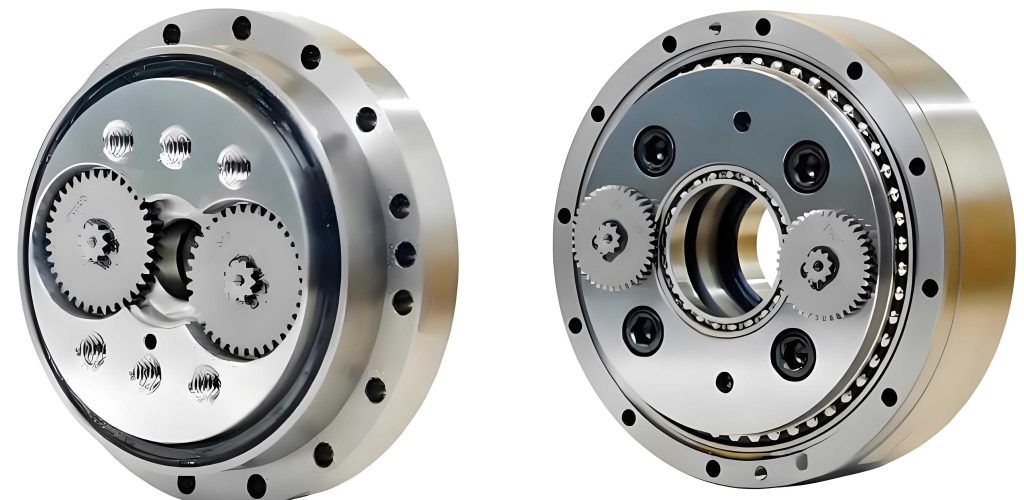
The development and validation of high-precision RV reducers are fundamental to the advancement of industrial robotics and precision machinery. As a core component, the RV reducer’s performance directly dictates the positional accuracy, load capacity, and operational stability of the entire robotic system. Performance testing is not merely a final quality check; it is an indispensable bridge connecting theoretical design, manufacturing processes, and field application. It provides critical data to verify theoretical models of meshing dynamics, contact stresses, and efficiency losses. More importantly, it serves as the ultimate arbiter of a manufactured RV reducer’s quality, measuring key parameters like transmission efficiency, backlash, torsional stiffness, and thermal characteristics against stringent design specifications.
Traditionally, performance evaluation of RV reducers has been reliant on specialized test-rigs. These systems are engineering marvels in themselves, integrating high-precision drives, sophisticated loading mechanisms, and an array of sensors. However, a significant and costly limitation persists in conventional designs: they are typically engineered for a single, specific model or a very narrow range of RV reducers. The mounting interfaces, shaft couplings, and structural frames are custom-built for a particular flange size and shaft configuration. When a manufacturer or research lab needs to test a different model—for instance, moving from an RV-20E to an RV-40E—it often necessitates the construction of an entirely new test-rig or extensive, time-consuming mechanical modifications to the existing one. This practice leads to substantial capital expenditure, underutilization of expensive core components like motors and sensors, and occupies valuable laboratory floor space with multiple single-purpose machines. Therefore, the pursuit of a universal, or multi-type capable, test-rig design is not just an incremental improvement but a strategic necessity to improve research agility and reduce lifecycle costs in RV reducer development and quality assurance.
In this comprehensive discussion, we present the design philosophy, theoretical underpinnings, and practical realization of a test-rig engineered from the outset for versatility. Our primary objective is to overcome the “one-rig, one-reducer” paradigm. We will systematically explore the architecture of test systems, delve into the mathematical formulation of a universal interface, detail the multi-body simulation for validation, and conclude with practical implementation insights. The core of our approach lies in a modular, reconfigurable fixture system combined with a strategically adaptable base frame, allowing for the rapid interchange of different RV reducer models while preserving the integrity and accuracy of the measurement chain.
1. Foundational Architectures for RV Reducer Testing
Before delving into the specifics of a universal design, it is essential to understand the fundamental test-rig architectures. The choice of architecture dictates the system’s complexity, cost, energy consumption, and applicability. For closed-gearbox testing like that of an RV reducer, two primary configurations dominate: the closed-loop (power recirculating) type and the open-loop (power absorbing) type.
The closed-loop test-rig is characterized by a mechanical or electrical power circulation path. Two identical or kinematically linked RV reducers are often connected back-to-back. The driver motor primarily supplies the power to overcome system losses (friction, windage, etc.), while the bulk of the torque circulates within the loop. A dedicated loading device, such as a torque-applying mechanism between the two reducer housings, applies the desired load. This setup is highly energy-efficient, as the required input power from the motor is only a fraction of the circulated power, making it ideal for endurance testing and high-load applications. However, its complexity is significantly higher. It requires precise alignment of two units, a sophisticated loading system, and the necessity for two identical test specimens, which is not always practical for prototype evaluation or small-batch quality control.
In contrast, the open-loop test-rig, which forms the basis for our universal design, employs a simpler “input-drive, output-load” topology. The architecture is straightforward:
- Drive Unit: A servo motor or similar prime mover provides the input motion and torque.
- Input Measurement Station: A torque-speed sensor and often a high-resolution angular encoder measure the input power precisely.
- Device Under Test (DUT): This is the RV reducer being evaluated.
- Output Measurement Station: Another set of torque-speed and angular measurement devices captures the output power and motion.
- Loading Unit: A controllable brake, such as a magnetic powder brake, an eddy current brake, or a servo motor in generator mode, applies a precisely controlled resistive torque to the output of the RV reducer.
The power flow is linear and dissipative; the drive motor supplies all the energy required to overcome both the internal losses of the RV reducer and the work done against the load, which is ultimately dissipated as heat by the brake. While this method is less energy-efficient, its advantages are compelling for a universal test-rig: simplicity, lower initial cost, ease of alignment, and, most critically, inherent flexibility. Since the DUT is a single, isolated component in the chain, swapping it out principally involves changing its mounting fixtures and adjusting the positions of the adjacent measurement stations. This inherent modularity makes the open-loop architecture the ideal candidate for our goal of multi-type RV reducer testing. The entire mechanical system is typically mounted on a rigid, monolithic base plate or frame, which provides the foundational datum for all components.
| Feature | Closed-Loop (Power Recirculating) Rig | Open-Loop (Power Absorbing) Rig |
|---|---|---|
| Energy Efficiency | High (only losses are supplied) | Low (all power is supplied and dissipated) |
| System Complexity | High (needs two reducers, loading mechanism) | Low (linear drive-DUT-load chain) |
| Cost | High (more components, complex loading) | Lower (simpler construction) |
| Alignment Criticality | Very High (multiple coupled shafts) | Moderate (independent shaft pairs) |
| Flexibility for Multi-Type Testing | Poor (difficult to reconfigure) | Excellent (inherently modular) |
| Typical Use Case | Endurance testing, high-volume production QA | R&D, prototype evaluation, multi-type QA |
2. The Core Challenge: Mathematical Definition of a Universal Interface
The primary obstacle in creating a universal test-rig for RV reducers is the dimensional variation between models. An RV reducer is defined by its reduction ratio, rated output torque, and its physical envelope—specifically, the flange mounting pattern (bolt circle diameter, number, and size of bolts) and the dimensions of the input and output shafts (diameter, keyway, spline). Our design solution decomposes this problem into two manageable sub-problems: (1) creating a set of quick-change, model-specific adapters, and (2) designing an adjustable base frame to accommodate the resulting positional shifts of the measurement stations.
Let us define the key interfaces mathematically. For any given RV reducer model \( M_i \), we can define its critical interface dimensions as a set:
$$ \text{Dimensions}(M_i) = \{ F_d^{(i)}, F_n^{(i)}, F_b^{(i)}, S_{in}^{(i)}, S_{out}^{(i)}, L_{body}^{(i)} \} $$
where:
- \( F_d^{(i)} \): Flange bolt circle diameter.
- \( F_n^{(i)} \): Number of flange bolts.
- \( F_b^{(i)} \): Flange bolt hole diameter.
- \( S_{in}^{(i)} \): Input shaft geometry (diameter, keyway size).
- \( S_{out}^{(i)} \): Output shaft geometry.
- \( L_{body}^{(i)} \): Axial length of the RV reducer body (affecting station spacing).
The universal test-rig provides a standardized mounting location on its base plate, characterized by a fixed, large-clearance pattern or T-slots. For each model \( M_i \), we design a unique Transition Flange. This component has two faces:
- Model-Specific Face: Matches exactly the bolt pattern \( (F_d^{(i)}, F_n^{(i)}, F_b^{(i)}) \) of the RV reducer’s housing. The RV reducer bolts directly to this face.
- Universal Rig Face: Has a bolt pattern that aligns with the standardized mounting pattern on the rig’s base plate or a dedicated reducer mounting pedestal.
The transition flange effectively translates the unique mounting footprint of the RV reducer to the common footprint on the rig. Its thickness is a known constant \( t_f^{(i)} \).
Similarly, the shaft connections are managed via custom Coupling Plates and Shaft Adapters. The input shaft of the RV reducer is connected to the output of the input measurement station via a shaft adapter that matches \( S_{in}^{(i)} \) on one end and a standard coupling interface (e.g., a bellows coupling with a specific bore) on the other. The output shaft of the RV reducer is connected to the input of the output measurement station via an “Axis End Connection Plate” (which bolts to the RV reducer’s output flange, matching its pattern) and a shaft adapter for \( S_{out}^{(i)} \).
The most significant design variable is the positional adjustment of the drive and load stations. Let \( P_{fix} \) be the fixed mounting point of the RV reducer’s transition flange on the base plate. The required position of the input measurement station’s centerline, \( P_{in} \), is determined by the assembled chain: Input Coupling + Input Shaft Adapter + RV Reducer Input Shaft. The position \( P_{out} \) for the output station is determined by: RV Reducer Output Flange + Output Connection Plate + Output Shaft Adapter + Output Coupling.
We can express the required adjustment \( \Delta X \) along the primary axis of the rig as a function of the model dimensions and adapter lengths:
$$ \Delta X_{in} = f(t_f^{(i)}, L_{adapter-in}^{(i)}, \text{engagement depth}) $$
$$ \Delta X_{out} = g(L_{body}^{(i)}, L_{adapter-out}^{(i)}, \text{engagement depth}) $$
To accommodate this, the base plate is not drilled with fixed hole patterns for the drive and load stations. Instead, it is equipped with a grid of threaded holes or, preferably, continuous T-slots running along its length. The pedestals for the drive motor, input measurement box, output measurement box, and loading brake are all designed with slotted or adjustable footings. This allows their positions \( P_{in} \) and \( P_{out} \) to be continuously adjusted along the axis to achieve the precise alignment required for each new RV reducer model \( M_i \), once its specific adapter set is installed. The mathematical goal is to ensure that for all models \( i \) in a target set, the following alignment condition is met after adjustment:
$$ \text{Align}(P_{drive}, P_{in}, P_{fix}, P_{out}, P_{load}) = \text{True} $$
This condition ensures coaxiality of all rotating elements, which is paramount for accurate torque measurement, reducing bearing loads, and preventing premature failure.
3. Measurement Principles and Parameter Extraction
A universal test-rig must not only mount different RV reducers but also accurately measure their key performance parameters. The open-loop architecture, with its dedicated input and output measurement stations, is perfectly suited for this. Each station typically integrates a rotary torque transducer (providing analog voltage outputs proportional to torque and speed) and a high-resolution absolute or incremental angular encoder. National Instruments CompactRIO or similar PLC/PAC systems are commonly used for high-speed, synchronized data acquisition from all sensors.
From the synchronously sampled time-series data of input torque \( \tau_{in}(t) \), input speed \( \omega_{in}(t) \), input angle \( \theta_{in}(t) \), output torque \( \tau_{out}(t) \), output speed \( \omega_{out}(t) \), and output angle \( \theta_{out}(t) \), we can compute the fundamental performance metrics for any installed RV reducer.
Transmission Efficiency (\( \eta \)): This is the ratio of output power to input power, typically calculated under steady-state conditions to average out dynamic effects.
$$ \eta = \frac{P_{out}}{P_{in}} = \frac{\langle \tau_{out} \cdot \omega_{out} \rangle}{\langle \tau_{in} \cdot \omega_{in} \rangle} $$
where \( \langle \cdot \rangle \) denotes a time average over a stable operating period. Efficiency maps are generated by testing across a matrix of input speeds and output torque levels.
Backlash or Lost Motion: This is a critical measure of positional precision. It is measured by fixing the output shaft (via the brake) and applying a small oscillating torque to the input side, or by slowly reversing the input direction under a very light load. The backlash \( B \) is the angular displacement at the output when the input reverses direction before the output begins to move, often derived from the hysteresis in the \( \theta_{out} \) vs. \( \theta_{in} \) curve.
$$ B \approx \Delta \theta_{out} |_{\tau_{out} = \text{const.}} $$
Torsional Stiffness (\( k_t \)): This measures the RV reducer’s resistance to elastic deformation under load. The output is again locked. A gradually increasing torque is applied to the input, and the angular deflection between input and output is measured. The stiffness is the slope of the torque-deflection curve in its linear region.
$$ k_t = \frac{\Delta \tau_{in}}{\Delta (\theta_{in} – N \cdot \theta_{out})} $$
where \( N \) is the reduction ratio. A high \( k_t \) is crucial for robotic applications requiring high positional accuracy under varying loads.
| Performance Parameter | Measurement Principle | Required Sensor Data | Calculation Method |
|---|---|---|---|
| Transmission Efficiency | Power ratio under steady load | \( \tau_{in}(t), \omega_{in}(t), \tau_{out}(t), \omega_{out}(t) \) | $$ \eta = \frac{\langle \tau_{out} \omega_{out} \rangle}{\langle \tau_{in} \omega_{in} \rangle} $$ |
| Backlash (Lost Motion) | Output free-play upon direction reversal | \( \theta_{in}(t), \theta_{out}(t) \) under low torque | Hysteresis width in \( \theta_{out} \) vs. \( \theta_{in} \) plot |
| Torsional Stiffness | Angular deflection vs. applied torque | \( \tau_{in}(t), \theta_{in}(t), \theta_{out}(t) \) with locked output | Slope $$ k_t = \frac{\Delta \tau}{\Delta(\theta_{in} – N\theta_{out})} $$ |
| Transmission Error | Deviation from ideal kinematic motion | High-resolution \( \theta_{in}(t), \theta_{out}(t) \) | $$ TE(t) = \theta_{out}(t) – \frac{\theta_{in}(t)}{N} $$ |
| Starting / Running Torque | Torque required to initiate/maintain motion | \( \tau_{in}(t) \) at very low \( \omega_{in} \) | Peak (starting) and average (running) values |
4. Virtual Validation through Multi-Body Dynamics Simulation
Prior to physical manufacturing, the entire universal test-rig concept, including the adapter systems for different RV reducer models, must be validated functionally. This is achieved through detailed 3D modeling and Multi-Body Dynamics (MBD) simulation. Software tools like SOLIDWORKS for CAD and Adams for MBD are instrumental in this phase.
The process begins with the creation of precise 3D part models for all standard rig components: the base plate with its T-slot pattern, adjustable pedestals, motor, brake, sensor housings, and standard couplings. Concurrently, detailed models of target RV reducers (e.g., RV-20E and RV-40E) are created or imported, along with their specific adapter sets (transition flanges, coupling plates, shaft adapters).
These components are then digitally assembled into two (or more) distinct configurations within the CAD environment. The first assembly features the RV-20E with its specific adapters, and the second features the RV-40E with its own set. In each assembly, the adjustable stations are positioned according to the calculations from Section 2 to ensure proper alignment. A critical check in CAD is verifying that there are no spatial interferences and that all bolts and shafts properly engage.
The validated CAD assemblies are then transferred to an MBD environment like Adams. Here, realistic kinematic joints are applied: revolute joints for all shafts (connected through the couplings and adapters), fixed joints for mounts, and a prescribed motion joint for the drive motor. The RV reducer itself is often modeled as a simplified kinematic joint with a fixed reduction ratio and a small amount of torsional compliance and backlash for initial studies, though more advanced models incorporating detailed tooth contact can be used later. A rotational spring-damper element or a controlled torque can be applied at the output to simulate the loading brake.
A dynamic simulation is run. For an input speed \( \omega_{in} \) corresponding to the reducer’s ratio (e.g., 141 °/s for RV-20E with N=141, 185 °/s for RV-40E with N=185), we observe the simulated output speed \( \omega_{out}(t) \). The theoretical ideal output is 1 °/s. The simulation output will show a signal fluctuating very closely around this value. The minor fluctuations represent simulated transmission error and system dynamics. The successful simulation, where both distinct assemblies operate as expected—with the output correctly reduced by the respective factor—provides strong virtual proof of the mechanical feasibility of the universal design. It confirms that the adapter system correctly integrates each unique RV reducer into the standard measurement chain without introducing kinematic conflicts.
5. From Concept to Reality: Manufacturing, Assembly, and Experimental Proof
The final and most crucial phase is the physical realization and experimental testing of the universal RV reducer test-rig. This phase validates not only the design but also the practicality of the reconfiguration process.
Manufacturing: The core structural components—base plate, pedestals, measurement housings—are machined from high-grade steel or aluminum to ensure rigidity and damping. Precision is paramount for mounting surfaces and bore alignments. Simultaneously, the model-specific adapter kits are manufactured. For example, the transition flange for an RV-40E is machined from a steel blank: one side is bored and drilled to match the RV-40E’s flange pattern exactly, while the other side is machined to interface with the rig’s standard mounting. The corresponding shaft adapters are turned and broached (or wire-EDM’d) to match the specific keyway of the RV-40E’s input and output shafts on one end and have a standard bore for a bellows coupling on the other.
Initial Assembly & Commissioning: The rig is first assembled in a “neutral” state, without any RV reducer installed. The drive motor, input sensor box, output sensor box, and brake are mounted on their adjustable pedestals, which are loosely positioned near the center of the base plate. The system is then wired, and the data acquisition and control software is configured. A laser alignment tool is used to ensure the initial coaxiality of the drive and load sides.
Reconfiguration and Testing Protocol: To test an RV-20E, the procedure is as follows:
- The adapter kit for RV-20E is selected.
- The transition flange is bolted to the designated area on the base plate.
- The RV-20E reducer is bolted onto the transition flange.
- The input shaft adapter is connected to the reducer’s input shaft and the input coupling.
- The output connection plate is bolted to the reducer’s output flange, and the output shaft adapter is connected.
- The pedestals for the input and output measurement stations are then slid along the T-slots. Using dial indicators, the stations are carefully aligned until the couplings slide smoothly onto their respective shaft adapters without binding, indicating good coaxiality. The pedestals are then locked down.
- The system is powered, and a test run is executed—for example, measuring efficiency across a torque sweep.
To switch to an RV-40E, the process is reversed: the RV-20E and its adapters are removed, the RV-40E kit is installed, and the measurement stations are re-aligned to the new positions dictated by the different dimensions of the RV-40E and its adapters. The time for this changeover can be reduced to a matter of hours with practice, compared to the days or weeks needed to build a dedicated rig.
The ultimate validation comes from the quality of the test data. When efficiency curves for both the RV-20E and RV-40E are generated on the same rig, they should align with expected performance benchmarks or data from other trusted sources. The consistency and repeatability of measurements across multiple reconfiguration cycles demonstrate the robustness of the universal design. It proves that the core measurement system’s accuracy is not compromised by the modular adapter approach, fulfilling the primary goal of enabling reliable, multi-type RV reducer performance evaluation with a single, flexible hardware platform.
6. Conclusion and Future Perspectives
The design and implementation of a universal test-rig for RV reducers address a significant inefficiency in the development and quality assurance processes for these critical components. By embracing a modular philosophy centered on a standardized open-loop architecture, customizable adapter kits, and an adjustable base frame, we have demonstrated a practical path toward a single test-rig capable of servicing a wide range of RV reducer models. This approach offers substantial benefits: it drastically reduces capital investment and laboratory footprint, increases equipment utilization rates, and accelerates testing cycles for R&D and production.
The journey from theoretical analysis—defining the universal interface mathematically—through virtual validation in multi-body dynamics simulations, to physical realization and experimental testing, provides a comprehensive blueprint. The successful measurement of key parameters like transmission efficiency for different models on the same hardware platform stands as concrete proof of concept.
Looking forward, the evolution of such universal test-rigs is promising. Future iterations could integrate more advanced features:
- Automated Reconfiguration: Incorporating linear actuators on the pedestals and a robotic tool changer for adapters could reduce changeover time to minutes.
- Enhanced Diagnostics: Integrating accelerometers and microphones for vibration and acoustic emission analysis directly into the adapter fixtures could provide deeper insights into the meshing quality and health of each specific RV reducer model.
- Digital Twin Integration: The test-rig could be linked to a digital twin of the RV reducer, where real-time test data is continuously compared against simulated performance predictions, enabling predictive maintenance and design optimization.
- Standardized Communication Protocol: Developing a standardized digital datasheet for adapter kits (containing 3D models, alignment coordinates, and recommended test profiles) would streamline the integration of new, future RV reducer models into the testing ecosystem.
In conclusion, the move towards universal, reconfigurable test equipment represents a maturation in testing methodology for precision gearboxes like the RV reducer. It shifts the paradigm from building specialized tools for each product to creating a flexible, enduring platform that can adapt to an evolving product line, ultimately fostering more agile and cost-effective innovation in the field of precision robotics and motion control.