
The global landscape is undergoing a profound transformation, driven by a new wave of scientific and technological revolution and industrial evolution. Advanced technologies, spearheaded by artificial intelligence (AI), are accelerating the innovative allocation of production factors and enabling the deep transformation and upgrading of industries. This powerful trend is fundamentally reshaping traditional sectors, empowering emerging ones, and catalyzing the birth of future industries. Among these, the humanoid robot stands out as a quintessential future industry, representing a sophisticated integration of cutting-edge technologies including AI, sensor control, new materials, and high-end manufacturing. With its extensive radiating influence, massive potential application scale, and promising growth prospects, the humanoid robot industry has captured the strategic focus of major global economies and attracted significant attention from international financial and industrial capital. This confluence of factors presents a historic opportunity for leapfrog development, positioning the humanoid robot as a pivotal arena for shaping future competitive advantages.
The imperative for innovation is central to modernization strategies. Technological innovation serves as the critical engine for national advancement. As a frontier field that embodies the comprehensive level of scientific and technological innovation, humanoid robot development has become a new focal point in global technological competition. Therefore, vigorously cultivating the humanoid robot industry is a crucial measure for implementing innovation-driven development strategies and fostering new, high-quality productive forces. It is instrumental in seizing the technological high ground, shaping future competitive advantages, promoting industrial upgrading, and enhancing comprehensive national strength. The high-quality development of the humanoid robot industry holds the potential to bring transformative impacts across numerous fields such as healthcare, services, and manufacturing, injecting powerful momentum into economic growth and meeting the people’s aspirations for a better life.
Evolution of Humanoid Robot Technology
A humanoid robot is typically defined as a robot with an anthropomorphic form and mobility, featuring structures analogous to a head, torso, and limbs. It utilizes legs or wheels for locomotion and employs multi-degree-of-freedom arms to perform a variety of manipulations, enabling more natural work, communication, and interaction within human-centric environments.
The developmental journey of humanoid robot technology can be broadly summarized into three distinct phases, as outlined in the table below:
| Phase | Time Period | Key Focus & Milestones | Representative Models |
|---|---|---|---|
| Early Exploratory Phase | Late 1960s – 1990s | Achieving basic bipedal locomotion and foundational control systems. | WABOT-1 (Waseda University, 1973) |
| Integrated Development Phase | Early 2000s | Developing robots capable of executing specific, predefined tasks with improved mobility and interaction. | ASIMO (Honda, 2000) |
| Breakthrough & Proliferation Phase | 2010 – Present | Significant leaps in dynamic motion capabilities, intelligence (perception, cognition), and the emergence of numerous commercial and research entities globally. | Atlas (Boston Dynamics), Optimus (Tesla), Digit (Agility Robotics), Figure 02 (Figure AI), Walker S (UBTech),远征 A2 (Zhiyuan), H1 (Unitree), GR-1 (Fourier Intelligence), and many others. |
The current era is marked by accelerated progress. Major technology and automotive corporations worldwide, including but not limited to Amazon, NVIDIA, Microsoft, Samsung, Hyundai, Huawei, BYD, and CATL, are now actively entering the humanoid robot arena. The public display of advanced robot arrays at major international conferences underscores the rapid maturation and competitive dynamism of this field. Consequently, the industry has dubbed recent periods as the “dawn of commercialization” for humanoid robot technology.
Global Industry Landscape and Prospects
International Developments
Primary research and development efforts in humanoid robots are concentrated in the United States, Japan, and Europe, each with distinct strengths.
- United States: Leverages a robust industrial ecosystem and superior computing infrastructure. This supports breakthroughs in highly dynamic motion and advanced AI integration. For instance, dynamic motion in robots often relies on precise actuator control and real-time processing. The power consumption for dynamic maneuvers can be modeled as:
$$P_{motion} = \sum_{i=1}^{N} (J_i \dot{\omega}_i \omega_i + b_i \omega_i^2 + \tau_i \omega_i)$$
where, for each joint \(i\), \(J_i\) is the moment of inertia, \(\omega_i\) is the angular velocity, \(b_i\) is the viscous friction coefficient, and \(\tau_i\) is the load torque. Companies benefit from cloud-based AI training platforms (e.g., Microsoft Azure) to efficiently develop machine learning, computer vision, and NLP algorithms for humanoid robot intelligence. - Japan: Excels in precise mechanical design, scenario-specific application, and strong industry-academia-research collaboration. Expertise in human biomechanics informs stable bipedal walking algorithms. The country has successfully deployed humanoid robots in niches like healthcare rehabilitation, elderly assistance, and specialized industrial tasks.
- Europe: Features companies focusing on consumer-facing applications and hyper-realistic human-robot interaction (HRI). Developments range from home assistant robots for companionship and chores to highly expressive robotic “employees” for interactive experiences in museums and hospitality.
Domestic Landscape in Key Regions
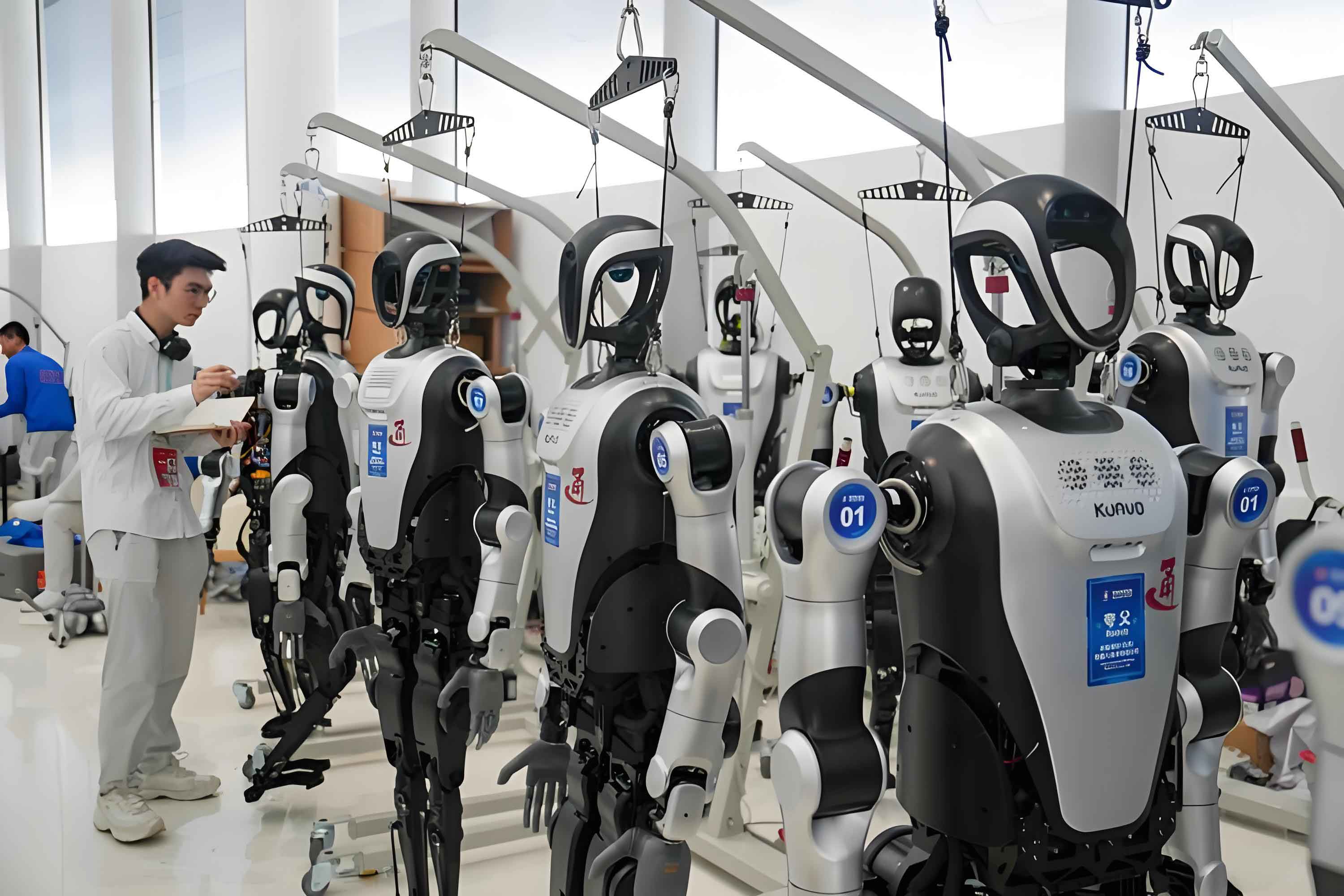
Significant humanoid robot industrial clusters have formed in major economic hubs, notably Beijing, Shanghai, and Guangdong, which collectively host a large percentage of domestic robot本体 (本体, meaning “ontology” or “robot body”) enterprises. These clusters encompass a comprehensive industrial chain from core components and整机 (整机, meaning “complete machine” or “robot本体”) manufacturing to application development. Leading companies span across these regions, fostering a competitive and innovative environment.
National and local governments have placed high strategic importance on this sector. Key policy moves include the establishment of national-level innovation centers dedicated to humanoid robot and embodied intelligence in major cities. This top-down support has stimulated a “spreading effect,” encouraging numerous provinces to launch their own initiatives and innovation centers, thereby activating nationwide industrial development.
Industry Chain Structure
The humanoid robot industry chain can be segmented into three primary layers:
| Layer | Core Components & Functions | Key Element Examples |
|---|---|---|
| Upstream: Systems & Components | Providing the fundamental hardware and control “organs” of the robot. |
|
| Midstream:本体 (Ontology/Body) Manufacturing | Integrating upstream components into a functional robot body, involving design, assembly, and testing. | Robot body design, manufacturing, system integration, performance validation. |
| Downstream: Application Fields | Deploying the通用 (通用, meaning “general-purpose”) humanoid robot platform into specific real-world scenarios. | Industrial Manufacturing, Logistics & Warehousing, Commercial Services, Healthcare, Education, Home Care, Entertainment. |
Diverse Application Scenarios
The application potential for humanoid robots is vast and expanding. The table below highlights current deployments across various sectors:
| Application Sector | Specific Use Case Examples | Representative Companies/Robots |
|---|---|---|
| Industrial Manufacturing | Parts handling, assembly, quality inspection, factory logistics. | Tesla (Optimus), Figure AI (with BMW), Apptronik (with Mercedes-Benz), UBTech (with BYD, NIO, etc.), Xiaopeng Motors. |
| Retail & Logistics | Goods replenishment, picking in smart warehouses/ pharmacies, last-mile delivery assistance. | Galaxy General (GALBOT in partnership with Meituan). |
| Commercial Services | Customer service, information kiosks, reception, guided assistance in banks, hotels, malls. | Fourier Intelligence (GR-1 in bank trials). |
| Education | Interactive teaching aids, STEM education tools, remote learning companions. | UBTech (Wukong robot in educational programs). |
| Entertainment & Tourism | Performance art, interactive guides, hyper-realistic recreations of historical figures for immersive experiences. | Various exhibition and theme park installations. |
Investment and Financing Landscape
The humanoid robot sector is characterized by vigorous early-stage investment activity. Global financing for humanoid robot本体 companies has reached substantial sums, with significant rounds attracted by leading startups. For example, major technology conglomerates are actively investing in promising ventures. The domestic market mirrors this trend, with numerous early-stage companies securing substantial funding from venture capital, private equity, and strategic corporate investors. Most active domestic players, aside from a few publicly listed entities, remain in the private equity financing stage, aligning with the global investment pattern focused on high-growth potential in this nascent field.
A simplified model for valuing a high-growth humanoid robot startup might consider its technology portfolio, team expertise, and market potential, often leading to valuations based on projected future revenue in a rapidly expanding market:
$$V \approx \sum_{t=1}^{n} \frac{CF_t}{(1+r)^t} + \frac{TV}{(1+r)^n}$$
where \(V\) is valuation, \(CF_t\) is projected cash flow in period \(t\), \(r\) is the discount rate (reflecting high risk), and \(TV\) is terminal value, heavily weighted towards assumed mass-market adoption.
Market Outlook
The future market for humanoid robots is projected to be enormous. Industry forecasts predict a remarkably high compound annual growth rate (CAGR) for the global humanoid robot market over the coming decade. Specific projections for regional markets, such as China, estimate the market size could reach a significant value by 2030. As core technologies continue to break through and the industrial chain matures, the inherent flexibility and growing intelligence of the humanoid robot platform are expected to unlock increasingly diverse applications, broadening market coverage and unleashing immense commercial value and developmental potential.
Policy Support Framework
Governments have enacted a series of supportive policies to guide the development of the humanoid robot industry. These policies outline industrial development goals, key tasks, and application promotion plans. Major regional hubs have implemented detailed measures focusing on core technological innovation, demonstration applications, and ecosystem cultivation.
| Region/Jurisdiction | Policy Focus & Key Objectives |
|---|---|
| National Level | Issuing overarching development plans and guiding opinions for robotics and specifically for humanoid robot innovation, promoting the “Robot+” application initiative. |
| Beijing | Introducing measures and action plans to support robot industry innovation, fostering proprietary intellectual property in intelligent and diversified humanoid robot products, establishing industrial alliances and innovation centers. |
| Shanghai | Aiming to build top-tier robot brands, create benchmark application scenarios, and achieve a large-scale associated industry economy through targeted action plans and catalogues. |
| Shenzhen | Supporting the R&D and application of general-purpose embodied intelligent humanoid robots as part of broader AI high-quality development plans. |
| Other Provinces (e.g., Zhejiang, Hubei) | Releasing guidance for cultivating future industries, including humanoid robots, and implementing action plans to build highlands for intelligent robotics, encouraging original R&D. |
This concerted, multi-level policy effort demonstrates a high degree of governmental prioritization. Positive舆论引导 (舆论引导, meaning “public opinion guidance”) and strong supportive measures are accelerating innovation in this “star” future industry sector, aiming for international leadership.
Common Challenges and Industry Needs
Despite the蓬勃态势 (蓬勃态势, meaning “vigorous momentum”), field research indicates that enterprises face several common challenges and have unmet needs that require attention for sustainable industry growth.
- Strong Demand for International Market Expansion and R&D Collaboration: Domestic companies express a clear desire to expand into overseas markets and seek international partnerships. Participating in foreign professional exhibitions and collaborating with top global universities and research institutes are seen as vital for enhancing technological prowess, gaining global perspective, and accelerating innovation.
- Intense Financing Requirements: The fast pace of technological iteration necessitates continuous, significant R&D investment. Access to timely financing is critical for product development and seizing market opportunities. While many have secured funding, companies—from upstream component suppliers to leading本体 manufacturers—consistently seek to broaden financing channels. Some face specific challenges in accessing overseas capital due to corporate structuring issues.
- Limited Presence of Leading International Players in the Domestic Market: While major global humanoid robot developers are active internationally, their R&D and manufacturing footprints within certain key markets remain limited. Furthermore, established multinational industrial robot corporations have been slow to pivot their local operations towards humanoid robot innovation, potentially constraining the diversity and vibrancy of the domestic ecosystem.
- Technological Bottlenecks in Key Areas: Several core technical hurdles persist:
- Generalization and Intelligence: Most humanoid robots lack robust generalization capabilities. They struggle to perform beyond narrowly trained tasks. While large language models (LLMs) offer potential, effective integration for real-world physical reasoning and manipulation remains a challenge. A simplified learning generalization metric can be considered:
$$G = \frac{|T_{success}|}{|S_{test}|}$$
where \(G\) is the generalization score, \(T_{success}\) is the set of novel tasks successfully completed, and \(S_{test}\) is the set of all tasks in a test scenario. High \(G\) is elusive for most current systems. - Static Stability vs. Dynamic Motion: Achieving reliable static standing posture, which is fundamental for energy-efficient operation, remains difficult for many bipedal designs that prioritize dynamic movement.
- Power Endurance: The high number of actuators leads to substantial energy consumption. Typical operational endurance is limited, constrained by current battery energy density and charging technology. The total power draw \(P_{total}\) can be expressed as:
$$P_{total} = P_{motion} + P_{computation} + P_{auxiliary}$$
where \(P_{computation}\) is the power for the AI/control brain and \(P_{auxiliary}\) is for sensors and other systems. Extending operational time requires advances across all terms.
- Generalization and Intelligence: Most humanoid robots lack robust generalization capabilities. They struggle to perform beyond narrowly trained tasks. While large language models (LLMs) offer potential, effective integration for real-world physical reasoning and manipulation remains a challenge. A simplified learning generalization metric can be considered:
- Lack of Unified Technical Standards for Core Components: The industry’s early-stage fragmentation leads to a lack of standardization in communication protocols and hardware interfaces requested by different本体 manufacturers. This inconsistency prevents upstream component suppliers from achieving economies of scale, increases costs, and hinders the formation of a stable, efficient supply chain.
- Nascent Application Market Requiring Cultivation: Beyond limited industrial and research applications, the market for humanoid robots in daily life and services is underdeveloped. A significant gap exists between product capabilities/price points and consumer expectations. High costs (often tens of thousands of currency units) for basic home service robots make them unaffordable for average households, lacking a clear value proposition against traditional appliances. The scarcity of viable, large-scale application scenarios restricts widespread adoption.
Strategic Considerations for Future Development
To foster high-quality industry development and accelerate the transition from keeping pace to leading in the global humanoid robot arena, proactive measures should be considered across several dimensions.
- Facilitating International Market Access and R&D Cooperation for Domestic Enterprises: Actively supporting and organizing domestic companies to participate in leading international专业展会 (专业展会, meaning “professional exhibitions”) in regions with industrial strengths (e.g., Europe, North America, Japan, South Korea). Facilitating visits to标杆企业 (标杆企业, meaning “benchmark enterprises”) and research institutions, and hosting high-level investment matchmaking events can help companies broaden their视野 (视野, meaning “horizons”), enhance their profile, and find partners. Efforts should also support market exploration in regions with significant growth potential, such as ASEAN and the Middle East, across applications, technology, and investment.
- Supporting Smoother Access to Domestic and International Financing Channels: Leveraging national-level exhibition platforms to create dedicated投融资对接 (投融资对接, meaning “investment and financing matching”) zones that integrate display and negotiation, featuring company roadshows. Exploring platforms to connect domestic humanoid robot companies with key international sovereign wealth funds and investment institutions can help secure overseas capital. Organizing investment promotion activities, such as company visits to national-level development zones, can facilitate匹配 (匹配, meaning “matching”) with local state-owned capital platforms and guidance funds that can act as patient, long-term capital.
- Enhancing Foreign Investment Utilization in the Humanoid Robot Sector: Conducting specialized roundtables and targeted investment promotion activities domestically and abroad to encourage international humanoid robot leaders to establish local presence. Guiding existing multinational robotics firms to strengthen exchanges with domestic humanoid robot enterprises and key industrial parks, encouraging them to accelerate their humanoid robot business布局 (布局, meaning “layout” or “deployment”) locally.
- Promoting Breakthroughs in Common Technologies and Establishing Technical Standards: Relevant industry authorities should coordinate platforms, associations, leading enterprises, and research institutes to accelerate breakthroughs in key technologies like intelligent generalization, static balance, and energy efficiency. It is crucial to expedite the research and formulation of unified technical standards and production norms for core humanoid robot components. This will help enterprises reduce costs, improve efficiency, achieve mass production, and build a stable, reliable, and efficient supply chain system.
- Actively Identifying Potential Demand and Nurturing the Application Market: Government departments, local authorities, industrial parks, platforms, and associations should actively搭建平台 (搭建平台, meaning “build platforms”) for dialogue between enterprises and potential end-users. This helps companies precisely grasp market脉搏 (脉搏, meaning “pulse”) and uncover latent demand across various sectors. Based on this insight, diversified, customized solutions can be developed (e.g., surgical-assist robots for healthcare, interactive tutor robots for education). Concurrently, assisting enterprises in strengthening industry promotion and marketing through media and exhibitions, offering丰富的 (丰富的, meaning “rich”) display and体验活动 (体验活动, meaning “experience activities”), will raise industry awareness, broaden sales channels, attract potential clients, and create favorable conditions for the widespread application of humanoid robots.