
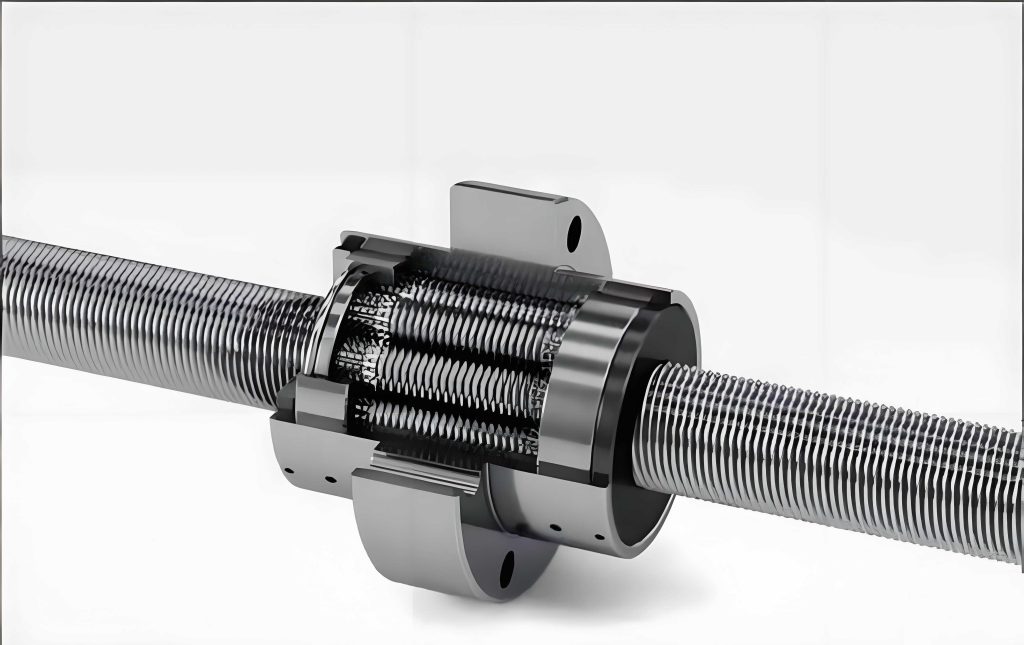
In the field of precision mechanical transmission systems, the planetary roller screw has garnered significant attention due to its exceptional performance characteristics. As a key component for converting rotary motion into linear motion, the planetary roller screw offers high transmission accuracy, large load capacity, minimal vibration, low noise, and long durability. These advantages make it indispensable in critical industries such as aerospace, defense, and renewable energy equipment. However, the manufacturing precision of its core rolling element—the roller—directly impacts the overall functionality. During processing and heat treatment, rollers are prone to bending, which degrades transmission accuracy and leads to issues like assembly interference, operational jitter, and increased axial loads. To address this, I have investigated a radial secondary rolling rotation straightening method for bent rollers. This study establishes a straightening forming model, simulates the process using finite element software, and validates the approach through experiments, focusing on tooth profile accuracy, diameter changes, and radial run-out. The findings provide crucial technical support for advancing rolling rotation straightening processes in planetary roller screw production.
The planetary roller screw operates on a unique principle where multiple rollers engage with a threaded screw and a nut, distributing loads evenly and enabling smooth motion conversion. The roller, often designed with a stepped configuration, must exhibit high straightness and minimal run-out to ensure optimal performance. Traditional manufacturing methods, such as single-pass rolling and grinding, often induce residual stresses that exacerbate bending after heat treatment. Therefore, developing an effective straightening technique is paramount. In this research, I propose a secondary rolling straightening process that applies radial pressure to correct bending, leveraging elastoplastic theory and finite element analysis to optimize parameters. The goal is to enhance roller precision, improve surface finish, and eliminate defects like tooth top “rabbit ear” phenomena observed in initial rolling.
The rolling straightening process for planetary roller screw rollers involves a radial secondary rolling rotation method, where two grooved rolling tools symmetrically act on the roller. These tools rotate synchronously at equal speeds while moving radially inward at a controlled feed rate. The roller, initially bent, undergoes alternating bending and reverse bending cycles as it rotates, leading to plastic deformation that corrects curvature. The process can be divided into stages: rapid approach, controlled radial feed with rolling, finishing at a set depth, and retraction. The roller’s surface is formed along an Archimedean spiral trajectory, ensuring multiple tension-compression cycles for effective straightening. To achieve high accuracy, the rolling tools are modified—for instance, by polishing the groove teeth at small-diameter ends to reduce stress concentrations and improve contact. This approach combines pressure straightening with rotational motion, allowing for precise control over deformation.
To model the straightening process, I consider the roller as a stepped cylindrical bar subjected to bending moments. Based on elastoplastic theory, the stress and strain distribution across the roller’s cross-section during reverse bending is analyzed. The strain at any height \(Z\) from the neutral axis is given by:
$$ \epsilon_Z = \frac{\epsilon_h}{R} \times Z $$
where \(\epsilon_h\) is the maximum strain and \(R\) is the radius of curvature. The corresponding stress, accounting for material hardening, is expressed as:
$$ \sigma_Z = \sigma_t + \lambda \left( \frac{Z}{R} \epsilon_h E – \sigma_t \right) $$
Here, \(\sigma_t\) is the yield strength, \(E\) is the elastic modulus, and \(\lambda\) is the hardening coefficient defined as \(\lambda = E’ / E\), with \(E’\) being the average hardening modulus derived from material properties. The plastic deformation depth coefficient \(\zeta = R_t / R\) characterizes the extent of deformation, where \(R_t\) is the radius at the yield boundary. The internal bending moment \(M\) is integrated over the cross-section:
$$ M = 2 \int_0^{R_t} y \sigma_z \, dz + 2 \int_{R_t}^{R} y \sigma_t z \, dz + 2 \int_{R_t}^{R} \lambda y \sigma_t \left( \frac{z}{R_t} – 1 \right) z \, dz $$
This leads to the dimensionless moment ratio:
$$ \bar{M} = \frac{4}{\pi} \left[ \left( \frac{1 – \lambda}{3} \right) \left( \frac{5}{2} – \zeta^2 \right) (1 – \zeta^2)^{1/2} + \frac{1 – \lambda}{2\zeta} \arcsin \zeta + \frac{\pi \lambda}{4\zeta} \right] $$
The straightening curvature equation ensures that residual curvature is minimized after springback. Defining curvature ratios for initial \(C_0\), reverse bending \(C_w\), springback \(C_f\), and residual \(C_c\), the relationship is:
$$ C_w – C_c – C_f = 0 $$
$$ C_0 + C_f – C_{\sum} = 0 $$
where \(C_{\sum}\) is the total curvature. By solving these equations, the required reverse bending curvature for straightening can be determined, ensuring the roller achieves near-zero residual curvature after processing. This theoretical framework underpins the design of rolling parameters for planetary roller screw rollers.
Finite element simulation is employed to analyze the straightening process and optimize parameters. The model includes the roller as a deformable body and the rolling tools, axial stops, and radial stops as rigid bodies. Key simulation parameters are summarized in the table below, based on the material 16MnCr5 commonly used for planetary roller screw rollers.
| Roller ID | Initial Curvature | Feed Amount (mm) | Rotation Speed (rpm) | Feed Velocity (mm/s) |
|---|---|---|---|---|
| Roller 1# | 0.1 | -0.05 | 15 | 0.01 |
| Roller 2# | 0.1 | -0.10 | ||
| Roller 3# | 0.3 | -0.05 | ||
| Roller 4# | 0.3 | -0.10 |
The material properties of 16MnCr5 are critical for accurate simulation. The table below lists key parameters obtained from uniaxial tensile tests.
| Property | Value |
|---|---|
| Elastic Modulus (GPa) | 211 |
| Poisson’s Ratio | 0.28 |
| Density (kg/m³) | 7.85 × 10⁻⁶ |
| Tensile Strength (MPa) | 1373 |
| Yield Strength (MPa) | 1187 |
In the simulation, the roller is meshed with hexahedral elements totaling 400,000 grids. Coulomb friction with a coefficient of 0.3 is applied between the roller and rolling tools, while frictionless contact is assumed with stops. The roller’s initial bend is set to 0.5°, and axial and radial clearances are 0.030 mm and 0.080 mm, respectively. The simulation captures stress distribution, plastic deformation depth, and curvature evolution during straightening. Results indicate that with proper feed and rotation, the roller undergoes sufficient plastic deformation to correct bending, particularly at small-diameter ends. The process induces a spiral residual stress pattern, beneficial for long-term stability in planetary roller screw assemblies.
Experimental validation is conducted using a precision rolling machine capable of phase adjustment and high rolling forces. The machine settings include a rolling tool rotation speed of 5 rpm and a radial feed rate of 0.01 mm/min. Rollers made of 16MnCr5, with small-end diameters of 5.58 mm, large-end diameters of 6.78 mm, and lengths of 36.00 mm, are selected for testing. Initial straightness ranges from 0.03 to 0.06 mm, with run-out up to 0.06 mm at small-diameter sections. Three types of rolling tools are designed: conventional grooved tools, tools with polished small-diameter grooves, and concave-convex tools with selective polishing. After straightening, 20 rollers are randomly sampled for measurement using run-out gauges and diameter micrometers.
The results demonstrate significant improvements. Tooth profile accuracy is enhanced, with the “rabbit ear” defect eliminated and surface finish improved. Run-out errors are reduced dramatically, as shown in the table below comparing pre- and post-straightening values for small-diameter (section a), middle (section b), and opposite small-diameter (section c) segments.
| Section | Pre-straightening Run-out (mm) | Post-straightening Run-out (mm) | Reduction (%) |
|---|---|---|---|
| Section a | 0.045 (avg) | 0.016 (avg) | > 60 |
| Section b | 0.022 (avg) | 0.012 (avg) | 45 |
| Section c | 0.046 (avg) | 0.014 (avg) | > 60 |
Diameter consistency is also improved. Measurements at points C, D, E, and F along the roller show reduced variation after straightening. For instance, at point C, diameter deviation decreases from 0.02 mm to 0.010 mm; at point D, from 0.016 mm to 0.008 mm; at point E, from 0.014 mm to 0.008 mm; and at point F, from 0.011 mm to 0.005 mm. The data confirms that the secondary rolling process effectively minimizes dimensional fluctuations, meeting precision requirements for planetary roller screw rollers.
The straightening effect can be quantified using the curvature reduction ratio \( \eta \), defined as:
$$ \eta = \frac{C_0 – C_c}{C_0} \times 100\% $$
where \(C_0\) is the initial curvature and \(C_c\) is the residual curvature post-straightening. For the tested rollers, \(\eta\) exceeds 85% in most cases, indicating high straightening efficiency. Additionally, the plastic deformation depth \(h_p\) is calculated as:
$$ h_p = R \left(1 – \sqrt{1 – \frac{2 \sigma_t}{\pi E} \zeta^2}\right) $$
This depth ensures that surface layers undergo sufficient plastic flow to correct bending while maintaining core elasticity. The process also enhances surface hardness due to work hardening, beneficial for wear resistance in planetary roller screw applications.
Comparative analysis with grinding processes shows that rolling straightening improves efficiency by 40%, reducing processing time by half. This makes it a viable alternative for high-volume production of planetary roller screw components. The table below summarizes key performance metrics before and after implementing the rolling straightening method.
| Metric | Pre-straightening | Post-straightening |
|---|---|---|
| Tooth Profile Defects | Present (rabbit ears) | Eliminated |
| Surface Roughness (Ra) | > 1.6 µm | < 0.8 µm |
| Run-out Tolerance | 0.03–0.06 mm | < 0.02 mm |
| Diameter Deviation | Up to 0.02 mm | < 0.015 mm |
| Processing Time | Base reference | Reduced by 40% |
In conclusion, this study establishes a comprehensive framework for roller straightening in planetary roller screw manufacturing. The secondary rolling rotation method effectively corrects bending, improves geometric accuracy, and enhances surface quality. Theoretical modeling, finite element simulation, and experimental validation collectively demonstrate the process’s robustness. Key achievements include run-out reduction over 60% at small-diameter ends and 45% at middle sections, along with improved tooth profile integrity. These advancements support the production of high-precision planetary roller screw systems, contributing to their reliability in demanding applications. Future work may explore adaptive control strategies for rolling parameters to further optimize straightening outcomes across varying roller geometries and material batches.