
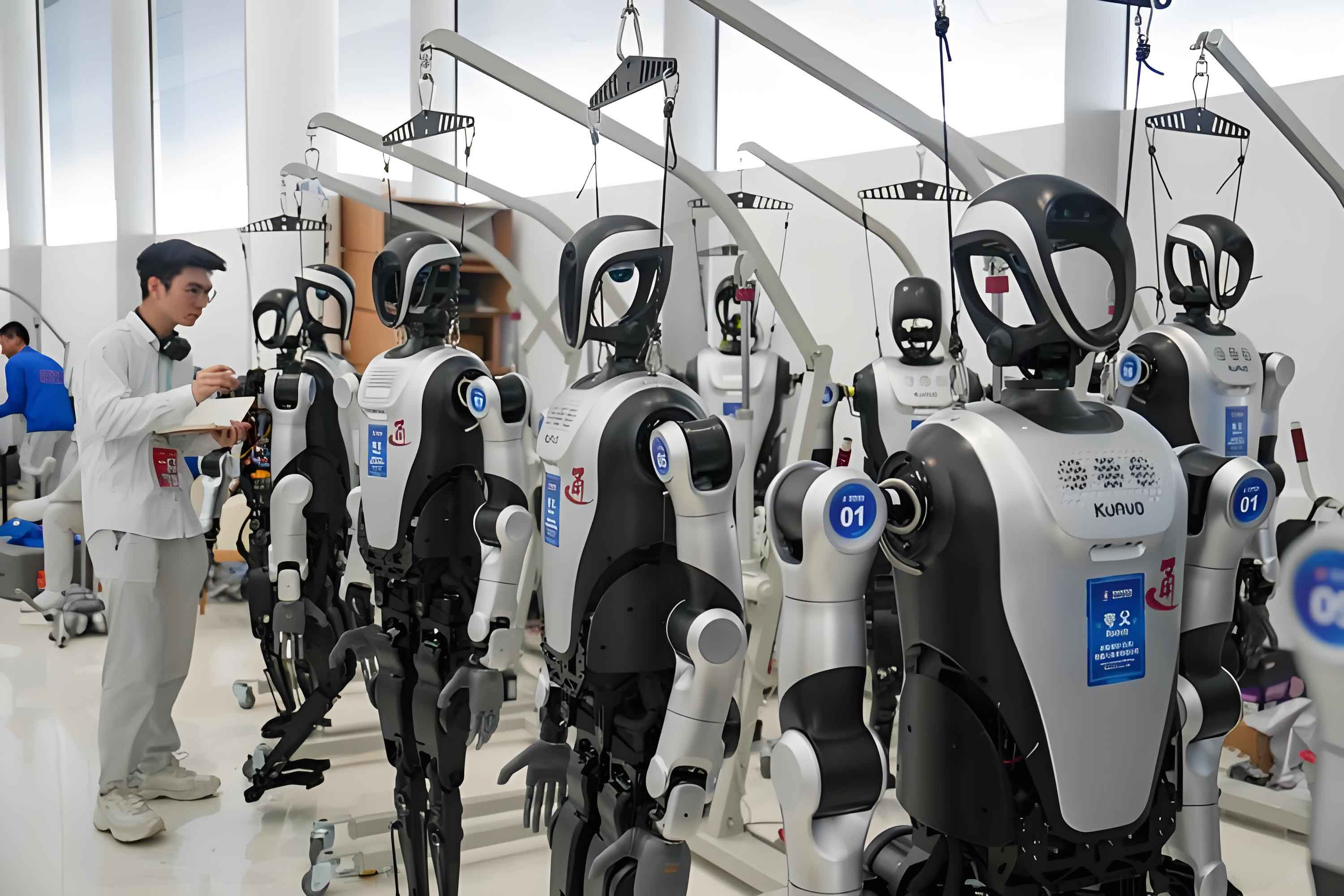
GUANGZHOU — As the humanoid robot industry enters a development window, more humanoid robots and related robotic systems are leaving laboratories and exhibition stands and entering factories, industrial parks and other real operating scenarios. The Agricultural Bank of China Limited Guangzhou Tianhe Branch is aligning closely with the development requirements of new quality productive forces, connecting deeply with the robot industry development plan of Guangzhou, Guangdong Province, and precisely supporting companies across the robot industry chain. Through financial services, the branch is helping accelerate the rise of Guangzhou’s humanoid robot and robotics industrial cluster and is supporting more humanoid robot companies as they move toward real industrial sites.
The shift is visible in the way humanoid robot technology is being tested, deployed and improved. Instead of remaining on display, humanoid robots are being placed into real work environments where they must understand scenes, make decisions, move autonomously and execute tasks. This change is important for the humanoid robot industry because it turns technical capability into practical application. It also creates new financial needs for humanoid robot companies, especially those that are asset-light, research-intensive and innovation-driven. The Guangzhou Tianhe Branch is responding to those needs with targeted credit support and a service approach that looks beyond traditional collateral.
1. Humanoid robot companies move into real industrial scenarios
The development of the humanoid robot sector is increasingly linked to real scenario deployment. A humanoid robot that can operate in a factory, an industrial park or an energy site must combine perception, decision-making, mobility and execution. This is why the humanoid robot industry is not only about a single product form. It is also about the integration of embodied intelligence, engineering capability and application experience. For financial institutions, understanding this integration is essential when serving humanoid robot companies and other robot enterprises.
In the energy sector, the need for reliable inspection and operation is especially strong. The China-Laos 500 kV interconnection project is known as a “power highway.” The transmission line crosses mountains and rainforests in both countries and is one of the larger and higher-voltage cross-border grid projects. Inside substations, machine dogs patrol autonomously, while remote humanoid robots cooperate to complete operation and maintenance tasks. This power inspection system has been deployed by Zhongke Kaichuang (Guangzhou) Intelligent Technology Development Co., Ltd. The case shows how humanoid robot systems and other robotic systems can be applied in high-risk and complex energy scenarios.
For the humanoid robot industry, such deployment is meaningful because it provides real feedback. A humanoid robot operating in a complex environment must be stable, safe and practical. The application of humanoid robot technology in power inspection also demonstrates how embodied intelligence can be connected to real operational tasks. The humanoid robot is not simply a demonstration tool. It is part of a larger system that includes machine dogs, remote operation, data transmission and task coordination. This system-level view is important for humanoid robot companies seeking to scale their applications.
The Guangzhou Tianhe Branch has been supporting this transition. Its work with robot companies reflects a broader effort to connect financial resources with the real needs of the humanoid robot industry. The branch is not treating humanoid robot companies as a single category. Instead, it is examining their scenarios, their technology paths and their delivery capabilities. This approach helps the bank serve humanoid robot companies more accurately and helps humanoid robot technology move from laboratories into industrial operations.
2. A humanoid robot and machine dog team supports cross-border power inspection
The cross-border power inspection case provides a clear example of how humanoid robot and machine dog systems can work together. The China-Laos 500 kV interconnection project passes through difficult terrain and requires reliable operation and maintenance. In this context, autonomous inspection and remote collaboration can improve the way grid facilities are monitored. Machine dogs can move through substations and carry out inspection tasks, while remote humanoid robots can support operation and maintenance work. The combination creates a practical model for humanoid robot deployment in energy infrastructure.
Zhongke Kaichuang has focused on high-risk and complex energy operation sites. The company has developed an embodied intelligence architecture described as a “dual-brain hierarchical decoupling” technology system. It has also developed embodied intelligence products, including the Jingling Zhiyu series and the Jingling Xingshu series. These products are designed to form an embodied intelligence operation loop that covers scene understanding, task decision-making, autonomous mobility and on-site execution. This loop is central to the value of humanoid robot and embodied intelligence systems in complex environments.
When the Guangzhou Tianhe Branch visited Zhongke Kaichuang, the bank’s technology finance team noted that the company’s core value lies in its proven scenario loop and its continuous technology iteration capability. This assessment is important for humanoid robot finance because it recognizes that the value of a humanoid robot company is not limited to fixed assets. It also lies in software, algorithms, system integration, application experience and the ability to improve products through real deployment. For humanoid robot companies with asset-light and research-heavy characteristics, this kind of evaluation can make financial support more accessible.
The bank subsequently provided Zhongke Kaichuang with a dedicated credit product and efficiently completed the release of 10 million yuan in credit funds. The credit support is intended to help the company continue promoting the engineering application of intelligent robots in more high-risk and complex scenarios. For the humanoid robot industry, this support is concrete because it helps a company move from proven scenarios toward broader application. It also shows how financial services can support humanoid robot companies at the stage when technology is being translated into engineering delivery.
The changes brought by credit support are specific. Based on its application experience in the power and energy sector, Zhongke Kaichuang is gradually introducing deployment solutions for rail transit, municipal utility tunnels, petrochemicals, metallurgical and mining industries. These sectors share a need for reliable operation in complex environments, and they can provide further application scenarios for humanoid robot and embodied intelligence systems. As humanoid robot technology continues to mature, the ability to adapt to different industrial settings will become increasingly important. Financial support can help humanoid robot companies shorten the path from scenario validation to broader deployment.
3. Asset-light humanoid robot firms need financial models that understand technology
The story between the Guangzhou Tianhe Branch and Zhongke Kaichuang began at a robot enterprise matchmaking exchange. Such exchanges are important because they bring financial institutions closer to the actual needs of robot companies. Humanoid robot companies often have light assets, heavy research and development investment and strong innovation attributes. These characteristics can make traditional financing difficult. For a humanoid robot company, the most valuable assets may be technical teams, algorithms, software platforms, patents, application data and scenario experience rather than large fixed assets.
This is why the humanoid robot industry needs financial models that understand technology. A humanoid robot company may invest heavily in research and development before it can generate stable revenue. It may also need working capital to support delivery, testing and iteration. If financial institutions rely only on traditional collateral, many humanoid robot companies may find it difficult to obtain timely support. The Guangzhou Tianhe Branch therefore went deep into the market and into the industry, actively bringing its batch credit plan to quality robot enterprises. At the matchmaking exchange, the bank’s staff noticed Zhongke Kaichuang, an embodied intelligence company focusing on energy scenarios.
The bank’s approach reflects a practical understanding of the humanoid robot sector. Humanoid robot companies are not all at the same stage. Some are developing core technologies, some are testing products in competitions or demonstrations, and some are delivering solutions to industrial customers. Their financial needs differ accordingly. A humanoid robot company focused on energy inspection may need support for engineering adaptation and delivery. A humanoid robot company focused on small, mass-producible products may need support for research, market development and production preparation. By visiting companies and studying their scenarios, the bank can design more suitable financial services for humanoid robot enterprises.
For Zhongke Kaichuang, the bank’s technology finance team evaluated the company’s scenario loop and technology iteration capability. This evaluation helped the bank provide a dedicated credit product and complete the 10 million yuan credit release efficiently. The support is not only a financial transaction. It is also a signal that humanoid robot companies with real application value can obtain financial recognition. As more humanoid robot companies enter industrial sites, financial institutions will need to develop similar capabilities to assess technology, scenario and delivery. The humanoid robot industry needs financial services that can see both risk and potential.
4. Credit helps turn humanoid robot technology into engineering applications
Turning humanoid robot technology into engineering applications requires more than laboratory breakthroughs. It requires testing, adaptation, integration and continuous improvement. A humanoid robot system must be able to operate reliably in a real environment. It must handle complex tasks, coordinate with other devices and provide useful results. This process takes time and resources. Credit support can help humanoid robot companies maintain research and development while also investing in engineering application and delivery.
Zhongke Kaichuang’s technology system is designed around the needs of high-risk and complex energy operation sites. Its embodied intelligence architecture and product series support a closed loop from scene understanding to on-site execution. This closed loop is important for humanoid robot and embodied intelligence applications because it connects perception and decision-making with actual movement and task completion. In energy inspection, for example, a humanoid robot or robotic system must understand the environment, decide what to inspect, move to the right position and execute the task. The ability to complete this loop reliably is a key step toward broader humanoid robot deployment.
The 10 million yuan credit support from the Guangzhou Tianhe Branch is helping Zhongke Kaichuang continue this work. The company is now building on its power and energy experience and gradually introducing solutions for rail transit, municipal utility tunnels, petrochemicals, metallurgical and mining industries. These sectors can offer new scenarios for humanoid robot and embodied intelligence systems. They can also help the company improve its products through repeated application. For the humanoid robot industry, this is an important path: application promotes iteration, and iteration improves application.
The bank’s support also shows how financial services can help humanoid robot companies move from project-based deployment to broader market expansion. A humanoid robot company that has proven a scenario may still need funds to adapt its products, train its teams and support customers. Credit can help bridge this gap. It can also give the company more confidence to invest in core technology and engineering capability. In this way, financial support for humanoid robot companies is not separate from industrial development. It is part of the process that helps humanoid robot technology become a practical industrial tool.
5. A compact humanoid robot tests the market through competition and commercialization
Another robot company rooted in Guangzhou is Guangzhou Gaoqing Power Technology Co., Ltd. The company is continuing to refine its humanoid robot products, testing its technology through competitions and accelerating commercial exploration. At the Second World Humanoid Robot Games, Gaoqing’s mass-produced humanoid robot, Mini Pi plus, attracted widespread attention. The humanoid robot is less than 70 cm tall and combines professional competition performance, operational stability and commercial application value in a compact form. It became a popular humanoid robot both within and beyond the competition venue.
Gaoqing was founded in 2022 and is a young humanoid robot company. It has set a vision of “building the PC of the embodied intelligence era.” The company insists on starting from technology, serving real scenarios and building a development platform. Its industrial route focuses on small size, safety, mass production and accessibility. This route is relevant to the humanoid robot industry because it explores how humanoid robots can become more practical, more affordable and easier to use in everyday and commercial settings. The humanoid robot is not only a technical showcase. It can also be a platform for development and application.
The Guangzhou Tianhe Branch has continued to increase financial support for science and technology companies. In serving Gaoqing, the bank fully considered the company’s high research and development investment and its lack of traditional collateral. The service team visited the company multiple times to understand in detail the orders and delivery situation of Gaoqing’s humanoid robot products in education and research, brand commercial performances, cultural tourism technology exhibitions and other scenarios. The bank also considered the company’s research and development cycle and funding needs. On this basis, it provided a dedicated credit plan for science and technology enterprises, simplified the process, approved the credit quickly and successfully released a large credit loan.
The injection of bank credit funds allows Gaoqing to focus more on core technology research. For a young humanoid robot company, this kind of support can be important during the stage when products are being tested and commercialized. A humanoid robot company must balance technology development, product improvement and market exploration. Financial support can reduce pressure and help the company maintain its research and development rhythm. It can also help the humanoid robot company respond to orders and deliver products in a more stable manner. The case shows how financial services can support humanoid robot companies with different product routes and different application scenarios.
Gaoqing’s experience also highlights the diversity of the humanoid robot industry. Some humanoid robot companies focus on large industrial systems, while others focus on compact, mass-producible humanoid robot products. Some humanoid robot applications are designed for high-risk energy sites, while others are designed for education, research, commercial performances and cultural tourism exhibitions. This diversity means that financial institutions need to understand the specific characteristics of each humanoid robot company. A tailored approach is more useful than a one-size-fits-all model. The Guangzhou Tianhe Branch’s work with Gaoqing reflects this tailored approach in practice.
6. Humanoid robot finance moves toward full life-cycle support
The Guangzhou Tianhe Branch is continuing to explore a financial service system for the robot industry. This system includes a dedicated credit evaluation model, diversified characteristic financial products and full life-cycle services. Such an approach is relevant to the humanoid robot industry because humanoid robot companies often pass through different stages of development. They may need support for research and development, testing, product improvement, market expansion and delivery. A full life-cycle service approach can help humanoid robot companies obtain more consistent financial support as they grow.
For the humanoid robot sector, a dedicated credit evaluation model can help financial institutions look beyond traditional financial statements and collateral. It can consider technology capability, scenario value, order delivery, research and development investment and team strength. Diversified financial products can meet the different needs of humanoid robot companies at different stages. Full life-cycle services can support humanoid robot companies from early technology development to large-scale application. This is important because the humanoid robot industry is still developing, and companies need financial partners that understand both technology and industry.
| Company | Humanoid robot and robotics focus | Financial support from the Guangzhou Tianhe Branch | Application and market direction |
|---|---|---|---|
| Zhongke Kaichuang (Guangzhou) Intelligent Technology Development Co., Ltd. | Embodied intelligence for high-risk and complex energy scenarios; machine dog and remote humanoid robot collaboration; dual-brain hierarchical decoupling architecture; Jingling Zhiyu series and Jingling Xingshu series | Dedicated credit product; 10 million yuan in credit funds completed efficiently | Power and energy inspection; rail transit; municipal utility tunnels; petrochemicals; metallurgical and mining industries |
| Guangzhou Gaoqing Power Technology Co., Ltd. | Humanoid robot products; Mini Pi plus humanoid robot under 70 cm; small, safe, mass-producible and accessible industrial route; vision of building the PC of the embodied intelligence era | Tailored science and technology enterprise credit plan; simplified process; fast approval; large credit loan | Education and research; brand commercial performances; cultural tourism technology exhibitions; humanoid robot commercialization exploration |
The table reflects the different but connected ways in which financial support can serve the humanoid robot industry. One company focuses on embodied intelligence systems for high-risk energy sites and is expanding into more industrial scenarios. Another company focuses on compact humanoid robot products and is exploring commercial applications through competitions, education, research and cultural tourism. Both are part of Guangzhou’s humanoid robot and robotics ecosystem. Both need financial services that understand their technology routes, their application scenarios and their development stages. The Guangzhou Tianhe Branch’s support for these companies shows how humanoid robot finance can be adapted to different business models.
The next step for the Guangzhou Tianhe Branch is to continue exploring the robot industry financial service system. The bank will support humanoid robot companies in using application to promote iteration and in using hard technology to define industrial scenarios. This approach is closely related to the development of new quality productive forces. For the humanoid robot industry, application and iteration are connected. A humanoid robot becomes more useful when it is tested in real scenarios. A real scenario becomes more valuable when it is supported by reliable humanoid robot technology. Financial services can help connect these two sides.
7. Humanoid robot clusters gain a stronger financial foundation
The growth of Guangzhou’s humanoid robot and robotics cluster depends on many factors. Technology, talent, supply chains, application scenarios and financial support all play a role. The work of the Guangzhou Tianhe Branch shows how financial institutions can contribute to the humanoid robot industry by moving closer to companies, understanding their technologies and designing services that match their needs. For humanoid robot companies, this kind of support can help them focus on research and development, product improvement and market expansion. For the wider industry, it can help more humanoid robot products move from laboratories to industrial sites.
The humanoid robot industry is still developing, and its financial needs will continue to evolve. Humanoid robot companies may need support for core technology research, engineering adaptation, testing and validation, production preparation and market development. They may also need financial services that can respond to different stages of growth. A full life-cycle approach can help humanoid robot companies maintain stability while pursuing innovation. A dedicated credit evaluation model can help financial institutions recognize the value of technology, scenarios and delivery capability. Diversified financial products can help humanoid robot companies meet specific needs at specific times.
In Guangzhou, the connection between finance and the humanoid robot industry is becoming more concrete. The cross-border power inspection project shows how humanoid robot and machine dog systems can support complex energy operations. The 10 million yuan credit support for Zhongke Kaichuang shows how financial services can help an embodied intelligence company expand its engineering applications. The support for Gaoqing shows how a young humanoid robot company can receive tailored financial services while testing its products and exploring commercialization. These cases are different, but they point in the same direction: financial services are becoming more closely integrated with the humanoid robot industry.
As more humanoid robot companies emerge and more humanoid robot applications are tested, the role of financial support will become more important. The humanoid robot industry needs financial institutions that can evaluate technology, understand scenarios and support long-term development. It also needs financial services that can help companies move from project-based deployment to broader market application. The Guangzhou Tianhe Branch’s continued exploration of a robot industry financial service system, including a dedicated credit evaluation model, diversified characteristic financial products and full life-cycle services, is part of this broader effort. By supporting humanoid robot companies in using application to promote iteration and in using hard technology to define industrial scenarios, financial services can help the humanoid robot industry develop with greater confidence.
The path from laboratory to industrial site is not a single step. For a humanoid robot company, it involves technology validation, scenario adaptation, product improvement and market development. For a humanoid robot application, it involves integration with existing systems, coordination with other devices and reliable execution in real environments. For the humanoid robot industry, it involves building a complete ecosystem that includes research institutions, manufacturers, application customers and financial partners. The Guangzhou Tianhe Branch is supporting this process by serving humanoid robot companies with targeted financial solutions. The result is a stronger financial foundation for Guangzhou’s humanoid robot cluster and a clearer path for more humanoid robots to enter real industrial operations.