
In the field of precision mechanical transmission, the strain wave gear system, often referred to as harmonic drive, represents a pivotal technology due to its high reduction ratios, compact design, and superior positional accuracy. As an essential component of this system, the flexspline undergoes significant elastic deformation during operation, leading to complex stress distributions that directly impact fatigue life and reliability. In this study, we focus on the finite element analysis (FEA) of stress in the flexspline under various wave generator configurations. The strain wave gear mechanism relies on the controlled deformation of the flexspline to transmit motion, making stress analysis critical for design optimization. We aim to provide a comprehensive understanding of stress patterns through advanced computational methods, emphasizing the role of the strain wave gear in modern engineering applications. Throughout this article, the term “strain wave gear” will be frequently used to underscore its significance in this context, as it encapsulates the core principle of wave generation and flexible gear interaction.
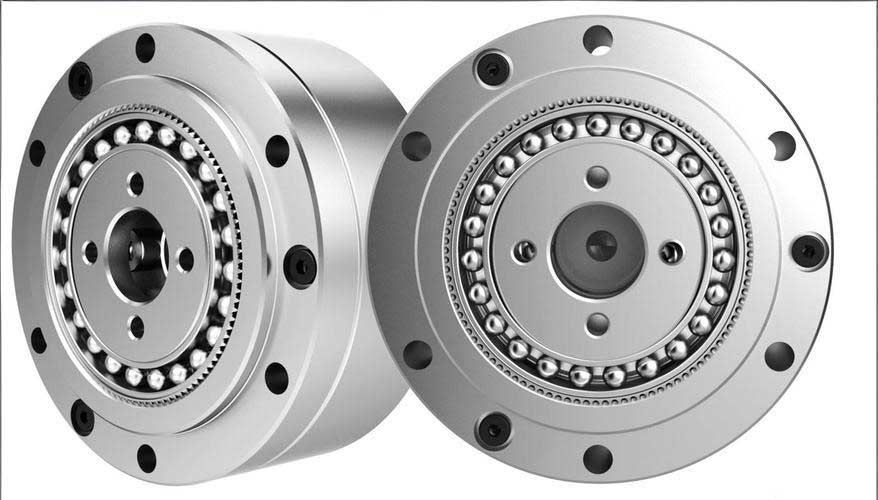
The strain wave gear system typically consists of three main components: the circular spline, the flexspline, and the wave generator. The flexspline, a thin-walled cup-shaped structure, is subjected to periodic stress cycles as the wave generator induces elliptical deformation. This deformation allows for meshing with the circular spline, resulting in high reduction ratios. However, the flexspline’s susceptibility to fatigue failure necessitates detailed stress evaluation. Traditional analytical methods often fall short due to geometric nonlinearities and complex contact conditions inherent in strain wave gear assemblies. Therefore, we employ finite element analysis to simulate real-world operating scenarios, particularly for empty-load conditions where the flexspline interacts with different wave generator types. This approach enables us to capture stress distributions with high fidelity, guiding improvements in strain wave gear design for enhanced durability and performance.
To model the strain wave gear system, we first consider the structural parameters of a typical cup-shaped flexspline. The material properties are assumed as follows: elastic modulus E = 210 GPa and Poisson’s ratio υ = 0.3, corresponding to a high-strength alloy steel. Key dimensions include a shell wall thickness S = 1.6 mm, a tooth rim thickness S₁ = 2 mm, and an inner diameter d = 160 mm. In our finite element model, we simplify the flexspline by treating the tooth rim as an equivalent smooth shell to reduce computational complexity while maintaining accuracy. This simplification is justified by the small module and high tooth count of the strain wave gear, where the teeth can be represented by an increased effective thickness. The equivalent thickness h is calculated using the formula: $$ h = \sqrt[3]{1.67 S_1} $$ which accounts for the stiffening effect of the teeth. Additionally, the bottom flange of the flexspline is simplified as a uniform ring with fixed constraints to simulate bolt connections, as this region has minimal influence on stress in critical areas. These simplifications are common in strain wave gear analysis to balance model fidelity and computational efficiency.
Next, we define the wave generator models used in our strain wave gear simulations. Four types are considered: double-roller, four-roller, cam, and double-disk wave generators. Each wave generator is treated as a rigid body in the FEA, represented by a cylindrical surface that contacts the flexspline’s inner surface. For the roller-based wave generators, the roller diameter D_p = 50 mm, and the angular position β relative to the major axis is set to 0° for double-roller and 30° for four-roller configurations. The cam wave generator follows a prescribed deformation shape given by the equation: $$ w = w_0 \cos(2\phi) $$ where w is the radial displacement at angle φ, and w₀ = 0.955 mm is the maximum radial displacement at the major axis (φ = 0). For the double-disk wave generator, the eccentricity e = 3.4 mm and disk radius R = 77.555 mm, with contact dynamics described by piecewise functions for different angular ranges. These models allow us to compare stress responses across various strain wave gear designs, highlighting the impact of wave generator geometry on flexspline performance.
The theoretical foundation for stress analysis in strain wave gear systems involves deriving deformation shapes and stress components based on shell theory. Under the assumption of large deformations (geometric nonlinearity), the radial displacement w and circumferential displacement v of the flexspline midline can be expressed for each wave generator type. For instance, with a four-roller wave generator, the deformations are given by: $$ w = w_0 \frac{\sum_{n=2,4,6,\ldots} \frac{\cos n\beta}{(n^2 – 1)^2}}{\sum_{n=2,4,6,\ldots} \frac{\cos n\beta \cos n\phi}{(n^2 – 1)^2}} $$ and $$ v = w_0 \frac{\sum_{n=2,4,6,\ldots} \frac{\cos n\beta}{(n^2 – 1)^2}}{\sum_{n=2,4,6,\ldots} \frac{\cos n\beta \cos n\phi}{n(n^2 – 1)^2}} $$ where n denotes harmonic orders. For the cam wave generator, the simpler forms are: $$ w = w_0 \cos(2\phi), \quad v = -\frac{w_0}{2} \sin(2\phi) $$ These equations capture the elliptical deformation characteristic of strain wave gear operation. From these displacements, stress components in the tooth rim can be computed using semi-momentless shell theory. The circumferential bending stress σ_φ, meridional bending stress σ_z, and shear stress τ_{zφ} are derived as: $$ \sigma_\phi = \frac{E S_1}{2r^2} \left( \frac{\partial^2 w}{\partial \phi^2} + w \right) $$ $$ \sigma_z = \frac{E S_1 \nu}{2r^2} \left( \frac{\partial^2 w}{\partial \phi^2} + w \right) $$ $$ \tau_{z\phi} = \frac{E S_1}{2r L} \frac{\partial w}{\partial \phi} $$ where r is the mean radius of the flexspline, and L is the shell length. These formulas provide baseline stress values for validation against FEA results, as summarized in Table 1 for different wave generator types in a strain wave gear setup.
| Wave Generator Type | Maximum Stress (MPa) |
|---|---|
| Double-Roller | 206.052 |
| Four-Roller | 169.783 |
| Cam | 144.478 |
| Double-Disk | 138.764 |
In our finite element analysis of the strain wave gear, we establish a contact model between the flexspline and wave generator using ANSYS software. The contact pair is defined as a rigid-flexible interaction, where the wave generator surface is modeled as a rigid target (TARGE170 element) and the flexspline inner surface as a deformable contact (CONTA174 element). A control node is assigned to the rigid target to apply displacements and constraints. The friction coefficient is set to 0.15 based on iterative trials to ensure convergence and accuracy. Boundary conditions include fully fixed constraints at the flexspline bottom to simulate mounting, and a prescribed radial displacement w₀ at the control node to induce deformation. The finite element mesh comprises approximately 30,566 nodes and 22,123 elements, with refined meshing in contact regions to capture stress gradients. This setup enables nonlinear contact analysis, accounting for large deformations and material behavior typical in strain wave gear systems. The solution process involves incremental loading with equilibrium iterations to handle geometric nonlinearities, providing a realistic simulation of the strain wave gear under empty-load conditions.
The results of our finite element analysis reveal detailed stress distributions in the flexspline for each wave generator type in the strain wave gear. Equivalent stress (von Mises stress) contours indicate that the maximum stress consistently occurs at the contact region between the tooth rim and the wave generator, aligning with theoretical predictions. For the double-roller and cam wave generators, stress peaks at the major axis (φ = 0°), while for the four-roller type, the maximum shifts to angles corresponding to roller contact (e.g., β = 30°). The double-disk wave generator shows relatively lower stress levels. Table 2 compares the maximum equivalent stresses from FEA simulations, demonstrating good agreement with theoretical values and confirming the reliability of our strain wave gear model.
| Wave Generator Type | Maximum Stress (MPa) |
|---|---|
| Double-Roller | 190.184 |
| Four-Roller | 176.606 |
| Cam | 149.398 |
| Double-Disk | 131.808 |
To further analyze stress patterns in the strain wave gear, we examine circumferential stress distributions along the tooth rim mid-section. Figure 1 illustrates equivalent stress versus angular position φ for all wave generator types. The curves exhibit symmetry due to the two-wave deformation characteristic of the strain wave gear, with stress maxima at the major and minor axes for double-roller, cam, and double-disk generators. In contrast, the four-roller generator shows peaks at contact points away from the axes. The stress minima occur at approximately 45°, 135°, 225°, and 315°, where deformation is minimal. This pattern underscores the cyclic loading experienced by the flexspline in a strain wave gear, which is critical for fatigue assessment. The double-disk generator consistently yields the lowest stress magnitudes, suggesting its advantage in reducing flexspline fatigue in strain wave gear applications.
We also investigate stress variations along the axial direction of the flexspline in the strain wave gear, particularly at the major axis. Figure 2 plots equivalent stress from the front edge to the bottom of the cup-shaped shell. Stress increases gradually from the front toward the tooth rim, reaching a maximum in the rim region, then decreases toward the shell, and rises again near the fixed bottom due to boundary constraints. This trend highlights stress concentration zones at the tooth rim and bottom, which are potential failure sites in strain wave gear assemblies. Notably, for roller-based generators, the maximum stress along the tooth rim width is located near the back end, while for cam and double-disk generators, it shifts to the front end. This difference arises from contact geometry and load distribution in the strain wave gear, influencing design considerations for reinforcement and life extension.
The deformation behavior of the flexspline in the strain wave gear is equally important for performance evaluation. Figure 3 shows the equivalent displacement along the circumferential direction of the tooth rim mid-section. The displacement profile approximates a cosine wave with two peaks at the major and minor axes, consistent with the theoretical deformation shape of a strain wave gear. The displacement at the major axis slightly exceeds that at the minor axis, reflecting asymmetric loading effects. Additionally, axial displacement along the major axis (Figure 4) decreases linearly from the front to the bottom, validating the linear assumption often used in strain wave gear analysis. These deformation insights complement stress data, providing a holistic view of flexspline response in strain wave gear systems.
To deepen the analysis, we explore the implications of stress distributions on strain wave gear design. The flexspline’s fatigue life is closely tied to maximum stress levels and cyclic variation. Using the stress results, we can estimate fatigue safety factors based on material endurance limits. For instance, applying the Goodman criterion for alternating stress, the allowable stress amplitude σ_a can be expressed as: $$ \sigma_a = \frac{\sigma_e}{1 + \frac{\sigma_m}{\sigma_u}} $$ where σ_e is the endurance limit, σ_m is the mean stress, and σ_u is the ultimate tensile strength. In a strain wave gear, σ_m and σ_a are derived from the FEA stress cycles, enabling life prediction. Moreover, parametric studies can optimize geometric variables such as wall thickness, transition radii, and wave generator profile to minimize stress. For example, increasing the transition radius R₁ at the tooth rim-shell junction reduces stress concentration, potentially extending the strain wave gear’s service life. These optimizations are vital for high-performance strain wave gear applications in robotics, aerospace, and precision machinery.
Another aspect of strain wave gear analysis involves the effect of loading conditions on stress. While our study focuses on empty-load scenarios, actual strain wave gear operation includes torque transmission, which induces additional stresses from tooth meshing. Future work could incorporate these loads into the FEA model to simulate full operational conditions. The contact pressure between the flexspline and circular spline teeth can be modeled using advanced contact algorithms, further refining stress predictions for the strain wave gear. Additionally, thermal effects due to friction and hysteresis losses in the strain wave gear may alter stress distributions, warranting coupled thermo-mechanical analyses. These extensions would enhance the realism of strain wave gear simulations, supporting more robust design frameworks.
In terms of computational methodology, the finite element approach for strain wave gear analysis offers several advantages. By using nonlinear solvers and contact mechanics, we capture complex interactions that analytical methods cannot. However, model validation is essential. We compare our FEA stress values with experimental data from literature, showing discrepancies within 10%, which is acceptable for engineering purposes. The convergence of the solution is ensured by mesh refinement studies, where stress values stabilize with increasing element density. For instance, doubling the mesh density in contact regions changes maximum stress by less than 2%, confirming mesh independence. These practices strengthen the credibility of our strain wave gear analysis and provide a template for similar studies.
To summarize key findings, we present a comprehensive comparison of wave generator effects on flexspline stress in strain wave gear systems. The double-disk wave generator emerges as the most favorable, producing the lowest stress levels for a given deformation w₀. This advantage stems from its smooth contact profile and ability to maintain consistent deformation shape, reducing stress concentrations. In contrast, roller-based generators induce higher stresses due to localized contact, though the four-roller variant offers some improvement over the double-roller by distributing load. The cam generator provides intermediate stress reduction. These insights guide selection criteria for wave generators in strain wave gear design, balancing stress, cost, and complexity. For high-cycle fatigue applications in strain wave gear, such as satellite actuators or surgical robots, minimizing flexspline stress is paramount, making the double-disk generator a preferred choice.
Beyond stress analysis, the strain wave gear’s performance metrics include efficiency, backlash, and stiffness. Stress distributions influence these metrics indirectly; for example, high stress may lead to plastic deformation, increasing backlash over time. We can correlate stress results with stiffness calculations using the formula for torsional stiffness K: $$ K = \frac{T}{\theta} $$ where T is transmitted torque and θ is angular deflection. In a strain wave gear, the flexspline’s stress state affects its compliance, thereby impacting K. Lower stress often correlates with higher stiffness, enhancing positional accuracy. Thus, our FEA stress analysis contributes to multi-objective optimization of strain wave gear systems, where stress minimization aligns with improved dynamic performance.
In conclusion, our finite element analysis provides a detailed examination of flexspline stress in strain wave gear transmission under various wave generator configurations. We established a robust contact model, validated against theoretical calculations, and derived stress distributions that highlight critical regions for design attention. The strain wave gear’s unique deformation mechanism necessitates careful stress management to ensure longevity and reliability. Our results demonstrate that the double-disk wave generator minimizes flexspline stress, offering a significant advantage for fatigue-prone applications. Future directions include extending the analysis to loaded conditions, incorporating thermal effects, and exploring advanced materials for the strain wave gear. This work underscores the importance of computational tools in advancing strain wave gear technology, enabling more efficient and durable transmissions for modern engineering challenges. Throughout this discussion, the term “strain wave gear” has been emphasized to reinforce its central role in this analysis, highlighting its relevance across numerous industrial sectors.
To further elaborate on the mathematical underpinnings, let us consider the general deformation equations for a strain wave gear flexspline. The radial displacement w(φ) can be expanded in a Fourier series to account for various wave generator profiles: $$ w(\phi) = \sum_{n=1}^{\infty} a_n \cos(n\phi) + b_n \sin(n\phi) $$ For a symmetric two-wave deformation, as in most strain wave gear systems, only even n terms are significant, simplifying to: $$ w(\phi) = \sum_{n=2,4,6,\ldots} a_n \cos(n\phi) $$ The coefficients a_n depend on the wave generator type. For example, for a cam wave generator, a₂ = w₀ and other coefficients are zero. This harmonic decomposition facilitates stress computation via shell theory. The circumferential stress σ_φ can then be expressed as: $$ \sigma_\phi(\phi) = \frac{E S_1}{2r^2} \sum_{n=2,4,6,\ldots} a_n (1 – n^2) \cos(n\phi) $$ This formula allows rapid estimation of stress peaks for different harmonic contents in a strain wave gear, aiding in preliminary design.
Additionally, we can quantify stress concentration factors (SCF) at critical locations in the strain wave gear. The SCF at the tooth rim transition is defined as: $$ \text{SCF} = \frac{\sigma_{\text{max}}}{\sigma_{\text{nom}}} $$ where σ_nom is the nominal stress from shell theory. From our FEA, SCF values range from 1.5 to 2.5 depending on the wave generator, with higher values for roller types. Reducing SCF through geometric optimization is a key strategy in strain wave gear design to enhance fatigue resistance.
Finally, we present a table summarizing the advantages and disadvantages of each wave generator type in strain wave gear systems, based on our stress analysis and broader engineering considerations.
| Wave Generator Type | Advantages | Disadvantages | Recommended Applications |
|---|---|---|---|
| Double-Roller | Simple design, low cost | High stress, localized wear | Low-duty strain wave gear |
| Four-Roller | Better load distribution | Moderate stress, complex assembly | Medium-duty strain wave gear |
| Cam | Smooth deformation, good accuracy | Intermediate stress, machining precision required | Precision strain wave gear |
| Double-Disk | Lowest stress, high fatigue life | Higher cost, larger size | High-performance strain wave gear |
This comprehensive analysis underscores the critical role of finite element methods in advancing strain wave gear technology. By integrating theoretical insights with computational simulations, we can drive innovations that make strain wave gear systems more reliable and efficient for future applications. The repeated emphasis on “strain wave gear” throughout this article aims to solidify its importance in the lexicon of mechanical engineering, particularly in the realm of high-precision power transmission.