
2026 has been widely recognized across the industry as the mass-production year of the humanoid robot. From the World Artificial Intelligence Conference in Shanghai to the World Robot Conference in Beijing, a clear signal is being released: the humanoid robot is no longer merely a device that dances or performs somersaults. Humanoid robots are now selling goods in retail zones, tightening screws on factory floors, and taking part in surgical procedures in hospitals.
The numbers themselves are genuinely encouraging. According to data from Counterpoint Research, global shipments of the humanoid robot exceeded 22,000 units in the first half of 2026, a year-on-year increase of nearly 300 percent. The Ministry of Industry and Information Technology of China estimates that the country’s full-year output of complete humanoid robot units is expected to surpass 100,000 units.
Yet what is the true quality of this mass-production year? Beyond the noise of exhibition halls, a more serious question is emerging: between being built and being used well, what exactly still stands in the way?
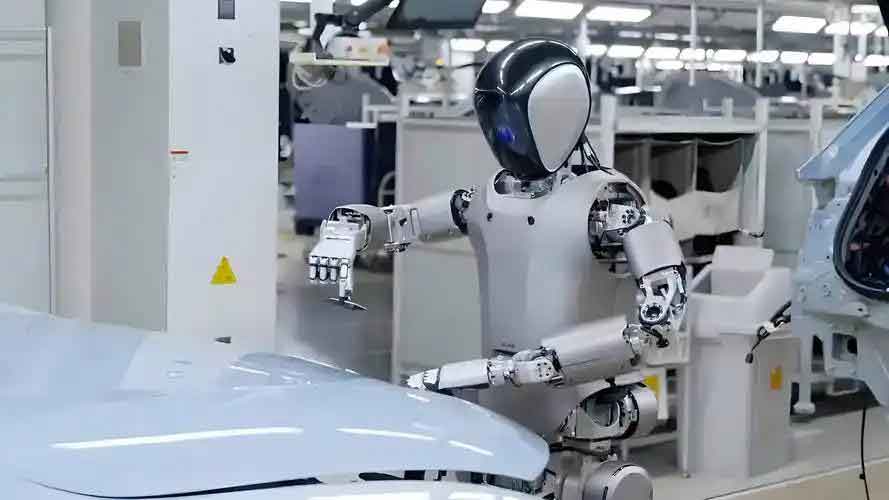
- Shipment Volume and the Two-in-Ten Reality of Real Work
During the 2026 World Robot Conference, a number of companies published striking commercialization figures. AgiBot shipped approximately 9,700 humanoid robot units in the first half of the year. Unitree Robotics shipped approximately 7,000 units as of August 21. Galbot shipped more than 1,100 units cumulatively in the first half of the year.
Order figures were even more dramatic. At its June 30 product launch, UBTECH announced that full-channel orders for its full-size ultra-biomimetic humanoid robot U1 series had exceeded 13,361 units, with the company aiming to deliver within the year. But UBTECH founder Zhou Jian also admitted candidly that the difficulty of such mass production is rare even in the history of human manufacturing. The U1 alone contains between 2,000 and 3,000 components in the head section alone, and capacity ramp-up, yield control, and delivery consistency are all formidable tests.
A signed order does not equal a delivery; a delivery does not equal stable operation; and stable operation does not equal customer repurchase. Multiple industry figures expressed similar views to journalists during the World Robot Conference.
This gap is reflected even more intuitively in the shipment structure. According to Counterpoint Research, in the first half of 2026, entertainment and commercial performances plus science education and data collection together still accounted for more than 60 percent of global humanoid robot shipments, even though that combined share had declined somewhat. Intelligent manufacturing accounted for only 13 percent, and warehousing and logistics only 5 percent. Fewer than two in ten humanoid robot units were genuinely going into factories and warehouses to work.
Unitree Robotics’ prospectus shows that in the first nine months of 2025, more than 70 percent of its humanoid robot-related revenue came from the science education sector, while genuine industry applications accounted for only about 9 percent. It is understood that the so-called science education category is a broad one. Beyond universities and research institutions, it also includes a large number of technology companies and developers who buy a humanoid robot to conduct secondary development. These customers are purchasing a research platform rather than a tool that can be put directly into production. This shows that a large share of current shipments still remains at the stage of developers buying a humanoid robot to study it, rather than enterprises buying a humanoid robot to work.
However, the other side of the numbers is that a cohort of humanoid robot units has indeed already taken up posts in real scenarios.
- A Structural View of Global Humanoid Robot Shipments in the First Half of 2026
Application Category Share of Global Humanoid Robot Shipments Entertainment and commercial performance, science education and data collection (combined) More than 60 percent Intelligent manufacturing 13 percent Warehousing and logistics 5 percent Genuine factory and warehouse work (combined) Fewer than 20 percent The table above illustrates why the phrase mass-production year deserves scrutiny. A humanoid robot that is shipped is not automatically a humanoid robot that is working. The distance between a shipping container and a shop floor remains the defining gap of this era.
- Where the Humanoid Robot Has Already Clocked In
Robot Era was the first embodied intelligence company in the industry to announce completion of product-market fit validation. Its logistics solution has already entered cooperation with SF Express and China Post, achieving normalized operation in more than ten logistics centers across five provincial-level regions.
Why was logistics chosen as the first large-scale breakthrough? Xi Yue, co-founder of Robot Era, explained during the World Robot Conference that the logistics working environment is harsh. Most operations run in the small hours of the night, there is no air conditioning, no air purifier, and noise levels are extremely high. Summers are exceptionally hot and winters exceptionally cold. Liberating people from such arduous environments was the first consideration. More importantly, the logistics scenario has a clear efficiency yardstick: defined takt time, accuracy, and working-hour requirements. This gives the humanoid robot a quantifiable value anchor.
Regarding the criteria for judging product-market fit, Xi Yue gave three signals. The first is that the solution addresses a genuine need, something that is a timely help rather than an added embellishment. The second is to look at repurchase rates and batch deployment. The third is that the economic model must be healthy and must run through to completion. Whether batch deployment has been achieved in that scenario is itself a signal.
The logistics sorting solution demonstrated by Galaxea at the World Robot Conference site achieved a measured efficiency of 1,816 items per hour, exceeding that of United States peers by 45 percent, with an accuracy rate of 98 percent. The solution has already been deployed into a real production environment in cooperation with a leading logistics enterprise.
The MoJia Robotics booth was particularly distinctive. More than 30 large screens live-streamed humanoid robot units working in real scenarios across different cities. At a crossroads in Jiangyin, a smart police humanoid robot was directing morning peak traffic. In a 4S dealership in Malaysia, the MoYin humanoid robot was receiving customers in the local language. Zhang Guibing, general manager of MoJia Robotics, stated that the company’s smart police humanoid robot has completed contracts for 1,000 units and delivered 100 units.
The coffee-making humanoid robot from Zhi Ping Fang has already been operating on a normalized basis in more than ten provincial-level regions. The demonstration on the exhibition stand was not choreographed temporarily for the event. This humanoid robot already has a long-term operating record in real commercial spaces.
The common features of these cases are that the task boundary is relatively clear, efficiency is quantifiable, and return on investment is calculable. They prove that the humanoid robot can work, but they are far from proving that the humanoid robot can do every kind of work.
- Selected Deployments and Measured Performance of the Humanoid Robot in 2026
Company Scenario Reported Deployment and Performance Robot Era Logistics Cooperation with SF Express and China Post; normalized operation in more than ten logistics centers across five provincial-level regions Galaxea Logistics sorting 1,816 items per hour; 45 percent faster than United States peers; 98 percent accuracy; deployed with a leading logistics enterprise MoJia Robotics Traffic control and retail reception Smart police humanoid robot: 1,000 units contracted, 100 units delivered; overseas dealership reception in Malaysia Zhi Ping Fang Beverage retail Coffee-making humanoid robot operating on a normalized basis in more than ten provincial-level regions Boundless Dynamics Battery manufacturing Nearly 700 million yuan in global orders booked within one year of founding; first batch delivered to Envision’s battery gigafactory in France - Delivery Is Only the First Step
Liu Yulong, co-founder of Zhishen Technology, broke down the mass-production challenge during the World Robot Conference into three gates. The first is the technology gate, moving from being able to do something once to being able to reproduce it stably. The second is the scenario gate, moving from being able to walk there to being able to finish the task. The third is the continuous delivery gate, moving from completing a single project to forming a reusable product capability.
As of June 2026, Zhishen Technology had cumulatively mass-produced more than 15,000 embodied intelligence humanoid robot units, with monthly capacity exceeding 5,000 units. But Liu Yulong also admitted that going from a laboratory prototype to ten-thousand-unit mass production requires two completely different sets of capabilities.
After mass production, the real challenge has only just begun. Whether product maturity, the supply chain, and the quality system meet commercial standards determines whether being able to build the humanoid robot can be transformed into being able to use the humanoid robot well.
It is understood that in terms of application scenarios, Zhishen Technology has joined hands with more than 300 ecosystem partners, landing in core industries including security, emergency response, and electric power, with service coverage spanning more than one hundred cities and provincial-level regions nationwide. But Liu Yulong also pointed out that the embodied intelligence field still lacks a very mature standard, including performance indicators, functional indicators, evaluation systems, and certification standards.
Delivery is only the first step; stable operation is the true test. Zhang Guibing offered a notably pragmatic timetable when discussing when a humanoid robot could enter an automobile final assembly line. In the logistics field, a large number of scenarios will land next year, but in the final assembly field, because of the enormous number of components and mixed-model production, considerably more time will be needed.
Zhang Yufeng, founder of Boundless Dynamics, defined 2026 as the mass-production year of operational intelligence, distinguishing it from the earlier mass production of the humanoid robot body itself. Mass production of operational intelligence means the humanoid robot has truly begun to work. The subtext of this judgment is that mass production of the body is only a precondition; making the humanoid robot capable of working is the real mass production.
According to Zhang Yufeng, Boundless Dynamics has secured nearly 700 million yuan in global orders within just one year of its founding, and its first batch of humanoid robot units has been delivered to Envision’s battery gigafactory in France.
- Manufacturing and Delivery Milestones Reported by the Humanoid Robot Sector in 2026
Company Reported Figure Period Covered AgiBot Approximately 9,700 units shipped First half of 2026 Unitree Robotics Approximately 7,000 units shipped As of August 21, 2026 Galbot More than 1,100 units shipped cumulatively First half of 2026 UBTECH More than 13,361 units in full-channel orders for the U1 series Announced June 30, 2026 Zhishen Technology More than 15,000 units cumulatively mass-produced; monthly capacity above 5,000 units As of June 2026 Global total More than 22,000 units shipped, up nearly 300 percent year on year First half of 2026 China full-year estimate Complete humanoid robot output expected to exceed 100,000 units Full year 2026 These figures collectively describe a sector that has crossed from the thousand-unit level to the ten-thousand-unit level. Yet the same figures also make clear that the overwhelming majority of the humanoid robot volume produced so far has not been absorbed by factories and warehouses.
- Standards, Evaluation, and the Missing Yardstick
One of the most frequently raised concerns during the World Robot Conference was the absence of shared benchmarks. The humanoid robot industry today operates without a fully mature set of standards covering performance indicators, functional indicators, evaluation systems, and certification criteria. Without such standards, buyers struggle to compare competing humanoid robot offerings, and suppliers struggle to prove that their humanoid robot delivers value beyond a demonstration.
The consequence is that commercialization evaluation is shifting toward efficiency, stability, and return on investment. This shift is significant because it changes what counts as success. A humanoid robot that performs impressively once is no longer sufficient. A humanoid robot that performs reliably across thousands of cycles, in a real working environment, under real time pressure, is what matters.
This also explains why the deployment cases that have attracted the most attention share a common structure. They involve tasks with clear boundaries, measurable throughput, and calculable economics. Logistics sorting is one such task. Coffee preparation in a fixed commercial space is another. Traffic direction at a fixed intersection is another. Each of these allows the operator of a humanoid robot to state, in numbers, what the machine delivers.
The harder cases remain those where the task boundary is fuzzy, the environment is unstructured, and the cost of failure is high. Final assembly of automobiles is the standard example. The number of components is enormous, and mixed-model production means that the sequence of tasks changes constantly. Under such conditions, the humanoid robot must not only complete a task but also adapt without interrupting the line. That is a substantially higher bar.
- Why Logistics Became the First Beachhead for the Humanoid Robot
The choice of logistics as the first scalable breakthrough for the humanoid robot is not accidental. Several structural features of logistics work align well with the current capabilities of the humanoid robot.
- The environment, while physically harsh, is relatively structured in terms of workflow.
- Takt time, accuracy, and working hours can be defined precisely and measured objectively.
- The labor supply problem is acute, particularly for overnight shifts in unconditioned spaces.
- Throughput can be compared directly against human benchmarks and against competing automation.
- The return on investment can be calculated from measurable labor substitution and throughput gains.
These features explain why a humanoid robot deployed in a logistics center can be evaluated on the same terms as any other piece of automation. The machine either moves a defined number of items per hour at a defined accuracy, or it does not. That clarity is precisely what makes logistics a viable first market for the humanoid robot.
By contrast, the entertainment and science education segments that still dominate humanoid robot shipments do not impose the same discipline. A humanoid robot purchased as a research platform does not need to hit a production takt time. A humanoid robot purchased for a stage performance does not need to sustain eight hours of repetitive accuracy. This is why the shift of shipment mix toward manufacturing and logistics matters far more than the headline shipment total.
- From Demonstrating Capability to Validating Value
A research report released by BOCOM International during the World Robot Conference pointed out that the industry is transforming from demonstrating capability toward validating value, and that commercialization evaluation has begun to shift toward efficiency, stability, and return on investment. The institution believes that the industry’s valuation logic is gradually shifting from technology beta toward delivery alpha, and that the focus of market pricing will gradually turn toward order fulfillment, scale delivery, and scenario replication capability.
This framework helps explain the current divergence in the humanoid robot sector. Companies that can show repeat orders, batch deployment, and a working economic model are being evaluated differently from companies that can only show a compelling demonstration. The humanoid robot that can be replicated across sites is worth more than the humanoid robot that performs well at a single showcase.
Xu Xiaolan, president of the Chinese Institute of Electronics, stated at the main forum of the World Robot Conference that the humanoid robot is accelerating its evolution from moving on stage and running on the field toward being used in the home and working in the factory. The humanoid robot in the exhibition hall has indeed begun to work, but there is still a considerable distance to travel before it can work at large scale, at low cost, and in a replicable manner.
- The Remaining Distance Between Built and Built to Work
Returning to the original question: what is the true quality of the humanoid robot mass-production year in 2026?
From the perspective of numbers, a leap from the thousand-unit level to the ten-thousand-unit level has indeed been achieved. From the perspective of scenarios, limited applications such as logistics sorting, retail service, and security patrol have already run through a commercial closed loop. From the perspective of the capital market, the listing of Unitree Robotics has injected confidence and resources into the industry.
But the true meaning of the mass-production year may not lie in how many tens of thousands of units were shipped. It may lie in the fact that the industry has begun to confront a more difficult question: between being built and being used well, how far is the distance that remains?
Several structural obstacles define that distance for the humanoid robot.
- Product maturity. A humanoid robot must survive continuous duty cycles, not just a demonstration window.
- Supply chain and quality systems. Thousands of components per unit must arrive on time and within tolerance, batch after batch.
- Delivery consistency. Two humanoid robot units of the same model must perform the same way in the same task.
- Standards and certification. Without shared benchmarks, procurement decisions for a humanoid robot remain slow and risk-averse.
- Scenario replication. A solution proven at one logistics center must be portable to the next one without a full re-engineering effort.
- Economic model. The humanoid robot must produce a return that a finance department can defend.
Each of these obstacles is being addressed, but none of them has been fully cleared. The humanoid robot that can be built in volume is now a reality. The humanoid robot that can be deployed in volume, operated stably, and purchased again is the next milestone.
The evidence from 2026 suggests that the industry understands this distinction better than it did a year ago. The conversation has moved from what the humanoid robot can do in a controlled setting to what the humanoid robot actually does in a working one. That shift, more than any shipment total, is what gives the mass-production year its real significance.
The humanoid robot has left the stage. Whether it can hold down a job is now the question that will define the years ahead.
- What to Watch Next for the Humanoid Robot
Several indicators will determine whether the momentum of 2026 carries into genuine industrial scale for the humanoid robot.
- Whether the share of humanoid robot shipments going to intelligent manufacturing and warehousing logistics rises meaningfully above the current combined figure of under 20 percent.
- Whether repurchase rates among industrial buyers of the humanoid robot become visible in company disclosures.
- Whether a shared standard for humanoid robot performance, function, evaluation, and certification emerges.
- Whether the economic model of a deployed humanoid robot can be reproduced across sites without bespoke engineering.
- Whether delivery alpha, rather than technology beta, becomes the primary basis on which the humanoid robot sector is valued.
- Whether operational intelligence, rather than body production alone, becomes the defining measure of the humanoid robot mass-production era.
Each of these indicators is measurable. Each of them will be tested in the coming quarters. And each of them will determine whether the humanoid robot remains a compelling exhibit or becomes a durable piece of industrial infrastructure.