
In recent years, the rapid advancement of artificial intelligence and robotics has captured global attention, particularly through events like the World Robot Conference and the Humanoid Robot Games. These gatherings showcase the evolution of embodied intelligence, where humanoid robots are not just mechanical entities but agents capable of interacting with the physical world. As I reflect on these developments, I see a clear trajectory from humanoid robots as experimental platforms to their emergence as “artificial employees” in various sectors. This transition is driven by the principles of parallel intelligence, which integrate virtual and real-world systems to enable continuous learning and adaptive behavior. The core of this approach lies in the ACP framework—Artificial Societies, Computational Experiments, and Parallel Execution—that forms a closed-loop system for guiding intelligent actions. Through this lens, I will explore how humanoid robots are evolving, the challenges they face, and their potential to reshape industries and society.
The Humanoid Robot Games, for instance, served as a vivid demonstration of the current state of humanoid robots. With over 500 humanoid robots from 127 brands participating in 26 events, the games highlighted both the capabilities and limitations of these machines. Humanoid robots competed in tasks ranging from simple movements to complex navigational challenges, exposing critical issues in hardware and software. For example, many humanoid robots struggled with balance and precision due to constraints in components like reducers and servos. This real-world testing is invaluable, as it provides data that can be fed back into virtual models for refinement. In essence, each physical humanoid robot is paired with a digital twin that undergoes extensive simulation-based training. This process, rooted in computational experiments, allows for the optimization of algorithms before deployment, reducing risks and improving performance in actual scenarios.
To understand the technical underpinnings, consider the mathematical representation of the ACP framework. Let \( A \) denote the artificial society, a virtual environment where humanoid robots are modeled. \( C \) represents computational experiments, involving simulations that test various scenarios, and \( P \) stands for parallel execution, where insights from virtual models guide real-world actions. The overall process can be described by the following equation:
$$ \text{Parallel Intelligence} = A \times C \times P $$
where \( \times \) denotes the interactive coupling between components. In practice, this means that for a humanoid robot, its behavior in the real world is continuously compared to its digital twin’s predictions, leading to iterative improvements. For instance, the control system of a humanoid robot can be modeled using dynamics equations. The motion of a humanoid robot is often governed by:
$$ \tau = M(q)\ddot{q} + C(q, \dot{q}) + G(q) $$
where \( \tau \) is the torque vector, \( M(q) \) is the inertia matrix, \( C(q, \dot{q}) \) accounts for Coriolis and centrifugal forces, and \( G(q) \) represents gravitational effects. By simulating these equations in artificial societies, we can predict how humanoid robots will perform under different conditions and adjust parameters accordingly. This approach not only enhances the reliability of humanoid robots but also accelerates their deployment in practical applications.
The evolution from humanoid robots to artificial employees hinges on their ability to learn and adapt in complex environments. One key aspect is multi-modal perception, which integrates vision, language, and action models. For humanoid robots, this involves processing sensory data to make decisions. A simplified model of this process can be represented as:
$$ \text{Decision} = f(\text{Vision}, \text{Language}, \text{Action}) $$
where \( f \) is a function that combines inputs from cameras, natural language processing, and motor controls. In computational experiments, we can test various \( f \) functions to find optimal strategies for humanoid robots. For example, in a factory setting, a humanoid robot might need to navigate around obstacles while communicating with human workers. Through parallel execution, the robot’s digital twin can simulate thousands of such interactions, identifying potential failures and refining the decision-making algorithm before the physical robot is deployed.
To illustrate the current capabilities and gaps of humanoid robots, the following table summarizes key performance metrics observed in events like the Humanoid Robot Games. These metrics highlight areas where humanoid robots excel and where further development is needed, particularly in components like actuators and sensors.
| Metric | Current Performance | Target for Artificial Employees | Challenges |
|---|---|---|---|
| Locomotion Stability | Moderate (prone to falls on uneven terrain) | High (stable in dynamic environments) | Improving balance algorithms and hardware durability |
| Object Manipulation | Basic (can grasp simple objects) | Advanced (handle delicate or complex items) | Enhancing gripper design and tactile feedback |
| Energy Efficiency | Low (short battery life during intense tasks) | High (sustained operation over long periods) | Developing better power management systems |
| Human-Robot Interaction | Limited (pre-programmed responses) | Seamless (natural language and gesture recognition) | Integrating AI models for real-time adaptation |
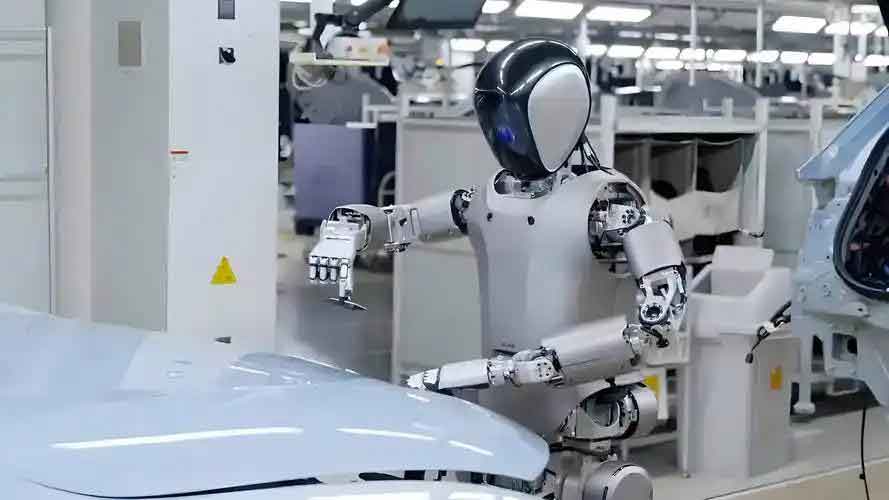
As humanoid robots advance, their role expands beyond laboratories into real-world applications such as manufacturing, healthcare, and domestic assistance. In factories, humanoid robots can take on repetitive or hazardous tasks, acting as artificial employees that work alongside humans. This requires not only physical dexterity but also cognitive abilities. For instance, in a parallel intelligent system, humanoid robots can use predictive models to anticipate machine failures or optimize production lines. The economic implications are significant; by reducing downtime and improving efficiency, humanoid robots can lower operational costs. However, this transition also exposes供应链 bottlenecks, as seen in the Games where performance issues often traced back to imported components like high-precision gears. This underscores the need for localized production and innovation in critical parts for humanoid robots.
Another critical area is the social acceptance of humanoid robots. The Games helped demystify these machines, showing them as tools for augmentation rather than replacement. This shift in perception—from “machines replacing humans” to “machines assisting humans”—is vital for widespread adoption. In my view, humanoid robots should be designed to enhance human capabilities, not supplant them. For example, in healthcare, humanoid robots can support nurses by handling routine patient monitoring, allowing medical staff to focus on complex care. The parallel intelligence framework facilitates this by ensuring that humanoid robots learn from human feedback, creating a collaborative ecosystem. The following equation captures this symbiotic relationship:
$$ \text{Human-Robot Collaboration} = \alpha \cdot \text{Human Input} + \beta \cdot \text{Robot Autonomy} $$
where \( \alpha \) and \( \beta \) are weighting factors that balance human guidance and robot independence. Through computational experiments, we can tune these parameters to maximize efficiency and safety in various contexts, such as hospitals or homes.
Looking ahead, the development of humanoid robots must address ethical and governance concerns. As these systems become more autonomous, questions arise about accountability and control. Parallel intelligence offers a solution by embedding governance mechanisms into the ACP loop. For instance, in artificial societies, we can simulate scenarios where humanoid robots face ethical dilemmas, and use those outcomes to inform real-world policies. This proactive approach ensures that humanoid robots align with human values and societal norms. Moreover, open platforms for data and model sharing can accelerate innovation while maintaining transparency. The table below outlines key considerations for the responsible deployment of humanoid robots as artificial employees.
| Consideration | Current Status | Future Goals | Recommended Actions |
|---|---|---|---|
| Safety | Basic protocols in controlled environments | Robust safety measures in unstructured settings | Implement real-time monitoring and fail-safes |
| Transparency | Limited explainability of AI decisions | Full auditability of robot actions | Develop interpretable AI models for humanoid robots |
| Accessibility | High cost limits widespread use | Affordable solutions for diverse users | Promote open-source hardware and software |
| Regulation | Emerging guidelines in some regions | Global standards for interoperability | Foster international collaboration on ethics |
In conclusion, the journey from humanoid robots to artificial employees is not merely a technological shift but a paradigm change driven by parallel intelligence. By leveraging the ACP framework, we can create humanoid robots that are not only capable in controlled settings but also adaptable and reliable in the real world. The Humanoid Robot Games exemplified this by serving as a large-scale parallel experiment, where successes and failures informed continuous improvement. As we move forward, it is crucial to focus on applications that benefit humanity, such as reducing poverty and improving healthcare, rather than pursuing technology for its own sake. Humanoid robots, when guided by principles of sustainability and inclusivity, have the potential to become invaluable partners in building a smarter, more equitable society. Through ongoing research and collaboration, I am confident that we will see humanoid robots evolve into trusted artificial employees, enhancing our lives in ways we are only beginning to imagine.
The integration of humanoid robots into daily operations requires a deep understanding of their learning processes. In parallel intelligence, the concept of prescriptive learning is key—it involves using data from real-world interactions to prescribe actions for future scenarios. For humanoid robots, this can be modeled as an optimization problem. Let \( S \) represent the state space of a humanoid robot, including its position, velocity, and sensor readings. The goal is to find a policy \( \pi \) that maps states to actions, maximizing a reward function \( R \). This can be expressed as:
$$ \pi^* = \arg\max_{\pi} \mathbb{E} \left[ \sum_{t=0}^{\infty} \gamma^t R(s_t, a_t) \right] $$
where \( \gamma \) is a discount factor, and \( a_t \) is the action taken at time \( t \). In computational experiments, we can use reinforcement learning to train humanoid robots in artificial societies, exploring various policies without physical risks. Once a policy is refined, it is deployed in parallel execution, where the humanoid robot applies it in the real world while continuously updating based on new data. This cycle enables humanoid robots to handle unexpected situations, such as navigating crowded spaces or adapting to tool variations in a workshop.
Furthermore, the scalability of humanoid robots depends on their ability to collaborate in multi-robot systems. In settings like warehouses or disaster response, teams of humanoid robots must coordinate their actions. This can be formulated using game theory or swarm intelligence models. For example, the coordination of multiple humanoid robots can be described by a set of differential equations:
$$ \frac{dx_i}{dt} = f_i(x_1, x_2, \dots, x_n, u_i) $$
where \( x_i \) is the state of the i-th humanoid robot, and \( u_i \) is its control input. By simulating these interactions in artificial societies, we can identify optimal coordination strategies, such as task allocation or formation control, and then implement them through parallel execution. This approach not only improves the efficiency of humanoid robots but also enhances their robustness in group tasks.
Ultimately, the success of humanoid robots as artificial employees hinges on addressing both technical and societal challenges. By embracing parallel intelligence, we can create a future where humanoid robots are integral to our economy and daily lives, working alongside humans to solve complex problems. As I continue to explore this field, I am inspired by the potential of humanoid robots to transform industries and improve human well-being, provided we guide their development with wisdom and foresight.