
In my exploration of modern mechanical transmission systems, I have found that the harmonic drive gear stands out as a revolutionary innovation since its invention in the mid-20th century by C. Musser. With the advancement of space technology, gear transmission techniques have seen significant breakthroughs, and the harmonic drive gear represents a paradigm shift from rigid-body mechanics to flexible component-based systems. This gear system relies on elastic deformation of flexible elements to achieve motion transmission, diverging from the traditional use of rigid components. This unique approach endows harmonic drive gears with a suite of exceptional functionalities that are difficult to replicate with other transmission methods, making them indispensable across various modern industrial applications. In this article, I will delve into the application domains of harmonic drive gears, examining their strengths, weaknesses, and developmental trends. By observing and learning from advanced international technologies and design philosophies, I aim to explore the design principles, manufacturing methods, and processing techniques for harmonic drive gear devices. Furthermore, I will analyze the factors influencing the motion accuracy of harmonic drive gears, addressing issues that have emerged in traditional design, assembly, debugging, and production line applications.
The harmonic drive gear has become a cornerstone in precision engineering, particularly in robotics. Over 60% of harmonic drive gear applications are embedded within robotic industrial systems, underscoring their critical role. As a core component enabling robotic motion functions, harmonic drive gears are essential for the reliable and precise operation of lightweight industrial robots and manipulators. For instance, humanoid robots like Honda’s ASIMO incorporate at least 24 sets of harmonic drive gear units in their arms and legs, while NASA’s Mars rovers utilize 19 sets each. In China, the standard for harmonic gear reducers in robotics (GB/T30819-2014) was established in 2014, highlighting their importance. Through this analysis, I seek to provide a comprehensive understanding of how harmonic drive gears enhance robotic performance, focusing on design considerations and accuracy challenges.
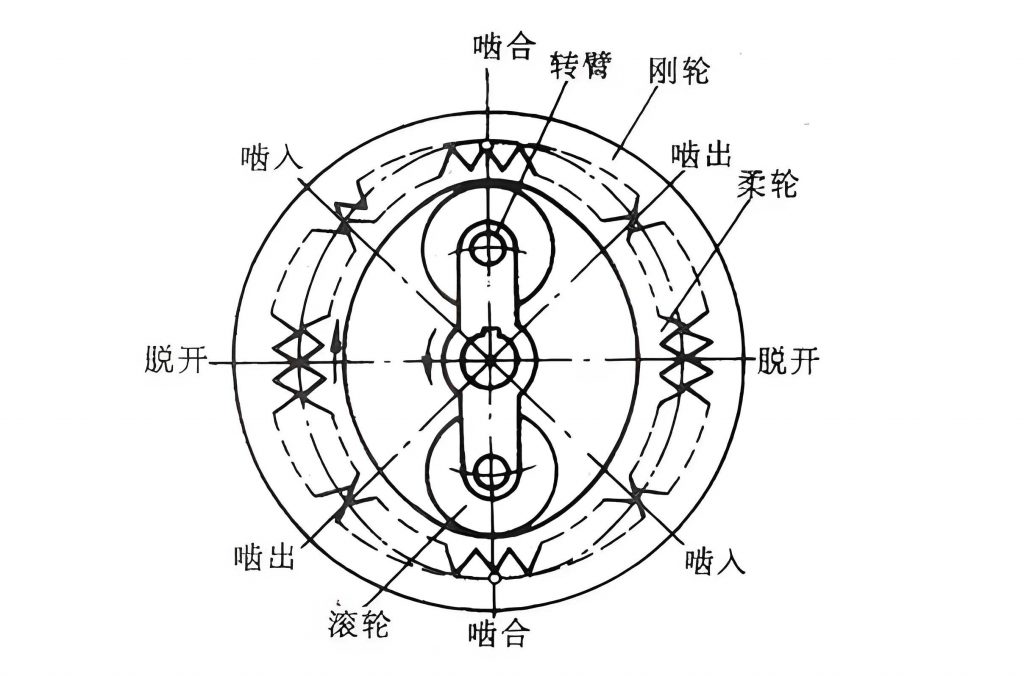
To begin, let me outline the fundamental aspects of harmonic drive gears. A harmonic drive gear system typically comprises three basic components: the wave generator, the flexspline (or flexible gear), and the circular spline (or rigid gear). By fixing any one of these components and designating the other two as input and output, one can achieve fixed-ratio speed reduction or increase. Alternatively, configuring two inputs and one output allows for differential transmission. This versatility stems from the innovative working principle, where the wave generator induces a controlled elastic wave in the flexspline, causing its teeth to engage with those of the circular spline in a cyclic manner. When the wave generator acts as the input, its rotation—often via an elliptical cam—deforms the flexspline and its thin-walled bearing, leading to sequential meshing (engagement), full meshing, unmeshing (disengagement), and complete separation of teeth along the major and minor axes. This “gear meshing cycle” results in a high reduction ratio, converting high-speed input into low-speed output. The harmonic drive gear’s distinct characteristics include compact size, light weight, high load capacity, substantial reduction ratios, efficiency, coaxiality, minimal backlash, and the ability to transmit power through sealed spaces. These attributes make harmonic drive gears particularly suitable for robotic joints, where space constraints and precision are paramount.
In industrial robotics, robots are programmable machines that automate repetitive or hazardous tasks, comprising mechanical, sensory, and control segments. From my perspective, the drive system and mechanical structure are pivotal in leveraging harmonic drive gears. The drive system encompasses power sources, transmission mechanisms, and auxiliary devices, with common types being hydraulic, pneumatic, and mechanical drives. Harmonic drive gears often serve as indirect drive elements within mechanical transmission systems, interfacing with servo motors to provide precise joint motion. The mechanical structure of an industrial robot includes the body, arm, wrist, and end-effector, each with multiple degrees of freedom (DOF). Joints are typically rotational or linear, and harmonic drive gears are extensively used in rotational joints due to their high torque density and accuracy. For example, in a five-DOF manipulator, harmonic drive gears can drive shoulder, elbow, and wrist rotations, enabling complex motions in confined spaces.
To elaborate on the harmonic drive gear’s design, I will present a table summarizing its key components and functions:
| Component | Role | Material Considerations |
|---|---|---|
| Wave Generator | Input element that induces elastic deformation in the flexspline; often an elliptical cam with a bearing. | High-strength steel for durability and minimal wear. |
| Flexspline | Flexible, thin-walled gear that deforms to mesh with the circular spline; transmits output motion. | Alloy steels with high fatigue resistance to withstand cyclic stresses. |
| Circular Spline | Rigid internal gear that engages with the flexspline; usually fixed or used as output. | Hardened steels to maintain tooth integrity under load. |
The working principle can be mathematically modeled. The reduction ratio \( i \) of a harmonic drive gear is given by:
$$ i = \frac{N_f}{N_f – N_c} $$
where \( N_f \) is the number of teeth on the flexspline, and \( N_c \) is the number of teeth on the circular spline. Typically, \( N_f – N_c = 2 \), leading to high reduction ratios (e.g., 50:1 to 320:1). The kinematic relationship between input and output angles can be expressed as:
$$ \theta_o = \frac{\theta_i}{i} $$
with \( \theta_i \) as the wave generator input angle and \( \theta_o \) as the flexspline output angle. This formula underpins the precision of harmonic drive gears, but in practice, errors arise due to manufacturing and assembly tolerances.
Moving to industrial robots, their system composition can be tabulated as follows:
| Subsystem | Description | Integration with Harmonic Drive Gears |
|---|---|---|
| Mechanical Structure System | Includes body, arms, wrist, and end-effector; provides multi-DOF motion. | Harmonic drive gears are used in joint actuators for compact, high-torque rotation. |
| Drive System | Converts power into motion; comprises motors, reducers, and transmission elements. | Harmonic drive gears serve as reducers, interfacing with servo motors for precise control. |
| Control System | Processes sensor data and commands to coordinate movements. | Relies on the low backlash and high stiffness of harmonic drive gears for accurate positioning. |
| Perception System | Sensors (e.g., encoders) monitor position, force, and environment. | Encoders often attached to harmonic drive gear outputs to feedback motion data. |
| Human-robot Interaction System | Interfaces for programming and operation. | Indirectly benefits from the reliability of harmonic drive gears in task execution. |
| Environment Interaction System | Enables adaptation to external conditions. | Harmonic drive gears’ sealing capabilities protect against contaminants in harsh environments. |
In a specific case study of a five-DOF mechanical arm, harmonic drive gears are employed to achieve compact and precise movements. The arm consists of a waist rotation (via DC motor and gear train), shoulder elevation, elbow extension, wrist tilt, and gripper rotation—all driven by harmonic drive gears except the waist. The shoulder and elbow joints, which require high torque and accuracy, utilize harmonic drive gear reducers directly coupled to servo motors. The wrist joint may involve a harmonic drive gear followed by additional gearing for fine manipulation. This design minimizes spatial footprint while maintaining dexterity, exemplifying how harmonic drive gears enable advanced robotic architectures. The torque transmission in such joints can be analyzed using:
$$ T_o = T_i \cdot i \cdot \eta $$
where \( T_o \) is output torque, \( T_i \) is input torque from the motor, \( i \) is the reduction ratio, and \( \eta \) is the efficiency (typically above 80% for harmonic drive gears). This equation highlights the torque amplification crucial for lifting payloads in robotic arms.
However, the performance of harmonic drive gears is contingent on motion accuracy, which I will now dissect. Transmission error is a key metric, defined as the deviation between the theoretical and actual output positions. Sources of error include manufacturing imperfections in the wave generator, flexspline, and circular spline, as well as assembly misalignments. The harmonic drive gear’s multi-tooth engagement (often 10-30% of teeth simultaneously) compensates for some errors, but residual effects persist. Let \( \delta \theta \) represent the transmission error, which can be modeled as a sum of harmonic components:
$$ \delta \theta = \sum_{k=1}^{n} A_k \sin(k \omega t + \phi_k) $$
where \( A_k \) are amplitudes, \( \omega \) is the angular frequency, \( \phi_k \) are phase shifts, and \( k \) denotes harmonic orders. Primary error sources include tooth profile errors, pitch deviations, and eccentricities. For instance, the circular spline pitch error \( \Delta p_c \) contributes to error proportional to the engagement cycle. A table of common error sources and their impacts is provided:
| Error Source | Description | Effect on Transmission Error |
|---|---|---|
| Tooth Profile Error | Deviations from ideal involute shape on flexspline or circular spline teeth. | Causes irregular meshing, increasing high-frequency error components. |
| Pitch Error | Irregular spacing between teeth on the circular spline or flexspline. | Leads to low-frequency errors that may be amplified through engagement. |
| Eccentricity | Misalignment of wave generator, flexspline, or circular spline axes. | Generates periodic errors at the rotation frequency, affecting accuracy. |
| Assembly Tolerances | Inaccuracies in bearing fits or component mounting. | Introduces backlash and stiffness variations, degrading repeatability. |
Error testing for harmonic drive gears often involves dynamic systems to capture both low and high-frequency components. Static tests are insufficient due to the high-frequency nature of errors in harmonic drive gears, where manufacturing flaws cause low-frequency errors to manifest as high-frequency signals in the output. A dynamic test system might use encoders on input and output shafts, with data processed via Fourier analysis to identify error spectra. The error curve often exhibits a “beat frequency” phenomenon, where two slightly different frequencies interfere. This occurs when eccentricities in the circular spline and flexspline produce error frequencies \( f_c \) and \( f_f \) that are close, resulting in a beat frequency \( f_b = |f_c – f_f| \). Mathematically, if the errors are sinusoidal:
$$ E(t) = A_c \sin(2\pi f_c t) + A_f \sin(2\pi f_f t) $$
the superposition yields amplitude modulation observable in the transmission error plot. This beat effect can impact the stability of robotic control systems, necessitating careful manufacturing to minimize eccentricities.
To quantify stiffness error, which affects positioning under load, I consider the torsional stiffness \( K \) of a harmonic drive gear. It can be approximated as:
$$ K = \frac{T_o}{\Delta \theta_e} $$
where \( \Delta \theta_e \) is the elastic twist under torque \( T_o \). Stiffness varies nonlinearly with rotation due to the changing number of engaged teeth, but an average value is often used in robot dynamics models. The overall motion accuracy of a robotic joint using a harmonic drive gear depends on the combined effects of transmission error, backlash, and stiffness. Backlash, though minimal in harmonic drive gears (typically < 1 arcmin), can be modeled as a dead zone in the torque-angle relationship. For control purposes, the total error \( \epsilon \) might be expressed as:
$$ \epsilon = \delta \theta + \frac{T_o}{K} + b(\theta) $$
with \( b(\theta) \) representing backlash hysteresis. Advanced compensation algorithms in robot controllers use such models to enhance precision.
In terms of design principles, optimizing a harmonic drive gear for robotics involves balancing weight, size, torque capacity, and accuracy. Material selection is critical: the flexspline must endure millions of deformation cycles without fatigue failure. Common materials include alloy steels like 40Cr or stainless steels, with heat treatment for enhanced strength. The wave generator bearing should have low friction and high rigidity, often using cross-roller or needle bearings. Manufacturing techniques like hobbling or shaping are used for gear teeth, while the flexspline may be machined from thin-walled cups via turning or grinding. Recent trends involve additive manufacturing for prototyping complex flexspline geometries. Furthermore, lubrication and sealing are vital to maintain performance in robotic environments, with grease or oil lubrication common in sealed harmonic drive gear units.
The application of harmonic drive gears extends beyond industrial robots to aerospace, medical devices, and semiconductor equipment, but robotics remains the dominant field. Their advantages align perfectly with robotic needs: high reduction ratios allow small motors to drive large loads, compactness enables dense joint packaging, and low backlash ensures repeatable movements. However, challenges persist, such as heat generation under continuous operation, which can affect lubrication and material properties. Thermal expansion may alter preload in the wave generator, impacting accuracy. Thus, thermal modeling is essential, with temperature rise \( \Delta T \) estimated from power losses \( P_l \):
$$ \Delta T = \frac{P_l}{h A} $$
where \( h \) is the heat transfer coefficient and \( A \) is the surface area. Designers must incorporate cooling fins or forced air in high-duty cycles.
Looking ahead, the evolution of harmonic drive gears focuses on improving accuracy, reducing weight, and integrating smart features. For instance, embedding sensors within the harmonic drive gear unit can provide real-time monitoring of torque, temperature, and wear, facilitating predictive maintenance. Additionally, advancements in materials like carbon fiber composites for flexsplines could further reduce inertia. The harmonic drive gear’s role in collaborative robots (cobots) is growing, where safety and precision are paramount. In such contexts, torque sensors coupled with harmonic drive gears enable force control for human-robot interaction.
In conclusion, my analysis underscores that harmonic drive gears are pivotal in modern robotics, offering unmatched benefits in precision and compactness. Through detailed examination of their design, application in five-DOF arms, and accuracy factors, I have highlighted how harmonic drive gears address the demands of robotic systems. The harmonic drive gear’s ability to transmit motion via elastic deformation revolutionizes traditional transmission paradigms, making it a key enabler of advanced automation. As robotics continues to evolve, the harmonic drive gear will undoubtedly remain at the forefront, driving innovations in manufacturing, space exploration, and beyond. Future research should focus on error compensation techniques and material science to push the boundaries of what harmonic drive gears can achieve in ever-more demanding robotic applications.