
In the field of precision motion control and robotics, the strain wave gear, commonly known as a harmonic drive or harmonic gear reducer, represents a revolutionary principle in mechanical power transmission. Unlike conventional gear systems that rely on rigid body kinematics, the strain wave gear operates on the principle of controlled elastic deformation of a flexible component. This unique mechanism offers exceptional advantages, including high reduction ratios in a compact package, near-zero backlash, high torque capacity, and coaxial input/output alignment. This article delves into the analysis of a specific variant—the teeth-form output stiff-gear assembly within a strain wave gear system. Utilizing the advanced simulation capabilities of ABAQUS finite element analysis (FEA) software, I will investigate the stress and displacement fields in this critical component under operational loads, providing a foundation for its structural optimization and reliability assessment.
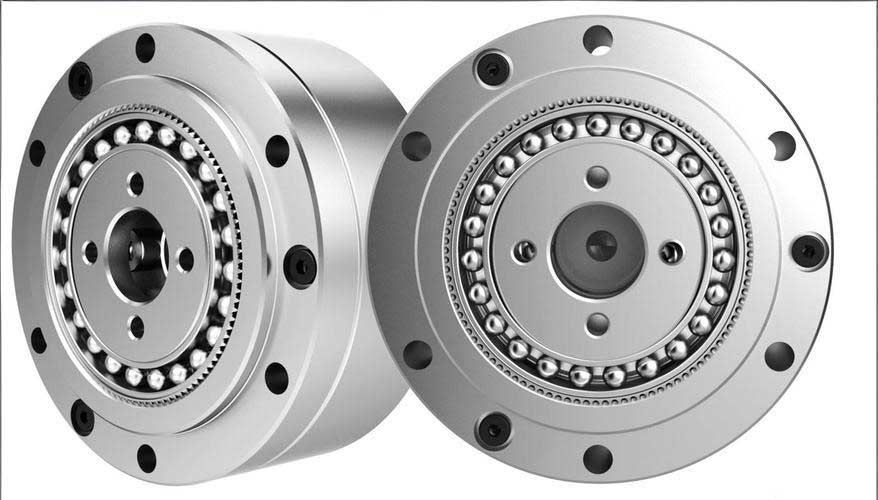
The fundamental components of a strain wave gear reducer are the wave generator (input), the flexible spline (or flexspline), and the circular spline (or stiff-gear). In the traditional cup-type or hat-type flexspline design, a lengthy thin-walled cylinder connects the toothed region to the output hub. This cylinder, while enabling motion transmission, introduces manufacturing challenges and creates areas of significant stress concentration at its transition fillets, potentially compromising the system’s longevity. The teeth-form output stiff-gear configuration presents an innovative architectural solution. This design utilizes a short, cylindrical flexspline and introduces a second, output stiff-gear that meshes with it. The motion is directly transmitted via this gear mesh, effectively eliminating the problematic long flexspline cylinder. The primary kinematic function remains with the fixed stiff-gear (z_c), while the secondary, output stiff-gear (z_f), which has the same number of teeth as the flexspline, serves as the power take-off element. The overall gear ratio for this strain wave gear setup is determined solely by the engagement between the flexspline and the fixed stiff-gear:
$$
i = -\frac{z_f}{z_f – z_c}
$$
Where a negative sign indicates a reversal in the direction of rotation between the wave generator input and the output stiff-gear.
Theoretical Foundation: Loads and Deformation in the Strain Wave Gear
To accurately model the system in ABAQUS, a clear understanding of the theoretical loads acting on the output stiff-gear is essential. The primary load is the output torque, which is a function of the input torque and the gear ratio. However, the gear teeth engagement generates complex contact forces. For a simplified analytical estimate of the tangential force component at the pitch circle of the output stiff-gear due to the transmitted torque \( T \), we use:
$$
F_t = \frac{2T}{d_p}
$$
where \( d_p \) is the pitch diameter of the output stiff-gear. This tangential force is crucial for defining boundary conditions in the FEA model. Furthermore, the radial force component arising from the pressure angle \( \alpha \) of the gear teeth must be considered:
$$
F_r = F_t \cdot \tan(\alpha)
$$
The combined loading on the stiff-gear shaft includes this torque and any external cantilever loads, such as those from connected couplings or pulleys. The stress state in the component is a superposition of torsional shear stress, bending stress, and contact stresses at the bearing seats and gear teeth roots. The maximum shear stress due to pure torsion in a cylindrical shaft is given by:
$$
\tau_{max} = \frac{T \cdot r}{J}
$$
where \( r \) is the radius and \( J \) is the polar moment of inertia. Bending stress from an external force \( F_{ext} \) at a distance \( L \) is:
$$
\sigma_b = \frac{M \cdot y}{I} = \frac{(F_{ext} \cdot L) \cdot y}{I}
$$
Finite Element Modeling Strategy in ABAQUS
The credibility of finite element analysis hinges on the fidelity of the model to the physical system’s mechanical behavior, while balancing computational efficiency. For the output stiff-gear of this strain wave gear reducer, a detailed model of all 202 teeth would be computationally prohibitive without yielding proportionally greater insight for a stress analysis focused on the shaft and bearing regions. Therefore, a simplification strategy is employed.
Geometry Simplification and Assembly
The toothed section of the stiff-gear is modeled as a solid cylinder with an equivalent outer diameter, effectively smearing the stiffness contribution of the teeth. The precise geometry of the shaft, with its steps for bearing seating and the output extension, is retained. Two analytical rigid surfaces are created to represent the inner races of the supporting bearings. These are assembled with the deformable stiff-gear model. A “Tie” constraint is defined in the Interaction module, binding the cylindrical surfaces of the shaft (slave surface) to the corresponding analytical rigid surfaces (master surface). This perfectly couples the degrees of freedom at the bearing locations, simulating a press-fit or tightly mounted bearing.
Material Properties and Mesh Generation
The stiff-gear is typically manufactured from high-strength alloy steel. For this analysis, a linear elastic material model is initially assumed, sufficient for stress analysis under operational loads well below yield. The key properties are defined in ABAQUS’s Property module.
| Property | Symbol | Value | Unit |
|---|---|---|---|
| Young’s Modulus | E | 210,000 | MPa |
| Poisson’s Ratio | ν | 0.3 | – |
| Density | ρ | 7.85e-9 | Tonne/mm³ |
| Yield Strength | σ_y | ≥ 600 | MPa (Assumed) |
Mesh quality is paramount for solution accuracy and convergence. The complex geometry is partitioned into simpler, mappable volumes to facilitate a structured hexahedral mesh. Global and local seed densities are carefully controlled to refine the mesh in regions of anticipated stress concentration, such as shaft fillets and steps. The primary element type selected is C3D8R—an 8-node linear brick element with reduced integration and hourglass control. This element provides a good balance of accuracy and computational speed for this type of stress analysis. The final meshed model contains a high-quality, predominantly hexahedral element set.
Loads and Boundary Conditions
Defining realistic loads and constraints is the most critical step in replicating the operational environment of the strain wave gear output assembly. The following loads are applied in the Load module:
- Torque Application: Since solid elements lack rotational degrees of freedom, torque cannot be applied directly to a node. A kinematic coupling constraint is created on the end-face of the output shaft, linking all nodes on that surface to a reference point (RP-Torque). The output torque \( T \) is then applied as a concentrated moment to RP-Torque.
- External Cantilever Force: A concentrated force \( F_{ext} \) is applied at a specified distance from the shaft end (e.g., 5 mm) to simulate load from a connected component.
- Gear Mesh Force: The radial force \( F_r \) calculated from the transmitted torque and pressure angle is applied as a distributed pressure or a concentrated force at the effective pitch radius location on the simplified gear body.
The boundary conditions, applied to the reference points of the analytical rigid bodies representing the bearings, constrain the shaft’s movement:
- Bearing 1 (near gear): Fully constrained in translations (U1=U2=U3=0) and rotations about axes perpendicular to the shaft axis (UR1=UR3=0). This allows rotation only about the shaft axis (UR2 free).
- Bearing 2 (away from gear): Constrained in radial translations (U1=U3=0) and rotations about axes perpendicular to the shaft axis (UR1=UR3=0). Axial translation (U2) and rotation about the shaft axis (UR2) are free.
| Item | Location/Method | Value / Type | Purpose |
|---|---|---|---|
| Output Torque (T) | Coupling Constraint on shaft end face | e.g., 50 Nm | Simulate transmitted load |
| External Force (F_ext) | Concentrated force at shaft end | e.g., 50 N | Simulate cantilever load |
| Radial Gear Force (F_r) | Pressure/Force on gear body | Calculated from \( F_t \) and \( \alpha \) | Simulate mesh reaction |
| Bearing 1 Constraint | RP of Analytical Rigid 1 | U1,U2,U3,UR1,UR3 = 0 | Fix radial/axial position, allow shaft rotation |
| Bearing 2 Constraint | RP of Analytical Rigid 2 | U1,U3,UR1,UR3 = 0 | Fix radial position, allow axial float and rotation |
ABAQUS Simulation Results and Discussion
The model is submitted for analysis using the ABAQUS/Standard implicit solver. The primary outputs of interest are the von Mises stress distribution (for yield criterion assessment) and the displacement field.
Stress Distribution Analysis
The von Mises stress contour plot reveals critical areas. The maximum stress, approximately 194 MPa in this simulation, is consistently located at the shoulder fillet where the smaller-diameter shaft section meets the larger bearing seat, specifically at the bearing closer to the output end. This is a classic location for stress concentration due to the abrupt change in cross-section under combined torsional and bending loads. The stress magnitude can be compared to the material’s yield strength using a safety factor \( N \):
$$
N = \frac{\sigma_y}{\sigma_{max}}
$$
Significantly elevated stress is also observed at both ends of the bearing contact zones. This is attributed to the edge effect of the distributed contact pressure from the bearing inner race. The stress in the main body of the gear and the central shaft regions is relatively low and uniform, confirming that the shaft’s stepped geometry and bearing interactions are the primary design drivers for stress, not the bulk transmission of torque through the shaft’s cross-section. This pattern aligns perfectly with the theoretical expectation for a shaft under similar loading.
Displacement and Deformation Analysis
The total displacement (U) contour shows the maximum deformation occurs at the very end of the output shaft, with a magnitude on the order of tenths of a millimeter. To decompose this deformation, it is insightful to examine the displacement component in the direction of the applied external force (e.g., U1). The maximum value in this directional plot is nearly identical to the maximum total displacement. This key observation indicates that the overall deformation of the strain wave gear output shaft is dominated by bending induced by the external cantilever force, not by torsional twist or gear mesh forces.
Plotting the total displacement along the axis of the shaft, from the output end towards the gear, produces a decaying curve. The displacement is highest at the free end and decreases monotonically towards the constraints provided by the bearings, following the expected shape for a cantilever beam with an intermediate support. The slope of this curve is related to the bending strain in the shaft.
| Result Metric | Location | Magnitude | Primary Cause | Implication |
|---|---|---|---|---|
| Max. von Mises Stress | Fillet at output-side bearing seat | ~194 MPa | Stress concentration under combined torsion & bending | Critical region for fatigue; requires generous fillet radius. |
| High Stress Zones | Edges of both bearing contact areas | Elevated | Edge pressure from bearing inner race | Ensure proper bearing seat geometry and surface finish. |
| Max. Total Displacement | Tip of output shaft | e.g., 0.15 mm | Bending from external cantilever force (F_ext) | Dictates shaft stiffness requirements for positional accuracy. |
| Displacement Profile | Along shaft axis | Exponentially decaying | Cantilever beam deflection | Bearing spacing is key to controlling deflection. |
Parametric Studies and Design Optimization Pathways
The established FEA model serves as a powerful tool for parametric exploration. Key geometric parameters can be varied to quantify their effect on performance metrics. For instance:
- Fillet Radius (r_f): Increasing the fillet radius at the shaft step is the most direct way to reduce the peak stress. The relationship between stress concentration factor \( K_t \) and fillet radius for a stepped shaft under bending and torsion is well-documented. The FEA can precisely quantify the benefit for this specific geometry.
- Shaft Diameter (d): The bending stiffness \( EI \) and torsional stiffness \( GJ \) are strong functions of diameter. The effect of increasing the smaller shaft diameter on both maximum displacement \( \delta_{max} \) and stress \( \sigma_{max} \) can be studied. Bending deflection and stress are inversely proportional to the area moment of inertia \( I \):
$$
\delta \propto \frac{1}{E I} \quad \text{and} \quad \sigma_b \propto \frac{1}{I} \quad \text{where} \quad I = \frac{\pi d^4}{64}
$$
- Bearing Spacing (L_b): The distance between the two supporting bearings significantly influences the shaft’s deflection. A wider spacing increases the overhang, amplifying bending deflection from the external force. This can be modeled to find an optimal balance between compactness and stiffness for the strain wave gear assembly.
These studies can be systematized using ABAQUS parametric scripting, generating response surfaces or Pareto frontiers to guide the designer towards an optimal configuration that minimizes stress and displacement while respecting package and weight constraints.
Conclusion
This detailed finite element analysis of the teeth-form output stiff-gear within a strain wave gear reducer, conducted using ABAQUS, provides profound insights into its structural behavior. The methodology demonstrates the effective application of simplifying assumptions, advanced meshing techniques, and realistic load coupling to create a computationally efficient yet accurate model. The results conclusively identify the shaft fillet at the bearing seat as the critical stress concentration zone, primarily driven by combined torsional and bending loads, and confirm that shaft deflection is dominated by external cantilever forces. The entire process, from model creation and meshing to load application and result interpretation, validates ABAQUS as an exceptionally reliable and powerful tool for the analysis and iterative design improvement of complex mechanical components like those found in advanced strain wave gear systems. The findings and the established FEA workflow offer a solid theoretical and practical foundation for optimizing the durability, stiffness, and overall performance of harmonic drive reducers in demanding applications such as robotics, aerospace, and precision machinery.