
In my extensive work on precision motion systems, the harmonic drive gear has consistently presented itself as a uniquely compelling and challenging transmission component. Its advantages—exceptionally high reduction ratios, compact form factor, remarkable positional accuracy, and near-zero backlash—make it indispensable in fields like aerospace, robotics, and precision instrumentation. Yet, its widespread adoption is perpetually shadowed by a critical limitation: the relatively short operational lifespan, often cited around 5,000 hours, primarily due to fatigue failure of its thin-walled flexspline. This persistent issue has driven my research to fundamentally reconsider the design paradigm for these components. While existing methodologies for calculating the meshing parameters of a harmonic drive gear, such as the modified kinematic method, envelope theory, or backlash control techniques, excel at achieving theoretical conjugacy or minimizing clearance, they often treat the problem as purely geometric. They largely sideline the profound mechanical consequences of these geometric choices on the highly stressed flexspline. My objective is to bridge this gap. I propose and detail a comprehensive optimization method for the meshing parameters of a harmonic drive gear that explicitly incorporates its intrinsic mechanical characteristics from the outset. This approach aims not just for good kinematic performance, but for a design that inherently improves the stress state of the most vulnerable component, thereby addressing the root cause of its premature failure.
Theoretical Foundation and Geometric Modeling
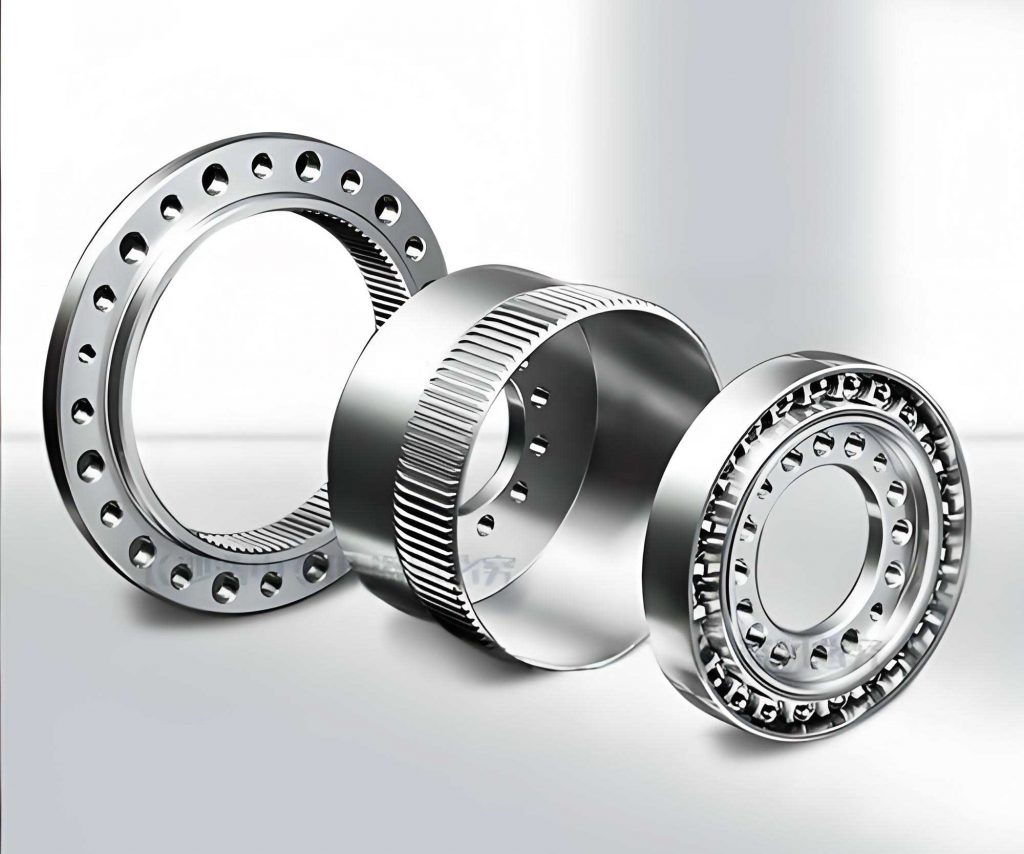
The analysis begins with establishing the geometric relationships between the three core components of the harmonic drive gear: the wave generator (WG), the flexspline (FS), and the circular spline (CS). To render this spatially complex problem tractable, several standard yet critical assumptions are adopted: 1) The length of the neutral curve of the flexspline’s thin-walled cylinder remains constant during deformation (inextensibility). 2) The tooth profile itself is assumed rigid, with all compliance arising from the flexspline body. 3) The flexible bearing is treated as a rigid body, meaning the neutral curve is modeled as an equidistant curve offset from the wave generator cam profile. 4) The three-dimensional gearing problem is simplified to a planar analysis, which is standard practice for initial parameter design.
The coordinate systems for this planar model are defined as follows. A fixed global coordinate system {OXY} is established. The wave generator, typically an elliptical cam, is defined in a polar coordinate system attached to it. Its profile, denoted as \(W\), is given by:
$$
\rho_e(\theta) = \frac{a b}{\sqrt{a^2 \sin^2\theta + b^2 \cos^2\theta}}
$$
Here, \(a\) and \(b\) are the major and minor semi-axes of the elliptical cam, \(\theta\) is the positional angle of a flexspline tooth relative to the cam’s major axis, and \(\rho_e(\theta)\) is the radial distance to the cam surface.
The major semi-axis \(a\) is directly related to the key mechanical parameter, the radial deformation amount \(\delta_{\omega 0}\) imposed by the wave generator:
$$
a = \frac{D_b}{2} – S_b + \delta_{\omega 0}
$$
where \(D_b\) is the nominal inner diameter of the undeformed flexspline (equal to the flexible bearing’s outer diameter) and \(S_b\) is the bearing thickness. The minor semi-axis \(b\) is calculated to satisfy the condition of constant neutral curve length. For an elliptical cam, it can be approximated from the geometry. The ratio \(N = a/b\) defines the ellipticity. The neutral layer radius of the flexspline cylinder is \(r = (D_b + \delta)/2\), with \(\delta\) being the wall thickness under the tooth root.
The neutral curve of the flexspline, curve \(N\), is offset from the cam profile by a distance \(H = S_b + \delta/2\). Its radial coordinate \(\rho\) and the corresponding angle \(\theta_d\) between its normal and radial vector are derived from cam geometry. The arc length \(S_e\) of the cam profile from 0 to \(\theta\) is calculated precisely using numerical integration (e.g., Simpson’s rule).
The kinematic relationship dictates that as the wave generator rotates, points on the flexspline neutral curve shift. This relative motion defines the kinematic angle \(\phi\) of the circular spline coordinate system {o2x2y2} relative to the global frame:
$$
\phi = \frac{z_1 (S_e + H(\theta + \theta_e))}{z_2 r}
$$
where \(z_1\) and \(z_2\) are the number of teeth on the flexspline and circular spline, respectively, and \(\theta_e\) is an angular offset related to the cam normal. Consequently, the angle \(\psi\) between the symmetry line of a flexspline tooth and its corresponding circular spline tooth is:
$$
\psi = \theta + \theta_e – \phi
$$
With these relationships, we can express the coordinates of a point on the flexspline’s involute tooth profile (with base radius \(r_{b1}\), pressure angle \(\alpha\), and profile shift coefficient \(e_1\)) within the circular spline coordinate system. Let \(u\) be the involute roll angle parameter for the flexspline profile:
$$
\begin{aligned}
x_{2\_1} &= r_{b1}(-\sin(u – \theta_{h1} – \psi) + u \cos(u – \theta_{h1} – \psi)) – r \sin \psi + \rho \sin(\psi – \theta_d) \\
y_{2\_1} &= r_{b1}(\cos(u – \theta_{h1} – \psi) + u \sin(u – \theta_{h1} – \psi)) – r \cos \psi + \rho \cos(\psi – \theta_d)
\end{aligned}
$$
where \(\theta_{h1}\) is the half-thickenss angle of the flexspline tooth. Similarly, a point on the circular spline’s involute profile (with base radius \(r_{b2}\), and profile shift coefficient \(e_2\)) is defined in its own system by parameter \(v\):
$$
\begin{aligned}
x_{2\_2} &= r_{b2}(-\sin(v – \theta_{h2}) + v \cos(v – \theta_{h2})) \\
y_{2\_2} &= r_{b2}(\cos(v – \theta_{h2}) + v \sin(v – \theta_{h2}))
\end{aligned}
$$
Meshing analysis involves finding, for a given \(\theta\), the minimal normal distance (backlash, \(c\)) between these two profiles. This is typically done by finding the intersection of the line normal to the flexspline tooth at its addendum with the circular spline tooth profile, a process requiring iterative solution.
Formulation of the Multi-Objective Optimization Problem
Traditional design of a harmonic drive gear focuses on a single kinematic goal, such as minimizing backlash at specific points or maximizing the zone of theoretical contact. My method redefines the objectives by integrating the system’s mechanical reality directly into the optimization target function.
Optimization Objectives
1. Meshing Interval (\(\Phi_a\)): Instead of chasing zero backlash at discrete points—a goal vulnerable to manufacturing tolerances—I define a meshing interval. This is the angular range over which the calculated normal backlash \(c\) remains below a specified acceptable threshold \(J_m\) (e.g., 6 µm). A larger \(\Phi_a\) implies more tooth pairs are participating in load sharing under working conditions, which enhances torque capacity and smoothness of operation. The computation involves sweeping \(\theta\) from the major axis towards the minor axis, accumulating the angular step where \(c \leq J_m\), typically starting from the point of minimum backlash.
2. Radial Deformation Amount (\(\delta_{\omega 0}\)): This parameter is the cornerstone of the mechanical characteristic consideration. The flexspline’s dominant stress component is the circumferential bending stress induced by the forced elliptical deformation. According to thin-shell theory, this stress can be expressed as:
$$
\sigma_{\phi k} = K_\sigma K_M K_d C_\sigma \delta_{\omega 0} \frac{E \delta_{f0}}{r^2}
$$
where \(C_\sigma\) is a positive stress coefficient, \(K_\sigma\), \(K_M\), \(K_d\) are coefficients for stress concentration, distortion, and dynamic load respectively, \(E\) is the elastic modulus, and \(\delta_{f0}\) is the cup wall thickness. Crucially, the stress \(\sigma_{\phi k}\) is linearly proportional to \(\delta_{\omega 0}\). Therefore, reducing the radial deformation amount directly and significantly reduces the primary stress driving fatigue failure in the harmonic drive gear. It is vital to note that \(\delta_{\omega 0}\) is not an independent variable but is determined by the cam geometry and the initial clearance between the components; it is a function of the design parameters.
The composite multi-objective function \(F(\mathbf{X})\) is thus formulated as a weighted sum:
$$
F(\mathbf{X}) = \alpha \Phi_a(\mathbf{X}) – \beta \delta_{\omega 0}(\mathbf{X})
$$
The sign for \(\delta_{\omega 0}\) is negative because we wish to maximize \(F\) while minimizing the deformation. The weighting coefficients \(\alpha\) and \(\beta\) balance the importance of kinematic performance against mechanical improvement. Determining their optimal ratio is a key step in the design process.
Design Variables
The design variable vector \(\mathbf{X}\) contains six key parameters that govern the geometry of the meshing partners and the wave generator:
$$
\mathbf{X} = [x_1, x_2, x_3, x_4, x_5, x_6] = [e_1, e_2, h_1, h_2, \delta^*_{\omega}, c^*]
$$
Where:
- \(e_1, e_2\): Profile shift coefficients for the flexspline and circular spline.
- \(h_1, h_2\): Addendum coefficients for the flexspline and circular spline (typically \(h_1 = h_2\)).
- \(\delta^*_{\omega}\): Radial deformation coefficient, relating deformation to module (\(\delta_{\omega 0} = m \cdot \delta^*_{\omega}\)).
- \(c^*\): Bottom clearance coefficient.
These parameters directly influence tooth thickness, depth, the positioning of the active profiles, and the severity of the flexspline’s deformation.
Constraint Conditions
To ensure a physically feasible and functional harmonic drive gear design, the following constraints \(g_k(\mathbf{X}) \geq 0\) are imposed:
| Constraint | Mathematical Expression | Purpose |
|---|---|---|
| Tooth Tip Thickness | \(g_1(\mathbf{X}) = s_1 – 0.25m \geq 0\) \(g_2(\mathbf{X}) = s_2 – 0.25m \geq 0\) |
Prevents weak, pointed tooth tips. |
| No Tooth Interference | \(g_3(\mathbf{X}) = c(\theta) – J_0 \geq 0\) for all \(\theta\) in mesh | Ensures positive backlash \(c\) exceeds a safe minimum \(J_0\) (e.g., 2 µm) to prevent jamming. |
| Sufficient Working Depth | \(g_4(\mathbf{X}) = h_0 – m \geq 0\) where \(h_0 = h_1 – c^*\) | Guarantees adequate contact depth for load carrying. |
| Clean Disengagement | \(g_5(\mathbf{X}) = c’ – J_c \geq 0\) | Ensures sufficient backlash \(c’\) at the exit point to avoid tip interference during unloading, with \(J_c > J_0\). |
Solution Strategy: Genetic Algorithm with Penalty Function
The formulated optimization problem is nonlinear, constrained, and likely multimodal (possessing multiple local optima). A robust global search method is therefore essential. I employ a Genetic Algorithm (GA), inspired by biological evolution, which is particularly effective for such complex engineering problems. Its population-based approach and stochastic operators (selection, crossover, mutation) allow it to explore the design space widely without being trapped by local minima.
To handle the constraints within the GA’s framework, a penalty function method is used. An auxiliary function \(G(\mathbf{X})\) is constructed:
$$
G(\mathbf{X}) =
\begin{cases}
F(\mathbf{X}), & \text{if } \mathbf{X} \in D_G \\
-\infty, & \text{if } \mathbf{X} \notin D_G
\end{cases}
$$
where \(D_G\) is the feasible domain satisfying all constraints \(g_k(\mathbf{X}) \geq 0\). This maps the constrained problem into an unconstrained one for the GA. An infeasible design (\(\mathbf{X} \notin D_G\)) is assigned a fitness of negative infinity, ensuring it is eliminated by the selection process. The algorithm proceeds as follows:
- Initialization: A population of candidate designs (individuals defined by \(\mathbf{X}\)) is randomly generated within specified bounds.
- Fitness Evaluation: For each individual, a nested computational loop is executed:
- Inner Loop: For a sequence of \(\theta\) values, compute the cam profile, neutral curve, kinematic angles, and finally the backlash \(c(\theta)\) and relevant geometric checks (tooth thickness, etc.).
- Determine the meshing interval \(\Phi_a\) and the radial deformation \(\delta_{\omega 0}\).
- Check all constraints \(g_k\). If violated, assign \(G(\mathbf{X}) = -\infty\). Otherwise, calculate \(F(\mathbf{X})\).
- Genetic Operations: Individuals are selected for “reproduction” based on their fitness \(G(\mathbf{X})\). Crossover combines parameters from two parents to create offspring, and mutation randomly alters parameters to introduce new traits.
- Iteration: Steps 2 and 3 repeat over many generations. The population evolves toward regions of higher fitness—i.e., designs with larger meshing intervals and smaller radial deformations that satisfy all constraints.
- Termination: The process stops when a maximum generation count is reached or the population’s fitness stabilizes.
Computational and FEM Framework for Validation
The optimization outputs a set of meshing parameters. To rigorously validate their performance, I implement a detailed Finite Element Method (FEM) modeling and analysis workflow. This moves beyond the simplified planar analytical model to capture 3D contact, stress concentrations, and system-level stiffness.
The finite element model is a significant undertaking, constructed to include all critical interactions:
- Wave Generator – Flexspline Contact: The elliptical cam surface is defined as a rigid analytical surface. Contact is established with the inner surface of the flexspline cup, simulating the force-fit assembly and load transfer.
- Flexspline – Circular Spline Tooth Contact: This is the core of the meshing simulation. Multiple tooth pairs are modeled with surface-to-surface contact definitions. The initial positions are based on the optimized geometry from the analytical model, ensuring the correct initial backlash distribution.
- Boundary Conditions and Loading: The circular spline is fixed. A prescribed rotational displacement is applied to the wave generator to simulate input motion. A static torque load is applied to the flexspline’s cup bottom (or flange) to represent the output load. Friction is defined at contact interfaces.
This comprehensive FEM model allows for the extraction of key performance metrics that validate the optimization goals and reveal secondary effects.
Case Study: Optimization of an XB60 Harmonic Drive Gear
To demonstrate the efficacy of my method, I applied it to a commercial harmonic drive gear model, the XB60-75-40, with the following baseline specifications:
| Parameter | Symbol | Value |
|---|---|---|
| Flexspline Teeth | \(z_1\) | 150 |
| Circular Spline Teeth | \(z_2\) | 152 |
| Module | \(m\) | 0.4 mm |
| Pressure Angle | \(\alpha\) | 20° |
| Flexspline Inner Diameter | \(D_b\) | 60 mm |
| Cup Wall Thickness | \(\delta\) | 0.3 mm |
| Bearing Thickness | \(S_b\) | 1.5 mm |
The initial (pre-optimization) meshing parameters were derived using a conventional backlash control method. The optimization was run with backlash thresholds \(J_0=2\mu m\), \(J_m=6\mu m\), \(J_c=4\mu m\). The GA parameters were: population size 400, crossover probability 0.9, mutation probability 0.2. Different weight combinations \((\alpha, \beta)\) were explored to understand the trade-off. Key results are summarized below:
| Case | \(\alpha\) | \(\beta\) | \(\Phi_a\) [deg] | \(\delta_{\omega 0}\) [mm] | FEM Max Stress [MPa] |
|---|---|---|---|---|---|
| I | 1.0 | 2.5 | 12.5 | 0.364 | 339.7 |
| II | 1.0 | 2.0 | 13.5 | 0.368 | 342.9 |
| III (Balanced) | 1.0 | 1.5 | 16.5 | 0.358 | 320.1 |
| IV | 1.0 | 1.0 | 16.25 | 0.356 | 313.5 |
| V | 1.0 | 0.5 | 11.5 | 0.388 | 383.7 |
| Initial Design | – | – | 9.25 | 0.425 | 457.7 |
Case III (\(\alpha=1, \beta=1.5\)) was selected as it offered a substantial increase in meshing interval (78% improvement) paired with a significant reduction in radial deformation (16% reduction). The resulting optimized parameters are:
| Parameter | Initial Design | Optimized Design |
|---|---|---|
| \(e_1\) | 3.225 | 3.785 |
| \(e_2\) | 3.275 | 3.705 |
| \(h_1, h_2\) | 1.800 | 1.725 |
| \(\delta^*_{\omega}\) | 1.0625 | 0.8900 |
| \(c^*\) | 0.2875 | 0.6725 |
Analysis of Optimized Performance
The post-optimization performance was analyzed using the detailed FEM model, comparing the initial and optimized harmonic drive gear designs.
1. Meshing Characteristics: The plot of backlash \(c\) versus position angle \(\theta\) shows a dramatic flattening and widening of the low-backlash zone for the optimized design. The FEM contact pressure plots on the tooth flanks provide direct visual evidence: the number of tooth pairs in simultaneous contact increased markedly. Quantitatively, the ratio of contacting tooth pairs to the total number of teeth increased from approximately 18% in the initial design to 32% in the optimized design—a 14-percentage point (78% relative) increase in load-sharing capacity.
2. Torsional Stiffness: The torsional stiffness was calculated by applying torque to the flexspline output and measuring its angular deflection. The stiffness curve for the optimized design showed a slight decrease of about 6.7% (from ~3.58e4 Nm/rad to ~3.34e4 Nm/rad). This minor reduction is a reasonable trade-off given the substantial gains in other areas and is attributable to the slightly reduced working depth (\(h_0\)).
3. Stress State (The Critical Metric): The von Mises stress distribution in the flexspline cup is the ultimate test. The optimization achieved its primary mechanical goal. The maximum equivalent stress in the flexspline was reduced from **457.7 MPa** in the initial design to **313.5 MPa** in the optimized design. This represents a **31.5% reduction** in peak stress. This dramatic decrease is the direct result of reducing the forced radial deformation \(\delta_{\omega 0}\) and is further aided by the improved load distribution across more teeth. Such a stress reduction has a profound impact on fatigue life, potentially increasing it by orders of magnitude according to classical S-N (Wöhler) curve relationships for high-cycle fatigue.
A consolidated comparison of key performance indicators is presented below:
| Performance Metric | Initial Design | Optimized Design | Change |
|---|---|---|---|
| Meshing Interval (\(\Phi_a\)) | 9.25° | 16.25° | +75.7% |
| Simultaneous Contact Pairs Ratio | 18% | 32% | +14 pp (+77.8%) |
| Working Depth Coefficient (\(h_0\)) | 1.5125 | 1.0525 | -30.4% |
| Torsional Stiffness (\(K_t\)) | 3.58e4 Nm/rad | 3.34e4 Nm/rad | -6.7% |
| Max Flexspline Stress (\(\sigma_{max}\)) | 457.7 MPa | 313.5 MPa | -31.5% |
Discussion and Broader Implications
The results clearly validate the proposed methodology. The holistic optimization of harmonic drive gear meshing parameters, which considers both the kinematic “meshing interval” and the mechanical “radial deformation amount,” successfully breaks the traditional single-objective paradigm. It proves that one does not have to choose between good kinematic performance and good mechanical performance; they can be synergistically improved. The increase in profile shift coefficients (\(e_1, e_2\)) and bottom clearance (\(c^*\)), coupled with a decrease in addendum (\(h\)) and deformation coefficient (\(\delta^*_{\omega}\)), creates a geometry that allows the wave generator to achieve sufficient meshing engagement with less severe deformation of the flexspline body.
This approach has several important implications for the design and application of harmonic drive gears:
- Design for Reliability: By proactively minimizing the primary driver of flexspline stress during the parameter design phase, the method directly targets and mitigates the main failure mode. This leads to inherently more reliable and longer-lasting transmissions.
- System-Level Benefits: A harmonic drive gear with lower internal stress and better load distribution will exhibit less hysteresis, lower heat generation, and potentially higher overload capacity. This enhances the performance of the entire system it serves.
- Methodological Generality: While demonstrated here with an elliptical cam and involute teeth, the core philosophy is general. It can be adapted to other wave generator profiles (e.g., four-roller) and tooth forms (e.g., double-circular-arc, S-tooth) by modifying the geometric and objective function calculations accordingly.
- Link to Manufacturing: The method provides a set of optimal parameters that can be directly used for tooling design. The relaxed requirement for “perfect” conjugacy at discrete points may also ease manufacturing tolerances, potentially reducing cost.
Future work will focus on expanding this model to include dynamic effects, thermo-mechanical coupling, and a more formal probabilistic treatment of manufacturing tolerances within the optimization loop itself. Furthermore, integrating the FEM analysis directly as a surrogate model within the optimization process (a simulation-based design optimization approach) could refine results even further, though at a much higher computational cost.
Conclusion
In this work, I have presented a comprehensive, multi-objective optimization framework for the meshing parameters of a harmonic drive gear that fundamentally integrates mechanical characteristics into the design process. Moving beyond purely geometric conjugacy or backlash minimization, the method simultaneously maximizes a defined meshing interval and minimizes the wave generator’s radial deformation—a parameter directly proportional to the flexspline’s critical circumferential stress. The optimization problem is solved robustly using a Genetic Algorithm combined with a penalty function method to handle geometric constraints.
The application of this method to a commercial harmonic drive gear model yielded decisive improvements. Compared to a baseline design from conventional methods, the optimized design achieved a 75% larger meshing interval, a 78% increase in the number of simultaneously contacting tooth pairs, and, most importantly, a 31.5% reduction in the maximum equivalent stress within the flexspline. This significant stress reduction, achieved with only a minor 6.7% decrease in torsional stiffness, demonstrates the power of the holistic approach. It confirms that through careful, integrated optimization of meshing parameters, the inherent weakness of the harmonic drive gear—flexspline fatigue—can be substantially mitigated at the design stage, paving the way for more robust, reliable, and high-performance harmonic drive transmissions across advanced engineering applications.