
In the context of rapid advancements in artificial intelligence and robotics, the integration of humanoid robots into various sectors, including education, has garnered significant attention. As a researcher focused on educational innovation, I explore the potential of humanoid robots to revolutionize college physical education teaching modes. Traditional approaches often face challenges such as uneven resource distribution, monotonous teaching methods, and difficulties in personalizing instruction. With societal demands for individual health and physical literacy rising, college physical education must evolve beyond mere skill transmission to foster comprehensive development in motor performance, fitness, and psychological resilience. This study investigates how humanoid robots can drive curriculum reconstruction and practical pathways, leveraging human-machine collaboration to enhance teaching efficacy and student outcomes.
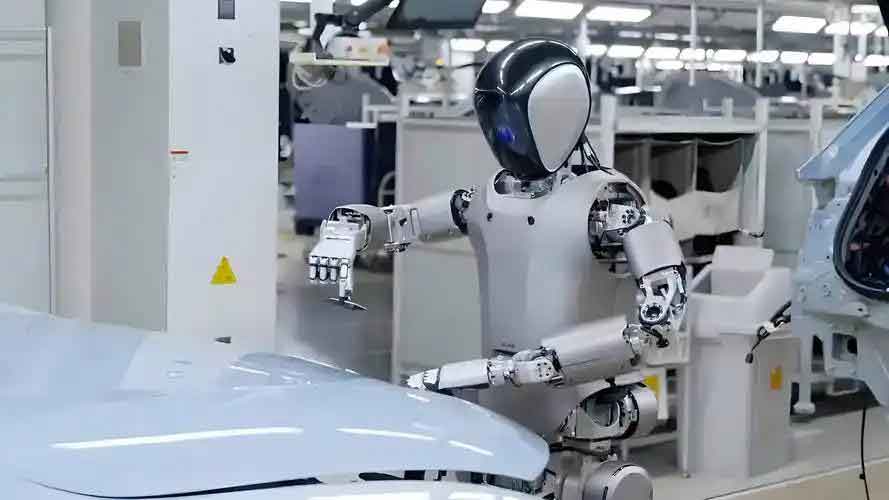
The application of humanoid robots in physical education offers multifaceted advantages. Firstly, these robots utilize computer vision and sensor technologies to capture and replicate sports movements with high precision, providing standardized demonstrations. Through intelligent recognition, a humanoid robot can detect student postures, offer real-time feedback, and correct errors, thereby improving learning efficiency. Secondly, powered by AI algorithms, a humanoid robot can design personalized training plans based on individual student factors like physical condition, motor ability, and learning progress. By collecting and analyzing运动 data via big data, it assists teachers in crafting more targeted instructional strategies. Thirdly, humanoid robots transcend temporal and spatial constraints of traditional teaching. In smart sports labs or virtual reality (VR) environments, students engage in immersive training through human-robot interaction, boosting趣味性 and participation. Fourthly, a humanoid robot serves as an intelligent assistant, handling repetitive tasks and alleviating teacher workload, allowing educators to focus on higher-level instructional design. This shifts the teacher’s role from knowledge transmitter to learning facilitator, promoting professional growth. Lastly, in智慧体育 settings, a humanoid robot enables data-driven decision-making by analyzing long-term trends in student运动 habits and fitness, offering scientific basis for personalized teaching.
To ground this inquiry, I review existing literature globally. Domestically, research highlights scenarios where humanoid robots demonstrate actions, provide feedback, and analyze data in sports like basketball and gymnastics. However, studies often prioritize technical aspects over pedagogical integration, with ethical concerns like data privacy remaining underexplored. Internationally, nations like Japan have pioneered applications, such as using humanoid robots like ASIMO for体操 instruction, while MIT has developed robots for羽毛球 training. Yet, challenges persist, including high costs, teacher upskilling needs, and ethical dilemmas. These insights inform my approach to contextualizing human-machine collaboration within local educational frameworks.
This study employs a quantitative research methodology to ensure scientific rigor. The研究对象 encompasses students and teachers in Chinese college physical education courses, focusing on innovation through humanoid robot integration. Methods include:
- Literature analysis: Synthesizing academic sources on AI, humanoid robots, and teaching models to establish theoretical foundations.
- Questionnaire survey: Distributed to 250 students and 50 teachers, with回收 rates of 96% and 88%, respectively. Questions gauge acceptance, satisfaction, application status, and skill enhancement related to humanoid robot教学.
- Experimental research: A 12-week模拟实验 with experimental and control groups. The experimental group uses human-machine collaboration with a humanoid robot for standardized demonstrations, intelligent feedback, and personalized guidance in sports like basketball and田径; the control group follows traditional teacher-led instruction. Sessions are 90 minutes weekly, assessing outcomes via skill tests and participation.
- Statistical analysis: Data processed with SPSS 27.0, using descriptive statistics, t-tests, ANOVA, and structural equation modeling (SEM) to evaluate effects and pathways.
Results from the survey reveal positive reception of humanoid robot教学. Table 1 summarizes student acceptance and satisfaction:
| Aspect | Percentage (%) | Details |
|---|---|---|
| Increased趣味性 and tech appeal | 78.4 | Believe humanoid robot enhances课堂 engagement |
| Willingness to adopt | 71.6 | Open to humanoid robot assistance in skill training |
| Satisfaction with application | 72.8 | Approve of标准化 demonstrations and feedback |
| Reservations | 12.3 | Due to doubts about robot capability or preference for传统教学 |
Regarding actual application, 61.3% of teachers report using a humanoid robot in courses, primarily for动作示范 and智能训练. Among students, 53.9% have experienced it, with over 80% noting advantages in rhythm control. However, only 36.7% envision complete replacement of traditional methods, highlighting the辅助 role of humanoid robots. Challenges include limited智能化, adaptive content, and单一交互模式.
The experimental analysis shows significant skill improvements with humanoid robot教学. Using t-tests, the experimental group’s average score increased by 14.5%, compared to 8.7% for the control group. This can be expressed as:
$$ \Delta S_E = 14.5\%,\quad \Delta S_C = 8.7\% $$
where $\Delta S_E$ and $\Delta S_C$ denote score changes for experimental and control groups, respectively. ANOVA confirms significant differences ($p < 0.05$) in体能测试如 endurance run and跳远, with the experimental group showing greater gains in柔韧性, strength, and coordination. Table 2 details the comparison:
| Metric | Experimental Group (Humanoid Robot) | Control Group (Traditional) | Significance (p-value) |
|---|---|---|---|
| Average skill score提升 | 14.5% | 8.7% | < 0.01 |
| Endurance run time improvement | 12.3% | 6.8% | < 0.05 |
| Jump distance increase | 9.7% | 5.2% | < 0.05 |
| Coordination enhancement index | 0.85 | 0.62 | < 0.01 |
To delve deeper, structural equation modeling (SEM) analyzes pathways through which humanoid robot教学 impacts learning outcomes. The model incorporates latent variables: humanoid robot application (HRA), learning interest (LI), skill training optimization (STO), and体育学习效果 (PLE). Path coefficients are estimated from survey and experimental data. The key equations are:
$$ LI = \beta_1 \cdot HRA + \epsilon_1 $$
$$ STO = \beta_2 \cdot HRA + \epsilon_2 $$
$$ PLE = \beta_3 \cdot LI + \beta_4 \cdot STO + \epsilon_3 $$
where $\beta$ coefficients represent standardized effects. Results show $\beta_1 = 0.72$ (HRA → LI) and $\beta_3 = 0.81$ (LI → PLE), indicating that humanoid robot application boosts learning interest, which in turn enhances体育学习效果. Similarly, $\beta_2 = 0.68$ (HRA → STO) and $\beta_4 = 0.75$ (STO → PLE), underscoring the role of optimized training. The overall model fit indices (e.g., CFI = 0.94, RMSEA = 0.06) confirm robustness. This quantifies how a humanoid robot drives outcomes through motivational and instructional channels.
Discussion of these findings reveals that humanoid robots effectively address传统教学 pitfalls. The high acceptance rates align with studies emphasizing the novelty and precision of humanoid robot demonstrations. For instance, the 14.5% skill提升 surpasses traditional gains, likely due to实时 feedback from the humanoid robot, which minimizes error persistence. The path coefficients highlight that fostering兴趣 is crucial; a humanoid robot achieves this through interactive features, making exercises like体操 more engaging. However, limitations persist, as noted in teacher反馈 regarding智能化不足. This calls for enhancing the humanoid robot’s contextual awareness and adaptive algorithms to better mimic human instructors. Moreover, the辅助 nature suggests that human-machine collaboration should synergize, not replace, teacher expertise.
From a curriculum reconstruction perspective, integrating humanoid robots necessitates redesigning运动项目模式. For example, in team sports, a humanoid robot can simulate scenarios for协作教学, while in individual disciplines like田径, it offers personalized pacing guides. A framework for such reconstruction can be modeled as:
$$ C_{\text{new}} = C_{\text{传统}} + \alpha \cdot R_{\text{humanoid}} + \beta \cdot T_{\text{teacher}} $$
where $C_{\text{new}}$ is the reconstructed curriculum, $C_{\text{传统}}$ the baseline, $R_{\text{humanoid}}$ the humanoid robot contribution, and $T_{\text{teacher}}$ the teacher’s role, with weights $\alpha$ and $\beta$ optimized via实践路径. Table 3 outlines sample modules:
| Sports Project | Humanoid Robot Role | Teacher Role | Expected Outcome |
|---|---|---|---|
| Gymnastics | Standardized动作示范, real-time form correction | Strategy guidance, motivation | Improved technique accuracy |
| Basketball | Simulated defense/offense patterns, shot analysis | Tactical coaching, team management | Enhanced decision-making skills |
| Track and Field | Personalized sprint pacing, jump technique feedback | Overall performance assessment | Optimized training loads |
| Team协作教学 | Scenario simulation for passing drills | Leadership and coordination facilitation | Better team dynamics |
Practical pathways for implementation involve phased rollouts. Initially, pilot programs in smart labs can test humanoid robot functionalities, followed by scaling with teacher training programs to foster人机协同师资. Long-term跟踪研究 should monitor outcomes like retention rates and injury prevention, using data from the humanoid robot’s sensors. Ethical considerations, such as data privacy when the humanoid robot collects student信息, must be addressed through policies. The humanoid robot’s evolution should focus on improving交互模式, perhaps via natural language processing for more dynamic communication.
In conclusion, this study affirms that humanoid robots hold transformative potential for college physical education through human-machine collaboration. By enhancing学习兴趣, providing精准指导, and enabling data-driven insights, a humanoid robot contributes to significant skill advancements, as evidenced by the 14.5%提升 and path coefficients like 0.72 for兴趣. However, challenges in智能化 and adaptation require ongoing innovation. Future efforts should refine the humanoid robot’s capabilities, design differentiated项目模式, and strengthen teacher-robot synergy. As AI continues to permeate education, embracing humanoid robots in体育教学 can propel a shift toward intelligent, personalized, and effective teaching paradigms, ultimately enriching student experiences and outcomes in physical education.