
GUANGZHOU, Sept. 8 — The humanoid robot has moved beyond the laboratory showcase and into the messy, unpredictable spaces where real work happens. At the 21st China International SME Fair, held in Guangzhou from Sept. 3 to 6, a new generation of embodied intelligence companies presented machines that walk, swing badminton rackets, smile, carry objects and interact with people in ways that only recently seemed confined to research demonstrations.
The fair, themed “Artificial Intelligence Empowers SMEs,” gathered more than 2,000 quality small and medium-sized enterprises from more than 40 countries and regions. Within the embodied intelligence professional exhibition area, covering 15,000 square meters, nearly 100 companies from across the industrial chain and more than 200 typical application scenarios were on display. The exhibition covered core components, complete humanoid robot machines, AI algorithms and industry applications, offering a one-stop view of technological innovation and commercial deployment.
The word “embodied intelligence” may sound academic, but the exhibition floor made it physical and visible. A humanoid robot tracked a shuttlecock, adjusted its stance and returned a smash. Another humanoid robot shifted between bipedal walking and wheeled movement. A third stood with a silicone face capable of subtle expressions. These were not static exhibits behind glass. They were working prototypes and early commercial products designed to enter malls, factories, hospitals and schools.
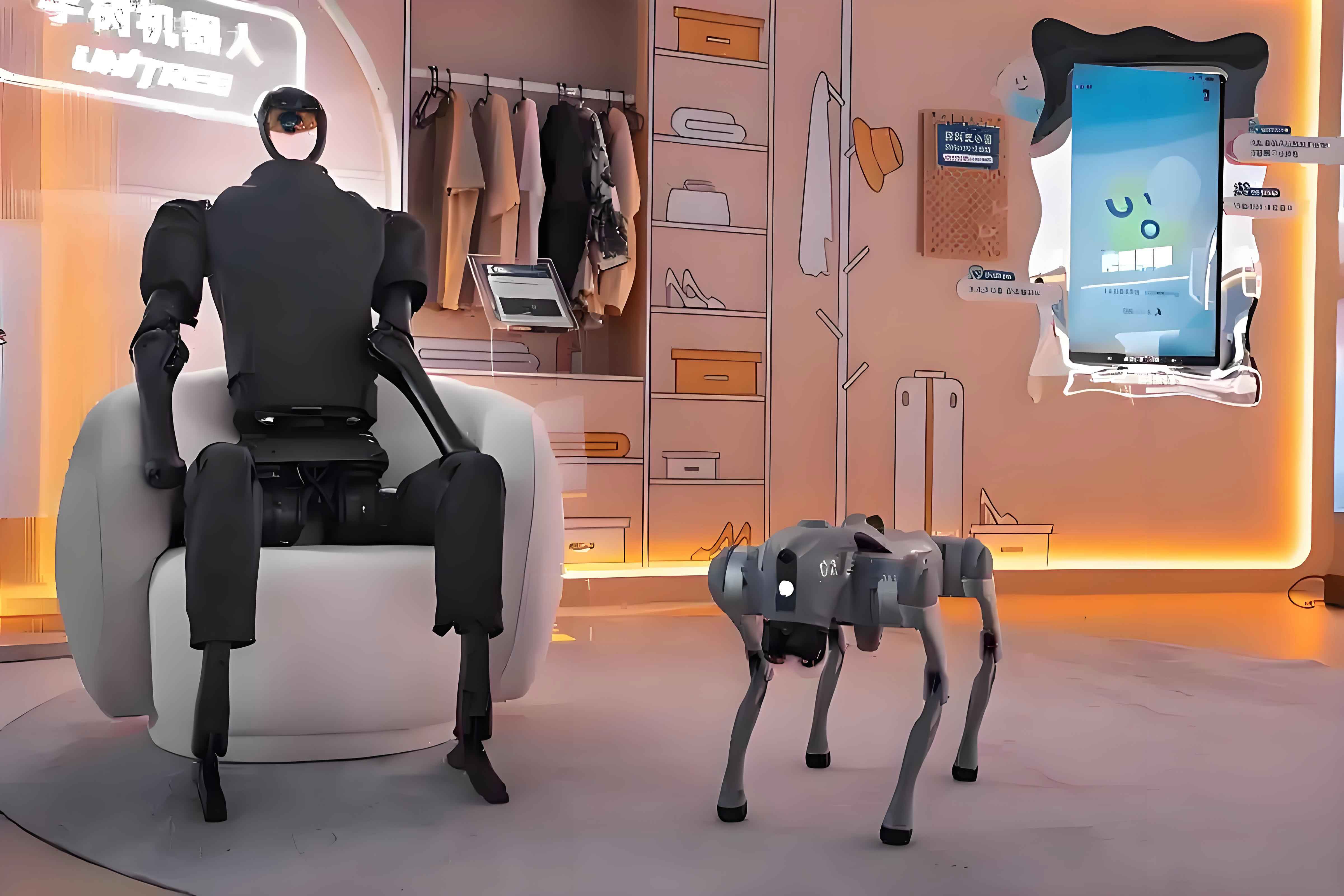
The central question at the fair was no longer whether a humanoid robot could perform a dramatic trick. The question was whether the humanoid robot could become a reliable, affordable and useful product. The companies on display offered three distinct answers: technology-driven design, scenario-driven development and industrialization at scale. Each path revealed a different part of the emerging humanoid robot economy.
1. Technology First: Designing a Body for Artificial Intelligence
At the booth of Dongyi Technology, a bipedal humanoid robot faced a series of human opponents in badminton. It moved forward and backward, switched between forehand and backhand strokes and delivered smashes. The shuttlecock did not follow a fixed script. The human players varied their shots, and the humanoid robot responded in real time. Crowds gathered, and applause broke out when the machine returned a difficult ball.
“This is the world’s first bipedal humanoid robot to autonomously play badminton with humans in the real world,” said Ren Xiaoyu, founder, CEO and CTO of Dongyi Technology. The company described the demonstration as a real-world test of perception, motion control and decision-making working together inside a physical humanoid robot.
Ren’s background illustrates how quickly the humanoid robot sector has matured. A Tsinghua graduate who was recognized as a deputy senior engineer at the age of 29, Ren previously served as the head of humanoid robot technology at Fourier Intelligence. There, he led the development of the GR-1 humanoid robot and helped achieve the first domestic implementation of reinforcement learning Sim-to-Real technology in motion control for a large-size humanoid robot. In September 2024, he founded Dongyi Technology.
At the new company, Ren advanced a philosophy that differs from much of the industry. “Many people in the industry are doing ‘AI for Robot,’ putting AI into an existing robot body,” he said. “We do the opposite. We first define what kind of body intelligence needs, and then we design the body.”
The distinction matters for the humanoid robot. In the “AI for Robot” approach, engineers begin with a mechanical platform and try to fit perception, learning and control systems into it. In the “Robot for AI” approach, the hardware architecture is shaped around the requirements of intelligence from the start. Actuators, sensors, joint ranges, compute placement and thermal design are treated as part of the AI problem rather than as fixed constraints.
For the humanoid robot, this is more than a design slogan. A machine that must play badminton needs fast visual perception, precise joint control and whole-body coordination. It must estimate the trajectory of a small object, predict where it will be, move its feet and arms in a coordinated way and recover balance after a stroke. The humanoid robot must also tolerate variability: different players, different speeds, different angles and different court conditions. A body designed for these tasks may look similar to other humanoid robot platforms, but its internal priorities are different.
The demonstration also showed why the humanoid robot is becoming a platform for AI. A fixed industrial robot repeats a programmed path. A humanoid robot must perceive an open environment, make decisions and act physically. The badminton match compressed these challenges into a few seconds. The humanoid robot had to see, think and move without a human operator controlling every joint.
Dongyi Technology is still a young company, but its presence at the fair reflected a broader shift. The humanoid robot is no longer only a mechanical engineering project. It is becoming a testbed for embodied AI, where software intelligence and physical design must evolve together. The company’s “Robot for AI” concept suggests that the next wave of humanoid robot development will be driven not only by better algorithms but also by bodies built to serve those algorithms.
2. Scenario First: Turning Humanoid Robot Demonstrations Into Business
If Dongyi Technology represents a technology-driven path, Digital Huaxia and Zhipingfang represent a scenario-driven path. Their displays focused on how the humanoid robot can enter specific service and interaction contexts, rather than on a single athletic feat.
At the Digital Huaxia exhibition area, three humanoid robots stood in a line: Xia Lan R03, Xia Qi and Xing Xing Xia. Each addressed a different aspect of commercial deployment. Xia Lan R03 used bionic silicone facial skin and carried more than 40 degrees of freedom in its face, allowing it to present more than 30 composite expressions with precision. Xing Xing Xia supported switching between bipedal walking and wheeled mobility and could perform high-level movements such as side flips and ethnic dances.
“Most humanoid robot products on the market can only complete basic movements and find it difficult to take on real business tasks,” said Jia Kaichao, product marketing manager at Digital Huaxia. “Our core differentiation lies in two sets of self-developed underlying systems.”
The company developed the Juhao 2.0 embodied intelligent interaction platform, which uses a dual-brain collaboration mechanism. A fast brain handles real-time multimodal interaction, while a slow brain carries emotional computing and long-term memory. The system is designed to understand user emotions and enable human-machine interaction with a degree of empathy. For a humanoid robot working in a service environment, this is a practical requirement. A machine that can walk into a lobby but cannot read a customer’s mood or remember a previous interaction remains a demonstration, not a useful colleague.
Jia described 2026 as “the first year of scenarios for large-scale commercial use of the humanoid robot.” From the company’s perspective, the fair offered multiple advantages at once: geographic location, platform access and industry cycle. The Greater Bay Area has a mature supply chain for motors, reducers and batteries, allowing Digital Huaxia to assemble complete humanoid robot units locally. That local supply chain can shorten development cycles, reduce logistics friction and support faster iteration.
The scenario-driven approach changes how a humanoid robot is evaluated. A technology demonstration may be judged by whether it can complete a difficult motion once. A commercial scenario is judged by whether the humanoid robot can complete a useful task repeatedly, safely and at acceptable cost. In a shopping mall, the humanoid robot may need to guide visitors, answer questions and handle unexpected obstacles. In a hospital, it may need to interact with patients, follow privacy rules and operate in crowded corridors. In a school, it may need to support education and entertainment while remaining safe around children.
Digital Huaxia’s three models illustrated how the humanoid robot is being segmented by use case. Xia Lan R03 emphasizes expressive interaction. Xing Xing Xia emphasizes mobility flexibility, combining bipedal walking with wheeled movement. Xia Qi adds another configuration to the product family. The company is not relying on a single universal humanoid robot for every task. Instead, it is shaping different humanoid robot variants around different scenarios.
Zhipingfang, another Shenzhen-based company at the fair, was presented as part of the same scenario-driven path. The company’s presence reinforced the idea that the humanoid robot industry is not a single race toward one perfect machine. It is a collection of races toward different commercial entry points. Some companies prioritize athletic performance. Others prioritize emotional interaction, mobility, service tasks or manufacturing. The humanoid robot market may develop through many specialized applications before a general-purpose humanoid robot becomes common.
The scenario-first logic also explains why so many companies at the fair emphasized local supply chains and rapid iteration. A humanoid robot that is designed for a specific scenario can be improved through real-world feedback. Each deployment generates data, exposes failure modes and suggests design changes. The humanoid robot becomes part of a learning loop that connects software, hardware and operations.
3. Scale-Up Breakthrough: From Pilot Lines to Volume Manufacturing
Leju Robotics, another Shenzhen company, presented a different kind of progress: industrialization. The company brought Kuavo, described as the world’s first 5G-A humanoid robot. Its full-size humanoid robot series has reached a domestic content rate of 95 percent for core components, making it one of the most industrialized humanoid robot products in China.
Kuavo has appeared in a series of high-profile settings. It performed in the “Beijing 8 Minutes” segment associated with the Pyeongchang Winter Olympics. It operated in the ice and snow venue of the Asian Winter Games at minus 20 degrees Celsius. In 2025, it served as a 5G-A torchbearer at the National Games. These appearances demonstrated the humanoid robot in public, media-rich environments, but the more important development was behind the scenes.
Leju Robotics and Dongfang Precision jointly built China’s first 10,000-unit-level automated production line for humanoid robot manufacturing. The line has entered large-scale manufacturing and forms a closed loop described as “Shenzhen research and development pilot production plus Foshan manufacturing mass production.” In the first half of 2026, Leju’s humanoid robot shipments reached 650 units.
That shipment figure is significant because it moves the conversation from prototypes to production. The humanoid robot industry has no shortage of impressive videos. It has a shortage of repeatable manufacturing, quality control and delivery. A 10,000-unit-level automated production line does not mean that 10,000 humanoid robot units are already in customers’ hands. It means the company has built infrastructure oriented toward volume. The humanoid robot is being treated as a manufactured product with supply chain planning, assembly processes and production capacity.
The cross-city division of labor is also notable. Shenzhen provides research and development plus pilot production. Foshan provides manufacturing mass production. This arrangement uses the strengths of both locations within the Greater Bay Area. Shenzhen contributes engineering talent, software development and rapid prototyping. Foshan contributes factory space, manufacturing experience and scale. For the humanoid robot, this kind of regional industrial organization may be as important as any single technical breakthrough.
Mass production creates its own challenges. A humanoid robot contains many precision components, including motors, reducers, sensors, controllers and batteries. Each component must meet consistency requirements. A small variation in a joint actuator can affect balance, motion control and safety. An automated production line must therefore combine assembly efficiency with testing and calibration. The humanoid robot is not a smartphone; it is a complex machine that must operate safely in physical space.
Leju’s progress suggests that the humanoid robot sector is entering a phase where manufacturing capability becomes a competitive advantage. Companies that can design a humanoid robot are numerous. Companies that can manufacture a reliable humanoid robot at scale are fewer. The fair made this distinction visible. Some exhibits highlighted a single capability. Leju’s exhibit highlighted the system behind the capability: components, production, local supply chain and shipment data.
4. Ecosystem: Supply Chain, Algorithms and Application Scenarios
The embodied intelligence exhibition was organized around the full industrial chain. Nearly 100 companies displayed products and services across core components, complete humanoid robot machines, AI algorithms and industry applications. More than 200 typical application scenarios were presented. This structure reflected a mature understanding of how the humanoid robot industry actually develops.
A humanoid robot does not emerge from a single innovation. It depends on motors that deliver high torque in small packages, reducers that provide precision, batteries that supply power without excessive weight, sensors that perceive the environment, chips that process data and algorithms that turn perception into action. It also depends on application developers who understand what a humanoid robot can do in a factory, hospital, mall or school.
The Greater Bay Area supply chain was a recurring theme. Digital Huaxia’s representative pointed to mature local suppliers for motors, reducers and batteries. That density of suppliers supports faster iteration and lower logistics costs. For a young humanoid robot company, the ability to source components nearby can be decisive. It shortens the loop between design, prototype and production.
| Indicator | Figure presented at the fair |
|---|---|
| Event | 21st China International SME Fair |
| Location | Guangzhou |
| Dates | Sept. 3 to 6 |
| Overall theme | Artificial Intelligence Empowers SMEs |
| Embodied intelligence exhibition area | 15,000 square meters |
| Countries and regions represented | More than 40 |
| Quality SMEs at the fair | More than 2,000 |
| Industrial chain enterprises in the embodied intelligence area | Nearly 100 |
| Typical application scenarios | More than 200 |
| Coverage | Core components, complete humanoid robot machines, AI algorithms and industry applications |
The table above shows why the fair was more than a product showcase. It was a map of an emerging ecosystem. The humanoid robot is the most visible node, but it depends on a network of suppliers, software developers and application partners. The presence of small and medium-sized enterprises across the chain suggested that the humanoid robot economy is not limited to a few large manufacturers. It is creating opportunities for specialized component makers, algorithm developers and scenario integrators.
The application scenarios displayed at the fair ranged from athletic interaction to service reception, mobility and industrial handling. The humanoid robot was shown walking, swinging a racket, smiling and carrying objects. These actions may appear simple to a human, but each represents a complex integration of perception, planning and control. A humanoid robot that smiles must coordinate facial actuators with interaction logic. A humanoid robot that carries an object must maintain balance while adapting its grip and path.
| Company | Focus | Humanoid robot highlight | Evidence presented |
|---|---|---|---|
| Dongyi Technology | Technology-driven design | Bipedal humanoid robot plays badminton with humans | Forehand, backhand and smash responses in real time; company describes it as the world’s first such bipedal humanoid robot in the real world |
| Digital Huaxia | Scenario-driven interaction | Expressive and mobile humanoid robot models | Xia Lan R03 with bionic silicone facial skin, more than 40 facial degrees of freedom and more than 30 composite expressions; Xing Xing Xia with bipedal and wheeled movement switching, side flips and ethnic dances |
| Leju Robotics | Industrialization and scale | Kuavo 5G-A humanoid robot and volume manufacturing | 95 percent domestic content rate for core components; 10,000-unit-level automated production line with Dongfang Precision; 650 humanoid robot shipments in the first half of 2026 |
The second table places the three paths side by side. Dongyi Technology emphasizes the humanoid robot as a platform for embodied AI. Digital Huaxia emphasizes the humanoid robot as an interaction product for real scenarios. Leju Robotics emphasizes the humanoid robot as a manufacturable industrial product. These are not mutually exclusive strategies. A successful humanoid robot company will eventually need strengths in all three areas: intelligence, application fit and manufacturing discipline.
The ecosystem perspective also explains why the humanoid robot is advancing faster in some areas than others. Athletic demonstrations attract attention because they are visible. Supply chain improvements are less visible but equally important. A better reducer or a more consistent actuator may not make headlines, but it can determine whether a humanoid robot can be produced at scale. Similarly, an application scenario may seem modest, but it can generate the revenue and operational data needed to improve the humanoid robot.
5. What the Expo Reveals About the Humanoid Robot Race
The fair revealed that the humanoid robot industry is entering a more disciplined phase. The earliest phase was dominated by proof of concept. Companies showed that a humanoid robot could walk, stand up after a fall or manipulate an object. The current phase is dominated by proof of value. Companies must show that a humanoid robot can perform a useful task, fit into a real workflow and make economic sense.
This shift was visible in the language used by exhibitors. Ren Xiaoyu spoke about designing a body for AI. Jia Kaichao spoke about real business tasks, emotional interaction and local supply chains. Leju’s display spoke about production lines and shipments. Each statement addressed a different question that investors, customers and partners now ask about the humanoid robot. Can it think? Can it work? Can it be built?
The humanoid robot is also becoming a symbol of broader industrial competition. The fair brought together companies from more than 40 countries and regions, but the embodied intelligence exhibition was concentrated in the Greater Bay Area’s manufacturing ecosystem. Shenzhen and Foshan, in particular, appeared as complementary nodes. Shenzhen contributed research, development and pilot production. Foshan contributed manufacturing scale. The humanoid robot supply chain is becoming regional, and regional advantages can shape which companies scale first.
At the same time, the fair avoided the temptation to present the humanoid robot as a finished product. The machines on display were impressive, but they were also clearly early-generation products. A humanoid robot that plays badminton is not yet a humanoid robot that can work in every environment. A humanoid robot that smiles is not yet a humanoid robot that understands every customer. A humanoid robot that ships in hundreds of units is not yet a humanoid robot that ships in millions. The industry is making progress, but the distance between demonstration and mass adoption remains real.
The most important insight from the fair may be that the humanoid robot is following multiple commercialization routes at once. One route is driven by AI research and advanced motion control. Another route is driven by service scenarios and human-machine interaction. A third route is driven by manufacturing scale and supply chain maturity. These routes will likely converge. The humanoid robot that succeeds at scale will need to be intelligent, useful and manufacturable.
For small and medium-sized enterprises, the humanoid robot economy offers both opportunity and pressure. The opportunity lies in specialized components, software tools, scenario integration and services. The pressure lies in the pace of iteration. Companies at the fair described a market that is moving quickly from prototypes to products. Suppliers that cannot meet consistency, cost or delivery requirements may be left behind. The humanoid robot supply chain will reward firms that can combine technical depth with manufacturing discipline.
6. Outlook: The Next Test for Humanoid Robot Companies
The humanoid robot companies at the fair were notably young. Most were founded only three to five years ago, yet they have already achieved globally leading technical indicators and business models in their respective segments. That speed is remarkable for an industry that requires expertise in mechanics, electronics, control theory, AI and manufacturing.
The next test will be less dramatic than a badminton match and more demanding than a stage demonstration. The humanoid robot must prove its reliability over thousands of operating hours. It must prove its safety around people. It must prove its cost-effectiveness in specific jobs. It must prove that its supply chain can deliver consistent quality. It must prove that its software can improve over time without creating new risks.
Those tests will not be passed by a single company in isolation. They will require collaboration across the industrial chain. Component suppliers must improve performance and consistency. Algorithm developers must make humanoid robot perception and control more robust. Application partners must define realistic use cases. Manufacturers must build production systems that can scale. Regulators and standards bodies will also play a role as the humanoid robot enters public and workplace environments.
The fair offered a preview of how this collaboration might work. Dongyi Technology showed the humanoid robot as an AI platform. Digital Huaxia showed the humanoid robot as an interaction product. Leju Robotics showed the humanoid robot as an industrial product. Together, they illustrated the three legs of commercialization: intelligence, application and manufacturing. A humanoid robot company that stands on only one leg may attract attention. A humanoid robot company that stands on all three may build a durable business.
The humanoid robot is no longer a distant vision. It is walking through exhibition halls, playing sports, greeting visitors and entering production lines. It is still early, and the industry still faces difficult engineering and commercial challenges. But the direction is clear. The humanoid robot is moving from a static display to a real productivity tool, and the companies that can turn demonstrations into reliable products will define the next stage of the embodied intelligence economy.
At the China International SME Fair, the humanoid robot appeared not as a single breakthrough but as an accumulation of many advances. Motors, reducers, batteries, sensors, algorithms, interaction systems and manufacturing processes are coming together. The humanoid robot is becoming a system product, and the system is beginning to scale. That may be the most important message from Guangzhou: the humanoid robot has left the stage and entered the supply chain, the factory and the everyday world.