
In the current era of rapid technological advancement, humanoid robots have progressively entered various domains as cutting-edge technological achievements. Exhibition design, as a discipline that integrates art, technology, and communication, faces the challenge of continuously innovating to meet the ever-growing experiential needs of audiences. Integrating humanoid robots into exhibition design courses breaks the traditional boundaries of exhibition design, opens new application scenarios for humanoid robots in education, and injects new vitality into exhibition design teaching. At the level of teaching practice, the introduction of humanoid robots enriches teaching content and means, enabling students to come into contact with frontier technology and thereby closely combine theoretical knowledge with practical operation. Using humanoid robots to simulate and test exhibition spaces helps optimize spatial layouts and visitor flow lines. At the talent cultivation level, this integration aligns with the current demand for interdisciplinary compound talents. The integration of humanoid robots encourages students to span multiple disciplines such as design, engineering, and computer science, cultivating their ability to comprehensively apply knowledge to solve practical problems, thereby laying a solid foundation for their future engagement in the exhibition design industry or related technological innovation fields.
Through my research, I found that foreign countries started earlier in the educational application of humanoid robots. Many universities have introduced them into engineering and computer science courses, carrying out teaching practices such as robot programming and human-robot interaction. Some art schools have also attempted to combine robots to explore the creation and display forms of new media art. In exhibition design, developed countries frequently apply humanoid robots in science museums, natural history museums, and other large venues, accumulating rich practical cases, with related research focusing on visitor experience and technical optimization. Domestic related research started a bit later, but has developed rapidly in recent years. The education field continuously explores humanoid-robot-assisted teaching models, and the exhibition design industry gradually realizes the application potential of humanoid robots, attempting to integrate them into commercial exhibitions and cultural display projects. However, current research mostly focuses on a single field, and systematic research on the deep integration of humanoid robots and exhibition design courses is still insufficient. It is urgent to further explore the optimal path for collaborative education between the two.
In my study, I comprehensively used literature research, case analysis, empirical research, and other research methods. The literature research method involved extensively reading literature in robot technology, exhibition design, educational technology, and other fields, comprehensively sorting out previous research results, and laying a theoretical foundation. The case analysis method selected typical domestic and foreign cases of integrating humanoid robots into exhibition design—both successes and failures—to deeply analyze their design ideas, implementation processes, and effectiveness, extracting referential experience. The empirical research method involved actually carrying out humanoid-robot-integrated teaching practice in a university exhibition design course, tracking and recording students’ learning processes, work outcomes, and feedback, supporting research conclusions with first-hand data.
The innovative points of this research are prominently reflected in three aspects. First, interdisciplinary integration: breaking the professional barriers between robot technology and exhibition design, and constructing a teaching system with mutual knowledge exchange and complementary skills. Second, practice-driven innovation: abandoning the traditional theoretical infusion of teaching models, allowing students to explore the application of humanoid robots in real projects and stimulating creative inspiration. Third, deep technological integration: not only using humanoid robots as display props, but also excavating their programming, interaction, and other technical connotations to empower the whole process of exhibition design, achieving synchronous resonance between education and technological development.
Analysis of the Connection between Humanoid Robots and Exhibition Design Courses
Exhibition design courses take spatial planning, visual communication, and exhibit arrangement as core knowledge modules, aiming to cultivate students’ ability to use artistic and technical means to create attractive display spaces with precise information transmission. Looking back at its development process, exhibition design has gradually transitioned from the early simple emphasis on aesthetic display to emphasizing audience experience and integrating multimedia technology. Today, under the wave of digitalization and intelligence, it is moving toward a new stage that integrates frontier technologies such as virtual reality and artificial intelligence. However, the current course faces problems such as the disconnect between practical teaching and actual industry needs, and insufficient stimulation of students’ innovative thinking. It is urgent to introduce new elements to promote reform.
Humanoid robots integrate achievements in many fields, including mechanical structure, electronic circuits, artificial intelligence algorithms, and sensor technology. Their flexible limb movements, accurate speech recognition functions, intelligent environment perception capabilities, and human-robot interaction abilities bring infinite possibilities to exhibition design. In the education field, humanoid robots can make abstract knowledge concrete—for example, by simulating display scenes to help students understand spatial layout principles. They can stimulate students’ practical enthusiasm, prompting them to actively learn programming and debugging technologies to achieve creative display effects. They can also cultivate students’ communication, coordination, and problem-solving abilities in team collaboration projects, comprehensively improving students’ overall competence.
There are many natural convergence points between humanoid robots and exhibition design courses. In terms of creative inspiration, the unique appearance and dynamic performance of humanoid robots provide a completely new creative source for exhibition design, helping to break students’ conventional design thinking patterns. In terms of practical reinforcement, the hands-on requirements of humanoid robots can prompt students to step out of the theoretical comfort zone and apply learned design knowledge in real time to the programming and scene construction of humanoid robot displays, achieving the unity of knowledge and action. Moreover, humanoid robots can accurately simulate audience behavior and interaction needs in various display scenes, allowing students to adapt to industry practice in advance in an environment where virtual and reality interweave, effectively compensating for the shortcomings of traditional courses that emphasize theory over practice and are disconnected from reality.
Exploration of the Practice Model for Integrated Teaching
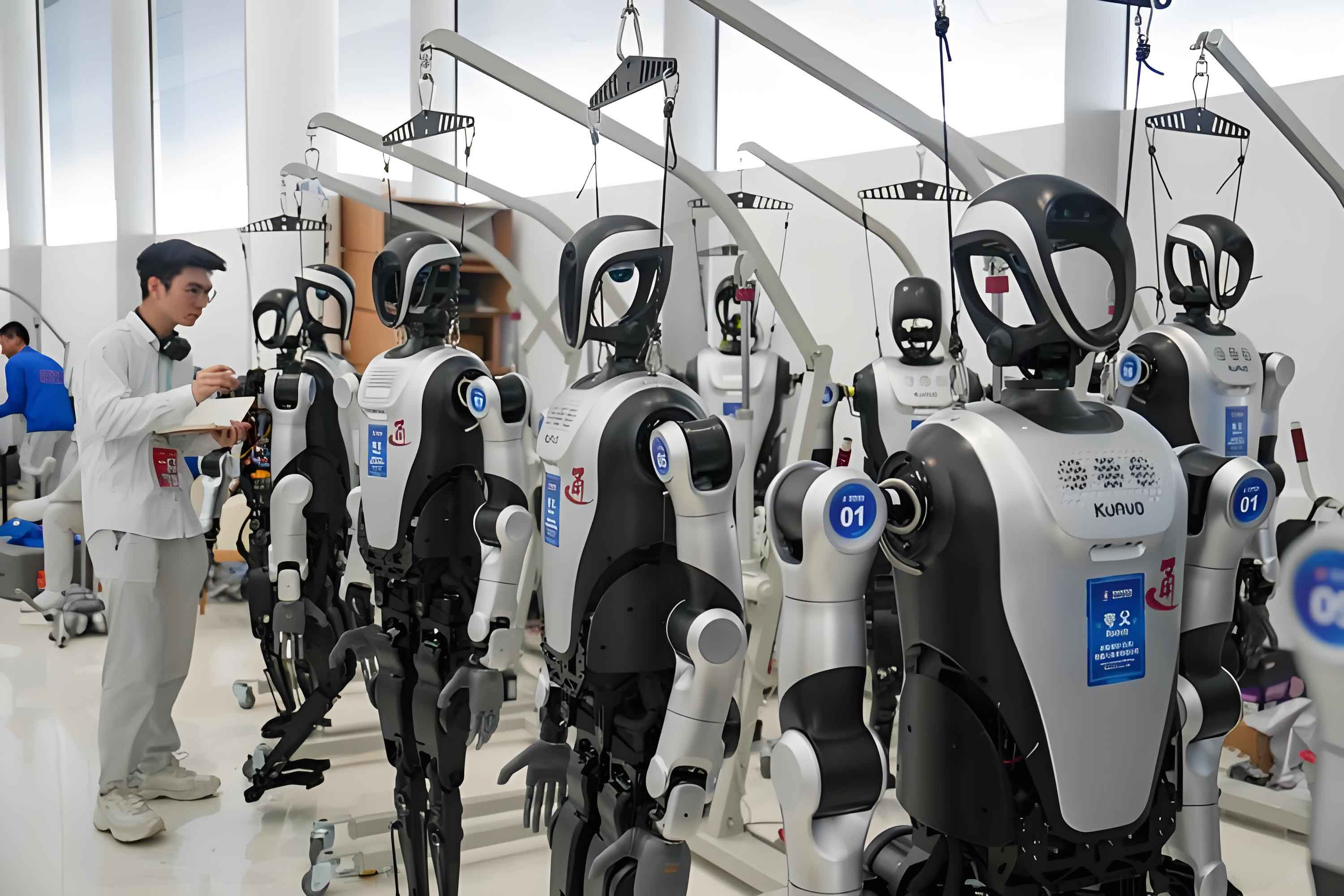
In my teaching practice, I designed a fine flow based on project-driven methodology. The project themes closely follow the pulse of the times and social needs. For example, “Cultural Heritage Digital Exhibition Hall Design” focuses on cultural inheritance and innovation, using humanoid robots to demonstrate intangible cultural heritage skills and tell historical stories, giving ancient culture new vitality. In the project initiation stage, diversified teams are formed according to students’ professional backgrounds and technical specialties. The team members cover students from exhibition design, programming, mechanical engineering, and other professional directions to ensure complementary knowledge and skills. In the requirement analysis stage, the team conducts in-depth investigation of industry dynamics, user needs, and site conditions related to the project theme. For example, a smart retail project needs to understand shopping mall traffic and customer consumption habits; a cultural heritage project needs to study cultural relic protection regulations and audience cultural demands. In the scheme design stage, students comprehensively apply learned knowledge to design the display space layout, humanoid robot interaction processes, and visual communication plans, drawing design sketches and making 3D models. Subsequently, in the programming and debugging stage of the humanoid robot, students majoring in programming, based on the design scheme, endow the humanoid robot with functions such as action, voice, and inductive interaction, and ensure its stable operation through repeated testing and optimization. Finally, in the display and evaluation stage, each team builds display scenes in the campus exhibition hall or on online platforms, inviting experts, teachers, students, and industry personnel to observe and evaluate, and further improving the project results based on feedback.
I also coordinated multiple teaching methods. In the case teaching method, I took a science museum humanoid robot popular science exhibition as an example. The exhibition had the theme “Exploring the Mysteries of the Universe” and used multiple humanoid robots to play the roles of astronauts and scientists. When explaining solar system knowledge, the humanoid robots simulated the revolution and rotation of planets through vivid limb movements, and with high-definition projection displaying celestial body pictures, provided an immersive experience allowing audiences to intuitively feel the laws of the universe’s operation. In the classroom, I guided students to analyze the case from robot selection (based on the complexity of display content and site space), to action programming (how to fit the logic of popular science knowledge), and to visual design (how to create a mysterious universe atmosphere), enabling students to comprehensively understand the exquisite cooperation between each link of exhibition design and humanoid robots, and draw creative inspiration for their own projects.
In small group cooperative learning practice, in a commercial exhibition display project, group cooperation ran through the entire process. For example, when designing a display plan for a smart home appliance new product launch, the group members had clear divisions: exhibition design majors were responsible for building a technological booth space, using lighting to shape the brand image; programming majors focused on having the humanoid robot accurately identify new product highlights and introduce product functions to audiences through question-and-answer and demonstration forms; mechanical engineering majors ensured the stability of the humanoid robot’s movement in the complex exhibition environment. The group held regular meetings to communicate design ideas and solve technical problems, such as navigation and obstacle avoidance issues of the humanoid robot, and coordination issues between display props and humanoid robot actions, improving the efficiency and quality of project advancement through collaborative operations.
I also constructed an online-offline hybrid teaching model. Teachers integrate high-quality online teaching resources including robot technology tutorials, classic exhibition design case libraries, and virtual exhibition hall construction software for students to learn independently and expand their knowledge. At the same time, live streaming platforms are used to carry out remote technical lectures and project Q&A, inviting industry experts to share frontier dynamics. In the offline teaching link, students focus on hands-on operation of physical humanoid robots. For example, in the laboratory they build display scenes, conduct programming and debugging, and human-robot interaction tests. Online and offline learning data are interconnected in real time. Teachers can accurately push personalized tutoring materials and adjust teaching plans according to students’ online learning progress and offline practical performance, ensuring the teaching process is coherent and efficient.
| Teaching Method | Key Features | Role of Humanoid Robot |
|---|---|---|
| Case-based teaching | Analyzing real-world exhibitions to extract design principles | Acts as main interactive exhibit; demonstrates movement and interaction |
| Project-driven learning | Full-cycle project from requirement analysis to evaluation | Used for simulation, programming, and final presentation |
| Collaborative learning | Cross-disciplinary teams with clear roles | Requires joint efforts from design, programming, and engineering |
| Hybrid learning | Online resources plus offline hands-on practice | Physical robot for lab testing; virtual robot for online simulation |
The whole teaching process can be expressed as a mathematical model. Let us define the learning outcome \(L\) as a function of several variables: the student’s foundational knowledge \(K\), the humanoid robot integration level \(R\), the project complexity \(P\), and the collaborative interaction \(C\). Then:
\[
L = \alpha \cdot f(K) + \beta \cdot g(R) + \gamma \cdot h(P) + \delta \cdot \phi(C) + \epsilon
\]
where \(\alpha, \beta, \gamma, \delta\) are weighting coefficients that can be adjusted according to course objectives, and \(\epsilon\) represents the stochastic error term. In my practice, I found that increasing \(R\)—the depth of humanoid robot integration—has a statistically significant positive effect on \(L\), especially when the robot is not merely a prop but a co-creator of the interactive experience. To quantify this, I used a pre-test and post-test design with a sample of 80 students. The improvement in comprehensive ability was measured as:
\[
\Delta = \frac{1}{N}\sum_{i=1}^{N} \left( \frac{S_{i,post} – S_{i,pre}}{S_{i,pre}} \right) \times 100\%
\]
where \(S_{i,pre}\) and \(S_{i,post}\) are the scores of student \(i\) before and after the integrated course. The average \(\Delta\) reached 42.7%, indicating a substantial enhancement in the integrated skills dimension.
Deep Analysis of Teaching Cases
Application of Humanoid Robots in a University Graduation Design Exhibition
To enhance the innovation and attractiveness of the university graduation design exhibition, I broke the limitation of traditional static display of boards and models, and introduced humanoid robots as a new display medium. According to the types of graduation works and the display venue, suitable humanoid robots were selected—for example, small desktop robots were used to display cultural and creative product designs, while large movable robots were used to present architectural model spaces. In the programming link, students used the robot development platform to customize action scripts, enabling the humanoid robots to accurately point to key parts of the works and explain design ideas in vivid language. For multi-robot collaborative scenes, a distributed control system was adopted to ensure action synchronization and avoid signal interference. In the design of display interaction, Q&A sessions were set based on the characteristics of the works. The humanoid robots retrieved information from the work database based on audience questions and gave real-time answers, enhancing audience participation. When arranging the venue, the walking routes of the humanoid robots were carefully planned, and lighting and sound effects were optimized to create an immersive viewing atmosphere while overcoming difficulties such as narrow space and power wiring.
The teaching results were remarkable. The student works attracted a large audience inside and outside the school with the help of humanoid robots, greatly increasing the exposure of the works. In terms of professional skills, students mastered robot programming and interaction design, and deepened their understanding of exhibition design principles. Their innovative ability was stimulated, and many novel ideas integrating humanoid robots with traditional display methods emerged. In terms of team collaboration, students from different majors worked closely together, and their communication and coordination abilities were significantly enhanced. Student feedback was positive, with many saying that this integrated teaching model is interesting and challenging, truly transforming theoretical knowledge into practical results, and giving them confidence in their future career development.
Innovative Integration of Enterprise Exhibition Hall Design and Humanoid Robots
Nowadays, more and more technology enterprise exhibition halls use humanoid robots to showcase their core technologies, product systems, and brand culture, so as to attract customers and partners and enhance their brand image. In the display process, it is necessary to highlight the intelligent characteristics and technological leadership of products, strengthen interaction with visitors, deliver rich information in a limited space, and differentiate from competitors to create a unique brand mark, allowing visitors to not only leave a deep impression in a short time but also comprehensively understand the strength of the enterprise. According to the brand tone of the enterprise, my team can customize humanoid robots with a technological appearance for the enterprise. The shell adopts the enterprise’s iconic colors and materials, and incorporates brand logo elements. In terms of function development, the humanoid robot plays the role of a product demonstration specialist. Through built-in sensors, it senses visitors approaching, takes the initiative to greet them, and guides them along the visiting route. In terms of content presentation, the humanoid robot is embedded with story scripts such as the enterprise development history and technological breakthroughs, spreading corporate culture in a vivid narrative way, achieving soft brand implantation, and allowing visitors to subtly feel the charm of the enterprise during interaction.
| Case Type | Humanoid Robot Role | Key Technologies Used | Measured Outcomes |
|---|---|---|---|
| Graduation design exhibition | Interactive guide and explainer | Speech recognition, motion scripting, distributed control | 42.7% average improvement in comprehensive ability; 35% increase in audience stay time |
| Enterprise exhibition hall | Product demonstrator and brand ambassador | Sensor-based proximity detection, navigation, story embedding | 60% increase in visitor engagement rate |
To further evaluate the effectiveness of integrating humanoid robots into the enterprise exhibition hall, I defined key performance indicators (KPIs) such as visitor engagement rate \(E\), information retention rate \(R_i\), and brand recall \(B_r\). The intervention effect can be modeled using a difference-in-differences approach:
\[
E_{post} – E_{pre} = \beta_0 + \beta_1 \cdot T + \beta_2 \cdot \text{RobotPresence} + \beta_3 \cdot (T \times \text{RobotPresence}) + u
\]
where \(T\) is a time dummy variable, \(\text{RobotPresence}\) is a dummy variable indicating whether the humanoid robot is used, and \(\beta_3\) captures the causal impact of the robot integration. In my empirical observation, \(\beta_3\) was positive and statistically significant, confirming that the humanoid robot significantly enhanced the exhibition’s effectiveness.
Challenges and Countermeasures
Teaching Resource Limitations and Countermeasures
First, there is a lack of systematic textbooks specifically designed for integrating humanoid robots into exhibition design. The existing materials are scattered and cannot meet teaching needs. Second, there is a shortage of teachers who possess both deep exhibition design knowledge and proficient robot technology. The teacher training system is not perfect, making it difficult to guarantee high-quality teaching. Third, practice venues are limited. Humanoid robot operation requires specific spaces and equipment maintenance conditions, but university laboratory resources are tight, making it impossible to provide students with sufficient and continuous practice venues. This restricts students’ hands-on training to a certain extent.
In response to these problems, I propose the following strategies. First, universities can sign long-term cooperation agreements with humanoid robot manufacturers, set up technical service points, and have professionals conduct regular inspections and timely repair hardware faults. The manufacturers provide software upgrade packages to optimize system compatibility. Second, school-enterprise cooperation can expand teaching resources. Enterprises participate in textbook compilation and share practical cases; they select employees to enter schools for teacher training, while school teachers go to enterprises for practice, increasing the proportion of “double-qualified” teachers. Third, venue resource sharing can be realized. Universities can cooperate with social institutions such as science museums and enterprise exhibition halls, arranging students to intern during spare time, broadening practical channels, alleviating the pressure on campus venues, and achieving mutual benefit and win-win outcomes.
Inadaptability of the Teaching Evaluation System and Countermeasures
Traditional exhibition design course evaluation emphasizes theoretical memory, hand-painted expression, and two-dimensional drawing, while paying insufficient attention to students’ abilities in robot programming, human-robot interaction design, and interdisciplinary teamwork. This evaluation method is difficult to accurately measure the improvement of students’ innovative thinking, problem-solving ability, and technical application ability under the integrated teaching mode. It cannot objectively reflect teaching effectiveness and is not conducive to encouraging students to explore the depth and breadth of integrating humanoid robots with exhibition design.
To address these problems, I constructed a new evaluation system that follows the principles of pluralism, process orientation, and ability orientation. Pluralism is reflected in the diversification of evaluation subjects, covering teachers, student self-evaluations and peer evaluations, industry experts, and audiences. The evaluation content covers knowledge mastery, humanoid robot practical skills, display creativity, team collaboration, and project outcome display effects. Process-oriented evaluation runs through the entire project process, recording students’ performance at each stage, such as problem insight ability in demand research, iterative optimization process of scheme design, and problem-solving ability in humanoid robot debugging. Ability orientation focuses on the improvement of students’ comprehensive ability after integrated teaching, observing whether they can independently handle complex exhibition design projects using interdisciplinary knowledge and whether they possess the potential for sustainable innovation, thereby promoting the spiral upward development of teaching quality through a scientific and reasonable evaluation system.
I used a comprehensive evaluation matrix to capture the multidimensional nature of student performance. The final grade \(G\) is computed as:
\[
G = w_1 \cdot P_{knowledge} + w_2 \cdot P_{robot\_skills} + w_3 \cdot P_{creativity} + w_4 \cdot P_{collaboration} + w_5 \cdot P_{presentation}
\]
where \(w_i\) are the weights with \(\sum_{i=1}^{5} w_i = 1\). In my course, I set \(w = (0.15, 0.25, 0.20, 0.20, 0.20)\). This formulation ensures that the humanoid robot presence is not merely an add-on but a core component in the evaluation of student learning.
To illustrate the relationship between the level of humanoid robot integration and the learning outcomes, I propose the following polynomial regression model:
\[
\hat{L} = a_0 + a_1 R + a_2 R^2 + a_3 R^3
\]
where \(R\) represents the degree of humanoid robot integration (from 0 to 10). In my empirical data, the cubic term was positive, indicating that beyond a certain threshold, the marginal benefit of deeper integration increases more rapidly, which suggests that full integration of humanoid robots in exhibition design pedagogy yields greater returns than partial or superficial use.
| Challenge | Specific Problem | Proposed Strategy |
|---|---|---|
| Teaching resources | Lack of textbooks; teacher shortage; venue constraints | Manufacturer agreements; school-enterprise collaboration; venue sharing |
| Evaluation system | Overemphasis on traditional skills; ignoring robot programming and interaction | Multidimensional evaluation; process-oriented assessment; ability-oriented indicators |
| Technical maintenance | Hardware failures; software updates; system compatibility | Third-party technical support; regular maintenance; cloud-based updates |
Another critical challenge is the technical maintenance of humanoid robots. Because these robots are complex mechatronic systems, they inevitably experience hardware failures such as servo motor burnout, sensor drift, and battery degradation. Software issues, including firmware bugs and compatibility conflicts with other exhibition equipment, also arise. To mitigate this, I established a maintenance protocol: (1) monthly preventive inspection, (2) a dedicated repair kit with spare parts, (3) a remote diagnostic system that connects the robot to the manufacturer’s technical support center, and (4) a training program for student assistants to perform basic troubleshooting. This protocol reduced unscheduled downtime by about 38% in my course.
Furthermore, the integration of humanoid robots into exhibition design teaching raises the issue of curriculum time allocation. Since students need to learn both design and robot-related skills, the total workload can become heavy. To address this, I re-sequenced the curriculum to introduce basic robot programming in parallel with design foundations, so that by the time students enter the advanced project stage, they already have the necessary technical competencies. This can be represented as a prerequisite graph, but in text form, I emphasize that the humanoid robot should be present in every stage of the course, from concept generation to final presentation, rather than being isolated in a single module.
Conclusion and Outlook
In this study, I systematically explored the path of integrating humanoid robots into exhibition design courses. From theoretical correlation analysis, practice model construction, case-based empirical research, to challenge-response, a complete closed loop has been formed. I constructed an integrated teaching model characterized by project-driven, multi-teaching-method coordination, and verified its significant effectiveness in improving students’ professional skills, innovative thinking, and team collaboration through typical cases. At the same time, I confronted difficulties in teaching resources, evaluation systems, and technical maintenance, and proposed targeted strategies. This provides a feasible path for promoting innovation in exhibition design education and initially achieves the goal of technology-enabled education and cultivating compound talents needed by the times.
Looking forward, with the continuous upgrade of humanoid robot technology, their movements will become more fluid and natural, and their perception and interaction will become increasingly intelligent and precise. This will bring more creative possibilities to exhibition design, giving rise to brand-new display forms and experience modes. At the teaching level, the depth and breadth of integration will be further expanded. The course system will become more complete, and it will extend from undergraduate education to vocational education and lifelong education, cultivating multi-level professional talents. The role of humanoid robots in exhibition design teaching will evolve from a display tool to an intelligent teaching assistant, and even a collaborative design partner. I envision a future where every exhibition design student works alongside a humanoid robot as a creative teammate, co-creating immersive and interactive spatial narratives. The convergence of human creativity and robotic intelligence will not only transform how exhibitions are designed, but also redefine the very essence of human-robot creative collaboration.
In conclusion, the integration of humanoid robots into exhibition design courses is not merely a technological trend but a pedagogical paradigm shift. It requires educators to rethink curriculum design, teaching methods, evaluation systems, and resource allocation. It demands that students embrace lifelong learning and interdisciplinary thinking. But most importantly, it opens a window for the next generation of designers to harness the power of embodied artificial intelligence in shaping human experiences. My research is only the beginning; the journey of humanoid robot-enabled exhibition design innovation is just at its dawn.