
The second World Humanoid Robot Games closed on the evening of August 26, 2026, after gathering 666 teams and 2,056 robots for competition across 51 events and more than 1,300 intense contests. The scale of participation rose 138 percent compared with the first edition. In a single year, the humanoid robot has moved beyond demonstrations that barely managed to run and jump. In sprinting, standing high jump, and other contests, humanoid robot platforms repeatedly broke records previously held by humans.
Earlier, the 2026 World Robot Conference concluded in Beijing. At the conference, the 2026 Humanoid Robot Industry Development Report disclosed that in the first half of 2026, China’s humanoid robot shipments exceeded 40,000 units, accounting for 97 percent of the global total. The two major gatherings offered a direct view of the rapid iteration and remarkable achievements of China’s humanoid robot industry. Today, the humanoid robot has gradually acquired comprehensive capabilities in autonomous action, operation, perception, and decision-making. Yet to truly open the doors of factories and homes and to complete a full commercial closed loop, the entire industry still faces a core examination.
1. Running Fast Is Not Enough: The Humanoid Robot Must Run on Its Own
Why should a humanoid robot participate in a running race? For a robot, a sports event is an intuitive and quantifiable test bed for extreme capability. Running, a seemingly simple action, can fully mobilize underlying core capabilities such as energy, power, motion control, and body structure. These are precisely the hard strengths that a humanoid robot cannot do without as it moves toward real application scenarios.
Take Honor Robot as an example. It competed in three speed events: the large-group 100 meters, 400 meters, and 1,500 meters. This tested a complete three-stage capability loop: short-distance explosive speed, middle-distance speed and stability balance, and long-distance sustained endurance. At this edition of the World Humanoid Robot Games, the 100-meter sprint became a must-win battlefield for many humanoid robot makers.
At the opening ceremony, the Tian Gong humanoid robot ran 9.39 seconds, surpassing the men’s 100-meter world record held by Bolt. Honor Robot’s “Flash” ran 9.32 seconds during preparation and then improved again in the final to 8.83 seconds. The Tian Gong humanoid robot ran 8.64 seconds in the final, after setting 8.85 seconds in the semifinal, once again breaking the 100-meter competition record.
In 2025, the best humanoid robot 100-meter time was still 21.50 seconds. From 21 seconds to 8 seconds, what was once considered impossible is becoming reality. Yet what truly excites the industry is not simply how much the data has improved, but who is in control.
The rules of this edition were comprehensively upgraded. For the first time, remote-control devices were fully eliminated from the full-size humanoid robot competition arena, and multiple events required robots to complete tasks independently. Gaoqing Dynamics from Guangzhou did not customize special models for different events. Instead, it directly used the already mass-produced Mini Pi plus humanoid robot and entered nearly 10 events, including float parade, 100 meters, long jump, high jump, martial arts Tai Chi, and street dance. All of these were achieved through fully autonomous operation.
In the remote-control era, a humanoid robot’s outstanding performance relied more on the skill level of the operator. Entering the fully autonomous era, the humanoid robot possesses the confidence to enter factories, homes, warehouses, and other real scenarios that cannot be rehearsed in advance. This is the difference between a humanoid robot that can perform and a humanoid robot that can work.
| Humanoid Robot Sprint Milestone | Context | Result |
|---|---|---|
| Best humanoid robot 100-meter time in 2025 | Previous benchmark | 21.50 seconds |
| Tian Gong humanoid robot | Opening ceremony | 9.39 seconds |
| Honor Robot “Flash” | Preparation stage | 9.32 seconds |
| Tian Gong humanoid robot | Semifinal | 8.85 seconds |
| Honor Robot “Flash” | Final | 8.83 seconds |
| Tian Gong humanoid robot | Final | 8.64 seconds |
2. Craft Over Spectacle: The Humanoid Robot Moves Into Real Work Scenarios
Another notable change at this edition of the World Humanoid Robot Games appeared in the design of competition events. The first edition had 26 events, mainly focused on speed competitions and exhibition performances. Scenario application events were limited to only a few areas such as hotels and hospitals. This edition expanded the number of events to 51, including 14 newly added scenario events covering households, hotels, logistics, retail, emergency rescue, and other fields. Tasks close to real life were brought onto the competition stage.
Why should real operational tasks be included in arena assessment? Because beyond robot performances, people now care more about whether a humanoid robot can truly work in the future. Take the newly introduced dexterous hand special competition. It covers eight contests, including “picking up beans with tweezers,” “powder weighing,” “opening a bottle and prying a cap,” and “nail fixing.” What is tested is not speed or collision, but the “handicraft” of the humanoid robot. This is also the most core shortcoming for humanoid robot deployment in industrial and service scenarios.
The 2026 World Robot Conference also conveyed the same signal. In the past, cool performances on exhibition stands gave way to “uninterrupted continuous operation demonstrations.” A humanoid robot needed to independently and continuously complete an entire set of actions: receiving an order, navigating, retrieving materials, delivering, and placing materials, without human intervention in the middle.
Actions taken by companies outside the competition arena illustrate the point even more clearly. Zhongqing’s T800 fought lively in the combat arena while also having already entered Luxshare Precision’s Suzhou factory, where it autonomously receives orders, navigates, and delivers. Zhao Tongyang, founder of the company, said directly: “Fighting is only a hobby; working is the main business.”
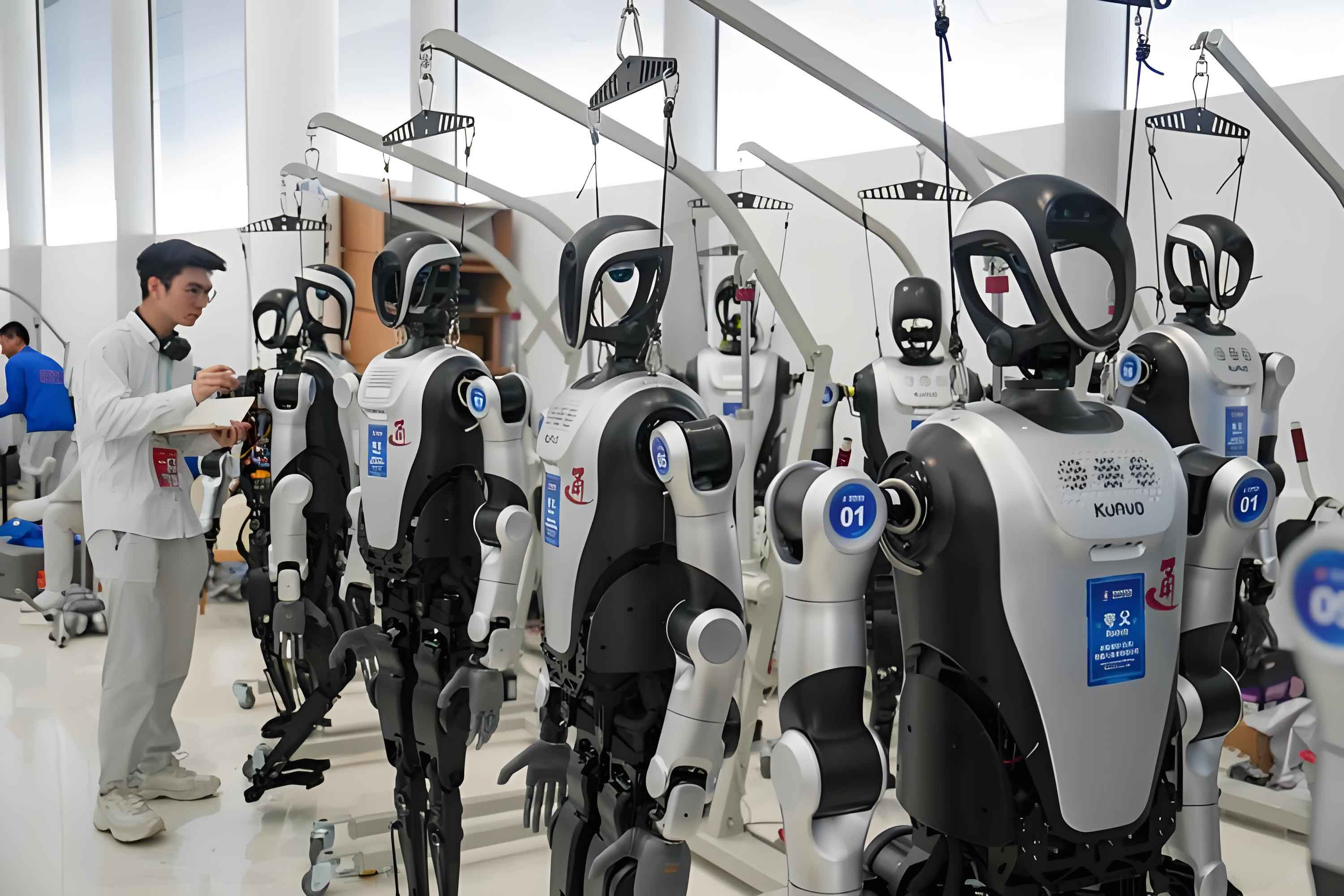
The increase in scenario events is not a simple adjustment of competition rules. It reflects a change in how the entire industry assesses progress. In the past, the focus was extreme capability; now it is task capability. The former is a laboratory metric, while the latter is a commercial metric. When the evaluation standard shifts from “looks impressive” to “can be used,” the industry moves from “proving I can” to “proving I am worth it.”
3. Selling Hardware Is Not Enough: The Humanoid Robot Must Sell Intelligence
If the first two trends focus on answering whether the humanoid robot can perform, the third trend answers whether the business can succeed. On this question, the industry’s attention is shifting from the “body” to the “brain.”
Consider a set of industry data: in the first half of 2026, China shipped more than 40,000 humanoid robot units, accounting for 97 percent of global shipments. The top five global shippers were all Chinese companies. Beneath the appearance of a hot market, however, a gap still stands in the way of commercial deployment.
A Counterpoint Research report shows that in the first half of the year, more than 60 percent of shipments went to entertainment performances and scientific research. In addition, although hardware prices have fallen significantly, for example, Unitree’s average robot price dropped from nearly 600,000 yuan to 166,400 yuan over two years, the closed loop of “making money with robots” has not yet been completed.
At the 2026 World Robot Conference, Wang Xingxing, founder and chairman of Unitree, pointed out the biggest bottleneck: insufficient generalization ability. He said that in a fixed scenario with sufficient data collection and training, a humanoid robot’s task success rate can approach 100 percent. But once the operating object or external environment changes, execution success rate can fall off a cliff.
The core of the contradiction lies in inadequate adaptation between the input and output of AI models and the humanoid robot body. In plain terms, the robot’s “brain” and “body” do not cooperate smoothly enough. An action plan that is perfectly deduced in virtual simulation often fails in the real physical world because of tiny errors.
Wang Xingxing set a standard for the humanoid robot’s “ChatGPT moment”: placing the robot in any unfamiliar environment, where it can complete about 80 percent of tasks through voice commands. In his view, achieving this goal could take as fast as 2 to 3 years, or as slow as 5 to 10 years.
Gao Jiyang, founder of Xinghaitu, made a judgment from the perspective of business models. He believes embodied intelligence commercialization will pass through three development stages. The first stage is whole-machine sales, with gross margins of about 40 percent to 60 percent. The second stage is solution subscription, where customers pay for solutions and the whole machine is merely a carrier, with gross margins falling to around 20 percent. The third stage is “physical world Token” sales, where the whole machine may even have negative gross margins, and profits come from intelligence consumption. Overall value will migrate from the whole machine to the intelligence layer.
| Commercial Stage for Embodied Intelligence | Business Model | Gross Margin Characteristic |
|---|---|---|
| Stage 1 | Whole-machine sales | About 40 percent to 60 percent |
| Stage 2 | Solution subscription, with the whole machine as carrier | About 20 percent |
| Stage 3 | Physical world Token sales, with revenue from intelligence consumption | Whole machine may have negative gross margin |
This trend has already been reflected on the exhibition floor of the 2026 World Robot Conference. Galaxy General and Yuejiang respectively promoted “one brain, many capabilities” and “one brain, many bodies.” Star Era proposed an “embodied world model” and won multiple championships in top global competitions. Mass production and delivery capability confirm the country’s strong manufacturing strength, but the key to truly opening the commercial closed loop must be held in a “smarter brain.”
4. Technology Competition Is Talent Competition: Regional Synergy and Guangdong’s Path
The industrial race for the humanoid robot cannot be separated from coordinated efforts across China’s regions. Each region relies on its endowments for differentiated layout, jointly building an industrial ecosystem with complementary advantages.
Beijing has a dense concentration of universities and research institutes, giving it significant advantages in original innovation “from 0 to 1.” Galaxy General, Star Era, the Beijing Humanoid Innovation Center, and others have all made efforts, building the algorithm and model foundation at the “brain” level. The Yangtze River Delta has taken the lead in precision manufacturing and supply chain systems. Unitree, AgiBot, Fourier, and other companies have run through “from 1 to 100” scaled mass production and industrial deployment.
The Pearl River Delta has a solid manufacturing base and rich application scenarios, forming the country’s most dense enterprise matrix. Guangdong’s hard strength is prominent: industrial robot output has ranked first nationwide for six consecutive years, and Shenzhen’s “15-minute industrial circle” allows 80 percent of components to be assembled within 40 kilometers.
| Region | Primary Strength | Representative Institutions or Companies |
|---|---|---|
| Beijing | Dense universities and research institutes, original innovation from 0 to 1 | Galaxy General, Star Era, Beijing Humanoid Innovation Center |
| Yangtze River Delta | Precision manufacturing and supply chain systems, scaled mass production and industrial deployment from 1 to 100 | Unitree, AgiBot, Fourier |
| Pearl River Delta | Strong manufacturing foundation, rich application scenarios, dense enterprise matrix | Guangdong industrial robot output first nationwide for six consecutive years; Shenzhen 15-minute industrial circle with 80 percent of components within 40 kilometers |
Regional synergy, however, is only the soil. The core engine that ultimately breaks through technical bottlenecks and pushes the industry forward is still people. For Guangdong, the reserve of top basic research talent is still insufficient. How to move from “strong manufacturing” to “strong creation” is a question that must be answered.
To this end, Guangdong is breaking through by using scenarios to attract projects and projects to gather talent. On the one hand, it has pioneered a nationwide “Embodied Intelligence Application Scenario Open Challenge Tour,” using real deployment projects to create a talent gravitational field. On the other hand, it is strengthening policy and capital support, launching the “Million Talents Gathering in Guangdong” plan, starting a 100-billion-yuan strategic emerging fund with no fixed duration, and making clear that by 2029 it will gather 10 whole-machine manufacturing enterprises and annually select demonstration scenarios for financial support.
Scenarios attract projects, projects gather talent, and talent fills shortcomings. This is Guangdong’s path to becoming an “innovation highland,” and it is also an inevitable choice for finding its own position within regional synergy.
The first half of technical validation has already submitted its paper. The second half of value realization has just begun to pose its questions. For the humanoid robot industry, the coming period will not be defined only by faster running, higher jumping, or more spectacular performances. It will be defined by whether the humanoid robot can operate autonomously, complete real tasks, adapt to unfamiliar environments, and generate sustainable commercial returns. The two major industry events have made the direction clear: the humanoid robot must move from the arena to the factory, from the exhibition stand to the service counter, and from hardware sales to intelligence value. The humanoid robot that wins the next stage will be the one that not only moves like a human, but also thinks, adapts, and works in the real world.
The second World Humanoid Robot Games and the 2026 World Robot Conference together present a vivid picture of an industry in transition. Competition records are falling, event categories are expanding, factories are beginning to deploy humanoid robot systems, and business models are being re-examined. At the same time, the commercial closed loop remains unfinished. Generalization ability, brain-body coordination, scenario adaptability, and profitable applications are all still being tested. The humanoid robot has already proved that it can run, jump, and perform. Now it must prove that it can work, earn, and scale. That is the real contest ahead.