
When I watched our humanoid robot walk from the side of the stage to the center of the listing ceremony, stop at exactly the right distance, and strike the gong at the moment the market opened, I felt that the many years of doubt about the humanoid robot were being answered in real time. That ceremony was not a publicity stunt. It was the product of more than a decade of engineering, a company-wide commitment to self-funded research, and a carefully designed system of robot hardware, algorithms, and operational discipline. The humanoid robot did not fail. It did not stumble. It did not shy away from the most visible moment in the company’s life. This article is my attempt to explain, from my own first-person perspective, why I believe the humanoid robot is not a dead end.
The humanoid robot sector has remained hot in 2024. Yet, after the first humanoid robot enterprise completed its initial public offering, there is still no second humanoid robot IPO. Some observers read this as hesitation. I read it as evidence of a high entry barrier. A humanoid robot is not a smartphone. It is a convergence of mechanical engineering, control theory, computer vision, natural language processing, embodied intelligence, and manufacturing. Investors can see the huge potential market, but they also need to see a company that can survive long enough to deliver that potential. The first mover has to build a financial backbone as strong as the robot’s legs. That is exactly what we tried to do.
Self-Sustaining Research and Development
When we started, we did not begin with a full-size humanoid robot. We began with servo actuators, the small but critical components that power every joint. The servo actuator is the muscle of a humanoid robot. Without high torque density, precise position feedback, and fast response, no walking algorithm can save the design. We spent years developing our own actuator family because the market did not offer a device with the right combination of cost, weight, and reliability for a humanoid robot.
For a single joint in a humanoid robot, the torque balance can be written as:
$$
\tau_{\text{joint}} = I_{\text{eff}} \ddot{q} + c(q, \dot{q}) + g(q) + \tau_{\text{friction}}
$$
where $q$ is the joint angle, $I_{\text{eff}}$ is the effective inertia seen at the joint, $c(q,\dot{q})$ captures Coriolis and centrifugal forces, $g(q)$ is the gravity term, and $\tau_{\text{friction}}$ is the friction torque. For a humanoid robot, this equation must be evaluated in real time for every joint, and the motor must generate the required torque faster than the body falls. The actuator needs not only high peak torque but also a high torque-to-mass ratio, low backlash, and enough stiffness to support dynamic motion.
We have designed and produced more than 40 different servo actuator models. The range covers small actuators for wrists and fingers, medium actuators for elbows and shoulders, and large actuators for hips and knees. These actuators have been produced in batches and used across different robot platforms. This was our first step toward self-sustaining research and development. The actuator business generated revenue, tested supply chains, and created the design knowledge that later made the large humanoid robot possible.
| Actuator range | Peak torque | Typical joint in humanoid robot | Design emphasis |
|---|---|---|---|
| Small torque | 0.5–5 Nm | Wrist, fingers, dexterous hands | Compactness, low backlash, sensor integration |
| Medium torque | 10–80 Nm | Elbow, shoulder, waist | High speed, lightweight, overload protection |
| Large torque | 100–500 Nm | Hip, knee, ankle | High torque density, heat dissipation, structural stiffness |
Revenue from earlier robot products was used to finance the next generation of humanoid robot research. This self-sustaining model is important. A humanoid robot program cannot rely only on external capital because the development cycle is long. It needs recurring income from products that can be sold today. In the early years, we released a compact humanoid robot platform that was used in education, entertainment, and research. That platform gave us mass manufacturing experience, field data, and a wide community of developers. More importantly, it helped us understand how a humanoid robot is perceived by ordinary users. The lessons from those small humanoid robot products directly influenced the architecture of our large humanoid robot.
Walking: The First True Challenge
The most visible difference between a wheeled robot and a humanoid robot is bipedal walking. A wheeled robot does not need to solve balance. A humanoid robot must do so while keeping its joints nearly fully extended in the upright posture. When the knee and hip are straight, the effective support polygon becomes smaller, and the robot has less space to adjust its center of mass. This is why early prototypes often fell even in simple walking tests.
Our walking algorithm evolved through multiple generations of iterations. We use a simplified model called the linear inverted pendulum model to plan the center-of-mass trajectory. The dynamic relationship between the center of mass and the zero moment point is:
$$
\ddot{x} = \frac{g}{z_c} \left( x – p_{\text{zmp}} \right)
$$
where $x$ is the horizontal position of the center of mass, $g$ is gravitational acceleration, $z_c$ is the constant height of the center of mass during the simplified step, and $p_{\text{zmp}}$ is the zero moment point. For stable walking of a humanoid robot, the zero moment point must remain inside the support polygon formed by the foot contact area. The planning algorithm generates a sequence of footsteps and center-of-mass trajectories that satisfy this constraint while also respecting joint velocity and torque limits.
The zero moment point itself can be computed from the full-body dynamics of a humanoid robot as:
$$
p_{\text{zmp}} = \frac{\sum_i m_i \left( \ddot{r}_i + g \right) \times r_i}{\sum_i m_i \left( \ddot{r}_i + g \right)}
$$
where $m_i$ is the mass of link $i$, $r_i$ is the position of that link, and $\ddot{r}_i$ is its acceleration. This formula summarizes the continuous struggle between gravity, body acceleration, and foot reaction forces. In a stable humanoid robot, the contact wrench on the ground must produce a zero moment point inside the contact polygon. If the planned motion drives the zero moment point outside that polygon, the foot will start to rotate, and the humanoid robot will fall.
Beyond footstep planning, we developed a multi-dimensional force-position hybrid controller. The controller does not simply track joint positions. It also modulates interaction forces with the environment. A simplified form of the end-effector force command is:
$$
\mathbf{F}_{\text{cmd}} = \mathbf{K}_p \left( \mathbf{p}_d – \mathbf{p} \right) + \mathbf{K}_d \left( \dot{\mathbf{p}}_d – \dot{\mathbf{p}} \right) + \mathbf{F}_{\text{ff}}
$$
where $\mathbf{p}_d$ is the desired end-effector position, $\mathbf{p}$ is the current measured position, $\mathbf{K}_p$ and $\mathbf{K}_d$ are gain matrices, and $\mathbf{F}_{\text{ff}}$ is a feed-forward force. This controller allows the humanoid robot to walk on uneven terrain and to withstand unexpected pushes. It also gives the robot a compliant behavior when interacting with humans in shared spaces.
| Walking module | Function | Key idea |
|---|---|---|
| Global perception | Build a terrain map before stepping | Fuses lidar, depth vision, and inertial data |
| Footstep planner | Compare reachable foot placements | Uses inverse kinematics and collision checking |
| Center-of-mass planner | Generate stable body motion | Uses linear inverted pendulum / ZMP model |
| Whole-body controller | Track the planned motion while limiting joint torques | Solves a quadratic program in real time |
| Force-position loop | React to ground contact and external pushes | Blends force feedback with position tracking |
Walking is not the only capability of a humanoid robot. The robot also needs to see, listen, understand, plan, reach, grasp, and cooperate. In our development process, we treat walking as the foundation. Once the foundation is stable, the rest of the system can be built on top of it. A humanoid robot that can walk but cannot manipulate its environment has limited industrial value. A humanoid robot that can manipulate but cannot walk may still be useful in a fixed cell, but it is not truly humanoid. Both capabilities must mature together.
Full-Stack Technology: No Open-Source Shortcut
One of the reasons the humanoid robot is difficult is that it demands a full-stack approach. Hardware, embedded software, artificial intelligence, integration, safety, and application frameworks all need to work as one system. No company can simply buy a complete humanoid robot and modify it. The act of designing one requires proprietary knowledge in almost every layer.
We describe our approach as “full-stack humanoid robot technology.” The stack can be divided into four layers:
| Technology layer | Typical components |
|---|---|
| Robot technology | Servo actuators, reducers, encoders, links, end effectors, motion planning, whole-body control |
| Artificial intelligence | Computer vision, speech recognition, natural language understanding, object detection, semantic mapping |
| Robot + AI integration | Simultaneous localization and mapping, visual servo operation, mobile manipulation, human-robot interaction |
| Operating system and application framework | Real-time task scheduling, fault management, cloud connection, application programming interfaces |
In the early stage, many teams focus on a single brilliant algorithm. The humanoid robot, however, is an embedded system. A breakthrough in reinforcement learning cannot compensate for an unstable power supply or a poorly tuned servo loop. A beautiful mechanical design cannot overcome a perception module that is too slow to avoid obstacles. The full-stack view is not a luxury. It is a survival requirement.
This is also why patent portfolios matter. Independent research reports have ranked our company first in the world in the number of valid humanoid robot patents and first in annual patent filings over the last five years. I do not think patent quantity is a goal by itself, but in a field as complex as the humanoid robot, patents reveal where the real engineering work is concentrated. They also protect the company’s ability to commercialize without being blocked by competitors.
The full-stack approach also helps us react quickly to changes in the market. When a large automotive customer asks for a new capability, we do not need to wait for an external supplier to redesign a joint. We can modify the actuator control law in our own laboratory. When an application requires a new perception model, we can retrain the model with our own data infrastructure. This vertical integration is a strategic advantage in the competitive humanoid robot race.
Large Models and Embodied Intelligence
If the servo actuator is the muscle of a humanoid robot, the large model is becoming its central nervous system. In the past, robot decisions were often hard-coded or limited by handcrafted state machines. A humanoid robot in a factory could pick a known object from a known location, but it failed when the object was moved or the lighting changed. Large models changed the picture by providing stronger perception, semantic understanding, and task planning.
Decision-making is the most abstract and difficult module in a humanoid robot. It must fuse information from vision, force, audio, maps, and language instructions. Then it must generate a sequence of actions that satisfy physical constraints. Large models are good at exactly this type of high-dimensional reasoning. They can decompose an instruction such as “tidy this workbench” into a series of subtasks: detect objects, classify them, choose a grasp pose, move to the bin, release the object, and then confirm that the task is complete.
For a humanoid robot, the mapping from observation to action can be learned through imitation learning. The behavior-cloning objective is:
$$
\mathcal{L}_{\text{BC}}(\theta) = -\mathbb{E}_{(s_t, a_t) \sim \mathcal{D}} \left[ \log \pi_{\theta}(a_t | s_t) \right]
$$
where $\mathcal{D}$ is a dataset of demonstrations, $s_t$ is the observed state, $a_t$ is the demonstrated action, and $\pi_{\theta}$ is the policy of the humanoid robot. This objective is simple, but collecting enough diverse demonstrations is difficult. Teleoperation is used to produce high-quality data, and simulation is used to expand the data distribution.
For skills that cannot be easily demonstrated, we use reinforcement learning. The standard objective for a parameterized policy is:
$$
J(\theta) = \mathbb{E}_{\tau \sim \pi_{\theta}} \left[ \sum_{t=0}^{T} \gamma^t r_t \right]
$$
where $\tau$ is a trajectory, $\gamma$ is the discount factor, and $r_t$ is the reward at time $t$. The policy gradient is:
$$
\nabla_{\theta} J(\theta) = \mathbb{E}_{\tau \sim \pi_{\theta}} \left[ \sum_{t=0}^{T} \nabla_{\theta} \log \pi_{\theta}(a_t | s_t) \hat{R}_t \right]
$$
This type of end-to-end reinforcement learning has been used to train the humanoid robot for robust walking, precise insertion, and object manipulation. We combine reinforcement learning with large-scale parallel simulation. For example, we can randomize mass, friction, joint damping, and motor delay inside a simulator. The resulting policy of the humanoid robot is more robust when transferred to the real world.
We also train multimodal planning models. The key idea is to align language instructions, visual sensor data, and robot action sequences in a shared representation space. This allows the humanoid robot to interpret a sentence and then produce a plan of end-effector poses. A simplified training objective is:
$$
\mathcal{L}_{\text{plan}} = -\mathbb{E}_{(\mathbf{x}, \mathbf{l}, \mathbf{a}) \sim \mathcal{D}} \left[ \log p_{\theta}(\mathbf{a} | \mathbf{x}, \mathbf{l}) \right]
$$
where $\mathbf{x}$ is the visual observation, $\mathbf{l}$ is the language instruction, and $\mathbf{a}$ is the action sequence. Compared with a pure text model, this multimodal approach gives the humanoid robot a stronger understanding of physical space. The robot can see a table, hear a command, infer an object location, and act in a way that is not simply copied from a finite library of motions.
Large models also improve the generalization of a humanoid robot in real-world settings. Traditional robot control is good at repeating a task with minor variations. Large models allow a robot to adapt to new tools, new object categories, and new sentences. Generalization is not infinite, and a humanoid robot will still fail in unknown environments. But the rate of improvement is increasing quickly because data collection and simulation are becoming more efficient.
The Factory Floor as a Testbed
Why did our humanoid robot enter automotive manufacturing first? The answer is that automotive factories are an ideal proving ground. They have a high level of industrial digitalization, which means that the robot can connect to the existing information system and receive accurate dynamic data. They also generate huge volumes of task data, which is useful for training artificial intelligence and embodied intelligence. And automotive manufacturing can be extended to other industrial manufacturing scenarios because many tasks share the same underlying structure: transfer, bolt tightening, part installation, inspection, and sorting.
In the current generation, our humanoid robot has been deployed in several automotive factory pilot lines. The robot performs tasks such as tightening bolts, installing parts, moving components from one station to another, and conducting quality checks. These tasks sound simple, but for a humanoid robot they require real-time collision avoidance, force control, visual servoing, and synchronization with the surrounding factory equipment. A mistake can damage a workpiece or injure a human worker, so the safety systems of the humanoid robot are always tested under harsh conditions.
One of the most important measurements in any industrial deployment is the task success rate:
$$
\eta_{\text{task}} = \frac{N_{\text{success}}}{N_{\text{attempts}}} \times 100\%
$$
For a humanoid robot to be accepted on a production line, this rate must be extremely high. A robot that succeeds 90 percent of the time is not enough if the whole line runs at 99.9 percent availability. The humanoid robot must also be able to self-recover from errors. When it fails to grasp a part, it must detect the failure, adjust its strategy, and try again without human intervention.
In addition, the humanoid robot now performs quality-inspection loops in a pilot production station, using its perception stack to compare the onboard sensor reading with the CAD model of the assembly. The same loop can be retrained for new product variants without changing the mechanical line.
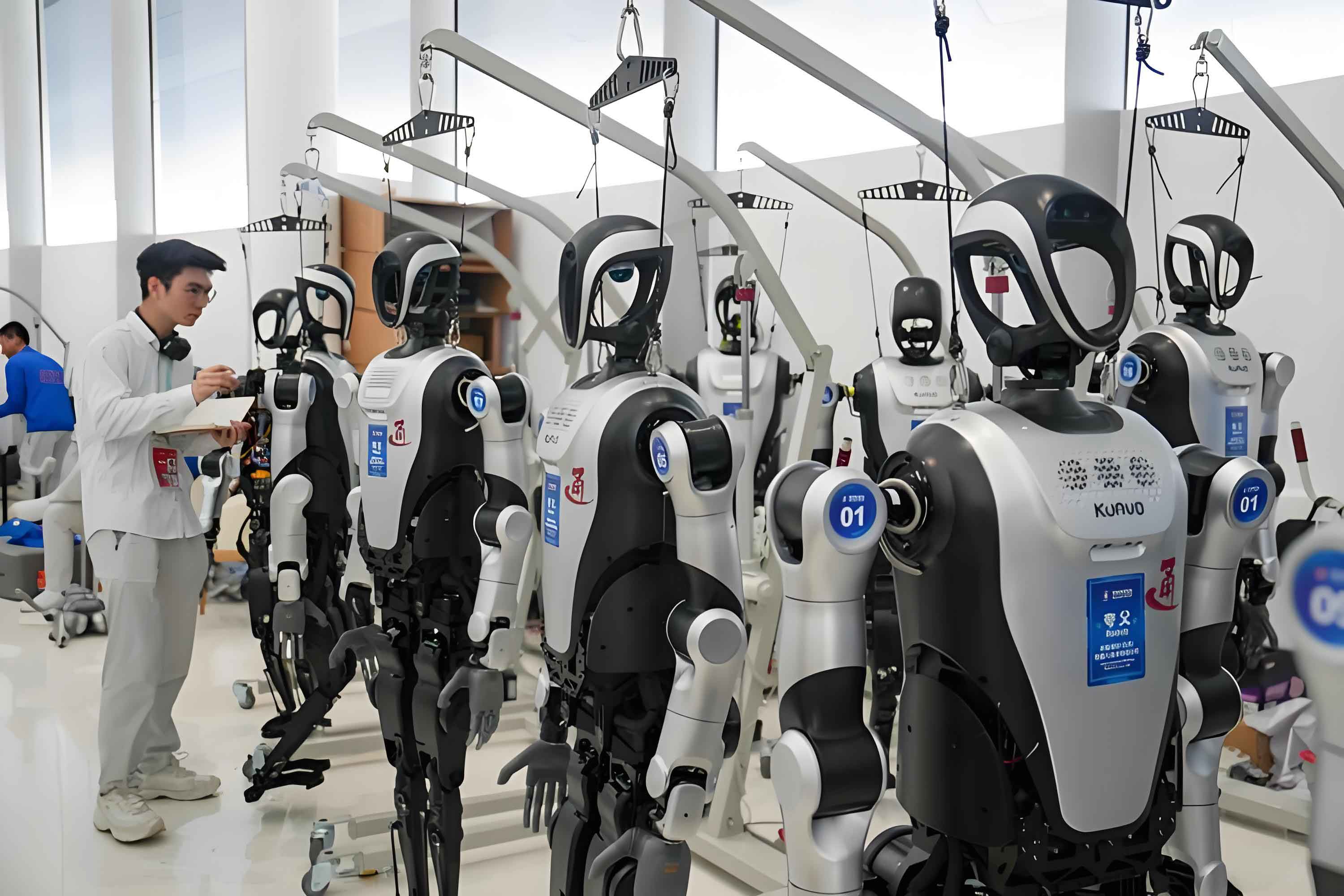
The industrial roadmap of our humanoid robot follows three phases. In the first phase, we focused on new-energy vehicle manufacturing as the entry point. The tasks were relatively simple, such as material handling and quality inspection. In the second phase, the humanoid robot will expand to medium-difficulty tasks, such as fine assembly, precision insertion, and tool operation. We plan to build three to five dedicated application scenarios and then expand horizontally into consumer electronics manufacturing and other industries. In the third phase, the humanoid robot will become a multi-task, general-purpose industrial operator with more than ten distinct skills. This roadmap is deliberately conservative because we want to validate each stage before scaling.
| Phase | Time period | Task complexity | Deployment scope |
|---|---|---|---|
| Phase 1 | 2023–2024 | Handling, inspection, simple installation | Pilot line inside automotive manufacturing |
| Phase 2 | 2025–2027 | Medium-difficulty assembly tasks, 3–5 dedicated scenarios | Multiple automotive plants, consumer electronics |
| Phase 3 | 2028–2033 | Complex tasks, more than 10 generalized skills | General-purpose industrial humanoid robot across industries |
Working with multiple automotive factories has given us a valuable signal. The more time the humanoid robot spends in a real factory, the faster it improves. Factory workers observe the robot and report edge cases. Maintenance engineers notice small vibrations in the joints. Data engineers see the difference between simulated sensor readings and factory floor data. Every issue becomes a new requirement for the next iteration. This is why we believe that the humanoid robot cannot be perfected in a laboratory alone. It must be tested in applications where failure is visible and safety is critical.
Public Demonstrations and the Burden of Proof
The public performance of a humanoid robot is not just marketing. Large-scale public events are among the harshest tests for a robot. In a laboratory, the lighting is stable, the floor is flat, and there are no journalists standing in the way. On a public stage, the humanoid robot must perform under unfamiliar lighting, electromagnetic interference, time pressure, and unpredictable human behavior.
I still remember the year when we sent hundreds of compact humanoid robots to a national television gala. Every unit had to move in synchrony, and a single failed Wi-Fi synchronization could have made the whole performance chaotic. It was a risk, but the engineering team prepared carefully. The event helped the public see that a humanoid robot was not a fictional image from a movie but a real product that could operate in a coordinated group. It also earned a Guinness World Record, which was a memorable moment for the whole team.
After that, our humanoid robot appeared in many international events, including world expositions and major sporting ceremonies. In each case, the robot had to be reliable, safe, and easy to operate for the host team. These events were open to millions of people, and the pressure to perform was enormous. The success of these public demonstrations gave us confidence that the humanoid robot is ready to interact with non-expert users.
Public demonstrations also shaped our design philosophy. A humanoid robot intended for showcase must have a beautiful appearance, low noise, and natural gestures. A humanoid robot intended for industry must have high payload, robustness, and easy maintenance. Those two requirements are not always aligned. Our engineering team learned to separate the core motion technology from the outer shell and the interaction interface. The same servo actuator and control algorithm can power both a charismatic public-facing robot and a rugged industrial robot.
| Type of public deployment | Main challenge for the humanoid robot | Engineering lesson |
|---|---|---|
| Television gala | Time synchronization, reliable communication, mass coordination | Fault-tolerant wireless protocol |
| International exposition | Long working hours, frequent interaction with visitors | Battery management and thermal stability |
| Sporting ceremony | Dynamic lighting, noisy acoustics, complex stage layout | Robust perception under changing conditions |
These public appearances also influenced investors’ perception of the humanoid robot. When investors see a robot walking on a stage, they can understand the maturity level in a more intuitive way than reading a technical white paper. That trust was important when we prepared for our initial public offering. The listing ceremony, in which our own humanoid robot struck the gong, was the clearest possible demonstration that the company had reached a new stage of financial and technical maturity.
Cost, Scale, and Patience
One of the most uncomfortable questions we are asked is: “When will the humanoid robot become cheap enough for mass adoption?” The honest answer is that it will take time. The humanoid robot is a thousand-part machine, and many of its components are still low-volume products. High-performance servo actuators, lightweight structural materials, and reliable battery systems are expensive. The cost curve will fall only when demand rises enough to justify production lines with large volumes.
For a factory producing a humanoid robot, the break-even quantity can be written as:
$$
Q^* = \frac{F}{P – C}
$$
where $Q^*$ is the annual production quantity needed to break even, $F$ is the fixed annual cost, $P$ is the average selling price of a humanoid robot, and $C$ is the variable unit cost. If $P – C$ is negative, mass production only increases losses. The correct strategy is to increase unit value before decreasing unit cost. That is why our first deployments are in automotive factories, where the robot can produce measurable value through labor-hour savings, process consistency, and flexible automation.
There is also a learning curve for the humanoid robot. The unit cost of a complex product tends to decline with cumulative production according to the relationship:
$$
C(Q) = C_0 Q^{-\alpha}
$$
where $C_0$ is the initial unit cost, $Q$ is cumulative production quantity, and $\alpha$ is the learning exponent. A steep learning curve can be achieved only through disciplined design-for-manufacturing. We reuse actuator families, common software modules, and standardized connectors across different humanoid robot models. This reduces the number of new parts in each generation and lowers the risk of supply chain disruptions.
Premature mass production is dangerous. If a company produces tens of thousands of humanoid robots before the product is reliable, it will face recalls, high warranty costs, and disappointed customers. The industry needs patience. The humanoid robot is not like a consumer gadget that can be refreshed every year. It is a capital asset, a production machine, and sometimes a human companion. The engineering culture has to match that reality.
| Cost driver | Challenge | Our mitigation strategy |
|---|---|---|
| Servo actuators | High precision and torque density | In-house design, shared parts across robots |
| Lightweight structure | Strong but expensive materials | Topology optimization and additive prototyping |
| Perception computing | High-power GPU/edge processors | Model distillation and custom neural accelerators |
| Data collection | Labor intensive teleoperation | Simulation expansion and automatic labeling |
| Field maintenance | Rare failures are hard to debug | Remote monitoring, digital twin logs, fast diagnostics |
“Sitting on a cold bench” is an expression that describes the ability to endure long years of research without immediate returns. In the humanoid robot community, this patience is not a weakness. It is a necessary condition for success. Every major breakthrough in robotics has required years of incubation. The humanoid robot will be no different.
Data, Simulation, and the Road to Generalization
The current generation of the humanoid robot is still heavily reliant on data. We need real-world demonstrations for tasks such as inserting a connector, turning a valve, or picking an irregular object. We also need simulation data to cover edge cases that would be dangerous to produce in the real world. The balance between real and simulated data is one of the most active areas of research in our company.
Simulation enables domain randomization. We can change the physical properties of the environment in each trial so that the policy of the humanoid robot does not overfit to one exact setting. A simple formalization is:
$$
s_{\text{sim}}^{(k)} = s_{\text{nominal}} + \delta^{(k)}
$$
$$
\delta^{(k)} \sim \mathcal{N}(0, \Sigma_k)
$$
where $s_{\text{nominal}}$ is the nominal state/value of a physical parameter, $\delta^{(k)}$ is a random perturbation sampled for trial $k$, and $\Sigma_k$ controls the magnitude of variation. By randomizing mass, friction, joint damping, sensor latency, and lighting, we train a humanoid robot policy that is more robust when transferred from simulation to reality.
We also use high-fidelity simulation for whole-body motion planning. Before a humanoid robot attempts a task in the real world, it can mentally simulate thousands of candidate trajectories. The optimal trajectory can be selected by minimizing a cost function:
$$
J_{\text{ctrl}} = \sum_{t=0}^{H} c(s_t, u_t)
$$
subject to the dynamics constraint:
$$
s_{t+1} = f(s_t, u_t)
$$
where $s_t$ is the state, $u_t$ is the control input, and $c$ is a cost function that includes collision avoidance, energy consumption, smoothness, and task error. This kind of model-based planning is combined with learning-based perception so that the humanoid robot can handle new objects without manual programming.
In the real world, data collection is accelerated by teleoperation. An operator wears a data suit or uses a master arm to guide the humanoid robot through a task. The collected data are stored as state-action pairs:
$$
\mathcal{D} = \left\{ (s_0, a_0, s_1), (s_1, a_1, s_2), \dots \right\}
$$
The humanoid robot can later reproduce the behavior from those demonstrations. The more diverse the demonstrations, the wider the generalization envelope. We intentionally collect data from different operators, different factory layouts, and different object positions. Diversity is as important as volume.
| Data source | Advantages | Limitations |
|---|---|---|
| Teleoperation in the real world | Accurate physics, fine sensor data | Slow, expensive, limited by operator skill |
| Synthetic simulation | Low cost, scalable, safe | Sim-to-real gap, unrealistic contacts |
| Autonomous trial and error | Discovers novel strategies | Potentially unsafe, slow without simulation |
| Human motion capture | Natural movement style | Hard to map to robot joints and forces |
The goal is not to collect all possible data. The goal is to build a learning system in which the humanoid robot can transfer from one task to another quickly. If a robot has learned to pick a cup, it should be able to pick a bottle with only a few additional demonstrations. If it has learned to tighten a bolt in one car model, it should be able to tighten a bolt in another car model by updating the target point. This kind of generalization is the only path to a general-purpose humanoid robot.
Toward the Home and Everyday Life
Industrial deployment is our near-term focus, but the long-term vision is broader. A humanoid robot that can work in a factory can eventually cook, clean, and care for people at home. The gap between the factory and the home is not only technical. A home environment is unstructured, cluttered, and full of soft objects and unpredictable pets. The humanoid robot at home must be safe at slow speeds, responsive to voice commands, and aware of human emotions and preferences.
We are now developing a humanoid robot designed for family companionship scenarios. This robot will not need the same payload capacity as an industrial humanoid robot. It will need better noise control, softer interaction surfaces, and a more expressive communication system. It must be able to recognize family members, remember daily routines, and decide when to act and when to remain quiet. These requirements push the boundaries of embodied intelligence and social robotics.
The home is also a more severe economic test than the factory. A factory line can pay for a humanoid robot through measurable productivity improvements. A home user buys a humanoid robot from disposable income or caregiving needs. The price needs to be much lower, and the reliability expectation is even higher. A robot that breaks down in a factory is annoying; a robot that breaks down while helping an elderly person can be dangerous.
We believe the home humanoid robot will evolve from the technology base of the industrial humanoid robot. The servo actuators, perception modules, and planning algorithms will be reused, but the form factor and software personality will be different. This is similar to the way commercial aircraft technologies often flow from industrial and transportation markets to private aviation. The humanoid robot industry will follow the same pattern: first prove safety and reliability in controlled environments, then expand to open-ended environments.
| Requirement | Industrial humanoid robot | Home companion humanoid robot |
|---|---|---|
| Payload capacity | High payload for heavy parts | Low payload, gentle manipulation |
| Speed | Fast cycle time | Slow, comfortable, safe speed |
| Interaction mode | Structured commands, PLC interfaces | Natural language, gestures, emotional cues |
| Failure response | Manual reset, maintenance crew | Self-recovery, user-friendly explanation |
| Sound and motion | Functional, not aesthetically constrained | Quiet, smooth, socially acceptable |
We are not claiming that the home humanoid robot is ready tomorrow. We are saying that the roadmap exists. The first generation of industrial humanoid robot deployments gives us the revenue, engineering data, and reliability testing needed to support more ambitious applications. The humanoid robot is not a single product. It is a platform that will serve many industries over many generations.
Humanoid Robot and the Future of Work
Some people fear that the humanoid robot will replace human workers. In my experience, the humanoid robot is more likely to change the nature of work than to eliminate it. In the automotive factories we have worked with, the humanoid robot is used for physically repetitive tasks, tedious quality checks, and dangerous transfers. Workers are then moved to higher-value tasks such as process planning, robot supervision, maintenance, and handling exceptions that require common sense.
The humanoid robot can also serve as a flexible automation tool for small and medium factories. Traditional industrial robots are fixed or expensive to reprogram. A humanoid robot can walk into a workstation, use the same tools as a human worker, and move to another workstation when the batch changes. This flexibility creates a new type of production system, where the humanoid robot is not an extra machine but a general-purpose teammate.
From a national competitiveness perspective, the humanoid robot is a strategic technology. It combines artificial intelligence, advanced manufacturing, sensor technology, and human-robot interaction. Countries that lead in the humanoid robot will have an advantage in the next wave of smart manufacturing. That is why investment and policy support have increased around the world. The technology is no longer contained in science fiction films. It is being tested on real assembly lines, in real logistics centers, and eventually in real homes.
The development of the humanoid robot also strengthens the upstream supply chain. Servo actuators with high torque density can be used in other robots, prosthetics, exoskeletons, and electric vehicles. Super-light structural design methods can be transferred to aerospace. Real-time simultaneous localization and mapping can be used in autonomous driving and logistics. Therefore, investment in the humanoid robot is not an isolated bet. It is an investment in the deep technology capability of the whole robotics industry.
Looking Back at the Road Traveled
If I look back at the last twelve years, I can see many moments when the project could have failed. The first humanoid robot prototype could not walk more than a few steps. The compact humanoid robot series faced fierce price competition. The large humanoid robot project required years of difficult work before it could perform stable bipedal motion. In each crisis, the solution was not magic. It was systematic engineering, patient capital, and a team that refused to abandon the humanoid robot dream.
What kept us going was not the hype. It was the observation that the human body is a highly optimized platform for the physical world. A humanoid robot can use the same tools that humans use, climb the same stairs, open the same doors, and operate in the same buildings. This compatibility is extremely valuable in factories, warehouses, hospitals, and homes. It means that the humanoid robot will always have a natural advantage over specialized machines when the task is varied and the environment is designed for human beings.
The financial listing of our company was not the end of the road. It was the beginning of a new phase. The capital market gave us the ability to invest in large models, simulation infrastructure, and next-generation actuators. It also gave us a public responsibility to deliver on our promises. We know that every milestone of the humanoid robot will be watched more closely than before. There is no room for overclaiming.
One of the greatest changes in the industry is the convergence of robot learning and large-scale language models. In the past, a humanoid robot was a mechanical machine with a limited intelligence shell. Today, the humanoid robot is becoming an embodied model that can perceive, reason, plan, and act in the physical world. The same model can read a manual, understand a task, and control the robot’s body to execute it. This shift will accelerate the entire field.
We have also learned that the humanoid robot needs a realistic metric system. Walking speed, torque density, and precision are not sufficient. A useful metric must include task completion time, reliability, safety, energy consumption, and economic payback. If a humanoid robot can work in a factory for eight hours with only one human intervention, it is far more valuable than a robot that is slightly faster but needs constant supervision. We measure the mean time between interventions as carefully as we measure walking speed.
The Road Ahead
In the next two years, our focus will be on reducing the gap between laboratory demonstrations and industrial endurance. The humanoid robot will need to operate in longer shifts, under harsher thermal conditions, and with less human support. The perception system will need to handle almost every variation of parts, lighting, and worker movement. The planning system will need to recover from failures in real time. This is not just an incremental challenge; it is a systems engineering battle.
We also plan to expand the humanoid robot ecosystem. No single company can solve every problem in the humanoid robot industry. We need partners in sensor design, AI chips, simulation software, and application development. By opening some of our interfaces and making our development platform more accessible, we can accelerate the pace of innovation. The humanoid robot is too complex to be built by one company in isolation.
The physical design of the next-generation humanoid robot will also change. We want to reduce the volume of the body, make the outer appearance more fluid, and increase power density. These improvements will make the robot more acceptable to human users. A humanoid robot standing in a home should not look like a heavy steel experiment. It should look like a safe, elegant, and friendly assistant. The technical path from today’s prototype to that vision is full of engineering trade-offs, but the direction is clear.
I believe the humanoid robot will pass through several waves of expectations. There will be overestimation, disappointment, and then real adoption. We are already in the early phase of real adoption. The fact that the humanoid robot is working in automotive factories, and not just standing on a display podium, is evidence of that. The transition from pilot project to routine tool will not happen overnight, but it is already underway.
Conclusion: The Humanoid Robot Is Not a Dead End
I return to the question that shaped this article. Is the humanoid robot a dead end? Our experience says no. The humanoid robot has survived the hardest test of all: the transition from laboratory curiosity to capital market scrutiny. It has stood on public stages, gala nights, international expositions, and industrial assembly lines. It has walked, danced, picked, placed, tightened, inspected, and learned. It has attracted tens of thousands of test hours and billions of dollars in cumulative investment. Most importantly, it has begun to earn its place through economic value rather than novelty.
A humanoid robot is not a dead end because the world around us is built for the human body. A robot that shares that body plan will always be able to operate in the same spaces, use the same tools, and collaborate with the same people. The engineering challenge is enormous, but the destination is worth the journey.
The first step is self-sustaining research and development. The second step is full-stack technology. The third step is generalization through large models. The fourth step is industrial deployment. The fifth step is cost reduction through scale. We have completed the first four steps in part, and the fifth step is a matter of time and discipline. The humanoid robot is a long race, but every mile changes the picture.
When the listing ceremony ended and the gong sound faded away, the humanoid robot stepped off the stage in a controlled and stable way. To me, that was the perfect metaphor. The dramatic moment was only a few seconds, but the real achievement was that the robot kept walking after the applause ended. That is where the humanoid robot industry is today. The applause will come and go, but the humanoid robot will keep walking forward.