
The second World Humanoid Robot Games closed on August 26, 2026, after a final competition day and a closing ceremony that brought the event to a complete and celebratory end. The gathering was more than a schedule of contests. It was a concentrated view of how the humanoid robot is moving from the high-precision laboratory into high-intensity movement and complex real-world environments. Across track and field, tennis, combat, garden service, hotel operations, family tasks, library work, and emergency response, the humanoid robot was placed under pressure that demanded speed, balance, perception, prediction, decision-making, and long-sequence execution. The closing ceremony marked the finish of the competition, but it also marked a visible stage in the development of the humanoid robot as a machine that must function in the human world.
The event was structured to test two broad dimensions of capability. The first was athletic performance, where the humanoid robot was asked to run, turn, jump, recover, and interact at high speed. The second was scenario performance, where the humanoid robot was asked to understand a real environment, identify objects and behaviors, follow rules, and complete practical tasks. Together, these dimensions produced a portrait of a technology that is no longer satisfied with a single clever demonstration. The humanoid robot is being pushed toward integrated autonomy, robust control, and useful deployment. The Second World Humanoid Robot Games made that shift visible in a way that a laboratory report or a staged product video cannot.
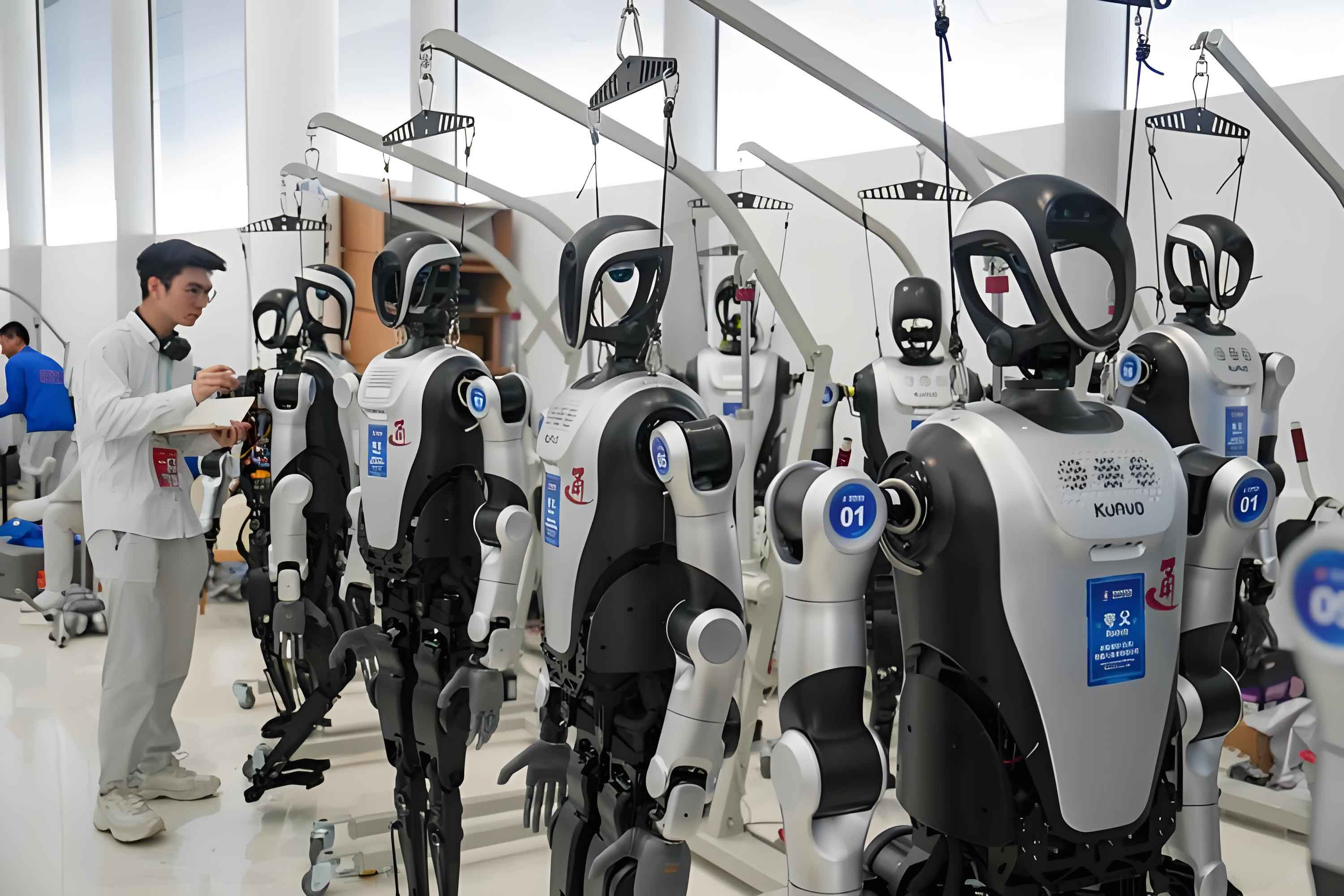
-
A Closing Day That Framed a Broader Shift
On the final day, the remaining competitions concluded and the closing ceremony drew the event to a close. Yet the most important story was not the end of the schedule. It was the accumulation of evidence that the humanoid robot has entered a new phase. In track events, the humanoid robot ran like an arrow released from a bow, turning with agility and maintaining control at speed. On the tennis court, the humanoid robot exchanged high-frequency shots with a human athlete, saved difficult balls, and delivered attacking strokes. In combat events, the humanoid robot performed connected and fluid movements. In garden, hotel, and family scenarios, the humanoid robot responded to complex environments and completed long-process tasks with precision. These images remain vivid after the final whistle.
The Second World Humanoid Robot Games therefore served as a clear mirror. It reflected a leap from the high-end laboratory to high-intensity sport and complex real situations. For the humanoid robot, the meaning of such a leap is profound. A laboratory environment can be controlled, measured, and repeated. A sports arena introduces timing pressure, surface variation, opponent behavior, and the risk of failure in public. A real-world scenario introduces clutter, unpredictable human activity, rules, safety concerns, and the need to finish a task rather than merely begin it. The humanoid robot that can survive both kinds of tests is a humanoid robot that is closer to practical value.
The event also demonstrated that competition can serve as a common language for engineers, researchers, and the public. When a humanoid robot runs a race, the audience can see stability, speed, and control without needing to read a technical paper. When a humanoid robot folds clothing or identifies a prohibited item in a garden setting, the audience can understand the practical challenge. This transparency matters because the humanoid robot is not only a research subject. It is a potential co-worker, service provider, emergency assistant, and household helper. The Second World Humanoid Robot Games turned those possibilities into a visible public narrative.
The final day did not stop the development of the humanoid robot. It simply paused the cheering. The broader movement continues: from athletic limits to diverse scenarios, from single skills to integrated autonomy, and from human intervention to independent perception and decision-making. The Second World Humanoid Robot Games witnessed a remarkable transformation and sketched a future blueprint of human-machine coexistence and intelligent empowerment.
-
Track and Field: Humanoid Robot Performance Redraws Familiar Limits
On the athletics field, the mechanical skeleton and artificial muscle of the humanoid robot were tested again and again. The results were not marginal. They challenged familiar assumptions about what a humanoid robot can achieve in dynamic movement. In the 100-meter race, the Tiangong humanoid robot from the Beijing Humanoid Robot Innovation Center recorded a time of 8.85 seconds, breaking the human record associated with Usain Bolt. In the 1500-meter final, Team Tianzhuo won with a remarkable time of 2 minutes 21.63 seconds, more than one minute faster than the human men’s 1500-meter world record of 3 minutes 26.00 seconds. In standing high jump, 100 meters, 400 meters, and other events, the humanoid robot also delivered performances that surpassed the best human results, refreshing understanding of motion control and physical limits.
These results should not be read as a simple claim that a humanoid robot is now superior to a human athlete in every sense. Athletic competition for humans includes biological limits, fatigue, recovery, diet, psychology, and rules that evolved around the human body. The humanoid robot competes under different constraints. Its performance is shaped by actuators, power systems, thermal management, control frequency, sensor fusion, and algorithmic stability. What the results do show is that the humanoid robot can now operate in a domain that was once considered a stronghold of biological agility. The humanoid robot is no longer limited to slow, cautious, pre-programmed movement. It can run, turn, and compete at a level that demands real-time control.
Event Humanoid Robot or Team Recorded Result Context from the Event 100-meter race Tiangong, Beijing Humanoid Robot Innovation Center 8.85 seconds Broke the human record associated with Usain Bolt 1500-meter final Team Tianzhuo 2 minutes 21.63 seconds More than one minute faster than the human men’s 1500-meter world record of 3 minutes 26.00 seconds Standing high jump Humanoid robot competitors Surpassed human best results Reported as part of the event’s athletics outcomes 100-meter and 400-meter events Humanoid robot competitors Surpassed human best results Reported as part of the event’s athletics outcomes The table above captures only a few of the headline outcomes. The deeper significance is that the humanoid robot is being tested in events that combine explosive power, balance recovery, and continuous control. A 100-meter race is not only about maximum joint speed. It is about starting, accelerating, maintaining a stable gait, limiting lateral deviation, and managing heat and torque. A 1500-meter race adds endurance, pacing, and repeated cycle stability. A standing high jump adds explosive takeoff and landing control. A 400-meter race adds sustained speed with turning and fatigue-like thermal constraints. When a humanoid robot performs across these events, it demonstrates that its motion stack is not narrowly tuned to one trick.
The athletics results also reveal why the humanoid robot is becoming a platform for broader research. The same control architecture that keeps a humanoid robot upright at speed can support safer movement in a factory, a hotel corridor, a garden path, or a home. The same balance recovery that prevents a fall in a race can help a humanoid robot avoid damage when a human bumps into it. The same energy management that allows a humanoid robot to finish a long race can influence battery life and operating cost in real deployment. Sport is not identical to work, but it is a demanding proxy. The humanoid robot that can compete is a humanoid robot that has learned to handle disturbance, timing, and physical uncertainty.
-
Motion Control Models and Reinforcement Learning Drive the Humanoid Robot Forward
Han Gang, a motion control algorithm expert at the Beijing Humanoid Robot Innovation Center, analyzed the source of the improvement. According to Han Gang, the rise in humanoid robot motion performance is fundamentally rooted in the deep integration of motion control large models and reinforcement learning algorithms. This is a crucial point. For years, many humanoid robot movements were designed by hand, with engineers specifying joint trajectories and balance corrections. That approach can work in controlled conditions, but it struggles to cover the enormous variety of surfaces, speeds, disturbances, and task transitions that a humanoid robot encounters in the real world. Large models and reinforcement learning change the scale of optimization.
Han Gang explained that the running posture displayed by the humanoid robot during competition was an optimal solution independently evolved by algorithms after millions of iterations in a virtual physical world. This statement captures the essence of modern learning-based control. The humanoid robot is not simply following a human-written script. It is discovering a gait that satisfies multiple objectives at once. Those objectives include speed, stability, energy efficiency, and thermal safety. The resulting posture effectively reduces joint torque and heat loss while maximizing energy conversion efficiency. In other words, the humanoid robot is learning not only how to move, but how to move in a way that preserves its own hardware.
This matters because the humanoid robot is a physical system with limits. Every joint has a maximum torque. Every actuator produces heat. Every battery stores a finite amount of energy. A movement that looks impressive for a few seconds may be unsustainable if it overheats a motor or drains power too quickly. Reinforcement learning allows the humanoid robot to search for policies that balance performance against durability. The running posture observed in competition is therefore not merely aesthetic. It is a visible trace of an optimization process that connects software intelligence to mechanical survival.
The virtual physical world also plays a central role. Training a humanoid robot in the real world is slow, expensive, and risky. A fall can damage hardware. A test can require human supervision. A single experiment may take minutes or hours. In simulation, the humanoid robot can experience millions of iterations, including unstable states that would be dangerous in reality. The algorithm can explore, fail, adjust, and improve at a speed impossible in physical testing. When the learned policy is transferred to the real humanoid robot, it brings with it a compressed experience of countless simulated attempts. This is why the humanoid robot can appear to learn a natural running style without a human manually designing every detail.
The integration of motion control large models adds another layer. A large model can represent broad patterns of movement, balance, and task context. Reinforcement learning can refine those patterns into precise control policies. Together, they allow the humanoid robot to generalize across tasks. A humanoid robot that learns balance in one setting may transfer part of that ability to another. A humanoid robot that learns to manage torque in a run may use similar principles when carrying a load, stepping over an obstacle, or recovering from a push. The Second World Humanoid Robot Games provided public evidence that this combination is no longer only a research promise. It is producing measurable performance in a humanoid robot.
-
Tennis and Combat: High-Dynamic Interaction Tests Perception and Prediction
In the world’s first public human-robot tennis confrontation, the humanoid robot achieved serving, returning, saving, and even standing up quickly after a fall. It also created a world record of more than one hundred consecutive rally shots. This was one of the most demanding displays of the event. Tennis is not a repetitive track motion. It requires the humanoid robot to perceive a fast-moving ball, predict its trajectory, choose a stroke, move into position, coordinate the upper body and lower body, and recover for the next shot. The opponent is human, so the humanoid robot cannot rely on a fixed script. It must respond to variation, spin, pace, placement, and timing.
Wang He, founder and chief technology officer of Galaxy General Robot, said that complex high-dynamic sports such as tennis place extremely high demands on the humanoid robot’s perception, prediction, and dynamic game abilities. This assessment identifies the core difficulty. A humanoid robot that can walk in a straight line is impressive. A humanoid robot that can play tennis must solve a moving-target problem in real time. It must estimate where the ball will be, where its own body should be, and how to move its limbs without losing balance. It must also decide whether to attack, defend, or simply keep the ball in play. That decision is a form of dynamic game against a human opponent.
The ability to stand up quickly after a fall is equally important. A fall is not only a loss of balance. It is a potential hardware failure, a safety event, and a temporary loss of task capability. A humanoid robot that can recover from a fall reduces downtime and increases trust. In a real environment, a humanoid robot may trip on an uneven surface, be pushed by a crowd, or misjudge a step. The capacity to return to a standing posture without human assistance is a practical requirement, not a sporting flourish. The tennis court made that requirement visible under public pressure.
In combat events, the humanoid robot displayed connected and fluid movements. Combat is another high-dynamic domain. It requires coordinated strikes, defensive postures, balance shifts, and rapid transitions. The humanoid robot must manage its center of mass while applying force. It must also avoid self-damage and remain stable after impact. The fact that the humanoid robot could perform coherent sequences suggests progress in whole-body control and motion planning. It also suggests that the humanoid robot is becoming more capable of operating in unstructured physical interaction, where contact and momentum are unavoidable.
Wang He noted that in the future, safely and sustainably completing high-intensity competition and scenario tasks will become an inevitable trend for humanoid robot events and technology development. The word “sustainably” is important. A humanoid robot may be able to produce a single spectacular movement. The real challenge is to repeat that movement safely, without overheating, without excessive wear, and without constant human repair. High-intensity competition exposes durability problems. Scenario tasks expose autonomy problems. Together, they push the humanoid robot toward a more complete engineering system.
-
Collective Performance: Humanoid Robot Swarms Without External Base Stations
Collective events also carried significant technical weight. Xu Zhiyuan, head of the motion control department at the Beijing Humanoid Robot Innovation Center, pointed to cheerleading as an example. The humanoid robot has achieved three major capability loops. The first is autonomous odometry and state estimation without an external base station. The second is multi-machine swarm cooperative control uniformly scheduled by a platform hub. The third is stable reproduction of high-difficulty movements such as jumps and turns. These three loops form a complete chain from self-localization to group coordination to precise execution.
The absence of an external base station is a major step for the humanoid robot. Many demonstrations rely on external motion capture, radio beacons, or fixed infrastructure to tell the humanoid robot where it is. That approach can work in a staged environment, but it limits deployment. If a humanoid robot needs a base station to function, it cannot easily enter a new building, a park, a disaster site, or a temporary event space. Autonomous odometry and state estimation allow the humanoid robot to understand its own motion and position using onboard sensors and internal models. This is a foundation for independence.
Multi-machine swarm cooperative control adds another layer. One humanoid robot can perform a solo routine. Multiple humanoid robots must coordinate their positions, timing, and movements. A small error in one humanoid robot can cascade into collision or chaos. A platform hub that uniformly schedules the group provides a central layer of coordination, while each humanoid robot still needs local control to execute its part. This combination of central scheduling and distributed execution is relevant beyond entertainment. In warehouses, hospitals, hotels, and emergency scenes, multiple humanoid robots may need to share space, avoid interference, and divide tasks. The cheerleading routine is a controlled test of that capability.
Stable reproduction of jumps and turns is the third loop. These movements are difficult because they involve flight phases, landing impact, and rapid orientation changes. A humanoid robot that can repeat them reliably has strong whole-body control. The audience sees choreography. The engineer sees state estimation, trajectory generation, landing control, and actuator coordination. When these three loops operate together, the humanoid robot is not merely following a timeline. It is maintaining a shared spatial and temporal understanding with other humanoid robots while executing dynamic movement.
Xu Zhiyuan said that the competition validated the humanoid robot’s base-station-free cluster performance ability and laid a solid technical foundation for deployment in event activities, cultural tourism, commercial scenarios, and other settings. This is a practical claim. A base-station-free humanoid robot swarm could support performances, guided tours, interactive exhibits, and service operations in spaces that cannot be permanently instrumented. The humanoid robot becomes easier to transport, install, and operate. The value of the collective event is therefore not only visual. It is a test of infrastructure independence.
-
Scenario Competition: Real Environments Push Humanoid Robot Autonomy
If athletic events tested the physical limits of the humanoid robot, scenario competitions directly addressed its ability to integrate into real production and daily life. These scenarios were not simple pick-and-place demonstrations. They required the humanoid robot to understand an environment, follow social or safety rules, and complete tasks that unfold over time. The outdoor garden scenario was a strong example. The environment included green trees and uneven pavement, creating a severe test for the humanoid robot. The ground was not a flat laboratory floor. The visual scene was cluttered. People and objects could appear unexpectedly.
In the competition, the humanoid robot could scan and identify a camping cart carrying prohibited items such as a cassette stove and provide a voice prompt. It could also automatically recognize uncivil behavior, such as lying on a seat, and offer civilized persuasion. These tasks combine perception, classification, decision-making, and speech interaction. The humanoid robot must not only see an object. It must understand the rule attached to that object. It must not only detect a person. It must interpret behavior in context. This is a higher level of intelligence than obstacle avoidance. It is social and regulatory understanding.
Liu Rujie, a relevant person in charge at Fujitsu Research and Development (China), told reporters that the garden scenario is a very good technology testing ground. It allows comparison between laboratory simulation environments and real environments. It helps identify shortcomings in actual combat and accumulates valuable measured data for subsequent algorithm iteration. This statement reflects a central theme of the event. The humanoid robot improves through contact with reality. Simulation is powerful, but it cannot perfectly capture every material, lighting condition, human behavior, or sensor noise. A real garden introduces differences that force the algorithm to adapt.
In the family scenario, the humanoid robot also demonstrated the ability to complete high-complexity long-process tasks such as folding clothes and tidying. These tasks are difficult for several reasons. Clothing is deformable. Its shape changes with every movement. Folding requires bimanual coordination, force control, visual feedback, and sequential planning. Tidying requires object recognition, placement decisions, and spatial memory. The humanoid robot must maintain context across many steps. A failure at an early step can affect later steps. The audience watched with admiration because the tasks are familiar to humans but difficult for machines.
The event also included a library, hotel, and emergency firefighting scenarios, among other work settings. Each scenario places different demands on the humanoid robot. A library may require quiet operation, navigation among shelves, and careful handling of materials. A hotel may require guest interaction, item delivery, and cleaning support. Emergency firefighting may require rapid response, hazard recognition, and operation in a dangerous environment. The humanoid robot cannot be designed for only one of these settings. It must carry a general core of perception, mobility, manipulation, and decision-making that can be adapted to each context.
The scenario competitions therefore did more than entertain. They exposed the gap between a humanoid robot that can perform a rehearsed routine and a humanoid robot that can work in an unpredictable world. They showed that the humanoid robot is beginning to handle long-horizon tasks, not only short commands. They also showed that real environments are essential for measuring progress. The humanoid robot that succeeds in a garden, a family room, a library, a hotel, and an emergency scene is a humanoid robot that has learned to generalize.
-
Rules That Reward Autonomy: The 1.0 Versus 0.5 Scoring Signal
In the scenario competitions, the rules placed greater emphasis on the autonomy and practicality of the humanoid robot. Gong Xiao, a member of the event organizing committee and deputy director of the China Software Testing Center, pointed out that the scoring weight for fully autonomous methods was 1.0, while the weight for teleoperation was only 0.5. The coefficient difference was double. This rule design was intended to guide the humanoid robot away from dependence on human intervention and toward genuine autonomous perception and decision-making, so that it can become a good helper for humans.
This scoring choice is significant. Teleoperation can make a humanoid robot appear capable while a human operator supplies the intelligence. The humanoid robot becomes a remote-controlled body. That approach has value in dangerous or precise situations, but it does not demonstrate autonomy. If the goal is a humanoid robot that can work independently, the scoring system must reward independence. By giving autonomous operation a weight of 1.0 and teleoperation a weight of 0.5, the event sent a clear signal. The humanoid robot that can perceive, decide, and act on its own is the humanoid robot that earns the higher score.
Autonomy is not a single switch. It is a spectrum. A humanoid robot may be autonomous in navigation but require help in manipulation. It may be autonomous in perception but require a human to select a task. It may be autonomous in a known environment but fail in a new one. The scenario rules push the humanoid robot toward higher levels of autonomy across the entire task. The humanoid robot must understand the goal, interpret the environment, plan a sequence, execute actions, monitor progress, and recover from errors. This is a much harder problem than following a remote command.
Wang He analyzed that the leap in scenario difficulty strongly tested the true capability boundary of embodied large models. The humanoid robot has the ability of “one brain, many uses.” This phrase captures an important ambition. A single model or architecture should support many tasks rather than requiring a separate program for every scenario. The humanoid robot should be able to transfer knowledge from one task to another. However, Wang He also noted that in unfamiliar scenarios, the humanoid robot still faces bottlenecks such as data collection and cost performance. Data collection is difficult because real-world tasks are diverse and expensive to record. Cost performance matters because a humanoid robot must be economically viable, not only technically impressive.
As the generalization ability of models improves, the cost of training new tasks will decline rapidly. This is a reasonable expectation based on the direction of the field, and it is supported by the event’s emphasis on embodied large models. A humanoid robot that can draw inferences from one instance and apply them to another will need less data for each new task. It will be able to adapt faster. The humanoid robot is accelerating away from pre-set scripts and moving from the competition field toward broad real-world application scenarios. The 1.0 versus 0.5 rule is not just a scoring detail. It is a statement about what the humanoid robot must become.
-
From Competition Field to Real-World Deployment
The Second World Humanoid Robot Games offered a rare opportunity to observe the humanoid robot across a wide range of tasks in a short period. The event connected athletic performance with practical service. A humanoid robot that runs quickly may also need to move efficiently through a hotel corridor. A humanoid robot that recovers from a fall on a tennis court may also need to recover after a slip in a garden. A humanoid robot that coordinates with other humanoid robots in a cheerleading routine may also need to coordinate in a warehouse or an emergency response. The competition field is not the final destination. It is a proving ground.
One of the clearest lessons is that the humanoid robot must be evaluated as an integrated system. A fast actuator is not enough. A powerful model is not enough. A good sensor is not enough. The humanoid robot must combine hardware, control, perception, planning, interaction, power, thermal management, and safety. A weakness in any one area can limit the whole. The track events stress the hardware and control loop. The tennis event stresses perception and prediction. The scenario events stress autonomy and long-horizon reasoning. The collective events stress coordination and infrastructure independence. Together, they form a multidimensional test.
Another lesson is that autonomy and practicality are becoming the organizing principles. The scoring rule that gave autonomous operation a weight of 1.0 and teleoperation a weight of 0.5 made this explicit. The humanoid robot that depends on a human operator is not yet the humanoid robot that can be deployed at scale. The humanoid robot that can perceive its environment, decide what to do, and execute a long task without constant intervention is the humanoid robot that can create real value. This does not mean teleoperation has no role. It means the direction of development is toward greater independence.
The event also showed that real-world scenarios are powerful drivers of innovation. The garden scenario forced the humanoid robot to deal with uneven ground, trees, people, and rule-based behaviors. The family scenario forced the humanoid robot to handle deformable objects and long sequences. The library, hotel, and emergency scenarios forced the humanoid robot to consider different social and safety contexts. Each scenario generated data and exposed weaknesses. That data is valuable because it comes from reality. The humanoid robot learns from the gap between simulation and the physical world.
The humanoid robot is also becoming a platform for public imagination. When people see a humanoid robot playing tennis, folding clothes, or responding to an uncivil behavior, they begin to form expectations. Those expectations include safety, reliability, privacy, and usability. The humanoid robot must meet not only technical benchmarks but also social ones. The Second World Humanoid Robot Games placed those social dimensions on the same stage as athletic achievement. The humanoid robot was not just a machine in motion. It was a participant in human spaces.
For industry, the event suggests that the humanoid robot is moving from isolated capability demonstrations toward integrated product development. The companies and research centers involved are working on motion control, embodied models, autonomous navigation, swarm coordination, and scenario understanding. These capabilities must eventually converge into a humanoid robot that is safe, affordable, maintainable, and useful. The competition helps identify which capabilities are mature and which still need work. It also helps align public understanding with engineering reality.
-
What the Second World Humanoid Robot Games Demonstrated
The event demonstrated that the humanoid robot has made a genuine leap in high-intensity motion. The 100-meter result of 8.85 seconds by Tiangong, the 1500-meter result of 2 minutes 21.63 seconds by Team Tianzhuo, and the other athletics outcomes that surpassed human best results are not isolated curiosities. They are evidence that the humanoid robot can now achieve dynamic performance that was previously associated with biological systems. The humanoid robot is learning to run, turn, balance, and manage energy in ways that were difficult to engineer by hand.
The event demonstrated that the humanoid robot is becoming more capable in high-dynamic interaction. The public human-robot tennis confrontation produced serving, returning, saving, and rapid recovery after a fall. It also produced a world record of more than one hundred consecutive rally shots. Combat events showed connected and fluid movements. These performances require perception, prediction, and dynamic game ability. They show that the humanoid robot can operate in unstructured, adversarial, and fast-changing situations.
The event demonstrated that the humanoid robot can coordinate in groups without external base stations. The cheerleading performance validated autonomous odometry and state estimation, platform-hub scheduling for multi-machine swarm cooperative control, and stable reproduction of jumps and turns. These capabilities are relevant to event activities, cultural tourism, commercial scenarios, and other settings. The humanoid robot is becoming less dependent on fixed infrastructure.
The event demonstrated that the humanoid robot can begin to handle real-world scenarios. In the garden scenario, the humanoid robot identified prohibited items and responded to uncivil behavior. In the family scenario, it folded clothes and tidied. It also entered library, hotel, and emergency firefighting scenarios. These tasks require autonomy, long-process planning, and practical decision-making. The scoring rule of 1.0 for full autonomy and 0.5 for teleoperation reinforced the direction. The humanoid robot must become a helper, not a remote-controlled puppet.
The event demonstrated that embodied large models are being tested against real boundaries. Wang He noted the humanoid robot’s “one brain, many uses” ability and identified data collection and cost performance as bottlenecks in unfamiliar scenarios. He also predicted that as model generalization improves, new task training costs will fall rapidly. The humanoid robot is accelerating away from pre-set scripts and moving toward broad real-world application scenarios. The competition field is helping to measure that progress.
-
Outlook: The Pace of Humanoid Robot Development Continues
The cheering in the competition venue has paused, but the pace of the humanoid robot industry has not stopped. The Second World Humanoid Robot Games witnessed a remarkable transformation and sketched a future blueprint of human-machine coexistence and intelligent empowerment. From the refresh of athletic limits to breakthroughs in diverse scenarios, the event showed that the humanoid robot is not standing still. It is improving in motion, perception, autonomy, coordination, and practical task completion.
The next stage for the humanoid robot will require continued work on reliability, safety, energy efficiency, and cost. A humanoid robot that can win a race must also be able to operate for a full work shift. A humanoid robot that can play tennis must also be able to work near people without causing harm. A humanoid robot that can fold clothes must also be able to handle unfamiliar garments and unexpected obstacles. A humanoid robot that can perform in a swarm must also be able to share space with humans and other machines. These are engineering and design challenges, but the direction is clear.
The event also suggests that competition will remain a useful tool for the humanoid robot. Competition creates standardized tests, public benchmarks, and pressure that reveals weaknesses. It motivates teams to improve. It allows the public to see progress. It brings together hardware, software, and scenario expertise. The humanoid robot benefits from this kind of focused challenge. The Second World Humanoid Robot Games is therefore not only a celebration. It is a measurement instrument for the field.
As the humanoid robot moves from the laboratory to the sports arena and from the sports arena to the real world, the relationship between humans and machines will continue to evolve. The humanoid robot will not replace all human work, nor should it. It will take on tasks that are dangerous, repetitive, physically demanding, or difficult to staff. It will assist in emergencies, support service industries, and provide companionship or care in some settings. The humanoid robot will need to be trustworthy, understandable, and safe. The event’s scenario competitions and autonomy rules point in that direction.
The Second World Humanoid Robot Games closed with a ceremony, but its most lasting output is a clearer picture of the humanoid robot’s trajectory. The humanoid robot is learning to move with speed and grace. It is learning to perceive and predict. It is learning to coordinate with others. It is learning to understand rules and complete long tasks. It is learning to act without constant human control. The humanoid robot is still far from perfect, but the distance between the laboratory and real life is shrinking. The event showed that the humanoid robot is no longer only a promise. It is a rapidly developing technology with visible momentum, and its next leap will be watched closely.