
The recent conclusion of the World Humanoid Robot Sports Meet marked a pivotal moment in the realm of advanced robotics, bringing together a global assembly of innovators and enthusiasts. This landmark event, held at a specially adapted venue, featured intense competitions that highlighted the rapid progress and immense potential of humanoid robot technology. With participation from 280 teams across 16 countries spanning five continents, the sports meet organized 487 matches across 26 diverse categories, including athletic contests, performance showcases, scenario-based simulations, and peripheral challenges, ultimately awarding 26 gold medals to the most accomplished humanoid robot participants. The gathering not only provided a platform for showcasing cutting-edge humanoid robot capabilities but also fostered international collaboration and knowledge exchange, setting the stage for future advancements in the field.
At the heart of the sports meet were the athletic events, which captivated audiences with dynamic displays of humanoid robot agility and speed. Humanoid robots of varying heights and designs sprinted on a custom-built circular track, engaging in races, jumps, and team sports like 3V3 and 5V5 football matches. The sight of these humanoid robots—some sleek and streamlined, others more robust—competing with determination and occasional missteps added a layer of relatability and excitement. Spectators marveled at the humanoid robot athletes as they navigated the course, with their stumbles and recoveries underscoring the authentic challenges of developing stable and efficient humanoid robot systems. One attendee, a student named Li, expressed delight at the novelty, noting that the humanoid robot performances felt genuine and engaging due to their imperfections.
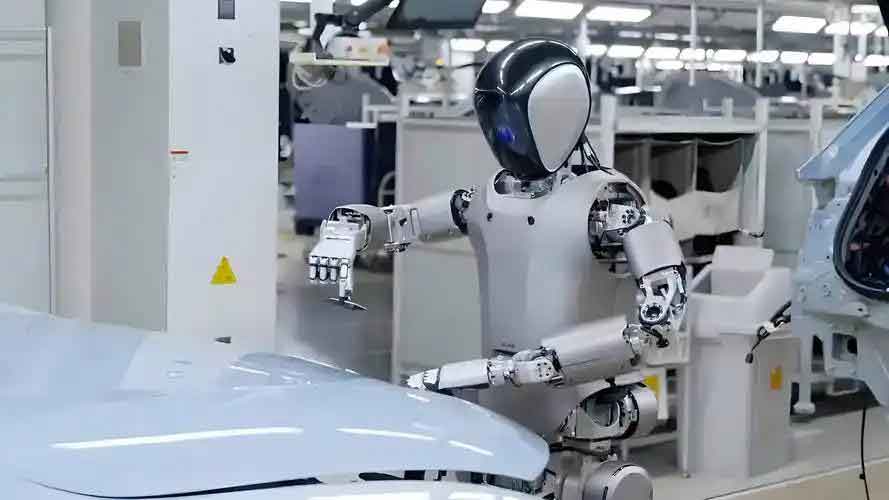
What distinguished this sports meet from previous robotics competitions was its exclusive emphasis on humanoid robot structures. The regulations mandated that each humanoid robot possess a torso, upper limbs, and a bipedal form, with specific requirements for the center of gravity relative to body height. This focus on human-like anatomy aims to push the boundaries of humanoid robot design, ensuring that these machines can better integrate into environments built for humans. While some scenario and performance humanoid robots were exempt from these rules to encourage creativity, the majority adhered to the strict guidelines, highlighting the event’s commitment to advancing humanoid robot technology that mirrors human capabilities.
In an era where quadrupedal robots demonstrate remarkable proficiency in traversing rough terrain, the rationale for investing in humanoid robot development becomes a topic of keen interest. Humanoid robot experts argue that the human form offers superior adaptability to human-centric settings. “Humanoid robot designs have a higher potential for widespread application because they are engineered to operate seamlessly in spaces designed for people,” explained Zhao Yu, a research engineer at the Beijing Institute for General Artificial Intelligence’s Embodied Robot Center and an active participant in the humanoid robot sports meet. “From staircases to kitchen counters, humanoid robot systems can perform tasks that require human-like dexterity and mobility, making them invaluable for future integration into daily life and industries.” This perspective underscores the strategic importance of humanoid robot innovation, as these machines are poised to revolutionize fields such as healthcare, logistics, and domestic assistance by leveraging their anthropomorphic features.
The technological foundation of modern humanoid robot systems represents a significant leap beyond traditional robotics. Unlike earlier models that relied primarily on mechanical engineering and automated controls, contemporary humanoid robot platforms incorporate sophisticated artificial intelligence and deep learning algorithms. This integration enables humanoid robot units to process complex environmental data and interact in real-time through embodied intelligence, where the humanoid robot body serves as a medium for dynamic engagement. The sports meet provided an invaluable hands-on opportunity for students and researchers to debug and refine humanoid robot functionalities. “Direct interaction with humanoid robot technology in a competitive setting accelerates learning and innovation,” remarked Wang Luyang from the Robotics Department at Beijing University of Civil Engineering and Architecture, emphasizing the educational benefits of such humanoid robot events.
Performance events, particularly the single-machine dance competitions, showcased the artistic and technical heights achievable with humanoid robot systems. The champion team, BIGAI-Unitree, invested two months in meticulous preparation for their humanoid robot dance routine. “The single-machine dance project rigorously tests the stability of humanoid robot movements under high-dynamic conditions,” Zhao Yu noted. “Even simple actions, like a single-leg rotation, demand precise control and balance from the humanoid robot, highlighting the intricate challenges of humanoid robot motion planning.” To achieve fluidity, the team utilized motion capture technology to record professional dancers’ movements, which were then translated into humanoid robot commands through redirection techniques. Extensive training in simulation environments allowed the humanoid robot to iteratively adapt its actions, enhancing stability and flexibility over time.
However, the development process for humanoid robot participants was not without obstacles. Teams frequently encountered technical hurdles, such as humanoid robot overheating and computational limitations. “We did not anticipate the humanoid robot systems facing thermal issues during operation,” shared Chen Haoran from the Jtop team of Jiangsu Ocean University, reflecting the unpredictable nature of humanoid robot testing. “In humanoid robot engineering, identifying and resolving such problems is fundamental to progress.” The BIGAI-Unitree team addressed these challenges by optimizing their humanoid robot models to reduce computational load and integrating external hardware to enhance processing power.他们还 navigated on-site complications like wireless interference, demonstrating the resilience required in humanoid robot development. Their efforts culminated in a captivating dance performance where the humanoid robot executed high-difficulty moves, such as single-leg jumps and spins, with remarkable grace. Audience members praised the humanoid robot routine for its human-like elegance and smooth execution.
Beyond the spectacle, the humanoid robot sports meet served as a critical benchmark for the industry’s technological maturity. Each humanoid robot on the field, regardless of its performance level, represented the current frontiers of humanoid robot capabilities and their practical applications. By transitioning from controlled laboratory settings to competitive arenas, humanoid robot technologies underwent real-world validation, revealing both strengths and areas for improvement. This environment also promoted synergy among universities, research institutions, and corporations, facilitating the exchange of ideas and accelerating humanoid robot innovation. “Observing the advanced humanoid robot systems from leading teams has motivated us to study their techniques and push our own humanoid robot projects to new heights,” said Mai Yanheng from the Vision Quest team in a post-competition interview, echoing the collaborative spirit of the event.
The implications of the humanoid robot sports meet extend far beyond entertainment, offering insights into the future integration of humanoid robot systems into society. As humanoid robot technology evolves, events like this will play a crucial role in driving research, standardizing protocols, and expanding the humanoid robot market. The ability of humanoid robot platforms to perform in diverse scenarios—from athletic feats to practical tasks—underscores their versatility and potential to address global challenges. Industry leaders anticipate that humanoid robot advancements will lead to broader adoption in sectors such as manufacturing, elder care, and emergency response, where humanoid robot assistants can enhance efficiency and safety. The sports meet, therefore, not only celebrated current humanoid robot achievements but also inspired continued investment in humanoid robot research and development.
In reflection, the World Humanoid Robot Sports Meet stands as a testament to the rapid progression of humanoid robot technology and its growing impact on various aspects of life. The event highlighted how humanoid robot systems are transitioning from experimental prototypes to functional entities capable of complex interactions. As humanoid robot designs become more refined and accessible, they are expected to play an increasingly prominent role in shaping the future of work, leisure, and innovation. The dance of humanoid robots on the field symbolizes a broader movement toward a world where humanoid robot companions and workers collaborate with humans, driven by shared goals and continuous improvement. This vision of humanoid robot integration promises to redefine possibilities and create new opportunities for generations to come.
Overall, the humanoid robot sports meet provided a comprehensive overview of the state of humanoid robot art, emphasizing both the technical prowess and the imaginative potential of these machines. Through competitive and collaborative endeavors, humanoid robot developers gained valuable insights that will inform future designs and applications. The event’s success underscores the importance of such forums in advancing humanoid robot technology and fostering a global community dedicated to pushing the boundaries of what humanoid robot systems can achieve. As the field moves forward, the lessons learned from this humanoid robot gathering will undoubtedly contribute to more robust, intelligent, and adaptable humanoid robot solutions, paving the way for a future where humanoid robots are an integral part of everyday life.