
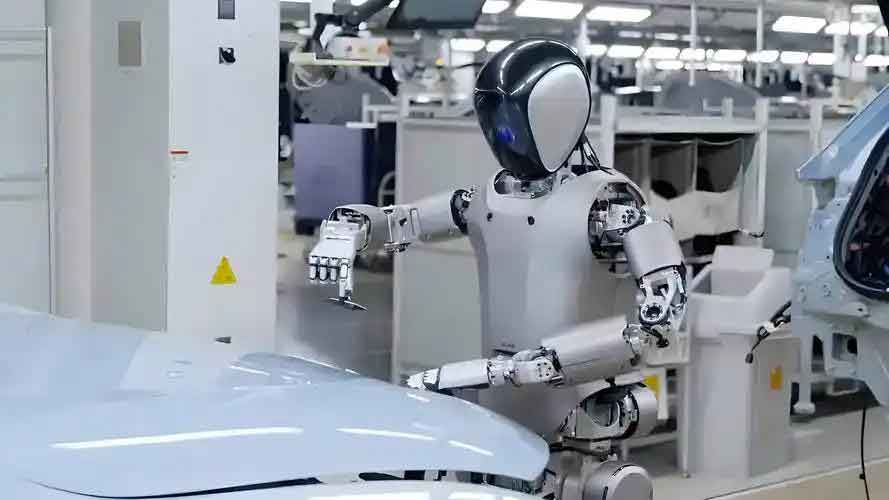
As an emerging product that integrates artificial intelligence, mechanical engineering, integrated circuits, advanced materials, and other cross-domain technologies, the humanoid robot has been widely recognized as a next-generation terminal product following personal computers, smartphones, and new energy vehicles. In recent years, I have observed that many countries and regions around the world have been actively deploying humanoid robot initiatives. The United States has implemented programs such as the National Robotics Initiative 3.0 and the National Artificial Intelligence Research and Development Strategic Plan, treating robot interaction with humans in complex environments as a key research area. Germany has launched a robotics research action plan focusing on AI-based robot algorithms, intelligent industrial robots, service robots, and rescue robots. Japan has issued a new robot strategy to promote itself as the world’s leading robot innovation center. In October 2023, the guiding opinions on the innovative development of humanoid robots in my country pointed out the direction for high-quality development of the humanoid robot industry. Meanwhile, several local governments have also released industrial policies to advance the humanoid robot sector based on local advantages and development plans. Under proper guidance and strong promotion, a full industry chain covering core components, complete machines, and applications has been preliminarily established, forming several industrial clusters.
Current Status of Humanoid Robot Development
Intelligence Level Continuously Upgrading
With the empowerment of multimodal large models, the intelligence level of humanoid robots is steadily improving. In July 2023, a major research lab released the RT-2 model, which was the first to propose a vision-language-action model. Compared with traditional vision-language models, RT-2 introduces action control, enabling humanoid robots to perform tasks in more complex scenarios. In October 2023, the RT-X model was released, consisting of a Transformer-based RT-1-X model and a vision-language-action model RT-2-X. The action instructions were expanded from traditional absolute positions to relative positions, significantly improving the intelligence level of humanoid robots. In March 2024, a prominent humanoid robot company announced a collaboration with an AI research organization to embed multimodal large models into its humanoid robot product. With the support of the large model, the robot demonstrated significantly improved intelligence, including visual recognition, speech recognition, spatial positioning, and tactile feedback, enabling interaction with the environment and users, accurately understanding user instructions, and possessing the ability to learn from the environment and make autonomous decisions. In February 2025, that partnership ended, and the company introduced an end-to-end vision-language-action model for humanoid robots, achieving intelligent perception, interaction, and upper-body motion control capabilities.
Technology Roadmap Becoming Increasingly Clear
Currently, the humanoid robot field has formed relatively clear technical routes in terms of the “brain,” “cerebellum,” and “body.” For the brain, there are four parallel technology routes: large language models, vision-language models, vision-language-action models, and multimodal large models. Among them, the combination of large models with visual foundation models is the most mature solution. For the cerebellum, the field is evolving from model-based control methods toward learning-based control methods, with reinforcement learning and imitation learning as two major solutions. For the body, with the abandonment of traditional hydraulic actuation by a well-known robotics company in April 2024, electric actuation has become the mainstream in the industry. At the same time, some industry consensus has been formed regarding actuators, chips, sensors, and power sources. For instance, for rotary actuators, two major schemes are widely adopted: the high-reduction-ratio scheme (high-speed low-torque motor plus harmonic reducer) and the quasi-direct-drive scheme (high-torque motor plus low-reduction-ratio planetary reducer). In terms of sensors, vision sensors and six-dimensional force/torque sensors are commonly used.
Continuous Emergence of Complete Humanoid Robot Products
Internationally, major technology companies have strengthened their investment in humanoid robots with increasing scale and intensity. In December 2023, a leading electric vehicle company released the second-generation humanoid robot, which showed significant improvements in weight and flexibility compared with the previous generation, only nine months after the first generation was unveiled. In April 2024, a renowned robotics company launched an electrically actuated version of its humanoid robot, achieving world-leading levels of athletic ability and stability. Additionally, multiple models of small humanoid robots have been deployed in many countries and regions. Domestically, several enterprises have been closely following international advanced levels and accelerating the launch of complete humanoid robot products. At a major world artificial intelligence conference in July 2024, multiple humanoid robot complete machines were exhibited, most of which possessed relatively stable capabilities for walking, running, jumping, and standing up.
Initial Application Trials
The application scenarios of humanoid robots can be divided into special application scenarios, manufacturing application scenarios, and service application scenarios. Special application scenarios mainly include hazardous environment operations, emergency search and rescue, deep-sea diving, aerospace, and patrol inspection. These are customized and individualized demands with relatively high technical requirements. For example, deep-sea diving requires strong pressure resistance, while aerospace requires certain radiation resistance and endurance capabilities. At present, industry exploration mainly focuses on manufacturing and service scenarios, which are more general-purpose. In October 2023, a humanoid robot began practical testing in a warehouse of a large e-commerce company. In February 2024, a humanoid robot performed “hands-on training” in an automobile factory, including tasks such as visual quality inspection, seatbelt quality inspection, and car logo assembly. In May 2024, a video showed a humanoid robot “working” in an automotive manufacturing plant, walking freely and completing tasks such as cell sorting and material organization.
Significance of Building a Humanoid Robot Standard System
Overall, the humanoid robot is at a critical stage of concentrated technological breakthroughs, continuous product emergence, and accelerated application exploration. This is precisely the key period for standard research to intervene in industrial development. However, due to the lack of a humanoid robot standard system and the absence of widely recognized technical, safety, and service standards, product compatibility is poor and quality varies greatly. This increases the cost of product development and the difficulty of application promotion, hindering industrial development to some extent. Carrying out standard system construction has the following important meanings for promoting the development of the humanoid robot industry.
Effectively Promoting Industry Collaboration
Most humanoid robot enterprises in my country are small and medium-sized enterprises or startups, with relatively weak market discourse power and industry chain integration capabilities. At the same time, enterprises are all in the free exploration stage, with core components mainly based on customized development and secondary development. The phenomenon of each enterprise fighting alone is widespread, resulting in a waste of innovation resources. Through the construction of a standard system, the unification of software interfaces and core components can be effectively achieved, strengthening the effective circulation of technologies and products, forming innovation links between upstream and downstream enterprises in the industry chain, and avoiding “reinventing the wheel.”
Ensuring the Safety of Humanoid Robot Products
Because humanoid robots possess relatively large kinetic energy and static mass, if improperly controlled, if system errors occur, or if they are maliciously remotely controlled, they are very likely to cause irreparable damage to surrounding personnel and the environment. In addition, since humanoid robots integrate numerous electronic devices, their electrical safety and electromagnetic compatibility issues cannot be ignored. Through further standard specification, the safety and reliability of humanoid robots under various working conditions can be ensured.
Avoiding Information Security Issues Caused by Humanoid Robots
Humanoid robots may collect users’ personal information, behavioral data, biometric data, and surrounding environmental information through built-in devices such as cameras, microphones, and various sensors. This poses serious privacy leakage risks, and in sensitive work scenarios, it may even lead to confidentiality leakage accidents. Through standard formulation, data security and privacy security can be ensured when humanoid robots are widely and deeply integrated into all aspects of people’s production and life in the future.
Current Standards in the Robot Field
In the traditional robot field, a relatively complete standard system has been formed, which can provide a reference for the construction of a humanoid robot standard system. According to the standard definition, a robot is an actuated mechanism programmable in two or more axes with a degree of autonomy, moving within its environment to perform intended tasks. According to function, robots can be divided into three categories: industrial robots, service robots, and special robots. Industrial robots include handling robots, loading/unloading robots, welding robots, painting robots, processing robots, assembly robots, and clean-room robots. Service robots include personal/home service robots such as domestic robots, educational robots, entertainment robots, elderly-care and disability-assistance robots, home security robots, and personal transportation robots, as well as public service robots such as catering robots, guidance robots, multimedia robots, public entertainment robots, and public transportation robots. Special robots include inspection and maintenance robots, professional detection robots, search and rescue robots, professional patrol robots, reconnaissance robots, explosive disposal robots, professional installation robots, mining robots, professional transportation robots, surgical robots, and rehabilitation robots.
Due to the diverse forms of traditional robots and significant differences in application requirements across industries, the robot field has formed a standard system with national standards as the core, supplemented by industry standards and local standards, and extended by group standards, effectively supporting the standardized development of the robot industry. Among them, national standards are currently the main implementation standards in the robot field and can be divided into four aspects: general standards, industrial robot standards, service robot standards, and special robot standards. General standards mainly cover robot classification, general principles, communication protocols, general robot products and components, and general test methods. Industrial robot national standards are mainly divided into two categories: one category covers safety, environmental reliability, electromagnetic compatibility, electrical equipment and systems, software control systems, and requirements for industrial robot components, as well as test methods; the other category covers general technical conditions for specific products such as welding robots, stamping robots, and assembly robots, generally including functional requirements and performance requirements. Service robot standards are similar to industrial robot standards, including overall requirements and requirements for specific products such as meal delivery robots, household cleaning robots, educational robots, and entertainment robots. Special robot standards mainly include terminology and classification requirements for special robots, as well as functional and performance requirements for specific products such as underwater robots and search and rescue robots.
In terms of industry standards, multiple industries such as machinery, electric power, electronics, light industry, building materials, finance, medicine, communications, oil and gas, fire protection, public security, and import/export inspection have issued robot-related standards. Among them, machinery industry standards are the most concentrated, mainly involving packaging robots, handling robots, warehousing robots, and other robots used in industrial production, as well as a few special robot requirements such as wounded evacuation and indoor patrol. Other industries mainly have requirements for specific robots used within their fields, such as inspection robots in power lines and substations, and robots used in surgical assistance, rehabilitation, assessment, compensation, and alleviation in the medical field. In terms of local standards, several provinces and cities have issued robot-related standards, mainly focusing on technical requirements for specific scenarios and training specifications for related personnel. In addition, many group standards have been released and implemented in the robot field as an important supplement to the standard system.
Preliminary Exploration of the Humanoid Robot Standard System
Compared with traditional robots, humanoid robots have the following three characteristics.
Stronger Versatility
Since humanoid robots are designed from the outset to use human-like limb structures to directly replace humans in various industrial production and life service scenarios, they can effectively use urban infrastructure, production and living tools designed for humans, achieving universality and generalization across various application scenarios. Therefore, in the standard system, it is not necessary to cover multiple forms of robots; only the single form of humanoid robot products needs to be specified. However, specific component standards and functional and performance standards for differentiated needs in different application scenarios will still be involved.
Higher Intelligence Level
Although humanoid robots belong to the robot category, with the empowerment and enhancement of artificial intelligence technology, humanoid robots possess more advanced understanding, interaction, and decision-making capabilities. Therefore, the standard system should fully consider the “brain” standards of humanoid robots.
Industry in a Stage of Concentrated Technological Breakthroughs
Currently, the humanoid robot field is at a critical stage of concentrated technological breakthroughs and initial application trials. In the construction of the standard system and the research and formulation of standards, the current industrial development situation must be taken into account. For hardware, software security should be strictly managed to avoid safety and privacy issues in the use of humanoid robots. For mechanical performance and environmental reliability, test methods should be clearly defined and recommended indicators should be provided. For intelligence level and perception capabilities, it is necessary to focus on building intelligent-level classification standards and forming corresponding evaluation systems. For functional requirements, suggestions and guidance should be the main approach.
Based on the above analysis, the humanoid robot standard system needs to not only meet the current development stage’s demand for standards but also reserve space for future industrial development. Considering that the publication cycle of national standards is relatively long, I suggest giving priority to the advancement of industry standards and group standards, and promptly carrying out standard research in three aspects: First, from the perspective of versatility, focusing on complete machine functions and performance, while taking into account technical development and application safety, formulate complete machine standards and key component standards for humanoid robots. Second, from the perspective of intelligence, formulate humanoid robot intelligence-level classification standards. Third, from the perspective of application, formulate functional and performance standards for humanoid robots in specific scenarios around mature application scenarios. The specific standard system is shown in the following table.
| Category | Subcategory | Standards to Develop |
|---|---|---|
| General Standards | Functional Requirements | Motion ability, balance ability, task execution ability, environmental perception ability, human-robot interaction ability, intelligent decision-making ability, etc. |
| Performance Requirements | Action accuracy, positioning performance, navigation performance, load capacity, etc. | |
| Safety and Reliability | Electrical safety, information security, electromagnetic compatibility, mechanical reliability, environmental reliability, etc. | |
| Intelligence Level | Classification of intelligent levels, evaluation methods, and grading criteria. | |
| Component Standards | Key Parts | Motors, reducers, ball screws, materials, structural parts, batteries, sensors, controllers, etc. |
| Application Scenario Standards | Specific Scenarios | Manufacturing scenarios, service scenarios, special scenarios, with differentiated functional and performance requirements. |
To express the relationship among these standards more formally, I can define a set of indicators. Let \(S\) represent the entire humanoid robot standard system. Then, I can decompose it into three major sub-systems:
\[
S = S_{\text{general}} \cup S_{\text{component}} \cup S_{\text{application}}
\]
where \(S_{\text{general}}\) denotes the general standards for the complete humanoid robot, \(S_{\text{component}}\) denotes the key component standards, and \(S_{\text{application}}\) denotes the application-scenario-specific standards. The general standards can be further expressed as:
\[
S_{\text{general}} = S_{\text{functional}} \cup S_{\text{performance}} \cup S_{\text{safety}} \cup S_{\text{intelligence}}
\]
Here, \(S_{\text{functional}}\) covers functional requirements, \(S_{\text{performance}}\) covers performance requirements, \(S_{\text{safety}}\) covers safety and reliability, and \(S_{\text{intelligence}}\) covers intelligent-level grading.
For the functional requirements, I propose a set of evaluation dimensions. Let \(F\) be the overall functional capability vector of a humanoid robot:
\[
F = [f_{\text{motion}}, f_{\text{balance}}, f_{\text{task}}, f_{\text{perception}}, f_{\text{interaction}}, f_{\text{decision}}]^T
\]
Each element corresponds to a specific capability. For example, \(f_{\text{motion}}\) can be measured by walking speed, running speed, jumping height, stair-climbing ability, etc. \(f_{\text{balance}}\) can be measured by the ability to maintain posture under external disturbances. \(f_{\text{task}}\) can be measured by success rates in completing representative tasks. \(f_{\text{perception}}\) can be measured by object recognition accuracy, spatial localization error, and semantic understanding accuracy. \(f_{\text{interaction}}\) can be measured by speech recognition accuracy, gesture recognition rate, and response time. \(f_{\text{decision}}\) can be measured by the quality of autonomous planning and decision-making in complex environments.
For the performance requirements, let \(P\) represent the performance vector:
\[
P = [p_{\text{accuracy}}, p_{\text{positioning}}, p_{\text{nav}}, p_{\text{load}}]^T
\]
where \(p_{\text{accuracy}}\) is the action accuracy, \(p_{\text{positioning}}\) is the positioning error, \(p_{\text{nav}}\) is the navigation performance (e.g., path following error), and \(p_{\text{load}}\) is the maximum load capacity. Each of these can be defined with specific test methods. For instance, \(p_{\text{accuracy}}\) can be measured as the deviation between the commanded end-effector position/orientation and the actual achieved one, expressed as:
\[
e_{\text{pos}} = \frac{1}{N} \sum_{i=1}^{N} \| \hat{x}_i – x_i \|
\]
where \(x_i\) is the desired position and \(\hat{x}_i\) is the actual position in the \(i\)-th repetition, and \(N\) is the number of trials.
For safety and reliability, I define a safety compliance vector:
\[
C = [c_{\text{electrical}}, c_{\text{info}}, c_{\text{emc}}, c_{\text{mech}}, c_{\text{env}}]^T
\]
Each element indicates compliance with corresponding safety requirements: electrical safety, information security, electromagnetic compatibility, mechanical reliability, and environmental reliability. The overall safety score can be computed as a weighted sum:
\[
R_{\text{safety}} = \sum_{i=1}^{5} w_i c_i, \quad \sum_{i=1}^{5} w_i = 1
\]
where \(w_i\) are the weights assigned according to the importance of each aspect.
For the intelligence level grading, I propose a multi-level scale. Let \(L\) denote the intelligence level of a humanoid robot, ranging from \(L_0\) to \(L_5\), representing from basic remote control to full autonomous decision-making. The intelligence level can be evaluated based on the following key capabilities:
\[
L = g(F_{\text{perception}}, F_{\text{interaction}}, F_{\text{decision}}, F_{\text{learning}})
\]
where \(F_{\text{learning}}\) represents the ability to learn from experience. The function \(g\) maps the capability scores to a discrete level. For example, the intelligence level can be defined as:
\[
L = \begin{cases}
L_0 & \text{if } F_{\text{perception}} < 0.2 \text{ and } F_{\text{decision}} < 0.2 \\
L_1 & \text{if } 0.2 \le F_{\text{perception}} < 0.4 \text{ and } F_{\text{decision}} < 0.3 \\
L_2 & \text{if } 0.4 \le F_{\text{perception}} < 0.6 \text{ and } F_{\text{decision}} < 0.5 \\
L_3 & \text{if } 0.6 \le F_{\text{perception}} < 0.8 \text{ and } F_{\text{decision}} < 0.7 \\
L_4 & \text{if } 0.8 \le F_{\text{perception}} < 0.9 \text{ and } F_{\text{decision}} < 0.85 \\
L_5 & \text{if } F_{\text{perception}} \ge 0.9 \text{ and } F_{\text{decision}} \ge 0.85
\end{cases}
\]
The specific thresholds need to be calibrated through experiments and industry consensus.
For the component standards, I consider the main key components of a humanoid robot. Let the set of core components be denoted by:
\[
\Omega = \{\text{motor}, \text{reducer}, \text{ball screw}, \text{material}, \text{structure}, \text{battery}, \text{sensor}, \text{controller}\}
\]
For each component \(\omega \in \Omega\), a set of technical requirements \(R_\omega\) and test methods \(T_\omega\) should be formulated. For example, for the motor, \(R_{\text{motor}}\) includes rated torque, peak torque, speed range, efficiency, and thermal characteristics. The test method \(T_{\text{motor}}\) specifies how to measure these parameters under standardized conditions. For the reducer, the key parameters include reduction ratio, backlash, torque capacity, and no-load torque. For the battery, the important parameters include energy density, power density, cycle life, and safety under abuse conditions.
For application scenario standards, I define a scenario parameter vector \(A\):
\[
A = [a_{\text{scenario}}, a_{\text{env}}, a_{\text{task}}, a_{\text{human}}]^T
\]
where \(a_{\text{scenario}}\) identifies the scenario type (manufacturing, service, special), \(a_{\text{env}}\) describes the environmental conditions (temperature, humidity, lighting, obstacles), \(a_{\text{task}}\) lists the tasks to be performed, and \(a_{\text{human}}\) describes the interaction mode with humans. The application standards can then specify the required values of \(F\) and \(P\) for each combination of \(A\). For instance, in a manufacturing scenario, the humanoid robot may need to have high positioning accuracy and repeatability:
\[
p_{\text{positioning}} \le 1 \text{ mm}, \quad p_{\text{accuracy}} \le 0.5 \text{ mm}
\]
In a service scenario, the human–robot interaction capability may be more critical:
\[
f_{\text{interaction}} \ge 0.9, \quad f_{\text{perception}} \ge 0.8
\]
In addition to the above standards, the standard system should also include evaluation and test method standards. I believe that the test methods should be as quantitative and reproducible as possible. A general test framework can be defined as:
\[
\text{Test Result} = \Phi(x, T, E)
\]
where \(x\) is the humanoid robot under test, \(T\) is the test procedure, and \(E\) is the test environment. For each capability, a specific test protocol should be developed. For example, to test the walking ability of a humanoid robot, the test environment may include a flat floor, a slope with a specified angle, stairs with specified dimensions, and an uneven surface. The robot is required to traverse these terrains while the test measures speed, stability, and success rate. The stability can be quantified by the number of falls or the deviation from the desired path.
Another important aspect is the interoperability and communication standards. Humanoid robots may need to communicate with other machines and systems in industrial environments. The communication protocol should be standardized to ensure seamless integration. Let the communication interface be defined as:
\[
M = \langle \text{Message Format}, \text{Transport Protocol}, \text{Semantic Model} \rangle
\]
Standardizing \(M\) ensures that humanoid robots from different manufacturers can exchange data with each other and with existing industrial control systems.
Furthermore, data security and privacy protection standards are essential for humanoid robots, especially when they are used in home and public environments. I propose that a data classification scheme be defined:
\[
D = \{D_{\text{public}}, D_{\text{personal}}, D_{\text{biometric}}, D_{\text{environmental}}, D_{\text{critical}}\}
\]
Each data type should have corresponding protection requirements. For example, biometric data must be encrypted and stored locally, and only authorized entities can access it. The information security standard should specify encryption algorithms, access control mechanisms, and audit logging requirements.
To better illustrate the structure of the humanoid robot standard system, I present the following table that summarizes the key standard categories and their main content.
| Standard Category | Focus Area | Example Contents | Priority |
|---|---|---|---|
| General Functional Standards | Capabilities of the complete humanoid robot | Motion, balance, task execution, perception, interaction, decision-making | High |
| General Performance Standards | Quantitative performance metrics | Accuracy, positioning, navigation, load capacity | High |
| Safety and Reliability Standards | Risk mitigation and robustness | Electrical safety, information security, EMC, mechanical reliability, environmental reliability | High |
| Intelligence Level Grading Standards | Evaluation of autonomy and cognitive ability | Levels L0–L5, capability scoring, evaluation methods | Medium |
| Key Component Standards | Core parts and subsystems | Motor, reducer, ball screw, sensor, battery, controller, structural materials | High |
| Application Scenario Standards | Scenario-specific requirements | Manufacturing, service, special applications | Medium |
| Communication and Interoperability Standards | Data exchange and integration | Message formats, transport protocols, semantic models | Medium |
| Data Security and Privacy Standards | Protection of sensitive information | Data classification, encryption, access control, audit | High |
The priority levels shown in the table reflect my recommendations based on the current development stage. Safety and reliability, general functional/performance standards, and key component standards are of high priority because they directly affect the basic usability and trustworthiness of humanoid robots. Intelligence-level grading and application scenario standards are of medium priority because the definitions may evolve rapidly as the technology advances. Communication and interoperability standards are also medium priority because they become more important as humanoid robots are deployed in fleets or integrated into existing systems.
It is worth noting that the humanoid robot standard system should not be static. I suggest a dynamic update mechanism that allows the standards to evolve with technological progress. For example, a standing review committee could be established to evaluate the standards every two years and propose revisions. The standard system should also align with international standards where possible to facilitate global trade and cross-border cooperation. However, due to the differences in industrial structures, safety regulations, and ethical norms across countries, the humanoid robot standards in my country may need to have some unique characteristics.
Another important consideration is the testing infrastructure. To implement the standard system effectively, I believe that accredited testing laboratories must be established. These laboratories should have the necessary equipment to test humanoid robots for all the standards mentioned above. For example, to test electromagnetic compatibility, a semi-anechoic chamber and appropriate measurement equipment are required. To test mechanical reliability, a vibration table and drop test equipment are needed. To test environmental reliability, temperature and humidity chambers, rain test chambers, and salt spray chambers are required. To test information security, a dedicated network security test environment is necessary. The establishment of such laboratories will also help in collecting data to refine the standards over time.
Let me elaborate on the intelligence-level grading standard with a more detailed example. I propose that the evaluation of a humanoid robot’s intelligence level be based on a set of standardized test tasks. These tasks are designed to assess perception, understanding, decision-making, planning, and learning abilities. Let \(T_{\text{task}}\) be a test task, and let \(S_{\text{task}}\) be the success score. The overall intelligence score \(I\) can be computed as a weighted average:
\[
I = \sum_{j=1}^{M} \alpha_j S_{\text{task},j}
\]
where \(M\) is the number of test tasks, \(\alpha_j\) are weights, and \(\sum \alpha_j = 1\). The test tasks are organized in increasing difficulty. For example:
- Level 1 tasks: simple teleoperation or pre-programmed motion.
- Level 2 tasks: following a predefined path while avoiding static obstacles.
- Level 3 tasks: object recognition and grasping in a structured environment.
- Level 4 tasks: natural language instruction understanding and task execution in an unstructured environment.
- Level 5 tasks: autonomous planning and learning from demonstration in novel scenarios.
The intelligence level is then mapped from the score \(I\). For instance:
\[
L = \begin{cases}
L_0 & I < 0.2 \\
L_1 & 0.2 \le I < 0.35 \\
L_2 & 0.35 \le I < 0.5 \\
L_3 & 0.5 \le I < 0.7 \\
L_4 & 0.7 \le I < 0.85 \\
L_5 & I \ge 0.85
\end{cases}
\]
This mapping should be validated through inter-laboratory comparisons to ensure consistency.
In terms of performance standards, I also recommend the use of statistical process control. The performance metrics should be measured over multiple trials and reported with statistics such as mean and standard deviation. For example, the positioning error should be reported as:
\[
\bar{e} \pm \sigma_e
\]
where \(\bar{e}\) is the mean error and \(\sigma_e\) is the standard deviation. This provides a more complete picture of the robot’s performance than a single value.
For safety standards, I want to emphasize the importance of risk assessment. A risk matrix can be used to determine the required safety integrity level for each hazard. Let the hazard severity be \(S_h\) (ranging from 1 to 4) and the probability of occurrence be \(P_h\) (ranging from 1 to 5). The risk ranking \(R_h\) is:
\[
R_h = S_h \times P_h
\]
The safety requirement is then determined based on \(R_h\). For humanoid robots, hazards related to high kinetic energy, sudden unexpected motion, and data leakage are of high concern. The standard should require that the robot has a safety-rated control system that can limit force, speed, and power to safe levels when human proximity is detected.
Electromagnetic compatibility (EMC) standards are also critical. Humanoid robots often contain multiple motors, wireless communication modules, and sensors, all of which may interfere with each other or with surrounding devices. I suggest that the EMC standards for humanoid robots include both emission limits and immunity requirements. For example, the radiated emission should not exceed the limits specified in the relevant generic standards. The immunity tests should include electrostatic discharge, radiated radio-frequency electromagnetic field, electrical fast transient/burst, surge, conducted RF, and power frequency magnetic field. The performance criterion should be that the robot continues to operate without deviation from its intended function or, if temporary degradation occurs, it can self-recover without operator intervention.
Environmental reliability standards should cover a wide range of conditions. The humanoid robot may be deployed indoors in warehouses, outdoors in urban environments, or in special environments such as disaster sites. I propose the following test conditions for the environmental reliability standard:
| Environmental Factor | Test Condition | Duration | Acceptance Criteria |
|---|---|---|---|
| High temperature | 50°C (operation), 70°C (storage) | 2 hours / 24 hours | No physical damage; all functions operate within specification |
| Low temperature | -10°C (operation), -30°C (storage) | 2 hours / 24 hours | No cracking; functions maintain performance |
| Humidity | 95% RH at 40°C | 48 hours | No condensation-induced failure; insulation resistance meets requirement |
| Vibration | 1.5 mm amplitude, 5–200 Hz sweep | 2 hours per axis | No loosening of parts; no malfunction |
| Shock | 150 m/s², 6 ms half-sine | 3 times per axis | No structural damage; after test, all functions pass |
| Water resistance | IPX1–IPX4 as per application | Per standard | No water penetration into hazardous parts |
| Dust resistance | IP5X for special scenarios | 8 hours | Dust-limited entry; no functional impairment |
These environmental tests help to ensure that humanoid robots are reliable in real-world deployments. The specific test levels should be selected according to the intended application scenarios, and the standards should provide a guide for choosing these levels.
For key component standards, I will provide an example for the electric motor. Humanoid robots typically require high power density and torque density motors. The standard for motors should specify the following parameters:
\[
M_{\text{motor}} = [T_r, T_p, n_{\max}, \eta, P_{\text{rated}}, M_{\text{mass}}, \tau_{\text{thermal}}]^T
\]
where \(T_r\) is the rated torque, \(T_p\) is the peak torque, \(n_{\max}\) is the maximum speed, \(\eta\) is the efficiency at rated conditions, \(P_{\text{rated}}\) is the rated power, \(M_{\text{mass}}\) is the mass, and \(\tau_{\text{thermal}}\) is the thermal time constant. The test method involves mounting the motor on a dynamometer and measuring torque, speed, current, voltage, and temperature under controlled conditions. The standard should also include a thermal cycling test to verify the motor’s ability to withstand repeated loading without permanent degradation.
Similarly, for the reducer, the key parameters include transmission error, backlash, torsional stiffness, and life. Let the reducer specification vector be:
\[
G_{\text{reducer}} = [i, \theta_{\text{backlash}}, k_{\text{torsion}}, T_{\text{allow}}, L_{\text{life}}, \eta_{\text{gear}}]^T
\]
where \(i\) is the reduction ratio, \(\theta_{\text{backlash}}\) is the backlash angle, \(k_{\text{torsion}}\) is the torsional stiffness, \(T_{\text{allow}}\) is the allowable torque, \(L_{\text{life}}\) is the rated life, and \(\eta_{\text{gear}}\) is the gear efficiency. The standards should provide standardized test procedures for measuring these parameters, including the use of a torque sensor and an encoder at both the input and output shafts.
In the area of application scenario standards, I should note that the manufacturing scenario may require different levels of precision and speed than the service scenario. For example, in electronics assembly, the humanoid robot’s positioning repeatability should be better than a certain threshold. In a warehouse environment, the humanoid robot may need to lift packages up to a certain weight and operate in narrow aisles. In a healthcare scenario, the robot must satisfy stricter safety and hygiene requirements. I propose that application scenario standards include a “scenario profile” that lists the environmental, functional, performance, and safety requirements. This profile can be used by both manufacturers and users to select the appropriate humanoid robot for their needs.
Let me present a summary of the recommended priority actions for the humanoid robot standard system in the near future. I believe that the following actions should be taken:
| Action Number | Action | Expected Outcome | Timeframe |
|---|---|---|---|
| 1 | Establish a technical committee for humanoid robot standardization | Coordinate stakeholders and align plans | Within 1 year |
| 2 | Develop safety and reliability standards first | Provide basic protection for users and society | Within 1–2 years |
| 3 | Develop general functional and performance test methods | Enable objective comparison of humanoid robots | Within 2 years |
| 4 | Develop the intelligence level grading standard | Guide the evolution of AI capabilities | Within 2–3 years |
| 5 | Develop key component standards and test methods | Reduce costs through interoperability and interchangeability | Within 1–2 years |
| 6 | Pilot application scenario standards in selected fields | Validate the standards and collect feedback | Within 2–3 years |
The above roadmap is based on my analysis of the current state of humanoid robot technology and industry. I have also considered the experiences from the standardization of industrial robots and service robots. The development of the humanoid robot standard system will be an iterative process. It requires close collaboration among researchers, manufacturers, users, regulators, and test laboratories. Only with a well-designed and continuously updated standard system can the humanoid robot industry achieve healthy and rapid development.
In conclusion, humanoid robots are expected to play a significant role in a wide range of fields, from industrial manufacturing to medical care, family services, education, and entertainment. They will greatly improve production efficiency and people’s quality of life. At the same time, the importance and urgency of humanoid robot standardization are becoming increasingly prominent. To ensure safe, high-speed, and intensive development of the humanoid robot industry, it is imperative to establish a unified technical standard system. Such a system will not only lay a solid foundation for the widespread application of humanoid robots but also promote the orderly and healthy advancement of the entire industry. I hope that the preliminary research presented here can serve as a useful reference for the future construction and improvement of the humanoid robot standard system, and I look forward to further contributions from the community to this important endeavor.