
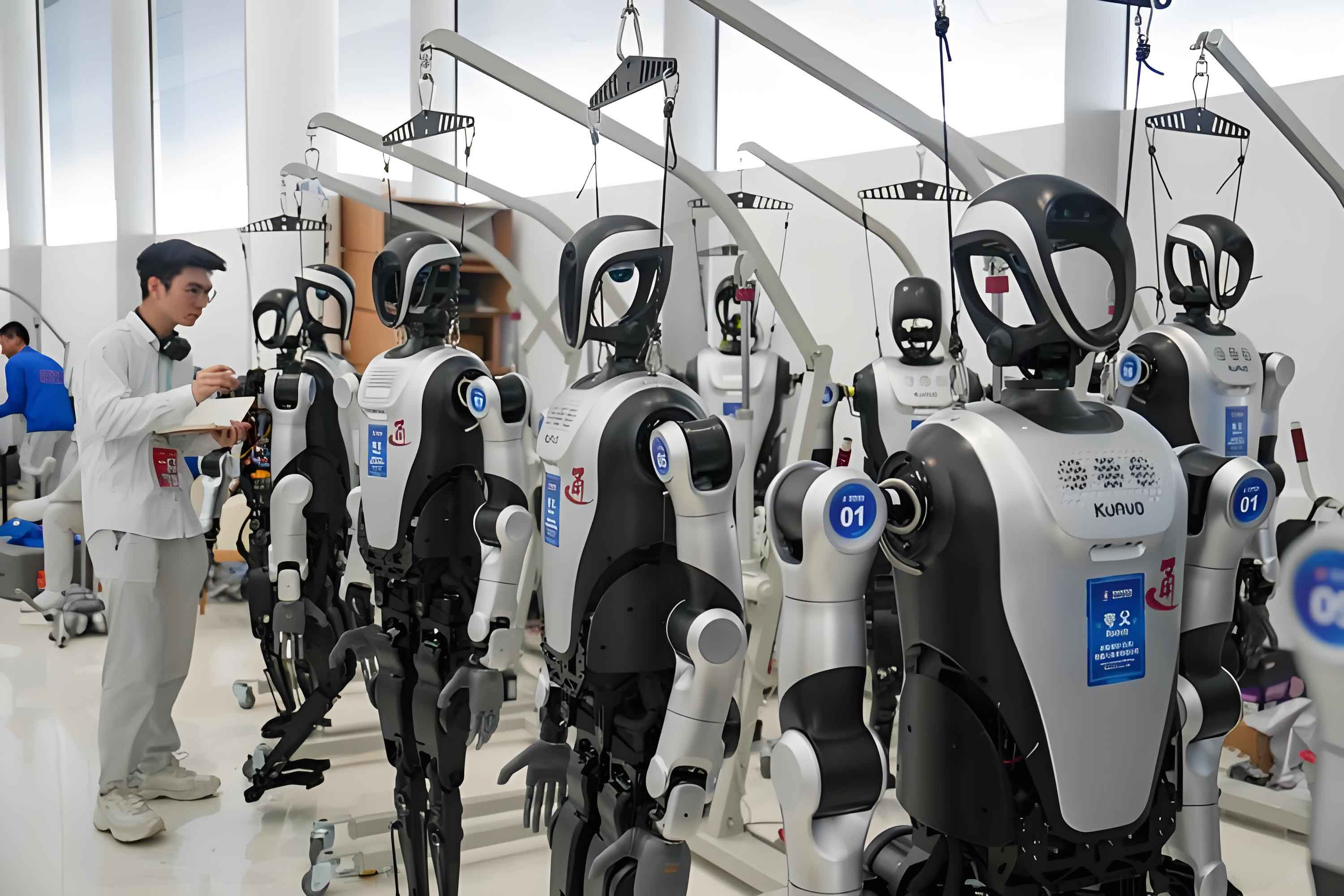
A signing ceremony held in Xun on September 2 marked the formal launch of Jiangxi’s first humanoid robot independent brand, following the establishment of Jiangxi Luyou Robotics Joint Venture Company. The agreement signals the beginning of a new phase for humanoid robot development in Jiangxi and places independent-brand humanoid robot complete-machine manufacturing at the center of a broader industrial effort. The project is an embodied intelligence initiative built through cooperation between state-owned capital and social capital. It is designed to focus on the humanoid robot industrial chain, strengthen the chain, and improve the core capacity of humanoid robot complete-machine assembly.
The humanoid robot project will be located in Poyang Lake Ecological Science and Technology City. It is set to build an independent-brand humanoid robot complete-machine production line and will concentrate on research, development, and production of humanoid robot products suitable for multiple scenarios, including industrial operations, government services, cultural tourism and elderly care, park operations and maintenance, and ecological governance. The project also aims to fill the gap in Jiangxi’s local humanoid robot scaled manufacturing and independent brand development.
The humanoid robot initiative is not limited to assembly alone. It is intended to link key enterprises within Jiangxi with high-quality external resources and to build a humanoid robot industrial ecosystem characterized by complete-machine traction, component support, data empowerment, and scenario iteration. This approach reflects a comprehensive humanoid robot strategy that seeks to strengthen front-end manufacturing while addressing weaknesses in components, data, algorithms, and operating systems.
1. Humanoid Robot Brand Launch Marks a New Stage for Jiangxi
The launch of Jiangxi’s first humanoid robot independent brand represents a significant step for the region’s advanced manufacturing and artificial intelligence sectors. The humanoid robot project is structured around an independent brand, meaning that the complete humanoid robot product is intended to carry local brand identity and local industrial ambition. The signing ceremony for Jiangxi Luyou Robotics Joint Venture Company was held in Xun on September 2, and the event marked the official start of humanoid robot independent brand construction in Jiangxi.
For the humanoid robot sector, the project carries importance because it combines complete-machine manufacturing with industrial chain development. The humanoid robot brand is expected to serve as a focal point for cooperation among enterprises, technology providers, data specialists, and application-side partners. The humanoid robot project therefore represents more than a single production line; it represents an effort to organize resources around a shared humanoid robot platform and a shared humanoid robot industrial vision.
The humanoid robot project is also positioned as a response to the absence of local scaled manufacturing and an independent brand in Jiangxi’s humanoid robot field. By establishing an independent-brand humanoid robot complete-machine production line, the project intends to create a foundation for humanoid robot manufacturing in the province. The humanoid robot brand will serve as a bridge between local scenario needs and external technological maturity, allowing the province to participate more fully in the humanoid robot value chain.
2. Humanoid Robot Project Brings State-Owned and Social Capital Together
The humanoid robot project is described as an embodied intelligence project jointly built by state-owned capital and social capital. This cooperation model brings together public-sector coordination capacity and private-sector flexibility around the humanoid robot opportunity. The humanoid robot joint venture is expected to combine different forms of capital and capability to support humanoid robot complete-machine manufacturing, humanoid robot supply chain development, and humanoid robot application expansion.
State-owned capital participation can support long-term industrial planning, infrastructure coordination, and resource integration for the humanoid robot project. Social capital participation can contribute market sensitivity, operational efficiency, and technology commercialization experience to the humanoid robot initiative. Together, these forces are expected to support the humanoid robot project’s goal of building an independent brand and strengthening the humanoid robot industrial chain.
The humanoid robot joint venture, Jiangxi Luyou Robotics Joint Venture Company, is therefore a vehicle for coordinating humanoid robot manufacturing, humanoid robot technology localization, and humanoid robot ecosystem development. The project’s stated focus is independent-brand complete-machine manufacturing as the leading segment, with supporting efforts in components, data, algorithms, and operating systems. This structure places the humanoid robot at the center of a wider industrial system rather than treating the humanoid robot as an isolated product.
3. Humanoid Robot Full-Chain Strategy and Industrial Ecosystem
The humanoid robot project will focus on strengthening the entire humanoid robot industrial chain. It aims to reinforce the core capability of humanoid robot complete-machine assembly and to fill shortfalls in key links such as components, data, algorithms, and operating systems. This full-chain approach is intended to make the humanoid robot project more resilient and more capable of supporting sustained humanoid robot development in Jiangxi.
The project will link key enterprises within the province and external high-quality resources. This linkage is expected to create a humanoid robot ecosystem based on complete-machine traction, component support, data empowerment, and scenario iteration. In this model, the humanoid robot complete machine serves as the demand driver, component suppliers provide industrial support, data systems empower humanoid robot learning and improvement, and real-world scenarios drive repeated humanoid robot iteration.
The humanoid robot ecosystem concept is important because humanoid robot development depends on many technological and industrial layers. A humanoid robot requires mechanical structures, actuators, sensors, control systems, software, algorithms, data, and operating system compatibility. By addressing these layers together, the humanoid robot project seeks to build a more complete local foundation for humanoid robot manufacturing and humanoid robot deployment.
4. Humanoid Robot Manufacturing Base in Poyang Lake Ecological Science and Technology City
The humanoid robot project will settle in Poyang Lake Ecological Science and Technology City. This location will host the independent-brand humanoid robot complete-machine production line. The production line is intended to support humanoid robot complete-machine manufacturing and to become a base for humanoid robot research, development, and production activities.
The humanoid robot products developed at the base will be adapted to multiple scenarios. These include industrial use, government services, cultural tourism and elderly care, park operations and maintenance, and ecological governance. The humanoid robot project therefore aims to connect humanoid robot technology with practical service needs and operational environments.
Poyang Lake Ecological Science and Technology City is expected to play a role in attracting humanoid robot-related enterprises and resources. The humanoid robot production line can serve as an anchor for upstream and downstream humanoid robot suppliers. As the humanoid robot project advances, the site is intended to become a concentration point for humanoid robot assembly, humanoid robot testing, humanoid robot debugging, and humanoid robot application development.
5. Humanoid Robot Application Scenarios Across Multiple Sectors
The humanoid robot project will focus on research and production of humanoid robot products for industrial, government service, cultural tourism and elderly care, park operations and maintenance, and ecological governance scenarios. These scenarios represent a multi-sector humanoid robot application strategy. The humanoid robot is not being developed for a single use case alone; instead, the project envisions humanoid robot deployment across several operational environments.
In industrial settings, the humanoid robot may support tasks that require mobility, interaction, and adaptability. In government services, the humanoid robot may serve as an interface for information delivery and service assistance. In cultural tourism and elderly care, the humanoid robot may support engagement, guidance, and care-related services. In park operations and maintenance, the humanoid robot may assist with inspection and routine operational tasks. In ecological governance, the humanoid robot may contribute to environmental monitoring and related field activities.
These humanoid robot application areas are drawn from the project’s stated scope. They show that the humanoid robot initiative is intended to connect with both public-service needs and industrial needs. The humanoid robot products developed under the independent brand are expected to undergo adaptation and iteration as they encounter different scenarios.
6. Humanoid Robot Technology Localization with UBTECH Complete-Machine Technology
The humanoid robot project will rely on UBTECH’s mature complete-machine technology. This technology foundation is expected to support the humanoid robot project’s complete-machine manufacturing and product development. At the same time, the project will combine this mature technology with scenario needs within Jiangxi to carry out localized secondary development for the humanoid robot.
Localized secondary development is important for the humanoid robot because application requirements differ across sectors and regions. The humanoid robot must be adapted to local service environments, local operational workflows, and local user expectations. By building on UBTECH’s humanoid robot complete-machine technology while conducting local secondary development, the project aims to create humanoid robot products that are both technologically grounded and locally relevant.
The humanoid robot project therefore combines external technological maturity with local scenario integration. This combination is intended to accelerate humanoid robot localization and to support the independent humanoid robot brand. The humanoid robot brand will not begin from an isolated starting point; it will build on existing humanoid robot complete-machine technology and then adapt it for Jiangxi’s needs.
7. Humanoid Robot Production Capabilities from Assembly to Scaled Manufacturing
The humanoid robot project will achieve complete-machine assembly, debugging, testing, small-batch trial production, and scaled production. These capabilities cover the main stages of humanoid robot manufacturing. The project is expected to build a complete humanoid robot production process that moves from assembly and adjustment to validation and larger-scale output.
Humanoid robot assembly requires the integration of mechanical, electronic, and software systems. Humanoid robot debugging requires functional verification and performance adjustment. Humanoid robot testing requires checking reliability and scenario suitability. Humanoid robot small-batch trial production allows for early-stage validation before larger-scale manufacturing. Humanoid robot scaled production is intended to support broader deployment and market participation.
By establishing these humanoid robot production capabilities, the project aims to reduce dependence on external complete-machine supply and to strengthen local humanoid robot manufacturing capacity. The humanoid robot production line in Poyang Lake Ecological Science and Technology City will serve as the core physical asset for this effort. It will also act as a platform for cooperation with humanoid robot component suppliers, humanoid robot software developers, and humanoid robot application partners.
8. Humanoid Robot Supply Chain and Upstream-Downstream Agglomeration
The humanoid robot project is expected to drive upstream and downstream supporting enterprises to gather in Poyang Lake Ecological Science and Technology City. This agglomeration effect is central to the humanoid robot industrial ecosystem. As the humanoid robot complete-machine production line develops, it can create demand for humanoid robot components, humanoid robot subsystems, humanoid robot software, and humanoid robot services.
Upstream humanoid robot suppliers may include providers of mechanical parts, sensors, actuators, control modules, and other humanoid robot components. Downstream humanoid robot partners may include application developers, service operators, data processors, and scenario owners. The humanoid robot project seeks to connect these groups around a shared humanoid robot manufacturing and deployment agenda.
The humanoid robot supply chain will also benefit from linkage with key enterprises within Jiangxi and high-quality external resources. This linkage is intended to strengthen humanoid robot component support and to build a more complete humanoid robot industrial foundation. The humanoid robot ecosystem will therefore depend on both local coordination and external cooperation.
9. Humanoid Robot Data, Algorithms, and Model Iteration
The humanoid robot project will link with artificial intelligence, big data, and large-model training enterprises within the province. This collaboration is intended to build a humanoid robot training dataset system. The project will carry out multi-domain data collection and processing to support humanoid robot model iteration and optimization.
Data is a critical resource for humanoid robot intelligence. Humanoid robot models require data from perception, movement, interaction, and operational scenarios. By building a humanoid robot training dataset system, the project aims to provide structured support for humanoid robot learning and improvement. Multi-domain data collection and processing will help the humanoid robot adapt to different tasks and environments.
The humanoid robot model iteration process depends on continuous data feedback. As humanoid robot products are tested and deployed in industrial, government service, cultural tourism and elderly care, park operations and maintenance, and ecological governance scenarios, data can be collected and processed to improve humanoid robot performance. The humanoid robot project therefore connects data, algorithms, and real-world scenarios into a cycle of humanoid robot development.
10. Humanoid Robot Operating System Integration with Huawei HarmonyOS
The humanoid robot project will fully connect with Huawei HarmonyOS. It will promote humanoid robot system adaptation and migration. This operating system integration is intended to support humanoid robot compatibility and connectivity within a broader digital ecosystem.
Operating system adaptation is an important part of humanoid robot development. A humanoid robot must be able to interact with other devices, platforms, and services. By connecting with Huawei HarmonyOS, the humanoid robot project aims to support system-level integration and to enable humanoid robot participation in connected environments.
The humanoid robot project will also seek to realize interconnectivity among humanoid robots, terminal devices, and platform backends. This interconnectivity is expected to allow humanoid robot systems to exchange information and coordinate with other digital infrastructure. The humanoid robot is therefore positioned not only as a standalone machine but also as a connected node in a larger service and operation network.
11. Humanoid Robot Interconnectivity Among Devices and Platforms
The humanoid robot project’s plan to achieve interconnectivity among robots, terminal devices, and platform backends reflects a broader vision for humanoid robot integration. In this vision, the humanoid robot can communicate with other devices and receive support from platform-level services. The humanoid robot thus becomes part of a connected system that can support data flow, service delivery, and operational coordination.
Interconnectivity can support humanoid robot deployment in complex environments. For example, a humanoid robot in a government service setting may need to connect with information systems and service terminals. A humanoid robot in park operations and maintenance may need to connect with monitoring devices and management platforms. A humanoid robot in cultural tourism and elderly care may need to connect with service platforms and care-related devices.
By promoting humanoid robot system adaptation and migration with Huawei HarmonyOS, the project aims to create a technical basis for these connections. The humanoid robot project therefore treats operating system compatibility as a foundation for humanoid robot application expansion and humanoid robot ecosystem development.
12. Humanoid Robot Industrial Chain Strengthening and Gap Filling
The humanoid robot project is designed to strengthen the humanoid robot industrial chain and fill key gaps. It will focus on independent-brand complete-machine manufacturing, improve complete-machine assembly capacity, and address shortcomings in components, data, algorithms, and operating systems. This approach directly targets the layers that are necessary for a self-reinforcing humanoid robot industry.
Component support is essential for humanoid robot manufacturing. Data and algorithms are essential for humanoid robot intelligence. Operating systems are essential for humanoid robot integration and connectivity. By addressing these areas together, the humanoid robot project seeks to build a more complete foundation for humanoid robot development in Jiangxi.
The humanoid robot project also aims to fill the gap in Jiangxi’s local humanoid robot scaled manufacturing and independent brand development. This gap-filling objective gives the project strategic importance. The humanoid robot independent brand is intended to represent local capability, local collaboration, and local application development.
13. Humanoid Robot Scenario Iteration and Regional Collaboration
The humanoid robot project will build an ecosystem based on complete-machine traction, component support, data empowerment, and scenario iteration. Scenario iteration means that humanoid robot products will be improved through repeated use and feedback in real environments. The humanoid robot will be tested in industrial, government service, cultural tourism and elderly care, park operations and maintenance, and ecological governance settings.
Regional collaboration is also central to the humanoid robot project. The project will link key enterprises within Jiangxi and external high-quality resources. It will also link provincial artificial intelligence, big data, and large-model training enterprises. This collaboration is intended to create a humanoid robot development network that combines local strengths with external expertise.
The humanoid robot project therefore operates at multiple levels. At the manufacturing level, it builds humanoid robot complete machines. At the component level, it supports humanoid robot supply chain development. At the data level, it builds humanoid robot training datasets. At the scenario level, it drives humanoid robot iteration. At the platform level, it connects humanoid robots with devices and backends through operating system integration.
14. Humanoid Robot Project Fact Summary
| Category | Details |
|---|---|
| Project type | Embodied intelligence project |
| Cooperation model | State-owned capital and social capital cooperation |
| Brand focus | Independent-brand humanoid robot complete-machine manufacturing |
| Industrial focus | Humanoid robot full industrial chain strengthening and gap filling |
| Core capability | Humanoid robot complete-machine assembly |
| Key links to improve | Components, data, algorithms, and operating systems for humanoid robots |
| Ecosystem model | Complete-machine traction, component support, data empowerment, and scenario iteration |
| Location | Poyang Lake Ecological Science and Technology City |
| Production asset | Independent-brand humanoid robot complete-machine production line |
| Application scenarios | Industrial, government services, cultural tourism and elderly care, park operations and maintenance, and ecological governance |
| Technology foundation | UBTECH mature complete-machine technology with localized secondary development |
| Production capabilities | Assembly, debugging, testing, small-batch trial production, and scaled production |
| Supply chain effect | Upstream and downstream supporting enterprises gathering in the science and technology city |
| Data collaboration | Provincial artificial intelligence, big data, and large-model training enterprises |
| Data system | Humanoid robot training dataset system with multi-domain data collection and processing |
| Operating system integration | Huawei HarmonyOS adaptation and migration for humanoid robots |
| Connectivity goal | Interconnectivity among humanoid robots, terminal devices, and platform backends |
15. Humanoid Robot Application Matrix
| Scenario | Humanoid Robot Focus |
|---|---|
| Industrial operations | Humanoid robot products adapted to industrial environments |
| Government services | Humanoid robot products supporting government service scenarios |
| Cultural tourism and elderly care | Humanoid robot products for cultural tourism and elderly care settings |
| Park operations and maintenance | Humanoid robot products for park operations and maintenance tasks |
| Ecological governance | Humanoid robot products for ecological governance scenarios |
16. Humanoid Robot Ecosystem Pillars
- Complete-machine traction: the humanoid robot complete machine serves as the leading demand driver for the humanoid robot industrial chain.
- Component support: humanoid robot components and supporting enterprises form the industrial foundation for humanoid robot manufacturing.
- Data empowerment: humanoid robot training datasets and multi-domain data processing support humanoid robot model iteration.
- Scenario iteration: real-world humanoid robot applications in multiple sectors drive repeated humanoid robot improvement.
- Regional collaboration: key enterprises within Jiangxi and external high-quality resources are linked around the humanoid robot project.
- Technology localization: UBTECH mature complete-machine technology is combined with local scenario needs for humanoid robot secondary development.
- Operating system integration: Huawei HarmonyOS adaptation and migration support humanoid robot connectivity and system compatibility.
- Production scaling: assembly, debugging, testing, small-batch trial production, and scaled production build humanoid robot manufacturing capacity.
17. Humanoid Robot Outlook and Conclusion
The humanoid robot project in Poyang Lake Ecological Science and Technology City is positioned to become a central platform for humanoid robot development in Jiangxi. It begins with an independent-brand humanoid robot complete-machine production line and extends into components, data, algorithms, operating systems, and application scenarios. The humanoid robot project therefore represents a coordinated approach to humanoid robot manufacturing, humanoid robot technology localization, and humanoid robot ecosystem building.
By relying on UBTECH mature complete-machine technology and conducting localized secondary development, the project aims to create humanoid robot products suited to local needs. By linking with provincial artificial intelligence, big data, and large-model training enterprises, it aims to build a humanoid robot training dataset system. By connecting with Huawei HarmonyOS, it aims to support humanoid robot system adaptation and migration. By pursuing interconnectivity among humanoid robots, terminal devices, and platform backends, it aims to integrate humanoid robots into broader digital and service environments.
The humanoid robot project also seeks to fill the gap in Jiangxi’s local humanoid robot scaled manufacturing and independent brand development. It will strengthen the humanoid robot industrial chain, improve humanoid robot complete-machine assembly capacity, and address key shortcomings in humanoid robot components, data, algorithms, and operating systems. Through complete-machine traction, component support, data empowerment, and scenario iteration, the humanoid robot project is intended to build a durable humanoid robot industrial ecosystem.
As the humanoid robot joint venture moves forward, its work is expected to focus on humanoid robot complete-machine assembly, humanoid robot debugging, humanoid robot testing, humanoid robot small-batch trial production, and humanoid robot scaled production. It will also work to attract upstream and downstream supporting enterprises to Poyang Lake Ecological Science and Technology City. In this way, the humanoid robot project aims to create a concentration of humanoid robot manufacturing capability, humanoid robot technology resources, and humanoid robot application partners.
The launch of Jiangxi’s first humanoid robot independent brand marks the beginning of a structured humanoid robot initiative in the province. The humanoid robot project combines state-owned capital and social capital, external complete-machine technology and local scenario development, manufacturing capacity and data-driven iteration, and operating system integration and platform connectivity. These elements together define the humanoid robot project’s approach and its ambition to support the growth of a humanoid robot industry in Jiangxi.