
The humanoid robot industry reached a critical point in 2026. In the first half of the year, humanoid robot shipments in China exceeded 40,000 units, and the country’s share of global humanoid robot shipments rose to 97 percent. The Ministry of Industry and Information Technology expects full-year humanoid robot production in 2026 to exceed 100,000 units. From the manufacturing side, the question of whether a humanoid robot can be built is no longer the central problem. The harder question is how a humanoid robot moves from being manufactured to being used, and that transition is blocked by data.
Training a humanoid robot requires large amounts of physical interaction data from real scenes. Such data serves as the teaching material for humanoid robot models. According to industry estimates, the world currently has only hundreds of thousands to one million hours of usable high-quality real data. For a humanoid robot to reach a “ChatGPT moment,” the industry would need tens of millions of hours of real data. The gap between supply and demand is measured in orders of magnitude.
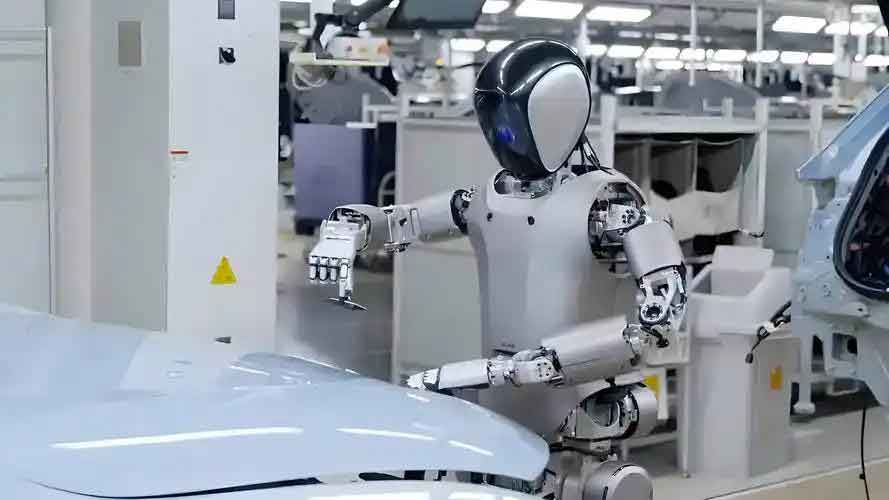
To help humanoid robot development cross the data barrier, embodied intelligence training grounds have become a key piece of infrastructure. At first, these training grounds were built to meet data demand. As technology has evolved, they have moved from pure data production toward scenario-based real-world training. They are becoming facilities that combine data production, model training, and capability validation in real physical environments. In effect, they are schools for the humanoid robot.
- The Humanoid Robot Data Gap
The data challenge is not only a matter of how much data can be collected. It is also a matter of what kind of data can be used. A humanoid robot needs demonstrations, trajectories, object interactions, and physical feedback that reflect the real world. The real world is variable. Objects differ in shape, color, quantity, and position. A humanoid robot must learn not only to imitate a single action but also to adapt when the conditions around that action change.
This is why data collection for humanoid robot training is labor-intensive and scenario-specific. In a real training environment, a data collector may repeat a simple action many times while wearing collection equipment. The humanoid robot observes the action and attempts to reproduce it. The motion trajectory data is captured, displayed on a screen, and sent back to the data collection system in real time. The process looks simple, but the amount of data required to make a humanoid robot perform the action reliably is substantial.
The industry is also learning that volume alone is not enough. Many training grounds describe their data holdings in terms of tens of thousands or even hundreds of millions of hours. Yet the usable portion is the high-quality data extracted from that total. For the humanoid robot industry, 10,000 hours of high-quality data may be more important than one million hours of repeated data. Much of the available data may be of unacceptable quality or may not be usable by a humanoid robot at all.
| Indicator | Reported Figure |
|---|---|
| Humanoid robot shipments in the first half of 2026 | More than 40,000 units |
| Share of global humanoid robot shipments in the first half of 2026 | 97 percent |
| Expected full-year humanoid robot production in 2026 | More than 100,000 units |
| Global supply of usable high-quality real data | Hundreds of thousands to one million hours |
| Real data needed for a humanoid robot “ChatGPT moment” | Tens of millions of hours |
| Embodied intelligence training grounds built and operational by June 2026 | More than 70 |
| Training grounds under construction or planned | More than 40 |
| Training space at the Beijing humanoid robot data and training base | Nearly 6,000 square meters |
| Typical humanoid robot training scenarios at the Beijing base | More than 30 |
| Global downloads of the RoboMIND embodied intelligence dataset | More than 20 million |
| Annual data capacity of the Beijing base | Up to 180,000 hours |
| High-quality data delivered externally by the Beijing base | Nearly 30,000 hours |
| Core artificial intelligence industry scale in 2025 | More than 1.2 trillion yuan |
| Number of artificial intelligence enterprises in 2025 | More than 6,200 |
- Inside a Humanoid Robot Training Base
The Beijing Humanoid Robot Innovation Center Embodied Intelligent Robot Data and Training Base is the first embodied intelligence training ground in China built on real scenes. In its nearly 6,000 square meters of training space, scenarios such as home organization, express parcel sorting, and chemical experiments are laid out in separate zones. Dozens of configurations and more than 100 humanoid robots practice repeatedly at different workstations.
In the chemical experiment zone, a humanoid robot is learning how to grasp a tray and control equipment to weigh a fixed amount of powder. This is a precision operation scenario, and it places high demands on the humanoid robot’s motion accuracy. A data collector stands beside the humanoid robot, wearing data collection equipment, and carefully performs actions such as grasping objects and weighing powder. The humanoid robot follows the demonstration. On a nearby computer screen, motion trajectory data updates continuously and is transmitted back to the data collection system in real time.
Liu Lei, project manager at the Beijing humanoid robot data and training base, said the actions look simple, but making a humanoid robot perform them as smoothly as a person requires large amounts of real data to train the model. Each operation by a data collector is a demonstration collected repeatedly under dynamic conditions in which factors such as the shape, color, quantity, and position of the target object are randomly combined and changed. Through learning, the humanoid robot can not only imitate but also gradually develop the ability to adapt to different environments.
By June 2026, more than 70 embodied intelligence training grounds had been built and put into use across China, with more than 40 under construction or planned. However, the obstacle facing the embodied intelligence industry is not only that data is scarce. High-quality data is even scarcer.
Shi Mingwei, product lead at the Beijing humanoid robot data and training base, said many training grounds in the market claim to have data measured in tens of thousands or even hundreds of millions of hours, but what is actually usable is the high-quality data extracted from that total. For the industry, 10,000 hours of high-quality data may be more important than one million hours of repeated data, because much of the data is either unqualified in quality or cannot be used by a humanoid robot.
- Defining High-Quality Data for Humanoid Robot Learning
What qualifies as high-quality data? Liu Lei used a home organization scenario as an example. High-quality data means that when a humanoid robot enters the scene, it can automatically determine which items need to be organized and which items are fragile and require careful handling during placement. Only when the humanoid robot can accurately make these judgments and issue these instructions does the data count as high quality. Conversely, if the humanoid robot is vague or hesitant in judging the target during operation, that situation represents low-quality data.
The definition of high quality must be verified through the training results of the model, Liu Lei said. At present, the base has built more than 30 typical humanoid robot training scenarios. In December 2025, the Beijing Humanoid Robot Innovation Center opened the RoboMIND embodied intelligence dataset to developers around the world. Global downloads of RoboMIND have now exceeded 20 million.
To improve the quality of data production, the base has built a complete data closed-loop chain. After massive amounts of data are collected, they are automatically uploaded to the backend of the data collection system. The data then goes through cleaning, annotation, validation, and quality inspection. The effective, high-quality data that remains is used for iterative training of algorithm models. The data serves both the center’s own humanoid robot research and development and external customers.
In this chain, quality inspection and annotation are not entirely manual. Shi Mingwei said the base first uses artificial intelligence for automated processing and then arranges a small amount of manual quality inspection and annotation. Before a collection task begins, the team breaks the task down in detail and defines a standard operating procedure. Data collectors judge whether actions are standardized according to the definitions and documents. If quality inspection finds a problem, the issue is fed back to the data collector, and the data is collected again.
The key to the closed loop lies after data processing is completed. Shi Mingwei said finished data is delivered to the model team, tested and validated, and then deployed on a real humanoid robot. Normally, that completes one loop. In practice, however, the base pays more attention to the problems the model encounters in actual operations after deployment. Through automated methods, those problems are returned to the data collection system for analysis, and targeted data collection is carried out again. This forms a larger closed loop.
- Why Real-World Scenarios Remain Essential
Humanoid robots already have applications in express parcel sorting, industrial manufacturing, and other scenarios, yet many embodied intelligence training grounds still keep such scenarios in place. Liu Lei used express parcel sorting as an example. The key indicators in the sorting process are efficiency and quality. At present, the range of parcel types is not comprehensive enough. Soft parcels, hard parcels, fresh produce, and parcels with abnormal appearances all require large-scale data supplementation.
Liu Lei compared the process to map products, which require test drivers to collect city information every year because cities are updated and changed. Humanoid robot models must also continuously supplement their recognition and cognitive abilities. All data in the embodied intelligence field needs continuous supplementation. It is not that data becomes sufficient at a certain point. A humanoid robot may never have enough data throughout its entire life.
If every change in humanoid robot configuration or every change in scene required a completely new round of data collection, production costs would be high, and the chain that allows embodied intelligence to be used would be difficult to sustain. To address this, the Beijing humanoid robot data and training base has adopted multiple methods to improve the generalization of data across scenes and across humanoid robot bodies.
On one hand, the base does not overly restrict collection tasks and actions in designated scenarios. On the other hand, it uses artificial intelligence for model generalization. At the same time, the base uses head-worn and other bodyless collection devices that allow people to collect data. It also uses simulation data for model training to ensure data volume and the model’s ability to handle different forms. Real production and daily life are also important sources of data. Shi Mingwei said that arranging tasks through manpower alone can solve only a small number of problems. To achieve true generalization, humanoid robots must be deployed in real scenes and complete the entire data loop.
- Scaling Data Supply for Humanoid Robot Deployment
The Beijing humanoid robot data and training base has an annual data capacity of up to 180,000 hours and has delivered nearly 30,000 hours of high-quality data to external parties. The base has sent hundreds of bodyless collection devices into real environments such as homes and industrial sites, allowing data collection to move from model showrooms to real production lines. The base is now moving toward the output of million-hour-level humanoid robot interaction data that is high-value, highly usable, and verifiable.
This effort reflects a broader shift in the humanoid robot sector. The first phase of training ground construction was driven by the need to produce data. The next phase is driven by the need to produce usable data, validate models, and connect data production with real deployment. A humanoid robot that performs well in a controlled training cell must still face changes in objects, lighting, placement, packaging, human activity, and workflow. The training ground is valuable because it can reproduce those changes in a structured way and feed the resulting data back into model development.
The data loop also changes how humanoid robot training is organized. Data collection is no longer a one-time task completed before model training. It is a continuous process that begins with task definition, proceeds through collection, cleaning, annotation, validation, and quality inspection, and continues after model deployment when real-world failures are returned for analysis. For a humanoid robot, the training ground is therefore not a fixed classroom. It is a working environment where data, models, and robot bodies are tested together.
- National Buildout and Remaining Challenges
Data from the Ministry of Industry and Information Technology shows that in 2025 the core artificial intelligence industry scale in China exceeded 1.2 trillion yuan, with more than 6,200 enterprises. The China Academy of Information and Communications Technology recently released a report on embodied intelligence training grounds in 2026. The report noted that in the past two years, embodied intelligence training grounds have rapidly set off a construction boom across the country. However, problems have gradually become apparent, including homogeneous scenario task construction, limited actual data capacity, insufficient data diversity and circulation, and the absence of a sustainable business model.
Relevant authorities have already paid attention to the data supply issue. The National Development and Reform Commission said that next steps will use embodied intelligence training grounds and application pilot bases as key levers to coordinate the layout of embodied intelligence training grounds and strengthen the supply of data, models, standards, and other elements. In terms of data, the commission will build a high-quality real-machine data collection system, improve the quality and scale of embodied intelligence data supply, and solve the “data thirst” problem in embodied intelligence training.
For the humanoid robot industry, the significance of these moves is straightforward. Manufacturing capacity has already reached a scale at which humanoid robot output can be counted in tens of thousands of units in half a year. The next competitive frontier is the ability to turn real-world interaction into usable data, turn usable data into capable models, and turn capable models into reliable humanoid robot deployment. The training ground sits at the center of that chain.
The challenge is not only technical. It is also organizational and commercial. A humanoid robot training ground must define tasks precisely, maintain collection quality, validate data through model training, and return deployment problems to the data system. It must also serve external customers while supporting its own research and development. If data remains fragmented, repetitive, or difficult to circulate, the humanoid robot industry will continue to face a gap between demonstration and daily use. If data can be collected, cleaned, validated, and reused across scenes and humanoid robot bodies, the training ground can become a durable piece of infrastructure for the humanoid robot economy.
The experience of the Beijing humanoid robot data and training base shows both the scale of the task and the direction of the solution. Nearly 6,000 square meters of training space, more than 30 typical scenarios, more than 100 humanoid robots, an annual data capacity of up to 180,000 hours, and nearly 30,000 hours of high-quality data delivered externally are all part of a single effort to make humanoid robot learning more grounded in reality. The base is also preparing to move toward million-hour-level humanoid robot interaction data, while recognizing that data demand will continue to evolve as humanoid robot models encounter new objects, new scenes, and new tasks.
At the national level, more than 70 embodied intelligence training grounds have been built and put into use, and more than 40 are under construction or planned. This buildout reflects the expectation that humanoid robot development will depend on shared data infrastructure, not only on individual robot makers. The humanoid robot that succeeds in the next stage will not be the one that merely moves well in a laboratory. It will be the one that can learn from real scenes, improve through closed-loop data, and adapt across configurations and environments.
The humanoid robot industry is therefore moving from a manufacturing story to a learning story. Shipments and production figures show that the humanoid robot can be built at scale. Training grounds show what it will take for the humanoid robot to be used at scale. The data gap remains large, and the quality gap remains difficult. Yet the direction is clear. Real scenes, high-quality data, automated processing, human validation, model iteration, real-machine deployment, and problem return are becoming linked into one continuous system. For the humanoid robot, that system is the path from the factory floor to the work floor.