
At a shared workstation, five humanoid dual-arm robots carried out coordinated tasks while mechanical arms threaded cable ties with error controlled at the sub-millimeter level. On another section of the same exhibition floor, a robot automatically applied adhesive and tightened components for a mobile phone, completing the takt in less than 10 seconds. Nearby, a composite robot simulated insertion and extraction inspection for optical modules. These scenes were not staged as isolated tricks. They were presented as working elements of real production lines, and they captured the attention of visitors at the 26th China International Industry Fair in Shanghai.
The fair, held from Oct. 12 to Oct. 16, was organized under the theme “Intelligent Economy, Intelligent Manufacturing Without Boundaries.” It covered 310,000 square meters and attracted more than 3,200 companies from 24 countries and regions. Nearly 300 key technologies and products made their global or China premieres at the event. Yet the strongest signal from the exhibition floor was not the number of premieres alone. It was the shift in what audiences wanted to see. The humanoid robot that once drew crowds by imitating human movement was now being judged by hours of uptime, yield rates, precision, stability and payback time.
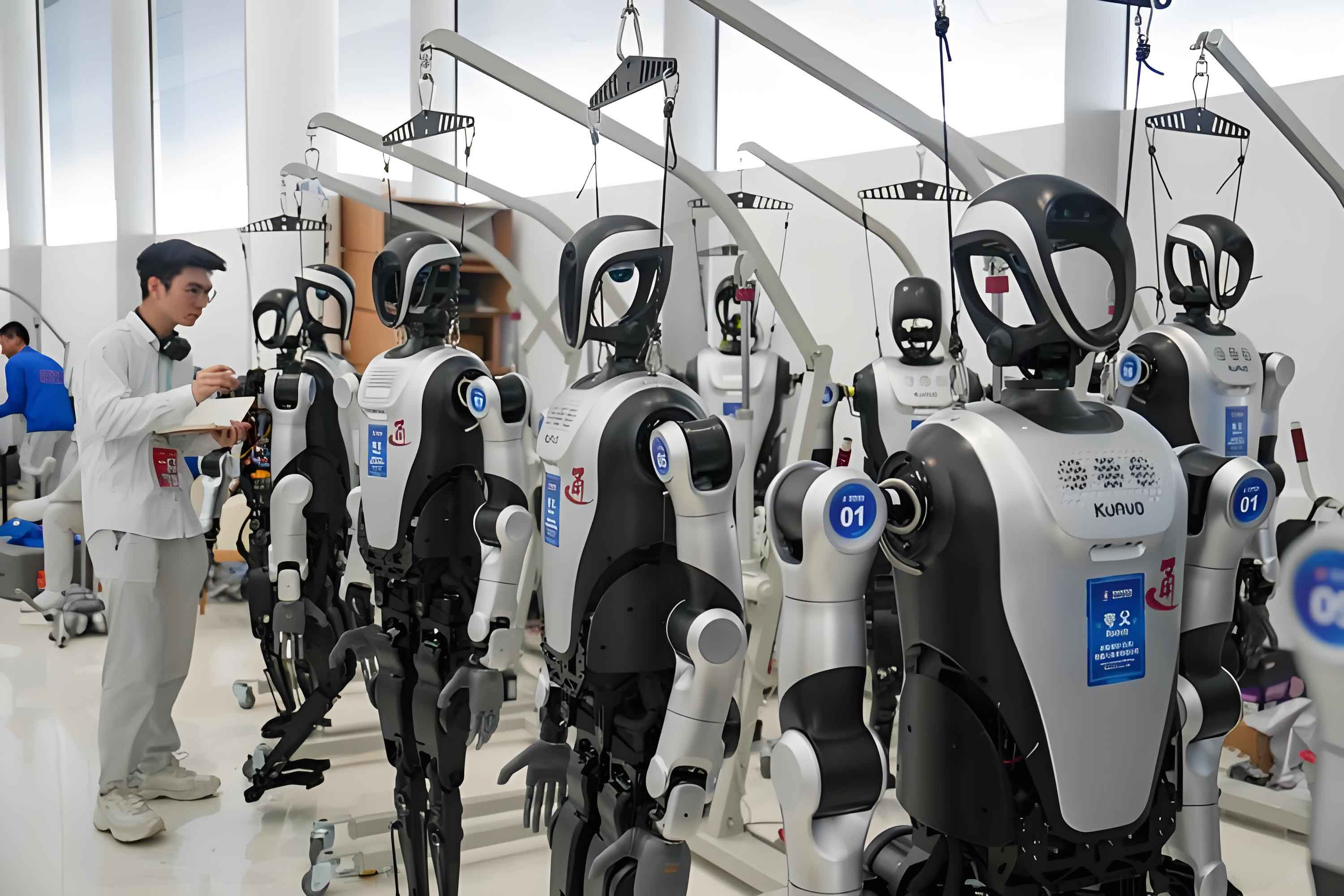
That change in attention reflects a broader transition in the robotics industry. Exhibitors and visitors were less interested in whether a humanoid robot could perform a dramatic routine once, and more interested in whether it could work reliably across shifts, processes and production rhythms. The fair became a testing ground for a simple question: can the humanoid robot move from the stage to the shop floor and become a dependable production asset?
- A Fair Floor That Looked Like a Production Line
The most crowded booths were not those showing isolated mechanical dexterity. They were the ones showing robots integrated into workstations, conveyors, inspection stations and assembly cells. Visitors watched robotic arms handle cable ties, apply adhesive, tighten small components, inspect optical modules and move between tasks under a shared scheduling system. The humanoid robot was presented not as a stand-alone spectacle but as one part of a larger production architecture.
At the Elite Robot exhibit, the company brought an entire real production line into the hall. The display included an optical module precision assembly robot, a mobile phone flexible adhesive and tightening robot, and a drone fully automatic battery swap robot. These were organized into 11 workstation-level applications around three areas: AI infrastructure, AI terminals and AI for Science. Multiple robot forms worked under one scheduling system, showing how a humanoid robot or a composite robot could be coordinated with collaborative robots and other equipment.
The significance of this arrangement was practical. A production line does not reward a single successful demonstration. It rewards repeatability, cycle time, accuracy and maintainability. When five humanoid dual-arm robots work at the same workstation, the challenge is not only arm movement. It is synchronization, collision avoidance, task allocation and error recovery. When a robot threads a cable tie with sub-millimeter error, the value lies in the stability of that action across thousands of cycles. When a robot completes adhesive application and tightening in under 10 seconds, the value lies in matching the takt of the line and sustaining it over time.
Elite Robot Chief Technology Officer Wu Min described the change in visitor interest directly. In the past, audiences loved watching robots somersault, write or paint. This year, the most common questions were how many hours a day a machine could run, what its yield rate was, and how soon it could recover its cost. Those questions are commercial questions. They are also engineering questions. They show that the humanoid robot is being evaluated less as a novelty and more as a candidate for real work.
This does not mean the fair abandoned showmanship. Robots still moved in ways that attracted attention. But the center of gravity had shifted. The humanoid robot was being asked to prove that it could work inside the constraints of a factory: production takt, quality control, safety, maintenance and cost. The fair floor looked less like a technology carnival and more like a production line under public observation.
- Elite Robot Puts a Real Line Inside the Exhibition Hall
The Elite Robot display offered a clear example of how the humanoid robot is being positioned within a wider industrial system. The company did not present one machine as a universal solution. Instead, it showed a matrix of robots for different tasks, all linked by a common intelligence layer. The optical module precision assembly robot addressed a high-value and precision-sensitive process. The mobile phone flexible adhesive and tightening robot addressed a high-volume consumer electronics process. The drone battery swap robot addressed automation in a different operational setting. Together, they illustrated how a humanoid robot or a collaborative robot could be deployed according to the task rather than according to a single fixed form.
The 11 workstation-level applications were grouped around AI infrastructure, AI terminals and AI for Science. That grouping is important because it shows where the industry sees near-term demand. AI infrastructure requires optical modules, printed circuit boards and packaging and testing. AI terminals require precision assembly and flexible inspection in consumer electronics. AI for Science requires automation in laboratories, including high-throughput compound screening and microbial streaking inoculation. In each area, the humanoid robot is not simply a moving machine. It is part of a process that must meet specific quality and throughput requirements.
Wu Min argued that the competitive dividing line is moving. Form is the entry point, intelligence is the foundation, and the scenario is the examination. In this view, the bottleneck for embodied intelligence is no longer only the body. It is the ability of intelligence to generalize and transfer. Can the same “brain” be reused across different robot forms and different processes? Can a humanoid robot learn a task in one workstation and apply related skills in another? Can a composite robot and a collaborative robot share the same planning and perception base?
To address that question, Elite Robot uses its self-developed industrial-grade embodied large model, Yuanqi Primo, as a unified intelligent base. The model drives three product matrices: composite robots, wheeled humanoid robots and collaborative robots. The goal is to upgrade robots from special-purpose equipment that executes programs into embodied intelligent agents that can understand the environment and plan tasks. That ambition is directly relevant to the humanoid robot. A humanoid robot that only repeats a fixed motion is a specialized machine with a human-like shape. A humanoid robot that can interpret its environment, adjust to variation and transfer skills across tasks is a different category of industrial tool.
The fair demonstrated why this distinction matters. A production line contains variation. Parts arrive slightly differently. Lighting changes. Operators intervene. Equipment drifts. A robot that cannot handle variation requires extensive engineering support. A robot that can generalize reduces deployment and adaptation cost. The humanoid robot therefore becomes more valuable when its intelligence can be reused, not when its body is merely more human-like.
- The Intelligence Base Extends Along the AI Value Chain
The unified intelligence base is not only a software concept. It is being linked to specific industrial processes along the AI value chain. In AI infrastructure, Elite Robot said it has achieved mass production in AI optical infrastructure, covering the full process range of optical modules from components and printed circuit boards to packaging and testing. This is a demanding area because optical modules require precision, cleanliness and consistent quality. A humanoid robot or a composite robot working in this area must meet those requirements while fitting into an existing line.
In AI terminals, the company’s precision assembly and flexible inspection solutions have been deployed in the production lines of leading consumer electronics manufacturers. The mobile phone adhesive and tightening demonstration at the fair reflected this direction. The process is fast, repetitive and quality-sensitive. The robot must apply the right amount of adhesive, tighten components to specification and maintain takt. The humanoid robot’s value in such a setting depends on repeatability, not on appearance.
In AI for Science, composite robots have entered laboratory scenarios such as high-throughput compound screening and microbial streaking inoculation. These tasks can be high-risk and highly repetitive for human workers. Automation in this context requires more than speed. It requires traceability, consistency and the ability to handle delicate materials. The humanoid robot and composite robot can support laboratory automation where human presence is limited or where repetitive operations create fatigue and error.
A system integrator at the fair said that a production line used to connect multiple independent control systems. With a unified intelligent base, deployment and adaptation costs fall noticeably. That observation helps explain why exhibitors are emphasizing a common intelligence layer. The humanoid robot is expensive to deploy if every task requires a separate control architecture. It becomes more practical if the same intelligence base can support multiple robot forms and multiple processes.
The commercial logic is straightforward. High-value AI-related manufacturing demands precision and flexibility. Labor availability and quality consistency are persistent concerns. A humanoid robot that can be adapted across workstations could reduce the cost of reconfiguration. A composite robot that can move between tasks could improve equipment utilization. A collaborative robot that shares the same planning system could simplify line design. The fair presented these possibilities as engineering directions rather than distant concepts.
The table below summarizes key figures reported at the fair and in cited industry research. It is intended to show the scale of the event and the current state of the humanoid robot market without adding estimates beyond the available figures.
Reported Indicator Figure Exhibition area 310,000 square meters Countries and regions represented 24 Exhibiting companies More than 3,200 Key technologies and products making global or China premieres Nearly 300 Global humanoid robot shipments in the first half of 2026 Nearly 25,000 units Year-on-year growth in global humanoid robot shipments 432.1 percent China market humanoid robot shipments in the first half of 2026 More than 19,000 units Share of global humanoid robot shipments going to research, education, performance display and government data collection centers About 69 percent Estimated China humanoid robot market size in 2026 About 3.4 billion yuan Projected China humanoid robot market size in 2030 Expected to exceed 20 billion yuan - The Humanoid Robot Market Is Growing, but Industrial Use Remains Limited
The fair took place as the humanoid robot market was expanding quickly. IDC data cited at the event showed that global humanoid robot shipments in the first half of 2026 reached nearly 25,000 units, up 432.1 percent year on year. China market shipments exceeded 19,000 units. Those figures show strong momentum. They also set a high bar for expectations. Rapid shipment growth does not automatically mean that the humanoid robot has become a mature industrial worker.
IDC reported that in the first half of 2026, research and education, performance display and government data collection centers accounted for about 69 percent of global humanoid robot shipments. The share actually entering industrial production lines remained limited. That distinction is central to any assessment of the sector. A humanoid robot sold to a research lab, a showroom or a data collection center serves a valid purpose. But it does not face the same demands as a humanoid robot working on a factory line across multiple shifts.
An analyst who has long tracked the robotics industry put the challenge plainly. Industrial scenarios require robots to comply with production takt over long periods and to maintain precision consistently. That is different from demonstrating dozens of successful actions at a fair. A demonstration can be repeated until it works. A production line requires the humanoid robot to work when conditions are not ideal, when the line is under pressure and when maintenance windows are short.
The fair reflected this tension. Exhibitors showed impressive integration. Visitors asked harder questions. The humanoid robot was praised for its flexibility but questioned on reliability. It was admired for its ability to work in human-designed spaces but assessed on its cost. It was presented as an intelligent agent but tested against the measurable requirements of yield, uptime and payback. The sector is moving forward, but it is doing so under commercial scrutiny.
This is not a contradiction. It is a normal stage in industrial adoption. New automation technologies often begin in controlled or non-industrial environments before entering mainstream production. The humanoid robot is following a similar path. The difference is the scale of expectation. Because the humanoid robot is often presented as a general-purpose platform, it faces pressure to prove general-purpose value. In practice, the near-term value is likely to come from specific workstations, specific processes and specific industries where the return on investment can be measured.
- Cost, Reliability and Ecosystem Form the Three Gates
Cost, reliability and ecosystem are widely seen as the three gates that the humanoid robot must pass before large-scale deployment. The fair provided evidence for each. On cost, the questions from visitors focused on payback time and deployment and adaptation expenses. On reliability, the questions focused on uptime, yield and precision over long periods. On ecosystem, the questions focused on integration with existing equipment, control systems, safety standards and maintenance networks.
The market size estimates underline why the sector is still in an early stage. A market research institute estimated that the China humanoid robot market would be about 3.4 billion yuan in 2026 and would only be expected to exceed 20 billion yuan by 2030. Those figures suggest that current industry revenue remains modest relative to the attention the humanoid robot receives. They also suggest that the path from exhibition hall to factory floor will require a sustained validation period.
For the humanoid robot, cost is not only the purchase price. It includes integration, programming, sensors, maintenance, spare parts, safety systems and downtime. A robot that costs less to buy but requires extensive engineering support may be more expensive over its life cycle. A robot that shares a common intelligence base with other machines may reduce adaptation cost. A robot that can transfer skills across workstations may improve utilization. These are the practical considerations that will shape purchasing decisions.
Reliability is equally important. A humanoid robot working in a factory must maintain precision under vibration, temperature variation and repeated use. It must recover from errors. It must not create new bottlenecks. It must be safe around human workers. The sub-millimeter cable tie operation and the under-10-second adhesive and tightening cycle demonstrated at the fair are meaningful because they point to real production requirements. But a demonstration at a fair is only a starting point. The next step is continuous operation in a customer line.
Ecosystem is the third gate. Factories do not buy robots in isolation. They buy production capacity. The humanoid robot must connect to programmable logic controllers, manufacturing execution systems, vision systems, conveyors and safety networks. It must be supported by system integrators and maintained by service teams. A unified intelligence base can help, but it must also be open enough to integrate with existing industrial software and hardware.
The system integrator’s comment at the fair was therefore significant. In the past, a production line had to connect multiple independent control systems. After the intelligent base was unified, deployment and adaptation costs fell noticeably. That is an ecosystem effect. The humanoid robot becomes more attractive when it reduces complexity rather than adding another layer of it.
- From the Exhibition Hall to the Factory Floor
The 26th China International Industry Fair showed that the humanoid robot has entered a more practical phase. The question is no longer whether a robot can perform a human-like motion. The question is whether the humanoid robot can perform useful work at a competitive cost. The fair offered several answers. Robots can work in coordinated teams. They can handle precision tasks. They can be scheduled under a common system. They can be linked to high-value AI manufacturing processes. They can enter laboratories and perform repetitive or high-risk tasks.
But the fair also showed the limits. The humanoid robot has not yet become a common sight on mainstream production lines. Most shipments still go to research, education, performance display and government data collection centers. Industrial deployment remains limited. The market is growing quickly from a small base. The cost of deployment, the demand for reliability and the need for a mature ecosystem remain real barriers.
For companies in the sector, the message is clear. The humanoid robot must be sold as a production solution, not as a spectacle. It must be measured by uptime, yield, takt and payback. It must be supported by an intelligence base that can generalize across forms and processes. It must be integrated into the wider automation ecosystem. The companies that can demonstrate these capabilities will be better positioned as the industry moves from technical validation to scale delivery.
For manufacturers, the message is also clear. The humanoid robot should be evaluated against specific process requirements. Not every task requires a humanoid form. In some cases, a composite robot, a collaborative robot or a fixed automation cell may be more appropriate. The value of the humanoid robot lies in flexibility, human-scale workspace compatibility and the potential to reuse intelligence across tasks. Those advantages must be weighed against cost and reliability.
For the wider industry, the fair marked a change in atmosphere. The humanoid robot was still a source of excitement. But the excitement was increasingly tied to engineering delivery. Visitors wanted to know how long the machine could run, how good the yield was and when the investment would pay back. Those are the questions that will determine the next stage of the humanoid robot market.
- What the Fair Signals for the Humanoid Robot Supply Chain
The supply chain implications are significant. A humanoid robot that enters real production requires more than arms, legs and sensors. It requires precision reducers, servo systems, force sensing, vision, thermal management, safety controls and industrial software. It requires manufacturing capacity for reliable components and service capacity for maintenance. It requires testing and validation standards that reflect industrial use rather than laboratory demonstration.
The fair showed that these supply chain elements are being assembled. Companies are not only showing humanoid robot prototypes. They are showing workstations, control systems, scheduling software and process-specific end effectors. They are linking robots to optical module assembly, consumer electronics assembly and laboratory automation. They are discussing deployment cost and adaptation cost. This is the groundwork for scale delivery.
The humanoid robot supply chain will also be shaped by the AI value chain. AI infrastructure demands optical modules, printed circuit boards and packaging and testing. AI terminals demand precision assembly and flexible inspection. AI for Science demands laboratory automation. These are not generic markets. Each has its own quality standards, cycle times and customer requirements. The humanoid robot must adapt to those differences. A unified intelligence base can help, but the physical execution and process knowledge must still be developed.
The fair’s focus on real production lines suggests that the next phase of competition will be less about human-like appearance and more about task-level performance. The humanoid robot that can work reliably in a specific high-value process will have an advantage over a more human-like robot that cannot meet production requirements. The humanoid robot that can transfer skills across processes will have an advantage over one that must be reprogrammed for every task. The humanoid robot that can reduce deployment and adaptation cost will have an advantage over one that adds complexity.
At the same time, the industry must avoid overpromising. The data presented at the fair showed rapid shipment growth but also limited industrial penetration. The market size estimates showed a large opportunity by 2030 but a modest base in 2026. The path from exhibition hall to factory floor will require a validation period. Cost, reliability and ecosystem will not be solved by a single product launch. They will be solved through sustained engineering, customer feedback and supply chain maturity.
The 26th China International Industry Fair therefore offered a measured picture. The humanoid robot is no longer only a demonstration platform. It is being tested as a working machine. It is being integrated into production lines. It is being evaluated by industrial metrics. But it has not yet completed the journey. The humanoid robot remains in an early stage of industrial adoption, with strong momentum and clear obstacles. The coming years will show which companies can turn the fair floor’s working demonstrations into repeatable, profitable and reliable factory operations.