
A white humanoid robot moves slowly toward a library shelf, raises its arm, bends its fingers, grips the spine of a misplaced book, pulls it out, turns its wrist, and slides the volume back into the correct position. In Shanghai, a wheeled humanoid robot takes a cup, dispenses ice cream, adds cookie crumbs, mixes the product at high speed, and then turns the cup upside down to show that the dessert does not spill. These are not staged demonstration rooms built around simplified tasks. They are real settings with ordinary tools, ordinary shelves, ordinary paper cups, and ordinary store equipment. The humanoid robot is no longer confined to a performance of waving, walking, or posing for a camera. It is being asked to do work.
The shift is significant for the humanoid robot industry because it changes the central question. The question is no longer whether a humanoid robot can complete a rehearsed motion in a controlled environment. The question is whether a humanoid robot can complete a full sequence of useful work in a place where people already work, using objects that were designed for human hands. A library shelf, a soft paper cup, a running ice-cream machine, and a busy store counter all introduce variables that a demonstration video can hide. The humanoid robot must see, decide, grip, adjust, and recover. It must also do so without special tools and without a simplified process. The workplace show has begun, but whether the humanoid robot deserves a long-term job remains open.
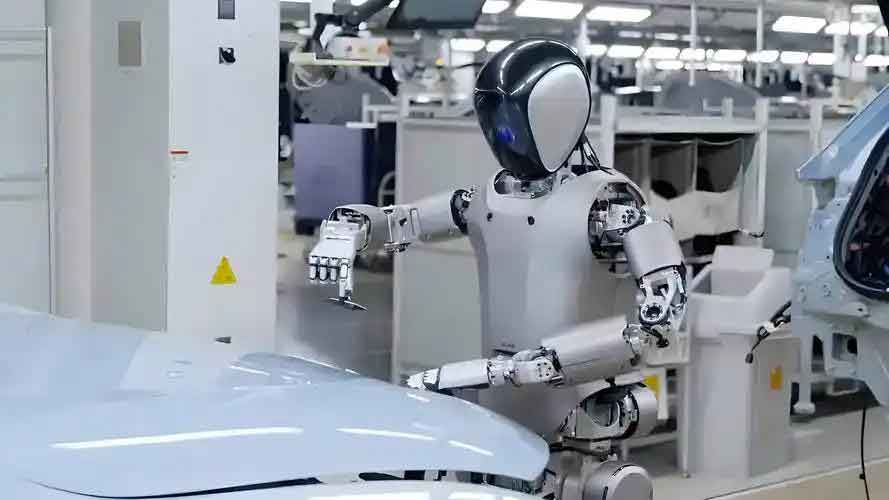
1. A Library Shelf Becomes a Real-World Test for the Humanoid Robot
At the library of Beijing No. 80 High School Wangjing Campus, spotlights are directed at rows of bookshelves. A humanoid robot in a white body walks to the shelf and begins the task. It reaches out, curls its fingers, pinches the spine of a book with precision, and gently removes the misplaced volume. With a turn of the wrist, the humanoid robot inserts the book back into the correct layer of the shelf. The motion is deliberate. The setting is not a laboratory mock-up. It is a school library, and the task is the complete organization of disordered books.
The scene took place in the work-task track of the 2026 second World Humanoid Robot Games. The event is described as the first time a humanoid robot has completed a full book-organizing task in a real campus scene. That description matters because the humanoid robot has often been presented in short clips that emphasize balance, agility, or human-like appearance. A library task emphasizes something less dramatic but more commercially relevant: the humanoid robot must identify an object, control a hand, manage contact, and place the object correctly. Each step is small. Together, they form a complete work process.
The games added a dexterous-hand special event, a multi-scene work competition, a multi-terrain obstacle race, and other new categories that move closer to industrial deployment. The judging standard also changed. Instead of asking which humanoid robot performs the most varied tricks, the events ask which humanoid robot completes the task well. The industry views the event as a collective examination of mass-production capability for the global humanoid robot sector. A humanoid robot that can complete a task once is a prototype. A humanoid robot that can complete the task repeatedly, with consistent quality, is a product. The library task sits between those two states, and the distinction is central to the next phase of the humanoid robot market.
The first-time entrant Zhiyuan Robotics became the most prominent dark horse of the event. Its reported results were 18 gold medals, 16 silver medals, and 12 bronze medals, placing it first on both the gold-medal table and the overall medal table. More important for the industry signal, all of its participating models were mass-production versions. They were not special machines modified only for the competition. That detail supports a broader claim: the capabilities shown by the humanoid robot on stage may be closer to the capabilities available to customers than the capabilities shown by a one-off demonstration unit.
The library scene also reveals why real environments are difficult for a humanoid robot. Books vary in thickness, weight, and friction. A shelf may be crowded. A spine may be recessed. A humanoid robot must decide how much force to apply before contact and how to correct the grip after contact. The humanoid robot cannot rely only on vision, because a book may shift when touched. It cannot rely only on force sensing, because the humanoid robot must first locate the correct book and the correct shelf level. The task combines perception, planning, manipulation, and error recovery. In a demonstration, a humanoid robot can repeat a known sequence. In a library, the humanoid robot must work with the books that are actually there.
The public may see a simple action: a humanoid robot puts a book back. The operational meaning is larger. A humanoid robot that can organize books can potentially handle other tasks that require reading a scene, selecting an object, and placing it with care. Warehouse picking, shelf replenishment, laboratory sample handling, and light assembly all share parts of that capability. The library task is not valuable because libraries need robots to shelve books. It is valuable because the humanoid robot demonstrates a transferable form of manipulation in an unstructured setting.
2. The 2026 World Humanoid Robot Games Shift Attention to Task Completion
The 2026 second World Humanoid Robot Games placed new emphasis on work rather than display. The dexterous-hand special event attracted particular attention because it set eight tasks that point directly to industrial scenes. These tasks include powder weighing, bottle opening and cap prying, box and package unpacking, and block building. Each task requires a humanoid robot to combine hand control, force feedback, and sequence planning. The humanoid robot is not judged only by whether it moves. It is judged by whether the work is finished.
The powder-weighing task offers a clear example. A humanoid robot must use its fingertips to pick up a small spoon and pour gram-level powder into a container with an error of no more than 0.2 grams. The requirement tests force control and stability to an extreme degree. A humanoid robot that grips too hard may deform the spoon or release too much powder. A humanoid robot that grips too lightly may drop the spoon or lose control of the pour. The humanoid robot must manage a delicate contact task while maintaining a stable body position. This is the kind of work that factories often still assign to human hands because the required adjustment is subtle.
Zhiyuan’s OmniHand was reported to complete all operations autonomously under the DUET dual-layer embodied contact intelligence architecture. The outer layer regulates pose, while the inner layer senses touch. The humanoid robot did not have algorithms separately tuned for the competition task. That claim is important because it suggests a commercially delivered dexterous hand can reach a level of precision in public competition that also meets the needs of fine industrial work. The humanoid robot market has been waiting for such evidence. A hand that can hold a spoon in a video is not the same as a hand that can deliver a controlled amount of powder within a narrow error margin.
The event also reflects a change in how the humanoid robot industry talks about progress. Earlier demonstrations often focused on the appearance of intelligence. A humanoid robot might walk across a stage, pick up a box, or respond to a command. The new competition focuses on completion quality. Did the humanoid robot finish the task? Did it finish without human intervention? Did it use the same hardware that a customer could buy? Did it adapt when the object behaved differently from the training data? These questions are less cinematic, but they are more relevant to deployment. The humanoid robot must be judged by work output, not by stage presence.
| Item | Reported detail | Why it matters for the humanoid robot sector |
|---|---|---|
| Event | 2026 second World Humanoid Robot Games | Provides a public test of task completion rather than staged performance |
| New categories | Dexterous-hand special event, multi-scene work competition, multi-terrain obstacle race, and other real-scene-oriented events | Moves the humanoid robot closer to industrial and service deployment |
| Judging shift | From variety of motion to quality of task completion | Aligns evaluation with customer requirements for reliable work |
| Zhiyuan Robotics result | 18 gold, 16 silver, and 12 bronze medals; first on gold-medal table and medal table | Signals competitive performance from a first-time entrant |
| Competing models | All mass-production versions, without special competition-only modification | Strengthens the link between public performance and commercial availability |
| Library task | Full book organization in a real campus library scene | Tests manipulation, perception, and placement in an ordinary environment |
3. Dexterous Hands Put Industrial Precision on Stage
The dexterous-hand special event is important because the hand is where many humanoid robot promises meet their hardest test. Walking is visible. A hand is intimate. The humanoid robot must make contact with objects that are small, soft, slippery, or fragile. The hand must transmit force without losing position. The humanoid robot must also know when contact has occurred and how the object is changing. In industrial work, these details determine whether a task is possible at all. A humanoid robot that can carry a box may still fail to open a bottle cap or weigh a small amount of powder.
The eight tasks in the dexterous-hand event were selected to point toward industrial scenes. Powder weighing tests precision. Bottle opening and cap prying test torque and leverage. Box and package unpacking test sequence planning and tool use. Block building tests spatial reasoning and stable placement. These tasks are not isolated tricks. They are fragments of real work. A humanoid robot that can perform them may be able to enter a factory, a laboratory, a warehouse, or a service counter. The humanoid robot does not need to perform every task in a factory on the first day. It needs to perform a defined task with repeatable quality.
The DUET architecture described for OmniHand separates outer pose regulation from inner touch sensing. That separation matters because a humanoid robot hand must handle two kinds of information at once. The outer layer positions the hand relative to the object. The inner layer detects contact and pressure. If the humanoid robot relies only on position, it may crush a soft object or miss a firm grip. If it relies only on touch, it may lose the planned trajectory. The combination allows the humanoid robot to adjust after contact. The reported result, in which the humanoid robot completed all operations autonomously without task-specific algorithm tuning, suggests that the hand’s control stack can generalize across tasks.
The industrial value of such a humanoid robot hand is easy to understand. Factories often contain tasks that are difficult to automate with fixed machinery because the objects vary or the process requires judgment. A humanoid robot with a capable hand can use tools designed for humans. It can pick up a spoon, a bottle, a box, or a small component. It can work in a space that was not rebuilt for automation. The humanoid robot does not need a perfect factory. It needs to fit into an existing factory. That is a different engineering goal, and it is a harder one.
| Task | Reported challenge | Operational meaning for the humanoid robot |
|---|---|---|
| Powder weighing | Use fingertips to pick up a small spoon and pour gram-level powder with error no more than 0.2 grams | Tests fine force control, stability, and controlled release |
| Bottle opening and cap prying | Apply torque and leverage while maintaining grip | Tests tool-like manipulation and contact-rich control |
| Box and package unpacking | Open containers and manage multiple objects in sequence | Tests planning, perception, and recovery in cluttered scenes |
| Block building | Place objects with spatial accuracy and stable contact | Tests assembly-oriented manipulation and repeatability |
| Overall event design | Eight tasks pointing directly to industrial scenes | Connects public competition to deployable humanoid robot skills |
4. From Factory Learning to Library Work: Generalization Is the Bottleneck
The humanoid robot industry has a familiar criticism: a humanoid robot looks capable in a demonstration but struggles on site. The library task and the dexterous-hand event are attempts to answer that criticism. The humanoid robot must not only perform a known motion. It must transfer a skill from one environment to another. Zhiyuan’s work-intelligence system is described as relying on the ViLLA embodied foundation model, a world model, and large-scale reinforcement learning. The system is said to have small-sample fast generalization capability. In plain terms, a skill learned in a factory can be adjusted with modest effort and transferred to a library scene.
That claim addresses the core bottleneck of humanoid robot deployment. A humanoid robot that must be custom-programmed for every shelf, every book, and every library cannot scale. A humanoid robot that can generalize from a related task can scale across sites. The difference is similar to the difference between a machine that can tighten one bolt in one position and a humanoid robot that can tighten many bolts in many positions. The first is automation. The second is embodied intelligence. The humanoid robot market will not be built only on the first. It will be built on the second, if the second can be made reliable.
The library scene is a useful generalization test because it is not a factory. The humanoid robot must deal with a public-facing space, a shelf arrangement, and books that were not designed for robotic handling. The humanoid robot must move among ordinary objects and complete a task that a human librarian understands. If the humanoid robot can transfer factory-learned manipulation to a library, it may also transfer library-learned manipulation to other scenes. The humanoid robot becomes a platform rather than a single-purpose machine. That platform idea is central to the commercial case for the humanoid robot.
However, generalization is not the same as universal competence. A humanoid robot that can organize books may not be able to repair a book, answer a reader’s question, or manage a complex catalog. A humanoid robot that can weigh powder may not be able to run a chemical process. The industry must avoid overreading a successful demonstration. The right conclusion is narrower and more useful: the humanoid robot is beginning to show transfer across related tasks. The wrong conclusion is that the humanoid robot is ready for every task. The workplace show is a sign of progress, not a final exam.
The library task also shows why the humanoid robot must be evaluated over time. A single book placement can be impressive. A full shelf of disordered books requires endurance and consistency. The humanoid robot must maintain accuracy after repeated reaches. It must recover from a failed grip. It must handle a book that does not slide as expected. These are the conditions that separate a demonstration from a job. The humanoid robot can win applause with one perfect action. It can win a contract only with many acceptable actions.
5. In Shanghai, a Humanoid Robot Serves a DQ Blizzard in a Real Store
In Shanghai, the humanoid robot workplace show moves from the library to a dessert counter. At a DQ store on Wujiang Road, a dual-arm humanoid robot takes a cup, receives ice cream, adds Oreo crumbs, mixes at high speed, and finally turns the cup upside down to show that the product does not spill. The sequence is performed independently by the robot. On August 29, DQ and AI robotics company Sharpa opened what is described as the world’s first “real store environment” Blizzard robot restaurant. The humanoid robot is not placed behind a glass wall in a showroom. It works in a store.
The humanoid robot at the center of the store is named North. It is a wheeled humanoid robot. To hand a cup of Oreo Blizzard to a customer, North must complete 55 continuous steps. Each step is displayed on a screen in the operating area so that observers can see the current stage. Compared with a human worker, the humanoid robot moves more slowly. That speed difference does not prevent consumers from waiting, because the novelty of receiving a dessert made by a humanoid robot is part of the experience. The humanoid robot is not only producing food. It is producing a moment that customers want to watch.
The difficulty is not only in the 55 steps. The difficulty is that the store’s equipment, ingredients, and process remain unchanged. The humanoid robot must use tools and paper cups designed for human hands. A soft paper cup can deform easily. The robotic hand must pull the cup gently without slipping. An ice-cream machine that has been running for one or two hours changes the temperature of the ice cream, and the viscosity changes with it. The mixing force must be adjusted accordingly. These problems do not appear in a simulation environment. The humanoid robot must sense the real product and adapt in real time.
This is a critical point for the humanoid robot sector. Real environments are full of slow drift. A machine warms up. A cup softens. A topping clumps. A customer changes the order. A human worker adjusts without thinking. A humanoid robot must be given the sensing and control to make similar adjustments. The DQ store provides a controlled but real setting in which the humanoid robot can encounter these variations. The store is not a laboratory. It is a commercial space with customers, staff, and a product standard. The humanoid robot must meet the standard while working in the space.
| Item | Reported detail | Implication for the humanoid robot |
|---|---|---|
| Location | DQ store on Wujiang Road, Shanghai | Places the humanoid robot in a customer-facing commercial setting |
| Opening date | August 29 | Marks the start of a real-store trial, not a permanent rollout |
| Robot name and type | North, a wheeled humanoid robot | Shows a humanoid robot form adapted to a fixed service counter |
| Task | Make an Oreo Blizzard, including cup handling, ice cream dispensing, topping, mixing, and upside-down display | Combines manipulation, sequence control, and product presentation |
| Sequence length | 55 continuous steps | Tests long-horizon task execution and recovery |
| Cycle time | About 6 minutes per cup | Slower than a skilled employee, according to the report |
| Human comparison | The humanoid robot is reported to be two to three times slower than a skilled employee | Speed remains a commercial constraint |
| Equipment price | At a level of tens of thousands of yuan | Cost remains high for broad deployment |
| Cost target | Sharpa aims to reduce cost to a level of 100,000 yuan when mass production reaches one million units | Scale is presented as the path to economic viability |
6. Speed and Cost Remain Open Questions for the Humanoid Robot Economy
The DQ humanoid robot is not yet a clear financial replacement for a human worker. It takes about 6 minutes to make one cup, which is two to three times slower than a skilled employee. The equipment is priced at a level of tens of thousands of yuan. From a simple throughput perspective, the humanoid robot looks inefficient. From a labor perspective, the calculation is different. A humanoid robot does not need social insurance, does not need shift scheduling, and can work through the night. If speed rises and cost falls, the economics could change. That “if” is the central uncertainty in the humanoid robot service market.
Sharpa’s stated goal is that when mass production reaches one million units, cost could be reduced to a level of 100,000 yuan. That target is not a current price. It is a direction. The humanoid robot industry often presents such targets because scale is expected to lower component costs, improve manufacturing yields, and spread software development across more units. The risk is that the target arrives later than expected. The humanoid robot may remain a premium attraction rather than a routine worker. The store trial must therefore be judged not only by customer curiosity but by whether the humanoid robot can keep working after the opening buzz fades.
The humanoid robot also faces a service-quality question. A humanoid robot that makes a dessert slowly can still attract customers if the experience is novel. A humanoid robot that makes a dessert slowly when the store is busy may create a queue. A humanoid robot that stops working may create a visible failure. A humanoid robot that needs frequent human assistance may not reduce labor at all. The economic case depends on uptime, maintenance, and intervention rates. These are not captured by a single demonstration. They are captured by sustained operation. The humanoid robot must be reliable before it can be cheap.
The cost discussion also needs to include the whole system. The humanoid robot is not only a pair of arms. It includes sensors, computing, software, safety systems, maintenance, and integration with the store’s equipment. A low hardware price without reliable service may not produce a low operating cost. A higher hardware price with high uptime may be more valuable. The humanoid robot industry is still learning how customers will weigh these factors. The DQ trial provides a real setting in which those factors can be observed. It does not yet provide a final answer.
7. A Training Ground for Fast-Food Workflows
The DQ store is also a data-collection environment for the humanoid robot. The restaurant industry is growing more slowly and needs novelty and emotional value to attract younger customers. A humanoid robot making a dessert provides that novelty. The robotics company needs real scenes to obtain operational data and validate commercial capability. Ice-cream production has standard steps and clear tolerance boundaries. It is a suitable training ground for the humanoid robot. The task is complex enough to be meaningful, but structured enough to be learned.
Li Yifan, co-founder of Sharpa, explained that the current demonstration is ice cream, but the real achievement is a relatively complex Western fast-food workflow. Once that workflow is proven, the same approach can be decomposed for burgers and pizza. In a ten-step process, seven or eight steps may already be available. That statement is important because it frames the humanoid robot as a workflow platform. The humanoid robot does not need a separate invention for every food item. It needs a set of reusable skills: pick up, place, dispense, spread, assemble, wrap, and hand over. A dessert is one composition of those skills. A burger is another.
The humanoid robot’s value in fast food may come from consistency as much as from novelty. A humanoid robot can follow a defined sequence and measure ingredients in a repeatable way. It can work in a small space. It can use existing equipment. It can be monitored through a screen that shows each step. These features make the humanoid robot a potential fit for chains that want standardized production. The challenge is that food is variable. A soft cup, a warm machine, a changed topping, or a rushed order can disrupt the sequence. The humanoid robot must be robust to those variations. The DQ trial is a test of that robustness.
The training-ground idea also has limits. A store is not a factory. Customers are present. Staff must interact with the humanoid robot. Food safety rules apply. A humanoid robot that works well in a quiet test may behave differently during a lunch rush. The humanoid robot must be evaluated under peak conditions, not only during a controlled opening. The store must decide whether the humanoid robot is a permanent part of the workflow or a temporary attraction. The answer will depend on data that only sustained operation can provide.
8. What Would Prove the Humanoid Robot Workplace Show Is More Than a Pop-Up
Feng Yuan, a practitioner in embodied intelligence, offered a cautious view. The future of such projects cannot be judged only by whether they attract consumers during the opening period. Observers must watch whether the humanoid robot can continue to operate, whether the store expands deployment, and whether the humanoid robot still has economic value after the novelty fades. The warning is direct: the project should not end up as a pop-up store. That warning applies to the entire humanoid robot service sector. A single viral moment is not a business. A repeatable operation is.
The humanoid robot industry needs a set of practical tests. Can the humanoid robot run for a full shift? Can it recover from a dropped cup? Can it ask for help when needed? Can a store employee service it without special training? Can the humanoid robot maintain food quality across many orders? Can the cost per unit of work fall below the human alternative? These questions are less exciting than a robot flipping a cup upside down, but they decide whether the humanoid robot gets a second shift. The library task and the dessert store are useful because they make these questions visible.
- Continuity: The humanoid robot must operate repeatedly, not only during a launch event.
- Deployment depth: A store or library must expand use beyond a single demonstration unit.
- Economic value after novelty: The humanoid robot must remain useful when customer curiosity declines.
- Recovery ability: The humanoid robot must handle small failures without stopping the whole workflow.
- Serviceability: Ordinary staff must be able to work with the humanoid robot and maintain the process.
- Task quality: The humanoid robot must meet the same standard as the human process it supports.
The library scene adds another test: public trust. A humanoid robot working among bookshelves must move safely around people. A humanoid robot working in a store must handle food and equipment safely. Safety is not a feature that can be added after the demonstration. It is part of the product. The humanoid robot must be designed to stop, yield, and ask for help when the situation is unclear. The workplace show will be judged not only by what the humanoid robot can do but by what it does when something goes wrong.
The humanoid robot also needs a clear role. In a library, the humanoid robot may organize books, but it may not replace a librarian’s judgment. In a dessert store, the humanoid robot may make a Blizzard, but it may not replace a manager’s decisions. The most realistic near-term role for the humanoid robot is to take on defined, repetitive, physically demanding, or hard-to-staff tasks while human workers handle exceptions. That division of labor is more plausible than a fully autonomous store. The humanoid robot does not need to do everything. It needs to do enough to justify its place.
9. Conclusion: The Humanoid Robot’s Next Test Is Endurance, Not Applause
The humanoid robot has moved from the stage to the shelf and the counter. In Beijing, a humanoid robot organized books in a real school library. In Shanghai, a humanoid robot made an Oreo Blizzard in a real DQ store. In the 2026 second World Humanoid Robot Games, mass-production humanoid robot models competed in dexterous-hand tasks that point to industrial work. These are meaningful steps because they shift the proof burden. The humanoid robot must now show that it can complete work, not merely perform. The humanoid robot must show that it can use human tools, not only custom fixtures. The humanoid robot must show that it can adapt, not only repeat.
The evidence is still early. The library task was a competition scene. The DQ store opened on August 29 and is a trial. The humanoid robot is slower than a skilled employee. The equipment cost is still at a level of tens of thousands of yuan. The cost target of 100,000 yuan depends on mass production at one million units. The humanoid robot has not yet proven that it can operate for long periods without intervention, that stores will expand deployment, or that customers will value the service after the novelty fades. These are not reasons to dismiss the progress. They are reasons to measure it carefully.
The humanoid robot workplace show is best understood as a transition. The humanoid robot is leaving the controlled demonstration and entering the messy reality of ordinary work. That reality includes soft paper cups, changing ice-cream viscosity, crowded bookshelves, and unpredictable human activity. The humanoid robot that can handle those conditions will earn a role. The humanoid robot that cannot will remain a spectacle. The next phase of the humanoid robot industry will be decided not by how many times the humanoid robot can wave to a crowd, but by how many shifts it can complete, how many tasks it can finish, and how many sites choose to keep it after the opening day.
The humanoid robot has now appeared in a library and a dessert shop. It has demonstrated precision in a dexterous-hand competition and long-sequence execution in a store. It has shown that a mass-production humanoid robot can compete and that a real-scene humanoid robot can serve a product. The workplace show has begun. The harder question is whether the humanoid robot can turn that show into a job. The answer will come from endurance, cost, reliability, and the quiet repetition of useful work. The humanoid robot has won attention. It must now win the second shift.