
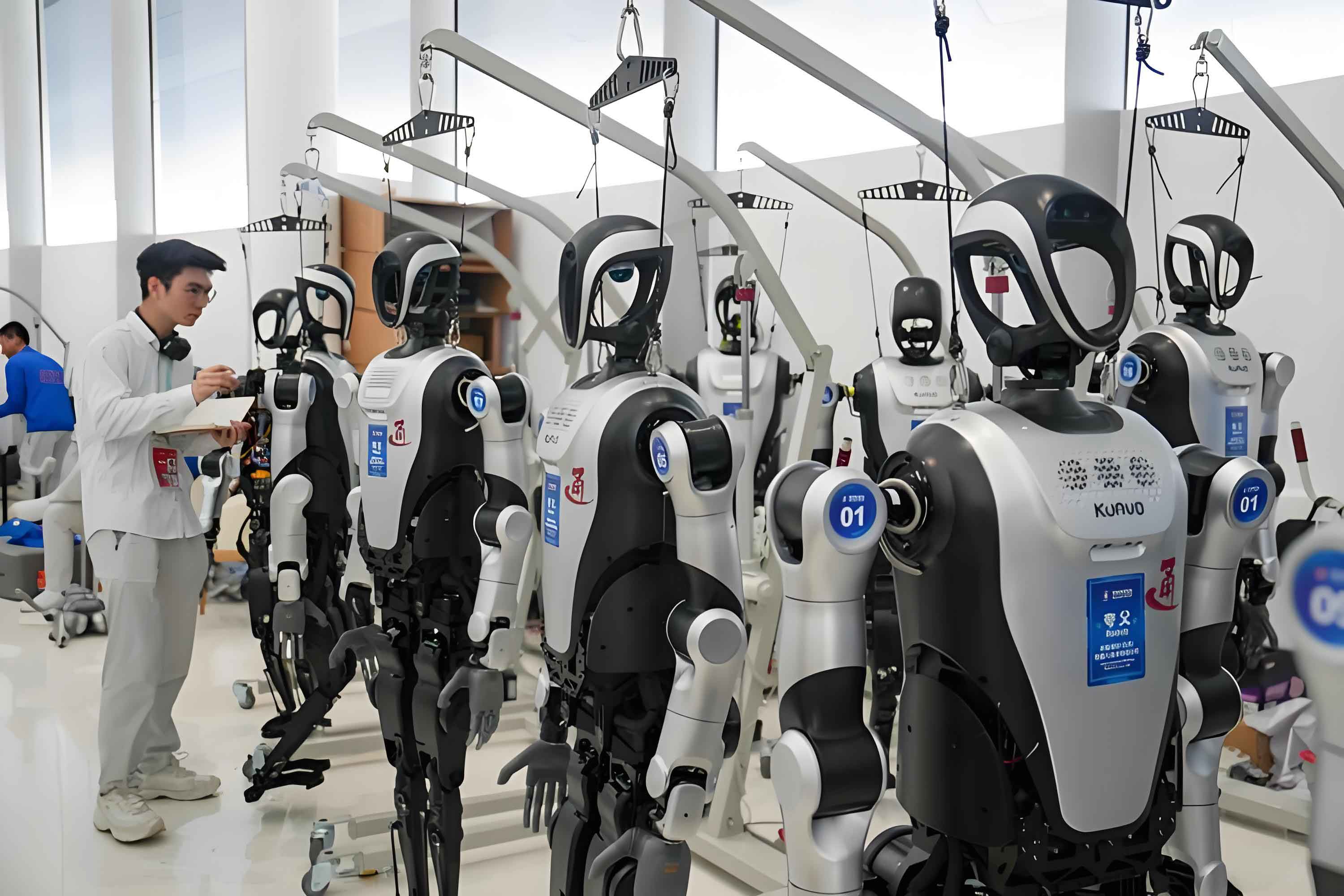
The 2025 World Robot Conference, held from August 8 to 12 in Beijing, has become a pivotal showcase for the rapid evolution of humanoid robots, with 50 humanoid robot整机 enterprises demonstrating their latest innovations. The event highlights how humanoid robots are transitioning from experimental prototypes to practical tools in industrial manufacturing, medical care, home services, and beyond, driven by breakthroughs in artificial intelligence, dynamic control systems, and substantial financial investments. This convergence of technology and capital is propelling the humanoid robot industry toward widespread adoption, with experts forecasting multi-trillion-dollar market opportunities by 2035.
-
Technological Innovations Enhance Humanoid Robot Capabilities
The conference featured live demonstrations that underscored significant advancements in humanoid robot functionality. For instance, Unitree Robotics’ G1 combat humanoid robots, each standing 1.32 meters tall and weighing 35 kilograms, engaged in a boxing match, executing roundhouse kicks and rapid punches with precision. These humanoid robots are equipped with 29 flexible joints and intelligent balance algorithms, enabling them to recover from falls autonomously within seconds, thanks to their dynamic balance systems. Such capabilities highlight the progress in stability and agility for humanoid robots in dynamic environments.
In another key display, the humanoid robot Tian Gong 2.0 conducted a long-distance walking and running直播 on a treadmill for several hours, showcasing its endurance and stable motion control. Xiong Youjun, General Manager of the National-Local Co-built Embodied Intelligent Robot Innovation Center, emphasized that this performance validates Tian Gong 2.0 as a versatile platform, marking a shift from pursuing extreme运动 abilities to ensuring reliability in complex scenarios. The evolution of humanoid robots is increasingly focused on making them “usable” rather than just “capable,” with embodied intelligence enabling more adaptive and efficient operations.
Underpinning these physical improvements are rapid iterations in the “brains” of humanoid robots, fueled by advances in AI large models and cloud computing. Liu Kewei, General Manager of科大讯飞’s Robot Superbrain Platform, noted that large model technology has dramatically enhanced cognitive intelligence, allowing humanoid robots to engage in multi-turn dialogues and execute commands effectively.科大讯飞’s “smart voice backpack” solution, showcased at the event, exemplifies this trend by enabling voice interaction capabilities for humanoid robots without requiring modifications to their hardware, thus lowering barriers to adoption. The integration of these technologies is making humanoid robots more intuitive and user-friendly.
Xu Xiaolan, Chairman of the China Electronics Society, highlighted that humanoid robots are achieving milestones in core technologies such as large models, intelligent协同 control, human-machine interaction, and multi-modal perception. Optimized AI control algorithms now allow domestic humanoid robots to achieve millisecond-level action responses, with continuous improvements in stability, flexibility, and coherence. This technological maturation is critical for deploying humanoid robots in real-world settings where precision and reliability are paramount.
Xin Guobin, Vice Minister of Industry and Information Technology, reaffirmed the government’s commitment to fostering deep integration between technological and industrial innovation, aiming to elevate smart机器人 technology from isolated breakthroughs to systemic, global industry advancements. This strategic focus is expected to accelerate the development of humanoid robots, positioning them as key drivers in the next wave of industrial automation and intelligent systems.
-
Capital Investment Surges into the Humanoid Robot Sector
Financial backing for humanoid robots has reached unprecedented levels, with data from IT桔子 revealing over 100 financing events in the humanoid robot领域 as of August 7 this year. This influx of capital is empowering companies to scale production, enhance research, and accelerate market entry. For example,众擎机器人 recently completed two rounds of financing, raising nearly 10 billion yuan, which will fuel its efforts to ramp up mass trial production and delivery processes. The company has already developed a comprehensive portfolio of humanoid robots, including bipedal and full-humanoid variants, and plans to increase investments in embodied intelligence technology to stay at the forefront of innovation.
Government support is also playing a crucial role in nurturing the humanoid robot ecosystem. Recent policies, such as Shanghai’s Embodied Intelligent Industry Development Implementation Plan, offer up to 50 million yuan in funding for key technology攻关 in embodied intelligence, which directly benefits humanoid robot development. Similarly, regions like Hubei, Shenzhen, Nanjing, and Suzhou have established specialized funds focused on robotics and embodied intelligence, aiming to spur technological breakthroughs and application deployments. These initiatives are creating a fertile ground for humanoid robot companies to thrive and collaborate.
The growing investor confidence is further evidenced by companies pursuing public listings. Unitree Robotics, for instance, has officially commenced its上市辅导 process, signaling a maturation phase for the humanoid robot industry. Stock exchanges are also stepping up support; a representative from the Shenzhen Stock Exchange stated that it will continue to leverage its functional advantages to bolster the integration of technological and industrial innovation in areas like humanoid robots. This includes optimizing mechanisms for mergers and acquisitions, refinancing, and spin-offs, enabling listed companies to enhance their competitiveness and drive industry consolidation. Such financial instruments are essential for humanoid robot firms to secure long-term growth and market stability.
-
Application Scenarios Expand for Humanoid Robots Across Industries
Humanoid robots are increasingly being deployed in diverse settings, from factories to homes, demonstrating their versatility and potential to address labor shortages and enhance efficiency. In industrial manufacturing, humanoid robots like Dobot’s Atom II exemplify how dual-brain decision-making and bimanual coordination can streamline processes. For example, this humanoid robot can tighten mechanical arm bearings with a tolerance of 0.1 millimeters using one hand while simultaneously sorting parts of different specifications into a six-compartment bin with the other, adapting seamlessly to flexible production lines. Such applications underscore the role of humanoid robots in boosting productivity and precision in manufacturing environments.
The service sector is another major frontier for humanoid robot adoption. Fourier’s third-generation intelligent humanoid robot, GR-3, features soft-skin packaging that provides a warm tactile experience, integrated with auditory, visual, and tactile modules for more natural and empathetic interactions. Gu Jie, Fourier’s founder and CEO, highlighted the growing demand for humanoid robots in elderly care, child companionship, and daily assistance, where these machines can offer reliable support and emotional engagement. This aligns with broader trends of humanoid robots becoming integral to social陪伴 and辅助陪护, potentially transforming how care is delivered in aging societies.
To guide future developments, the China Electronics Society released the “Top Ten Potential Application Scenarios for Humanoid Robots,” which includes areas like general industrial operations (e.g., loading/unloading and transfer handling), automotive manufacturing (sorting and ingredient distribution), 3C manufacturing (material quality inspection), and home services (life assistance, companionship, and daily care). These scenarios reflect a consensus on where humanoid robots can have the most immediate impact, driven by their ability to perform repetitive or delicate tasks with high accuracy.
Market projections further validate the optimistic outlook for humanoid robots. According to related research estimates cited by Xu Xiaolan, China’s industrial manufacturing sector for humanoid robots could reach a market size of 1.6 trillion yuan by 2035, while the life services segment might hit 1.9 trillion yuan. These figures highlight the vast economic potential of humanoid robots as they become more embedded in everyday operations, offering solutions to challenges in healthcare, logistics, and domestic support.
-
Future Prospects and Industry Evolution for Humanoid Robots
Industry experts believe that humanoid robot technology is at a critical juncture, transitioning from laboratory breakthroughs to产业化 applications. The ongoing improvements in AI, sensor integration, and mechanical design are expected to make humanoid robots more affordable and accessible, paving the way for broader adoption. Companies are already accelerating their pace in commercializing humanoid robots, with a focus on refining user experiences and ensuring safety in interactive environments.
As humanoid robots continue to evolve, collaboration between academia, industry, and government will be vital to address challenges such as cost reduction, energy efficiency, and ethical considerations. The momentum from events like the World Robot Conference and supportive policies suggests that humanoid robots will play an increasingly prominent role in shaping the future of work and daily life, ultimately contributing to societal well-being and economic growth.
In summary, the 2025 World Robot Conference has vividly illustrated how humanoid robots are overcoming technical hurdles and attracting substantial investments to realize their potential in real-world applications. With continuous innovation and strategic backing, the era of humanoid robots is dawning, promising to redefine industries and enhance human capabilities in the years to come.